
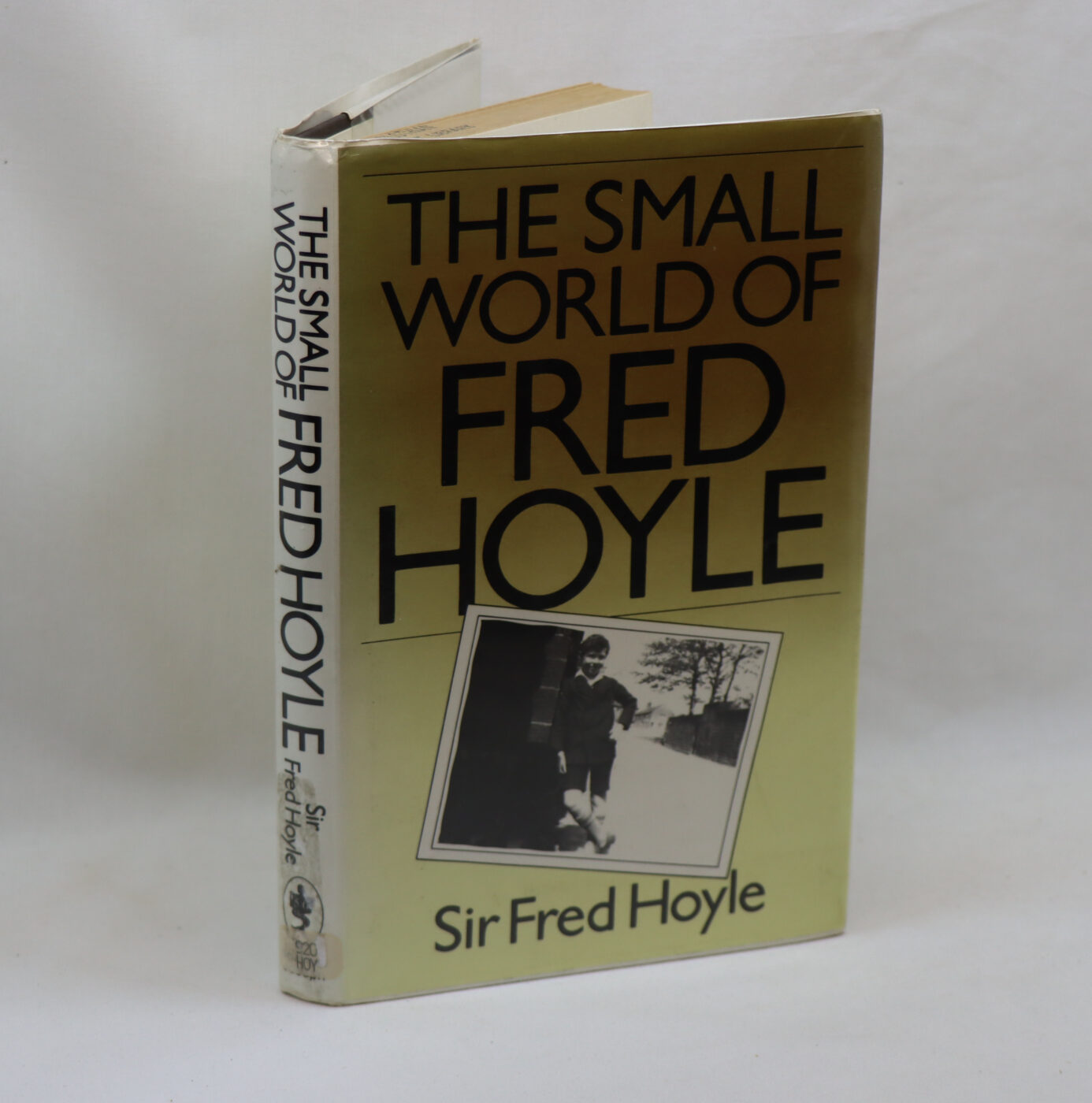
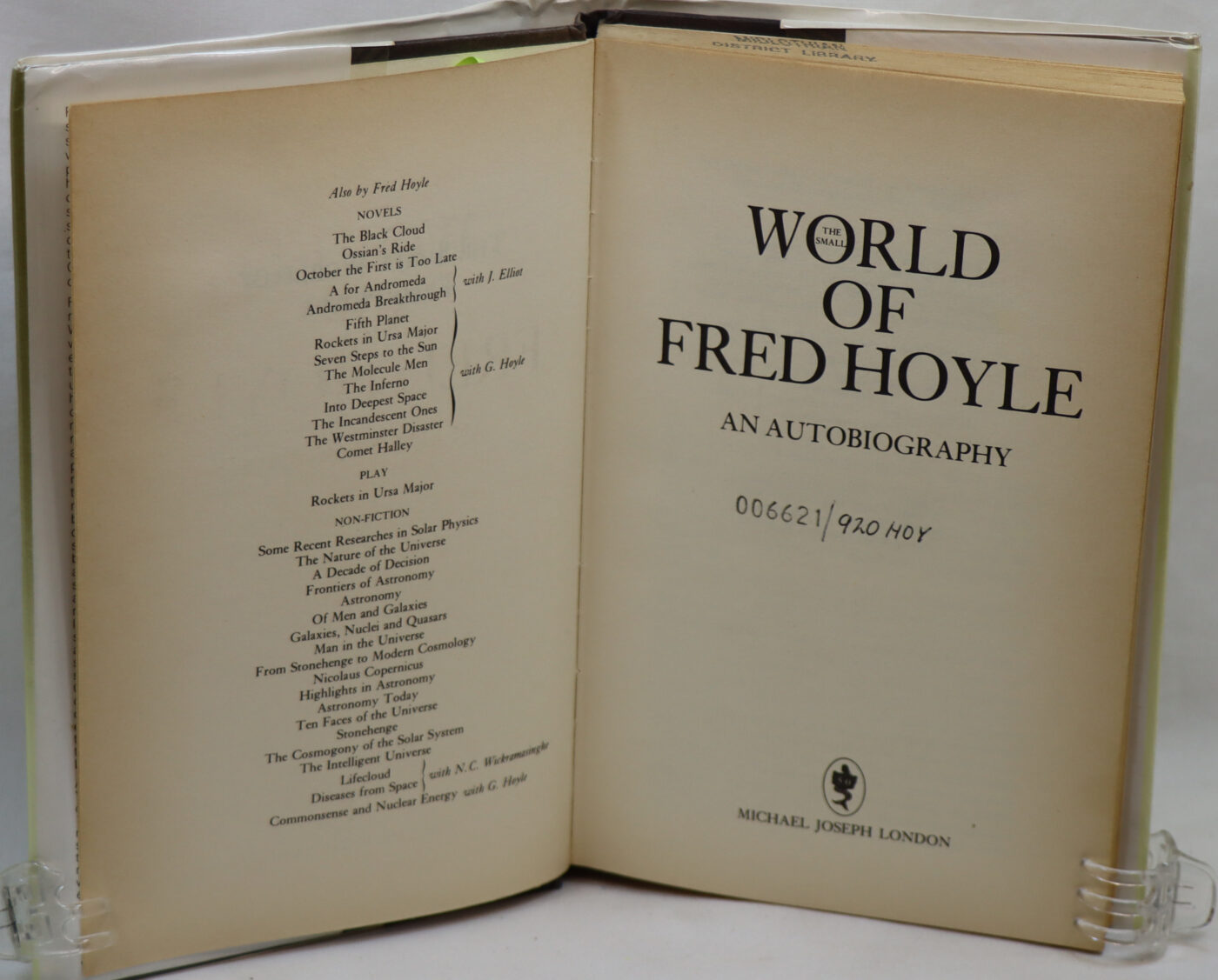
The Small World of Fred Hoyle.
By Sir Fred Hoyle
Printed: Circa 1990
Publisher: Michael Joseph. London
| Dimensions | 15 × 23 × 2 cm |
|---|---|
| Language |
Language: English
Size (cminches): 15 x 23 x 2
Condition: Good (See explanation of ratings)
£18.00
Buy Now
Your items

Item information
Description
In the original dust jacket. Black cloth binding with gilt title on the spine.
We provide an in-depth photographic presentation of this item to stimulate your feeling and touch. More traditional book descriptions are immediately available.
- Note: This book carries a £5.00 discount to those that subscribe to the F.B.A. mailing list
The Small World of Fred Hoyle (1986) is the first volume of autobiography by the eminent 20th-century British astronomer and cosmologist Sir Fred Hoyle. Unlike his numerous scientific and sci-fi books, this charming personal memoir focuses on his formative youth in the West Riding of Yorkshire and his early years at Cambridge.
Published by Michael Joseph Ltd., the 187-page book offers very little about his later revolutionary work in astrophysics or his famous rivalry over the “Big Bang” theory. Instead, it contains a rare, intimate look at the environment that shaped him.
Key highlights and themes of the memoir include:
- Childhood in Yorkshire: Hoyle reflects on his upbringing in the close-knit village of Gilstead. He details the profound influence of his parents: his father, a machine-gunner who survived the First World War, and his mother, a talented musician who encouraged her son’s intellectual and creative development without forcing him into over-achievement.
- Early Education: The book explores his regular truancy and avoidance of formal schooling in his early years, juxtaposed with his innate self-education and his eventual scholarship to Bingley Grammar School.
- Pre-War Cambridge: Hoyle chronicles his journey to Emmanuel College, Cambridge in 1933 and the atmosphere of the university in the years leading up to the outbreak of the Second World War.
A brief overview of his incredible scientific contributions and his challenging of established scientific paradigms:
Review: Perhaps the most amazing thing about this first autobiography by the 20th century’s greatest astronomer and cosmologist is that there is very little astronomy and cosmology contained within its 187 pages. What “The Small World of Fred Hoyle” does give us is an amazing insight into the kind of world in which the author spent his formative years. Though his world was “small” in the geographical sense, it was a world which made it possible for Hoyle and others of his generation to assume the status of a giant in scientific achievement and technological development. So we may say that the book is a study of the influences of an era which made possible the tremendous eruption of ideas, discoveries and inventions which poured forth from the fertile mind of its author.
Sir Fred Hoyle opens his first chapter with a discussion of trilby hats. The effect of the trilby hat was to make the face and head of its wearer appear larger than it actually was. We can only really be cognizant of this fact when we examine it from a historical rather than from a contemporary perspective for facts such as these are best understood within the context of a comparative analysis of the fashions and designs of different eras. This apparent triviality of trilby hats transparently demonstrates the great extent of Hoyle’s observational and analytical abilities which, though mainly exercised in scientific fields, could switch to other disciplines and there offer insights of such penetrating depths as to shame their practitioners engaged in their full-time study.
In later life, Hoyle bemoaned what he saw as the late 20th century’s lack of scientific progress and dearth of scientific ideas all of which stood in stark contrast to the prolific output of scientists in the 19th century and early part of the 20th century. Hoyle put all this down to science becoming big, corporatist and above all conformist. The straitjacket in which scientists now find themselves confined militates against any originality of thought and development of ideas. That Hoyle always desisted from taking the eggs from birds’ nests that he and his friends found, preferring instead to leave them and watch what eventually happened, is not only indicative of his scientifically enquiring mind forming at an early age but of the non-conformity for which he was known throughout his adult life. Hoyle’s persistent truancy during the early years of his schooling, his feelings that most of what was given to children to learn was essentially useless, are other examples of the ingredients that went into the making of Hoyle’s non-conformity with establishment norms and practices.
The mysterious untimely deaths on the local Milnerfield estate, the dark strip of woodland enclosed by the “Great Wall of Milnerfield” and the eerie Sparrow Bills Lane with its strange twists and turns all of which went into creating a world of ghosts and ghouls and dragons and ogres must have been for Hoyle an imaginative wonderland whose seeds would eventually sprout in his science fiction novels whose characters, plots and themes became almost as well-known as his work as a serious scientist.
“The Small World of Fred Hoyle” has something big to tell us who are living in the opening years of the 21st century. Our world is bigger, but yet it is smaller! We can travel further and faster but we see less. Hoyle’s learning about factory machines and canal lock gates were the fruits of a real education which paradoxically came from his periods of truancy, from the freeing of himself from the confines of the four walls of a classroom. Situations of scarcity of resources which were manifested in an ill-equipped school chemistry laboratory served to throw the pupils back on their own resources and inventiveness. The mythical creatures of Milnerfield and the machinery of the mills were the contrasting blends which made Hoyle at once the practical scientist and the man of fresh ideas and healthy imagination. Is it not astonishing that factories and fairies’ dens were the properties of the Salt family of Milnerfield? Do we not see in these starkly contrasting worlds a microcosm of Britain, a nation which has prospered and succeeded on a marriage of tradition and progress, a Britain which Hoyle loved and to which he showed the greatest patriotism.?
In our world of plenty, inventiveness is very much reduced; in a childhood of electronic games and play stations imagination is stunted and the ghosts and ghouls have fled the tree-shaded winding lanes to become mere blips on a computer monitor. Yet, if we re-read the autobiographical works of the late Sir Fred Hoyle and take as our own his commiserations for a long lost past we may have the chance of re-creating the immensity of his small world and in so doing provide a bigger and better world of our own.
Sir Fred Hoyle (24 June 1915 – 20 August 2001) was an English astronomer. With Margaret and Geoffrey Burbidge and William Alfred Fowler, he formulated the theory of stellar nucleosynthesis in the influential B2FH paper.
He held controversial views on some scientific matters — in particular, in his rejection of the “Big Bang” theory (a term he jokingly coined on BBC Radio, though he later denied doing so in derision) in favour of a “steady-state model”, and his promotion of panspermia as the origin of life on Earth.
He spent most of his working life at St John’s College, Cambridge, and served as the founding director of the Institute of Theoretical Astronomy at Cambridge.
Hoyle also wrote science fiction novels, short stories, and radio plays, co-created television serials, and, with his son, Geoffrey Hoyle, co-authored twelve books.
Want to know more about this item?
We are happy to answer any questions you may have about this item. In addition, it is also possible to request more photographs if there is something specific you want illustrated.
Ask a question
Related products
Share this Page with a friend
