
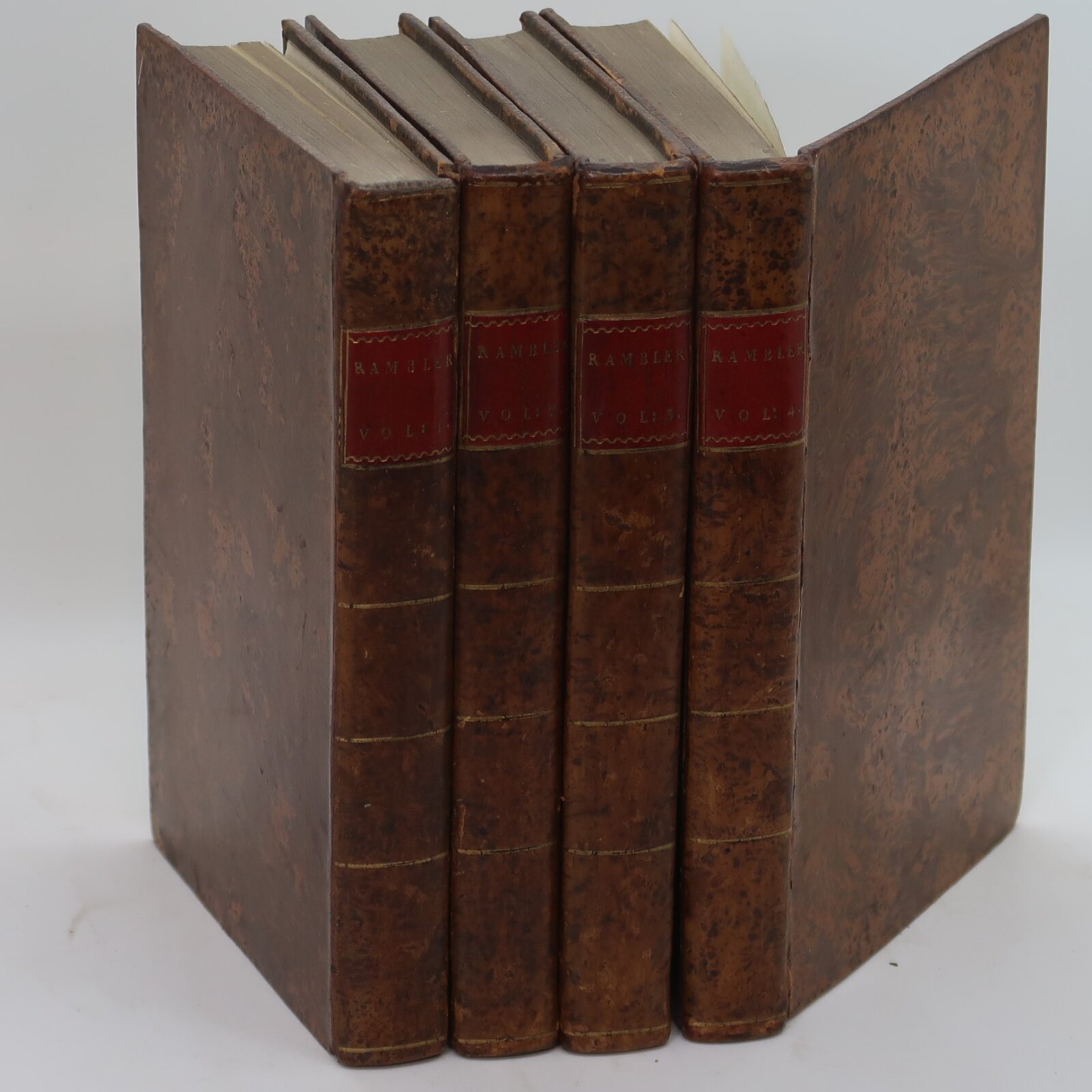
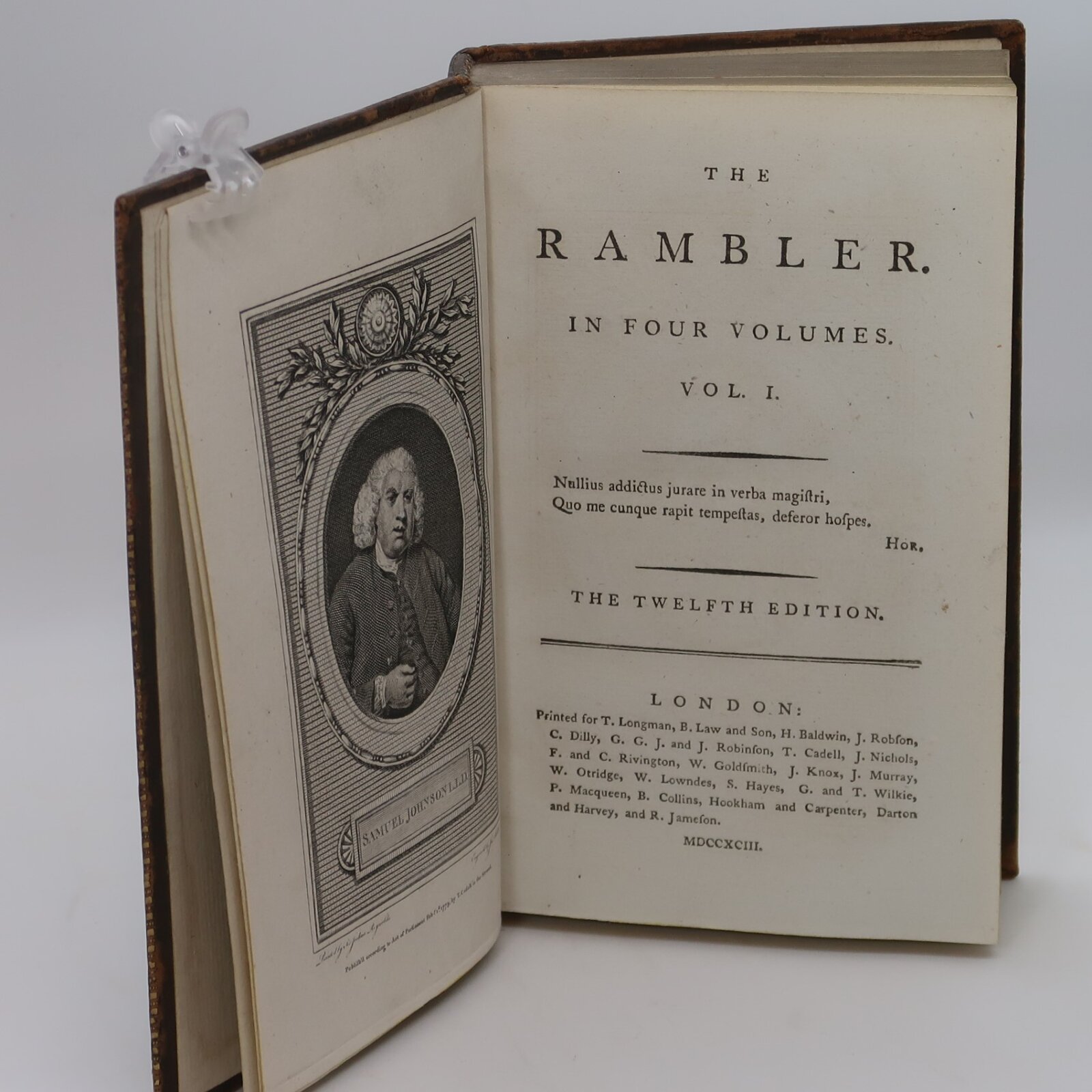
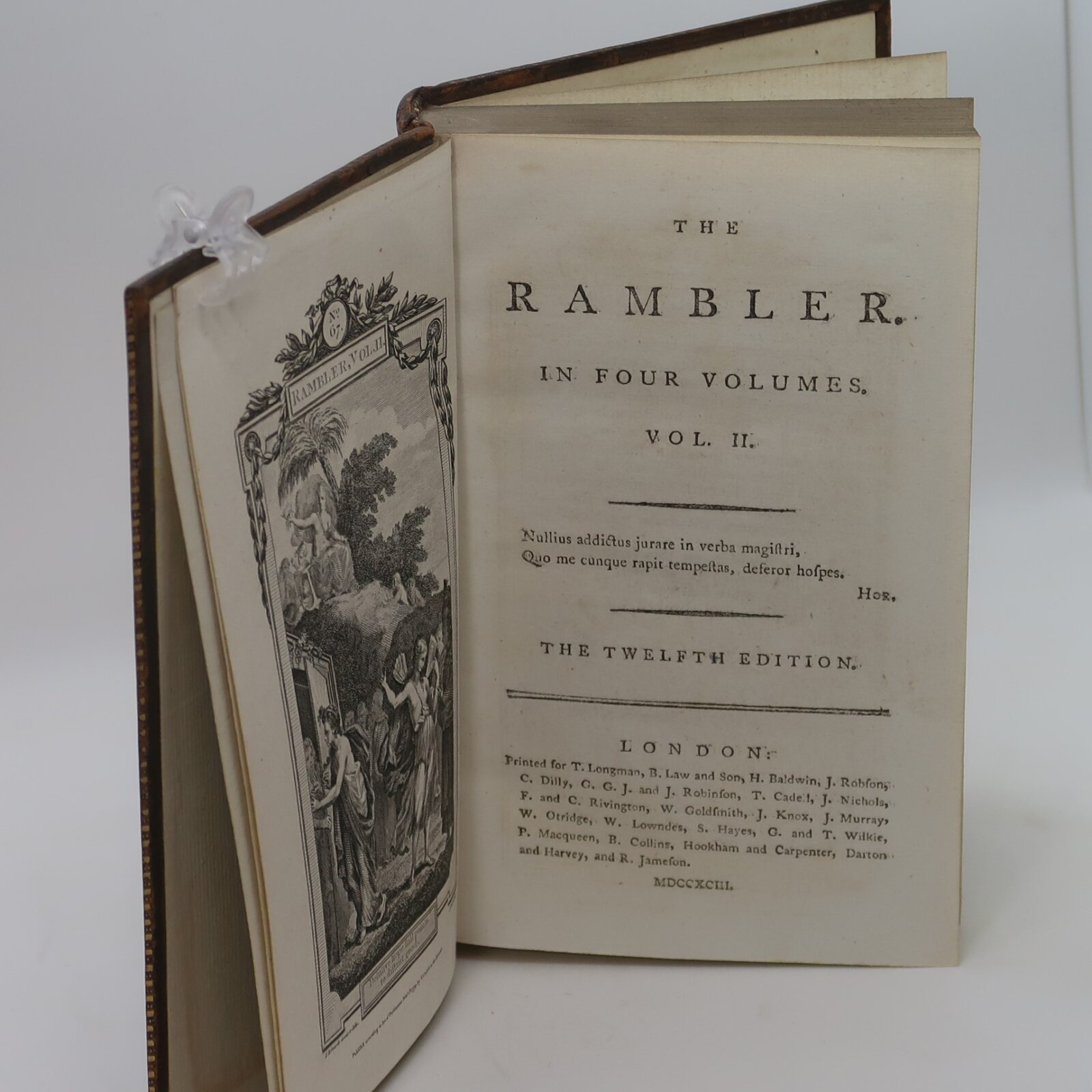
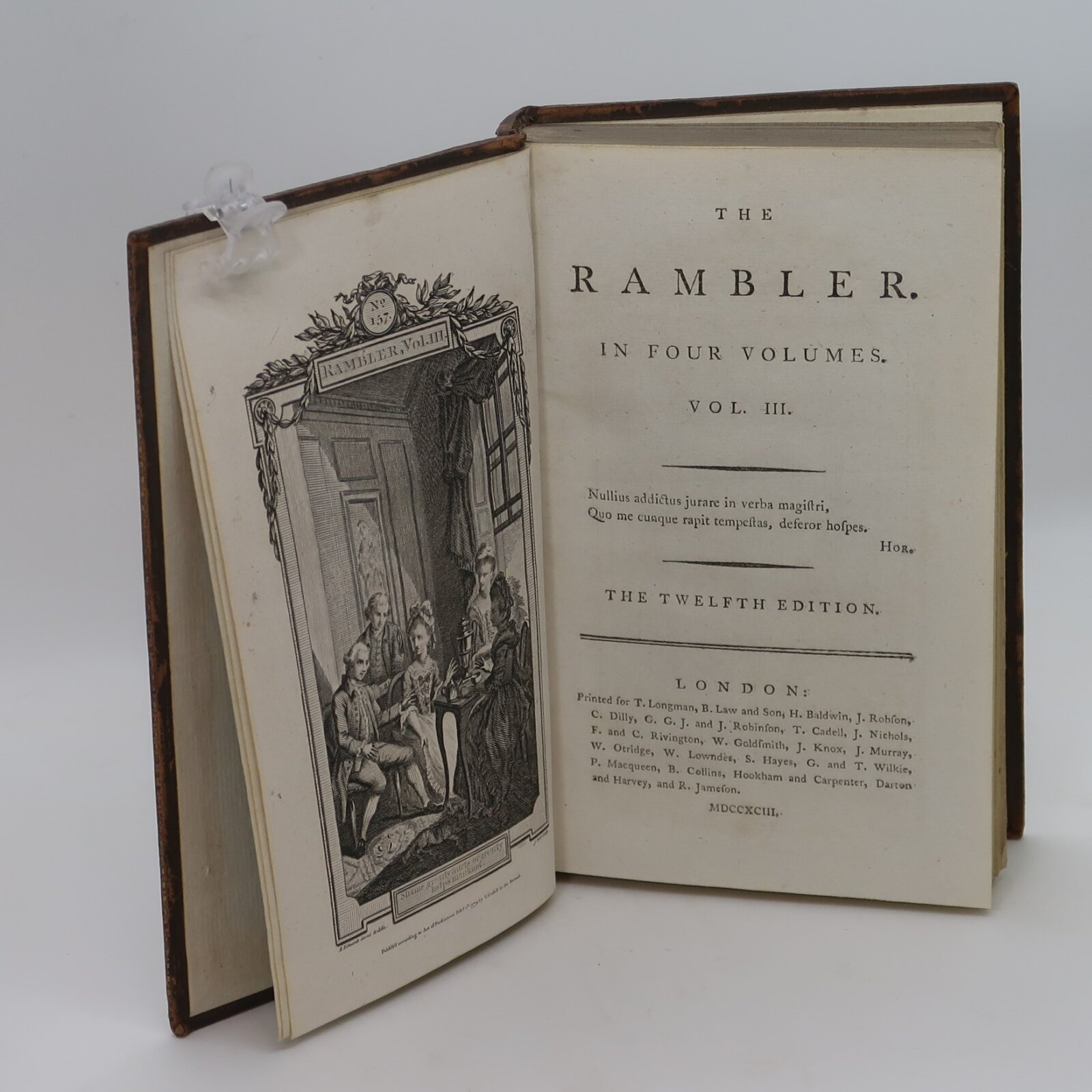
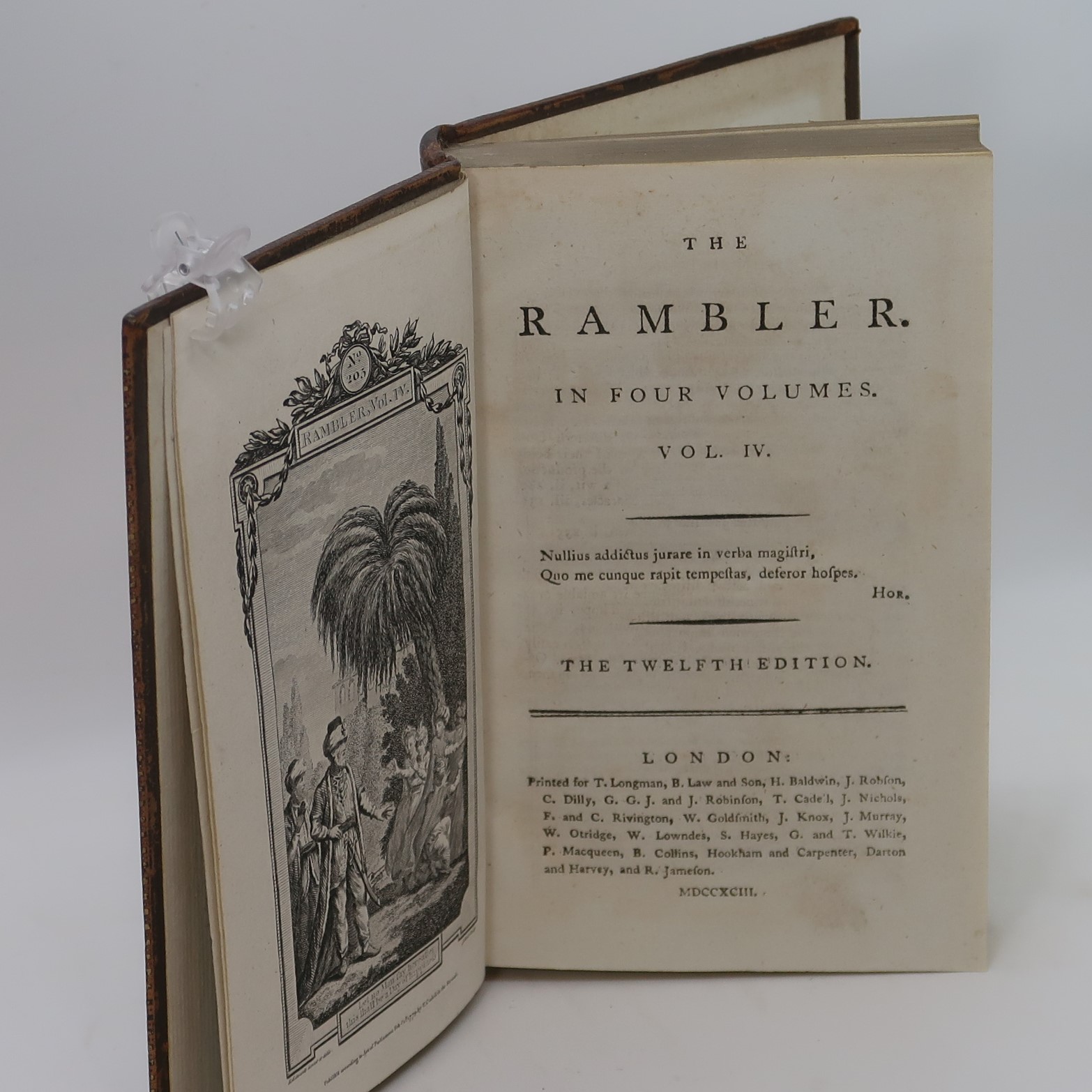
The Rambler. Volumes 1 to 4.
Printed: 1793
Publisher: T. Longman. London
Edition: twelfth edition
| Dimensions | 11 × 18 × 2 cm |
|---|---|
| Language |
Language: English
Size (cminches): 11 x 18 x 2
Condition: Fine (See explanation of ratings)
THIS ITEM WILL BE AVAILABLE SOON
SORRY, THIS ITEM HAS SOLD
Item information
Description
Mottled calf binding with red title plate, gilt banding and lettering on the spine. Dimensions are for one volume.
The Rambler was a periodical (strictly, a series of short papers) by Samuel Johnson.
The Rambler was written primarily for the newfound, rising middle-class of the 18th century, who sought social fluency within aristocratic social circles. It was especially targeted to the middle-class audience that were increasingly marrying into aristocratic families in order to create socio-economic alliances, but did not possess the social and intellectual tools to integrate into those higher social circles which required great understanding of subjects, as listed above in the Description. Copies of The Rambler were written in essay form and were made cheaply available to the middle-class. In his fourth section of The Rambler (31 March 1750), Johnson points out that he would like to “Join both profit and delight in one” in the prelude; that is, provide intellectual profit and literary delight to those who read his work. This desire to “join both profit and delight” streams throughout the publications, and is particularly resonant of Classical literary design. The majority of the subject matter in The Rambler focused more on moral than social issues. In this sense, Johnson’s writings were didactic, although he maintains an explorative attitude rather than a strictly instructive voice.
As its author lamented in its final essay, “I have never been much a favourite to the publick,” the publication was not an immediate success. Perhaps this was due to Johnson’s departure from The Spectator, which could be considered his precedent. The latter was a periodical published from 1711 to 1712 by Joseph Addison and Richard Steele, popular for its light treatment of elevated subjects by “enliven[ing] morality with wit.” In tone and subject matter, The Rambler was both lengthier and more serious than its popular ancestor in the genre. It also had a strong element of didacticism. The Rambler contained more sermon-like reflective essays and lacked the Spectator’s “dramatic” qualities.
There were many however who religiously read and appreciated the publication. One contemporary author thought so highly of The Rambler to say, “May the publick favours crown his merits, and may not the English, under the auspicious reign of George the Second, neglect a man, who, had he lived in the first century, would have been one of the greatest favourites of Augustus.” The Rambler was widely respected for the quality and power of the writing and the masterful use of language and rhetoric.
Samuel Johnson (18 September 1709 – 13 December 1784), often called Dr Johnson, was an English writer who made lasting contributions as a poet, playwright, essayist, moralist, critic, biographer, editor and lexicographer. He was a devout Anglican, and a committed Tory. The Oxford Dictionary of National Biography calls him “arguably the most distinguished man of letters in English history”. James Boswell’s Life of Samuel Johnson was selected by Walter Jackson Bate as “the most famous single work of biographical art in the whole of literature”.
Born in Lichfield, Staffordshire, he attended Pembroke College, Oxford until lack of funds forced him to leave. After work as a teacher, he moved to London and began writing for The Gentleman’s Magazine. Early works include Life of Mr Richard Savage, the poems London and The Vanity of Human Wishes and the play Irene. After nine years’ effort, Johnson’s A Dictionary of the English Language appeared in 1755 with far-reaching effects on Modern English, acclaimed as “one of the greatest single achievements of scholarship”. Until the arrival of the Oxford English Dictionary 150 years later, Johnson’s was pre-eminent. Later work included essays, an annotated The Plays of William Shakespeare and The History of Rasselas, Prince of Abissinia. In 1763 he befriended James Boswell, with whom he travelled to Scotland, as Johnson described in A Journey to the Western Islands of Scotland. Near the end of his life came a massive, influential Lives of the Most Eminent English Poets of 17th and 18th centuries.
Tall and robust, his gestures and tics disconcerted some on meeting him. Boswell’s Life along with other biographies, documented Johnson’s behaviour in a detail that allows a posthumous diagnosis of Tourette syndrome, a condition then undefined. After several illnesses, he died on the evening of 13 December 1784 and was buried in Westminster Abbey. Thereafter he was increasingly seen to have had a lasting effect on literary criticism and even claimed to be the one truly great critic of English literature.
Want to know more about this item?
We are happy to answer any questions you may have about this item. In addition, it is also possible to request more photographs if there is something specific you want illustrated.
Ask a question
Related products



Share this Page with a friend
