
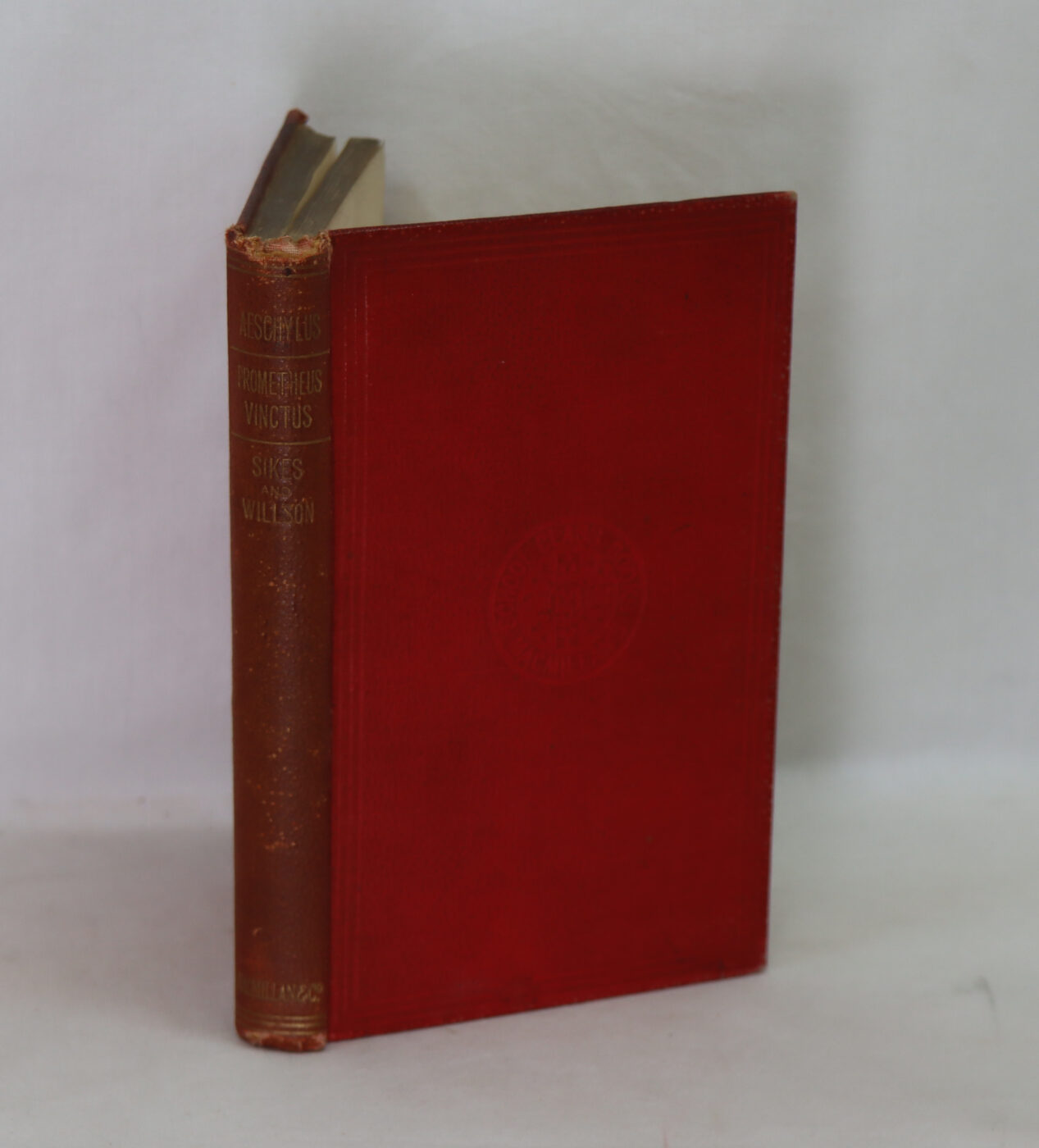
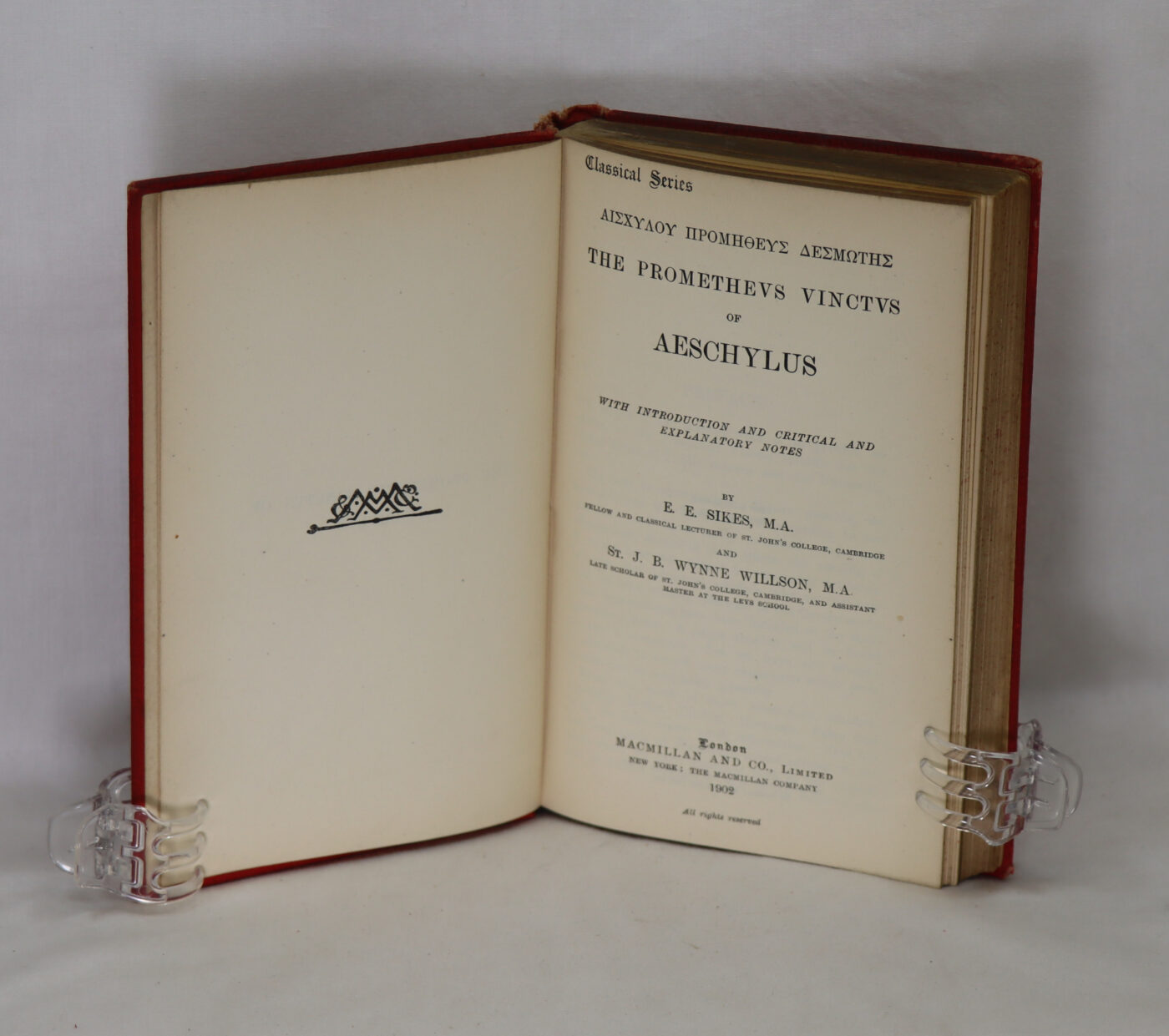
The Promethevs Vinctvs.
By E E Sikes & St.J B Wynne Wilson
Printed: 1902
Publisher: Macmillan & Co. London
| Dimensions | 11 × 16 × 1.5 cm |
|---|---|
| Language |
Language: English
Size (cminches): 11 x 16 x 1.5
Condition: Fair (See explanation of ratings)
£18.00
Buy Now
Your items

Item information
Description
Red cloth binding with gilt title on the spine.
We provide an in-depth photographic presentation of this item to stimulate your feeling and touch. More traditional book descriptions are immediately available
- Note: This book carries a £5.00 discount to those that subscribe to the F.B.A. mailing list
For the conditions of this rare book, please view our photographs.
Prometheus Bound is an ancient Greek tragedy traditionally attributed to Aeschylus and thought to have been composed sometime between 479 BC and the terminus ante quem of 424 BC. The tragedy is based on the myth of Prometheus, a Titan who defies Zeus, and protects and gives fire to mankind, for which he is subjected to the wrath of Zeus and punished.
British-born author, C.J. Herington, a scholar of classical Greek and Latin, wrote that Aeschylus certainly did not mean Prometheus Bound to be a “self-contained dramatic unity”, and suggests that “most modern students of the subject would probably agree” that Prometheus Bound was followed by a work with the title Prometheus Lyomenos (Prometheus Unbound). Herington adds that “some very slight evidence” indicates that Prometheus Unbound “may have been followed by a third play”, Prometheus Pyrphoros (Prometheus the Fire-Bearer); the latter two survive only in fragments. Some scholars have proposed that these fragments all originated from Prometheus Unbound, and that there were only two Promethean plays rather than three. Since the final two dramas of the trilogy have been lost, the author’s intention for the work as a whole is not known.
The ascription to Aeschylus had never been challenged since antiquity down to relatively recent times. By the 1970s, both R. P. Winnington-Ingram and Denys Page had become sceptical of its authenticity, but the majority of scholars still affirmed the traditional attribution of authorship. Independently in 1977 both Oliver Taplin and Mark Griffith made forceful cases, on linguistic, technical and stagecraft grounds, for questioning its authenticity, a view supported by M. L. West. To date, no consensus on the matter has been established, though recent computerized stylometric analysis has thrown the burden of proof on those who uphold the traditional claim.
Want to know more about this item?
We are happy to answer any questions you may have about this item. In addition, it is also possible to request more photographs if there is something specific you want illustrated.
Ask a question
Related products
Share this Page with a friend
