
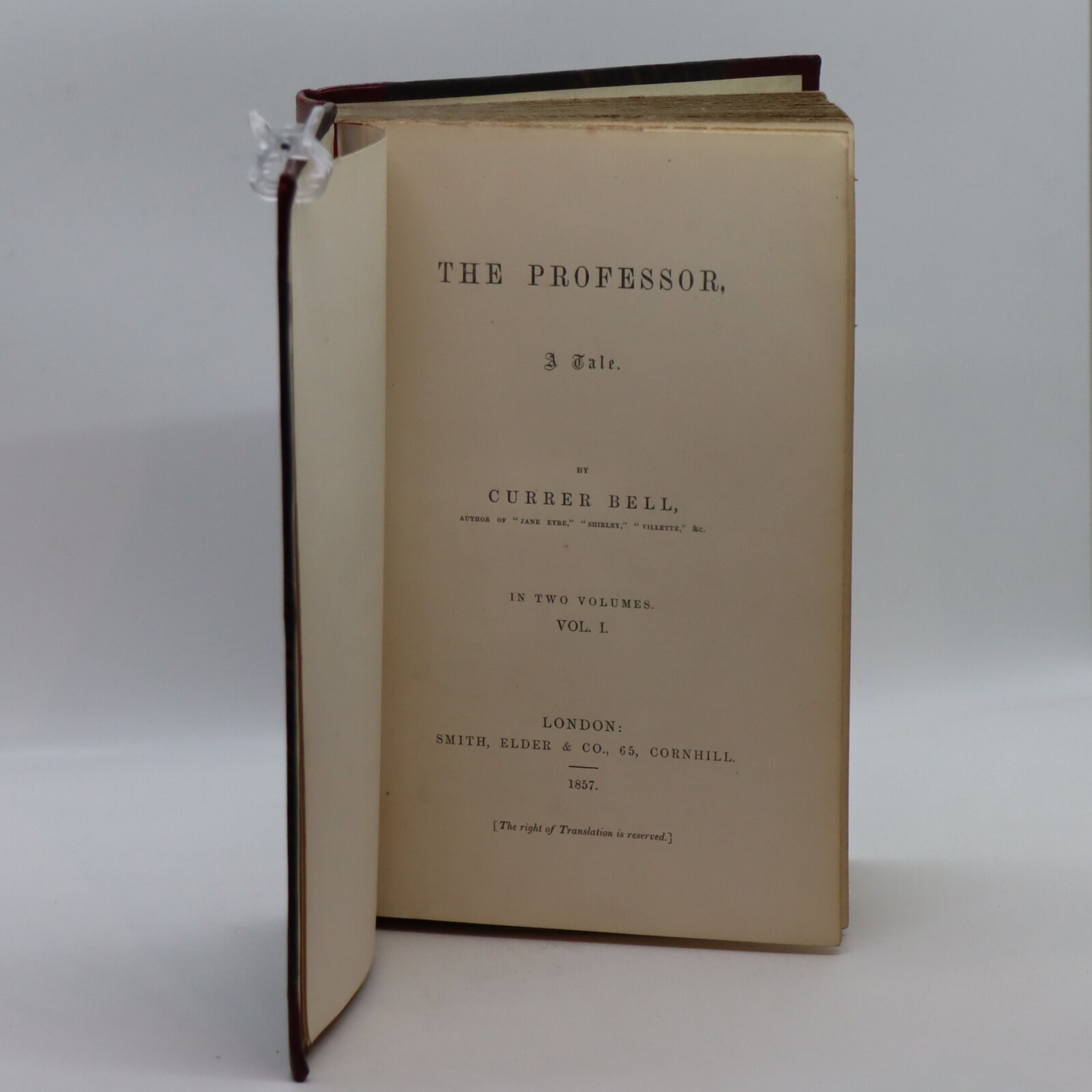
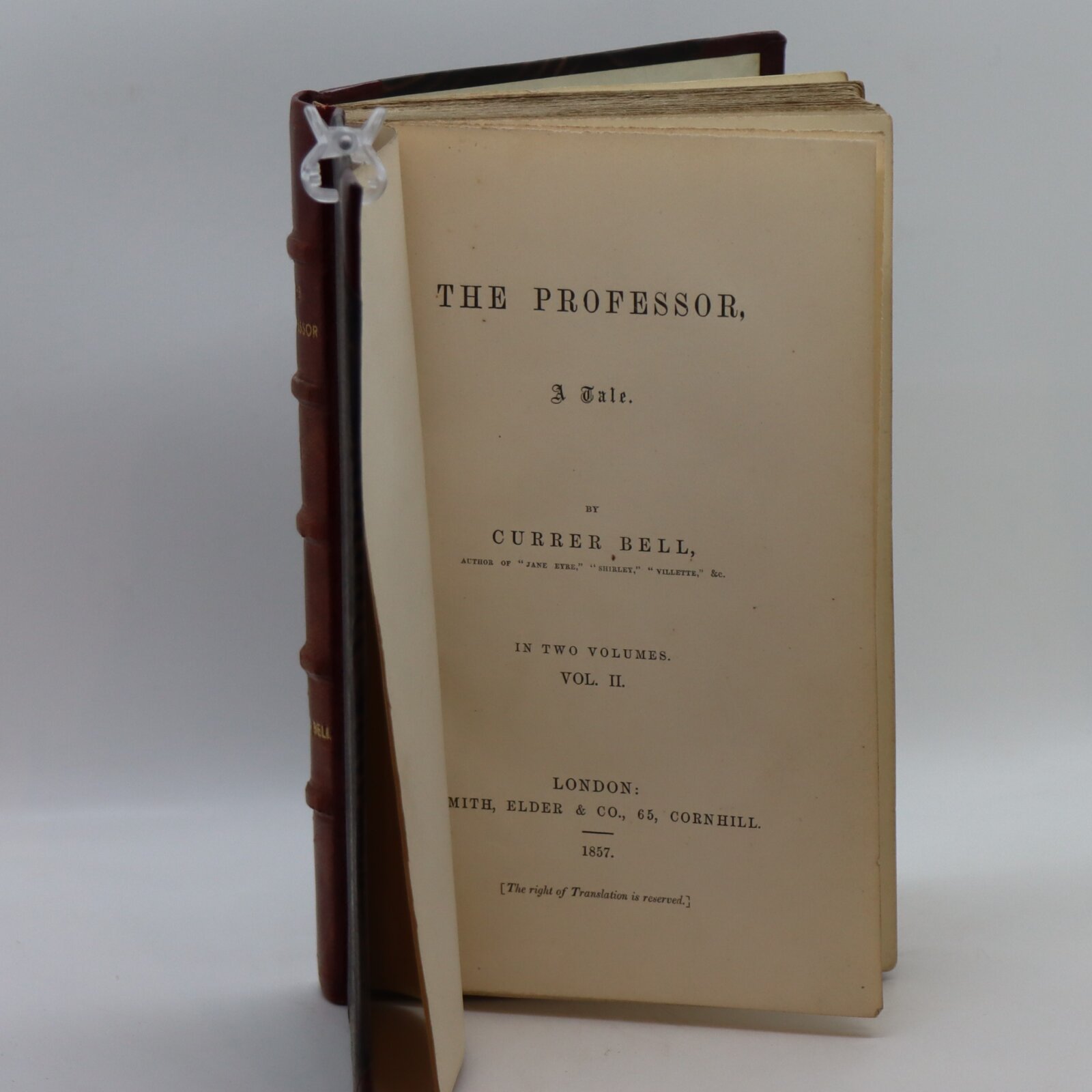
The Professor. Currer Bell. Volumes I and II.
By Currer Bell
Printed: 1857
Publisher: Smith Elder & Co. London
Edition: first edition
| Dimensions | 14 × 21 × 2.5 cm |
|---|---|
| Language |
Language: English
Size (cminches): 14 x 21 x 2.5
Condition: Fine (See explanation of ratings)
THIS ITEM WILL BE AVAILABLE SOON
SORRY, THIS ITEM HAS SOLD
Item information
Description
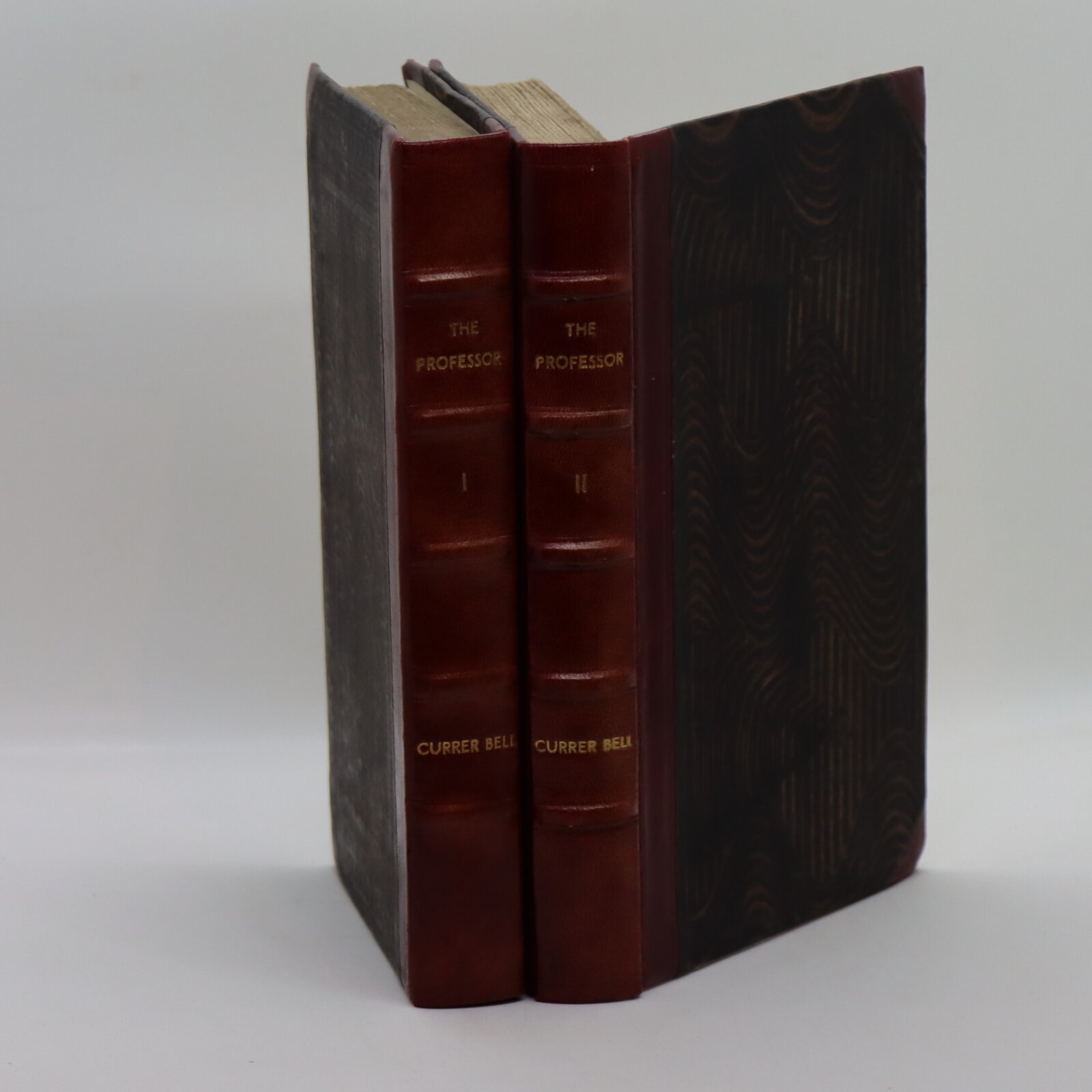
Maroon calf spine with dark swirl patterned boards. Gilt tilt on spine. Dimensions are for one volume.
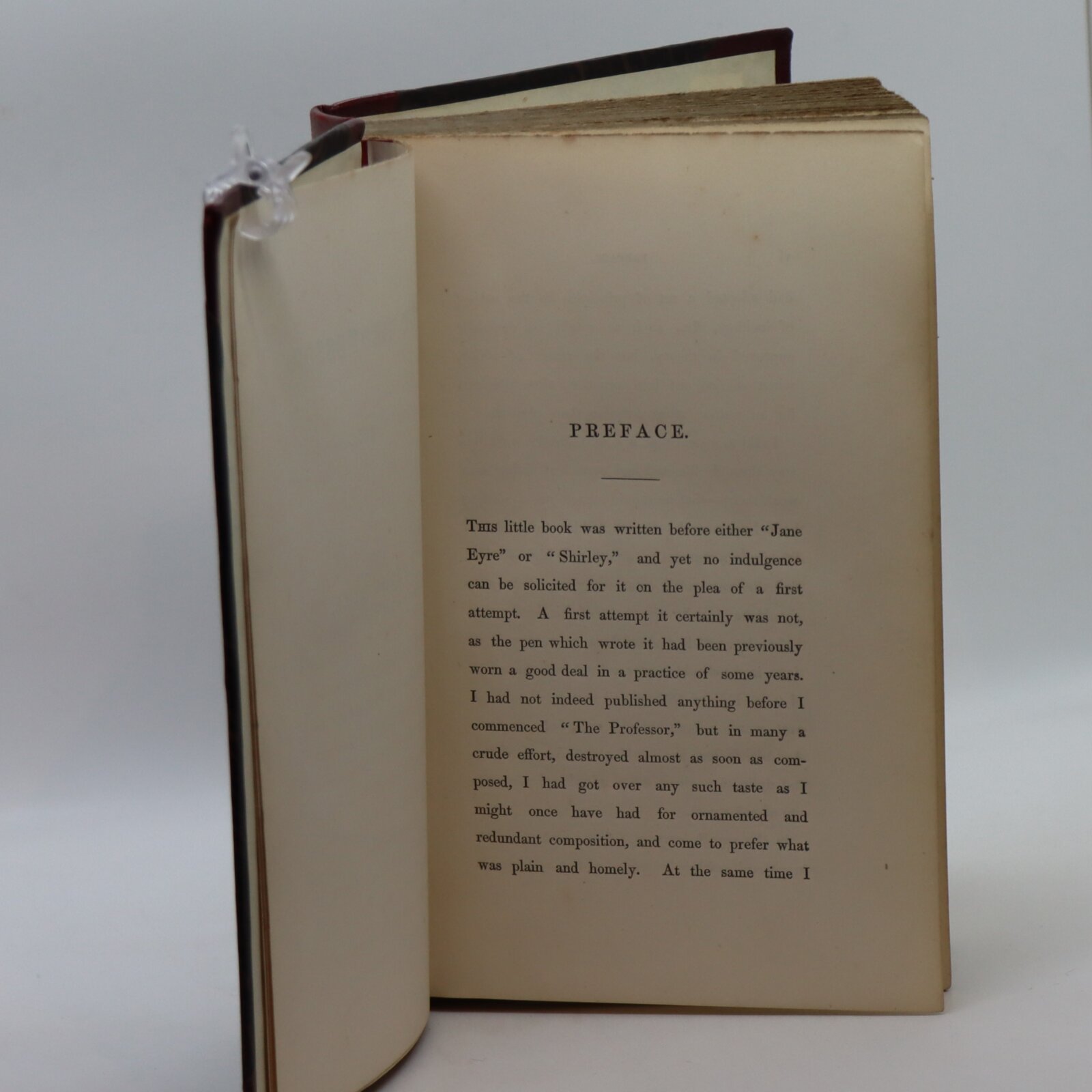
First Edition
The Professor, A Tale. was the first novel by Charlotte Brontë. It was written before Jane Eyre, but was rejected by many publishing houses. It was eventually published, posthumously, in 1857, with the approval of Charlotte Brontë’s widower, Arthur Bell Nicholls, who took on the task of reviewing and editing the text.
The novel is the story of a young man, William Crimsworth, and is a first-person narrative from his perspective. It describes his maturation, his career as a teacher in Brussels, and his personal relationships.
The story starts with a letter William has sent to his friend Charles, detailing his rejection of his uncle’s proposal that he become a clergyman, as well as his first meeting with his rich brother Edward. Seeking work as a tradesman, William is offered the position of a clerk by Edward. However, Edward is jealous of William’s education and intelligence, and treats him terribly. Through the actions of the sympathetic Mr Hunsden, William is relieved of his post, but starts a new job at a boys’ boarding school in Belgium.
The school is run by the friendly Monsieur Pelet, who treats William kindly and politely. Soon William’s merits as a “professor” reach the ears of the headmistress of the neighbouring girls’ school. Mademoiselle Reuter offers him a position at her school, which he accepts. Initially captivated by her, William begins to entertain ideas of falling in love with her, but then he overhears her and Monsieur Pelet talking about their upcoming marriage and their deceitful treatment of him.
William begins to treat Mademoiselle Reuter with cold civility as he sees her underlying nature. She, however, continues to try to draw him back in by pretending to be benevolent and concerned. She asks him to teach one of her young teachers, Frances, who hopes to improve her skill in languages. William sees promising intelligence in this pupil and slowly begins to fall in love with her.
Jealous of the attention Frances is receiving from William, Mademoiselle Reuter takes it upon herself to dismiss Frances from her post and to hide her address from William. After a long search he re-encounters Frances in a graveyard and they renew their acquaintance.
It is revealed that as she was trying to make herself amiable in William’s eyes, Mademoiselle Reuter had accidentally fallen in love with him herself. Not wanting to cause a conflict with Monsieur Pelet, William leaves his establishment.
William gets a new position as a “professor” at a college, allowing him and Frances to marry. The two eventually open a school together and have a child. After achieving financial security, the family travels around England and then settles in the countryside, near to Mr Hunsden.
Charlotte Brontë (21 April 1816 – 31 March 1855) was an English novelist and poet, the eldest of the three Brontë sisters who survived into adulthood and whose novels became classics of English literature.
She enlisted in school at Roe Head in January 1831, aged 14 years. She left the year after to teach her sisters, Emily and Anne, at home, returning in 1835 as a governess. In 1839 she undertook the role as governess for the Sidgwick family but left after a few months to return to Haworth where the sisters opened a school but failed to attract pupils. Instead, they turned to writing and they each first published in 1846 under the pseudonyms of Currer, Ellis, and Acton Bell. Although her first novel, The Professor, was rejected by publishers, her second novel, Jane Eyre, was published in 1847. The sisters admitted to their Bell pseudonyms in 1848, and by the following year were celebrated in London literary circles.
Charlotte Brontë was the last to die of all her siblings. She became pregnant shortly after her marriage in June 1854 but died on 31 March 1855, almost certainly from hyperemesis gravidarum, a complication of pregnancy which causes excessive nausea and vomiting
In May 1846 Charlotte, Emily, and Anne self-financed the publication of a joint collection of poems under their assumed names Currer, Ellis and Acton Bell. The pseudonyms veiled the sisters’ sex while preserving their initials; thus, Charlotte was Currer Bell. “Bell” was the middle name of Haworth’s curate, Arthur Bell Nicholls whom Charlotte later married, and “Currer” was the surname of Frances Mary Richardson Currer who had funded their school (and maybe their father). Of the decision to use noms de plume, Charlotte wrote:
Averse to personal publicity, we veiled our own names under those of Currer, Ellis and Acton Bell; the ambiguous choice being dictated by a sort of conscientious scruple at assuming Christian names positively masculine, while we did not like to declare ourselves women, because – without at that time suspecting that our mode of writing and thinking was not what is called “feminine” – we had a vague impression that authoresses are liable to be looked on with prejudice; we had noticed how critics sometimes use for their chastisement the weapon of personality, and for their reward, a flattery, which is not true praise.
Although only two copies of the collection of poems were sold, the sisters continued writing for publication and began their first novels, continuing to use their noms de plume when sending manuscripts to potential publishers.
Brontë’s first manuscript, ‘The Professor’, did not secure a publisher, although she was heartened by an encouraging response from Smith, Elder & Co. of Cornhill, who expressed an interest in any longer works Currer Bell might wish to send. Brontë responded by finishing and sending a second manuscript in August 1847. Six weeks later, Jane Eyre was published. It tells the story of a plain governess, Jane, who, after difficulties in her early life, falls in love with her employer, Mr Rochester. They marry, but only after Rochester’s insane first wife, of whom Jane initially has no knowledge, dies in a dramatic house fire. The book’s style was innovative, combining Romanticism, naturalism with gothic melodrama, and broke new ground in being written from an intensely evoked first-person female perspective. Brontë believed art was most convincing when based on personal experience; in Jane Eyre she transformed the experience into a novel with universal appeal.
Jane Eyre had immediate commercial success and initially received favourable reviews. G. H. Lewes wrote that it was “an utterance from the depths of a struggling, suffering, much-enduring spirit”, and declared that it consisted of “suspiria de profundis!” (sighs from the depths). Speculation about the identity and gender of the mysterious Currer Bell heightened with the publication of Wuthering Heights by Ellis Bell (Emily) and Agnes Grey by Acton Bell (Anne). Accompanying the speculation was a change in the critical reaction to Brontë’s work, as accusations were made that the writing was “coarse”, a judgement more readily made once it was suspected that Currer Bell was a woman. However, sales of Jane Eyre continued to be strong and may even have increased as a result of the novel developing a reputation as an “improper” book. A talented amateur artist, Brontë personally did the drawings for the second edition of Jane Eyre and in the summer of 1834 two of her paintings were shown at an exhibition by the Royal Northern Society for the Encouragement of the Fine Arts in Leeds.
Condition notes
Rebound
Want to know more about this item?
We are happy to answer any questions you may have about this item. In addition, it is also possible to request more photographs if there is something specific you want illustrated.
Ask a question
Related products



Share this Page with a friend
