
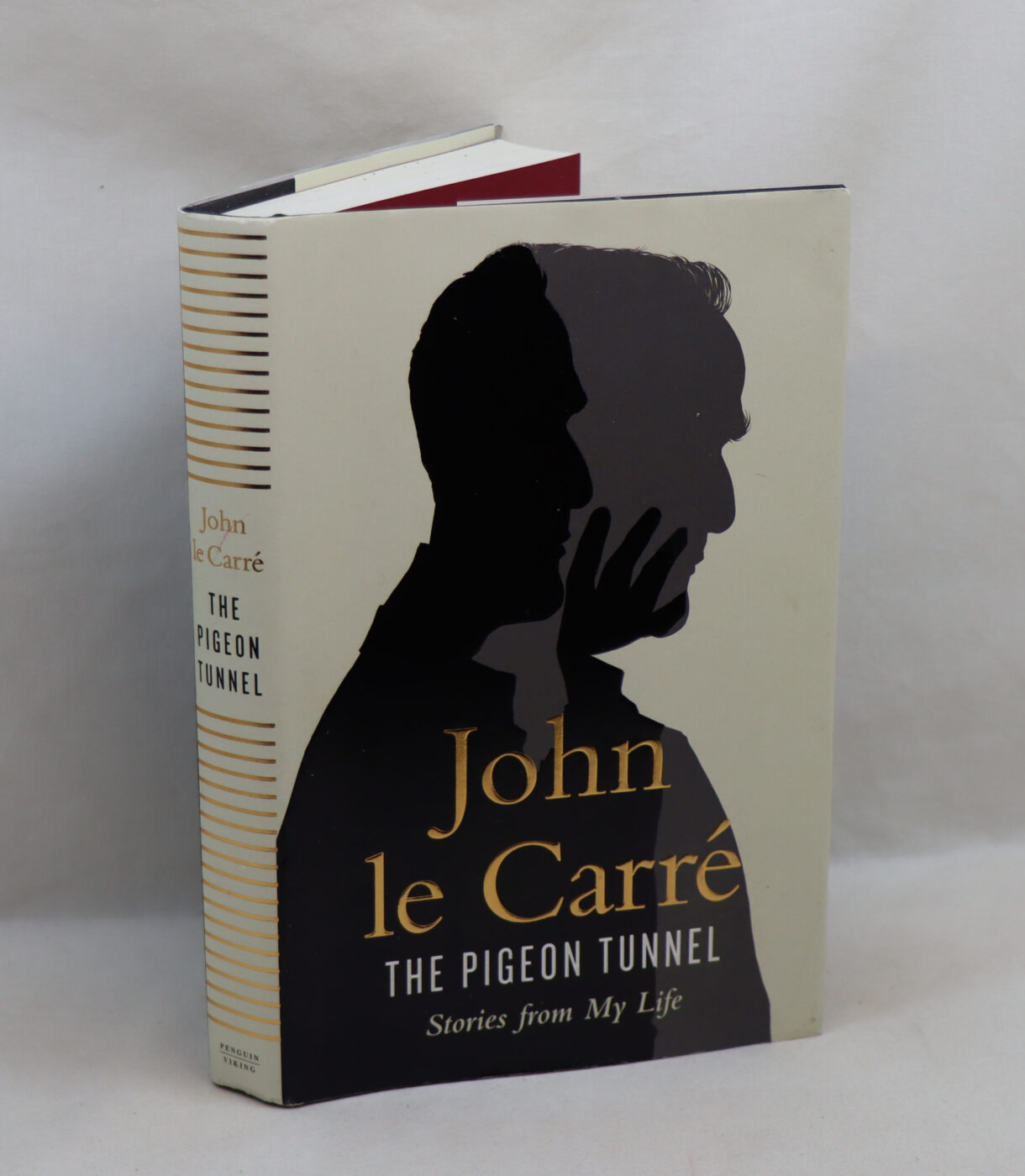
The Pigeon Tunnel. Stories from My Life.
By John le Carre
ISBN: 9780735220799
Printed: 2016
Publisher: Viking. London
| Dimensions | 16 × 24 × 3 cm |
|---|---|
| Language |
Language: English
Size (cminches): 16 x 24 x 3
Condition: Very good (See explanation of ratings)
£19.00
Buy Now

Item information
Description
In the original dust jacket. Black cloth binding with gilt title on the spine.
We provide an in-depth photographic presentation of this item to stimulate your feeling and touch. More traditional book descriptions are immediately available
- Note: This book carries a £5.00 discount to those that subscribe to the F.B.A. mailing list
For conditions, please view our photographs. An original book from the library gathered by the famous Cambridge Don, computer scientist, food and wine connoisseur, Jack Arnold LANG.
This book was donated to Jack by the publishers.
“Recounted with the storytelling élan of a master raconteur — by turns dramatic and funny, charming, tart and melancholy.” -Michiko Kakutani, The New York Times
The New York Times bestselling memoir from John le Carré, the legendary author of Tinker, Tailor, Soldier, Spy; The Spy Who Came in from the Cold; and The Night Manager, now an Emmy-nominated television series starring Tom Hiddleston and Hugh Laurie. John le Carré’s new novel, A Legacy of Spies, is now available.
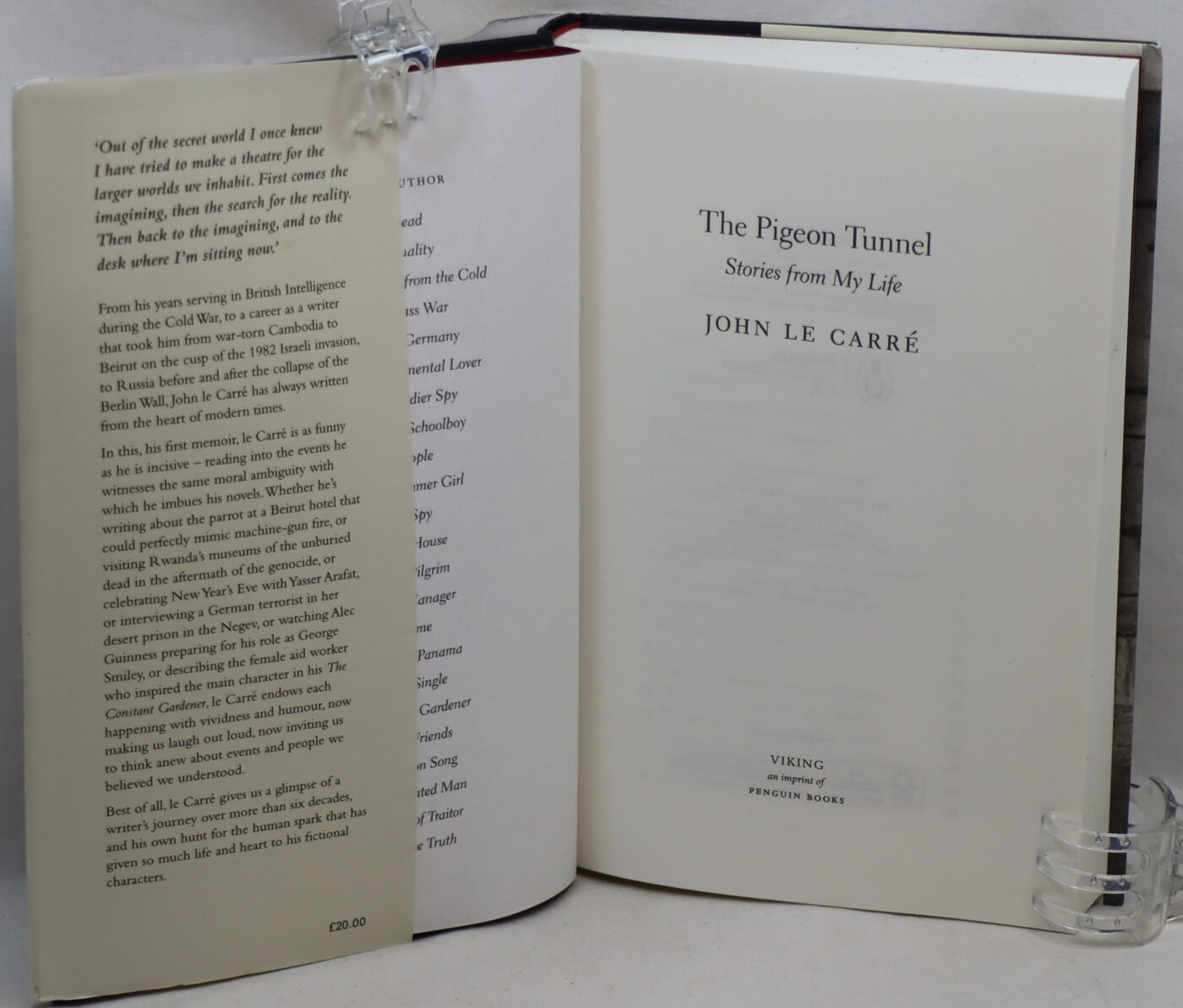
From his years serving in British Intelligence during the Cold War, to a career as a writer that took him from war-torn Cambodia to Beirut on the cusp of the 1982 Israeli invasion to Russia before and after the collapse of the Berlin Wall, le Carré has always written from the heart of modern times. In this, his first memoir, le Carré is as funny as he is incisive, reading into the events he witnesses the same moral ambiguity with which he imbues his novels. Whether he’s writing about the parrot at a Beirut hotel that could perfectly mimic machine gun fire or the opening bars of Beethoven’s Fifth; visiting Rwanda’s museums of the unburied dead in the aftermath of the genocide; celebrating New Year’s Eve 1982 with Yasser Arafat and his high command; interviewing a German woman terrorist in her desert prison in the Negev; listening to the wisdoms of the great physicist, dissident, and Nobel Prize winner Andrei Sakharov; meeting with two former heads of the KGB; watching Alec Guinness prepare for his role as George Smiley in the legendary BBC TV adaptations of Tinker, Tailor, Soldier, Spy and Smiley’s People; or describing the female aid worker who inspired the main character in The Constant Gardener, le Carré endows each happening with vividness and humor, now making us laugh out loud, now inviting us to think anew about events and people we believed we understood.
Best of all, le Carré gives us a glimpse of a writer’s journey over more than six decades, and his own hunt for the human spark that has given so much life and heart to his fictional characters.
Review: What a joy it is to have a glimpse, or even better a series of glimpses, into the life of a man with many a story to tell and many insights to share. John Le Carré is a favourite writer of mine. That made ‘The Pigeon Tunnel’ particularly attractive: he writes with the same mastery of language and brilliance of style as in his novels. Nor is this a simple autobiography, rather a series of brief vignettes about his life. The anecdotes are enchanting. There are, for instance, stories about the elegant way newscaster Reginal Bosanquet helped Le Carré out financially, and the equally graceful way Le Carré later passed the favour forward to Vladimir Pucholt, a Czech actor who wanted to become a doctor. Or there is one of the chapters I liked most, Le Carré’s compelling picture of his conman father. It included a magnificent quotation from one of the father’s friends and collaborators: ‘We was all bent, son, but your dad was very, very bent indeed.’ Anyone who knows ‘A perfect spy’ will recognise such a figure as the model for Rick Pym in that novel. ‘The Pigeon Tunnel’ tells us how Le Carré based it on his own upbringing, but at first he came up with a draft that ‘dripped with self-pity’; it wasn’t until he revisited it, after his father had died, ‘and made the sins of the son a whole lot more reprehensible than the sins of the father’ that it became the outstanding novel it now is. As Le Carré suggests, a lot of its power derives from the son having committed a far deeper offence, although it is clearly the direct consequence of the less serious crimes of the father. Here we are into one of the areas I found most appealing in ‘The Pigeon Tunnel’: it tells us about the real events that lie behind some of Le Carré’s most effective books. For instance, he talks about his interview with a member of the German Baader-Meinhof terrorist group, in a secret Israeli prison, as part of the preparation for ‘The Little Drummer Girl’. That anecdote, with its surprising and poignant ending, is on its own sufficient reason to read the whole book. As is the story of his work with Palestinians groups, for the same novel, which led to his dancing with Yasser Arafat. And there are plenty more, in other novels, including ‘The Spy who came in from the cold’ or the Smiley series. That includes small revelations that I particularly savoured. I didn’t realise that it was J. Edgar Hoover, iconic director of the FBI who, on being told that Kim Philby of the British intelligence service was a Soviet spy, said ‘Tell ’em Jesus Christ only had twelve, and one of them was a double’ – a line Le Carré uses to telling effect in ‘Tinker, Tailor, Soldier, Spy’. Equally, he tells us that when his father returned home after a spell in gaol, he would stop in front of doors waiting for them to be opened for him. The prisoner’s habit took a while to fade. That, of course, is an anecdote told by Charlie in ‘The Little Drummer Girl’, though in her case she’s lying. Le Carré, on the other hand, is telling the truth. Or is he? He also tells us he has a vivid memory from childhood, of standing outside Exeter prison while his father waved to him from his cell window. He admits that this is impossible – none of the cells give on to the road. Which leads Le Carré to wonder whether we need a different word for certain types of memory, those in which imagination plays a role. Something, of course, to which such a writer, whose trade it is to apply imagination to what he knows of reality, is particularly inclined. A fascinating notion, which it was a pleasure to encounter in this delightful book. And which led me to think about everything it said in a different light. Though that only led me to enjoy it all the more.
David John Moore Cornwell (19 October 1931 – 12 December 2020), better known by his pen name John le Carré, was a British-Irish author,best known for his espionage novels, many of which were successfully adapted for film or television. A “sophisticated, morally ambiguous writer”, he is considered one of the greatest novelists of the postwar era. During the 1950s and 1960s, he worked for both the Security Service (MI5) and the Secret Intelligence Service (MI6). Near the end of his life, le Carré became an Irish citizen.
Le Carré’s third novel, The Spy Who Came in from the Cold (1963), became an international best-seller, was adapted as an award-winning film, and remains one of his best-known works. This success allowed him to leave MI6 to become a full-time author. His other novels that have been adapted for film or television include The Looking Glass War (1965), Tinker Tailor Soldier Spy (1974), Smiley’s People (1979), The Little Drummer Girl (1983), A Perfect Spy (1986), The Russia House (1989), The Night Manager (1993), The Tailor of Panama (1996), The Constant Gardener (2001), A Most Wanted Man (2008) and Our Kind of Traitor (2010). In 2008, The Times named le Carré one of the “50 greatest British writers since 1945”. Philip Roth said that A Perfect Spy (1986) was “the best English novel since the war”.
Want to know more about this item?
We are happy to answer any questions you may have about this item. In addition, it is also possible to request more photographs if there is something specific you want illustrated.
Ask a question
Share this Page with a friend
