
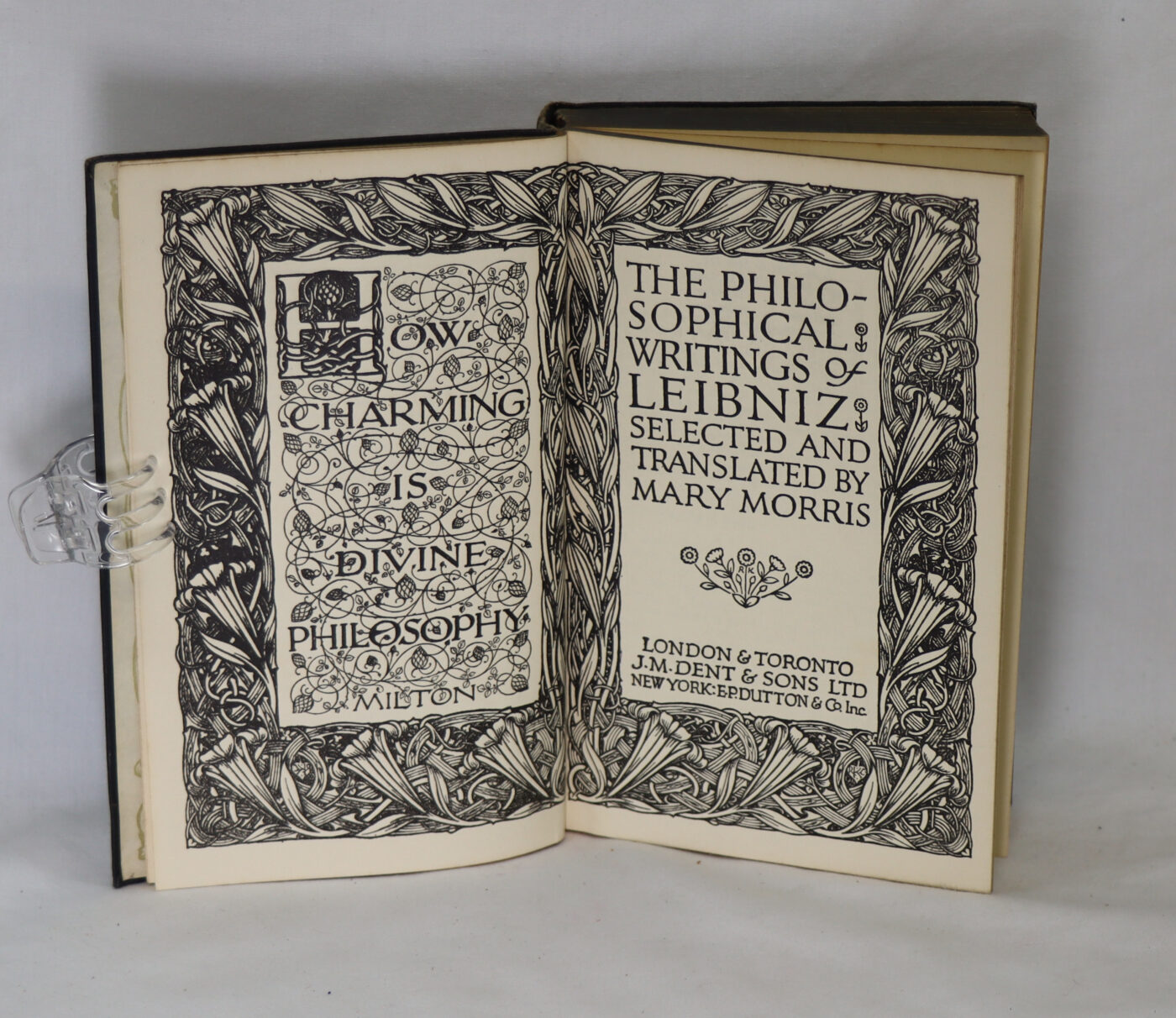
The Philosophical Writings of Leibniz.
Printed: 1934
Publisher: J M Dent & Sons. London
Edition: 1st edition
| Dimensions | 12 × 18 × 2 cm |
|---|---|
| Language |
Language: English
Size (cminches): 12 x 18 x 2
Condition: Good (See explanation of ratings)
£23.00
Buy Now
Your items

Item information
Description
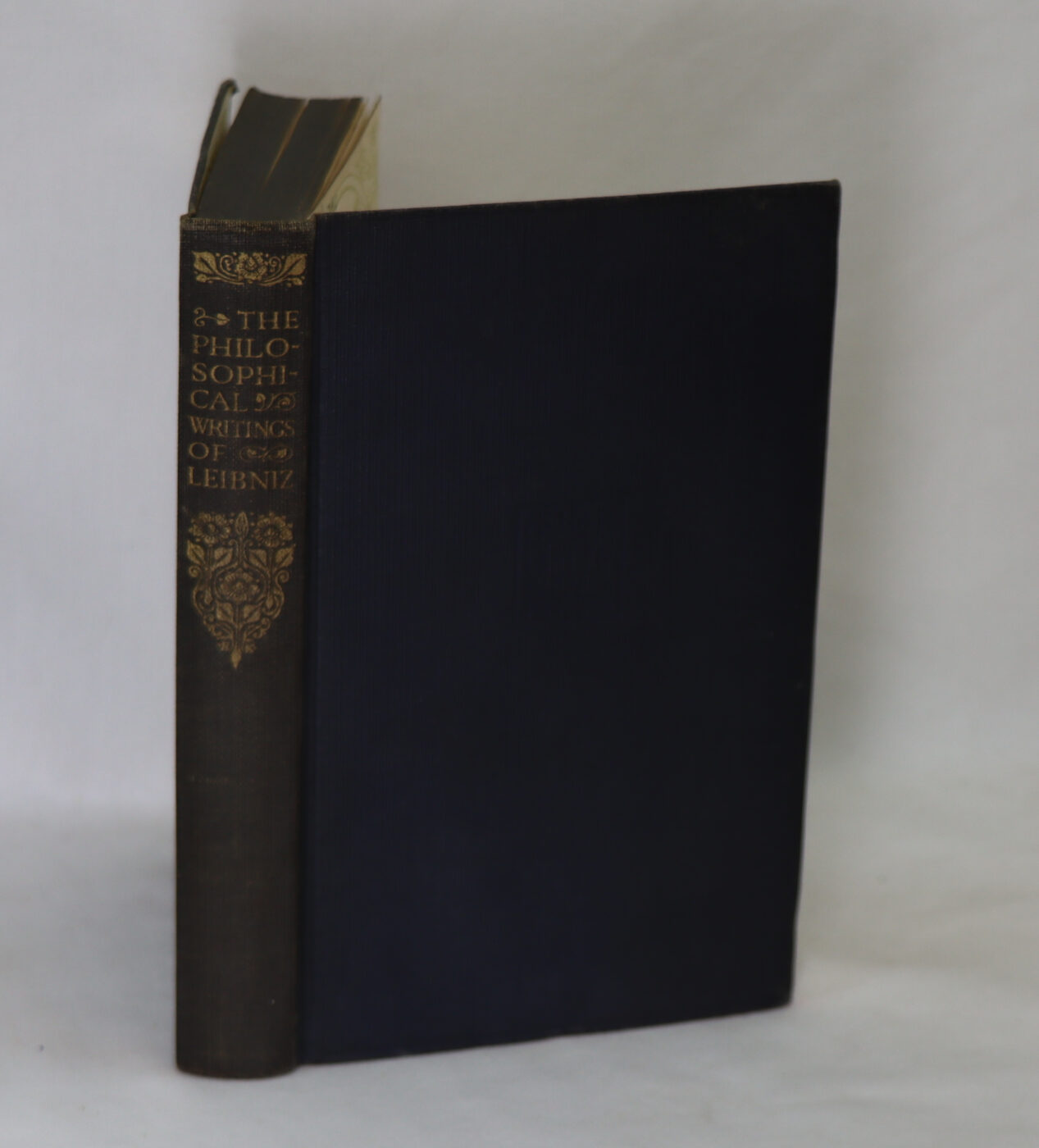
Black cloth binding with gilt title on the spine.
We provide an in-depth photographic presentation of this item to stimulate your feeling and touch. More traditional book descriptions are immediately available.
- Note: This book carries a £5.00 discount to those that subscribe to the F.B.A. mailing list
Please view our photographs. A good copy without a dust cover.
The Philosophical Writings of Leibniz, published in 1934 by J. M. Dent & Sons in London, is the first edition of the classic Everyman’s Library volume (No. 905), featuring translations by Mary Morris and an introduction by C. R. Morris.
Book Overview
-
Author: Gottfried Wilhelm Leibniz
-
Translator: Mary De Selincourt Morris
-
Series: Everyman’s Library (Theology and philosophy, no. 905)
-
Length: 284 pages (plus introductory matter)
Key Contents
-
Selected translations of major texts by the 17th-century rationalist philosopher.
-
Explores foundational concepts like individual substances, a priori knowledge, and pre-established harmony.
-
Includes classic shorter works and correspondence.
Gottfried Wilhelm Leibniz (or Leibnitz; 1 July 1646 [O.S. 21 June] – 14 November 1716) was a German polymath active as a mathematician, philosopher, scientist, and diplomat who is credited, alongside Isaac Newton, with the creation of calculus in addition to many other branches of mathematics, such as binary arithmetic and statistics. Leibniz has been called the “last universal genius” due to his vast expertise across fields, which became a rarity after his lifetime with the coming of the Industrial Revolution and the spread of specialized labour. He is a prominent figure in both the history of philosophy and the history of mathematics. He wrote works on philosophy, theology, ethics, politics, law, history, philology, games, music, economics and other studies. Leibniz also made major contributions to physics and technology, and anticipated notions that surfaced much later in probability theory, biology, medicine, geology, psychology, linguistics and computer science.
Leibniz contributed to the field of library science, developing a cataloguing system (at the Herzog August Library in Wolfenbüttel, Germany) that came to serve as a model for many of Europe’s largest libraries. His contributions to a wide range of subjects were scattered in various learned journals, in tens of thousands of letters and in unpublished manuscripts. He wrote in several languages, primarily in Latin, French and German.
As a philosopher, he was a leading representative of 17th-century rationalism and idealism. As a mathematician, his major achievement was the development of differential and integral calculus, independently of Newton’s developments. Although Newton first developed his theory earlier in 1666, and which had been in circulation among mathematicians since 1668, Leibniz’s notation has been favoured as the conventional and more exact expression of calculus. In addition to his work on calculus, he is credited with devising the modern binary number system which is the basis of modern communications and digital computing (though the English astronomer Thomas Harriot had devised the same system decades before). He envisioned the field of combinatorial topology as early as 1679, and helped initiate the field of fractional calculus.
In the 20th century, Leibniz’s notions of the law of continuity and the transcendental law of homogeneity found a consistent mathematical formulation by means of non-standard analysis. He was also a pioneer in the field of mechanical calculators. While working on adding automatic multiplication and division to Pascal’s calculator, he was the first to describe a pinwheel calculator in 1685 and invented the Leibniz wheel, later used in the arithmometer, the first mass-produced mechanical calculator.
In philosophy and theology, Leibniz is most noted for his optimism, i.e. his conclusion that our world is, in a qualified sense, the best possible world that God could have created, a view sometimes lampooned by other thinkers, such as Voltaire in his satirical novella Candide. Leibniz, along with René Descartes and Baruch Spinoza, was one of the three influential early modern rationalists. His philosophy also assimilates elements of the scholastic tradition, notably the assumption that some substantive knowledge of reality can be achieved by reasoning from first principles or prior definitions. The work of Leibniz anticipated modern logic and still influences contemporary analytic philosophy, such as its adopted use of the term possible world to define modal notions.
NOTE: This is an original book from the library gathered by the famous Cambridge Don, computer scientist, food and wine connoisseur, Jack Arnold LANG. Note: Jack founded the Michelin Guide ‘Midsummer House’- Cambridge’s paramount restaurant. This dining experience is hidden amongst the grassy pastures and grazing cattle of Midsummer Common and perched on the banks of the River Cam.
In 2008, Jack was one of the co-founders of the Raspberry Pi Foundation, alongside other members of the Department, and acted as the Foundation’s Chair. The project’s original goals were modest: to build and distribute low-cost computers for prospective applicants to our Computer Science degree. Initially the project was a “success disaster”, as Jack would say, as demand far outstripped the low-scale manufacturing plans. Ultimately the Raspberry Pi became the UK’s most successful computer with more than 60 million sold to date. Jack was drawn to the educational possibilities of the Raspberry Pi, its potential uses in emerging economies and the way it could support self-directed learning.
Want to know more about this item?
We are happy to answer any questions you may have about this item. In addition, it is also possible to request more photographs if there is something specific you want illustrated.
Ask a question
Related products



Share this Page with a friend
