
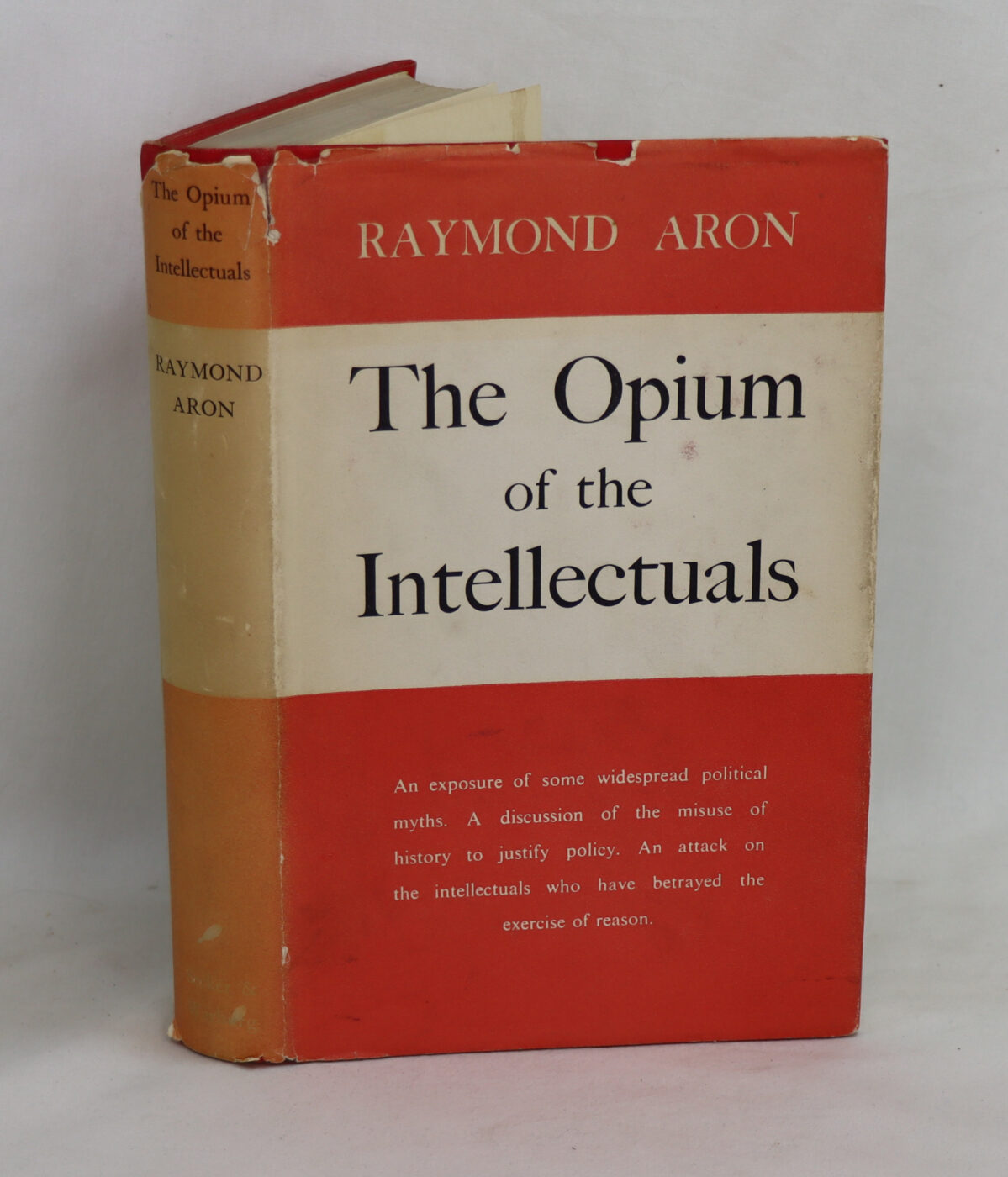
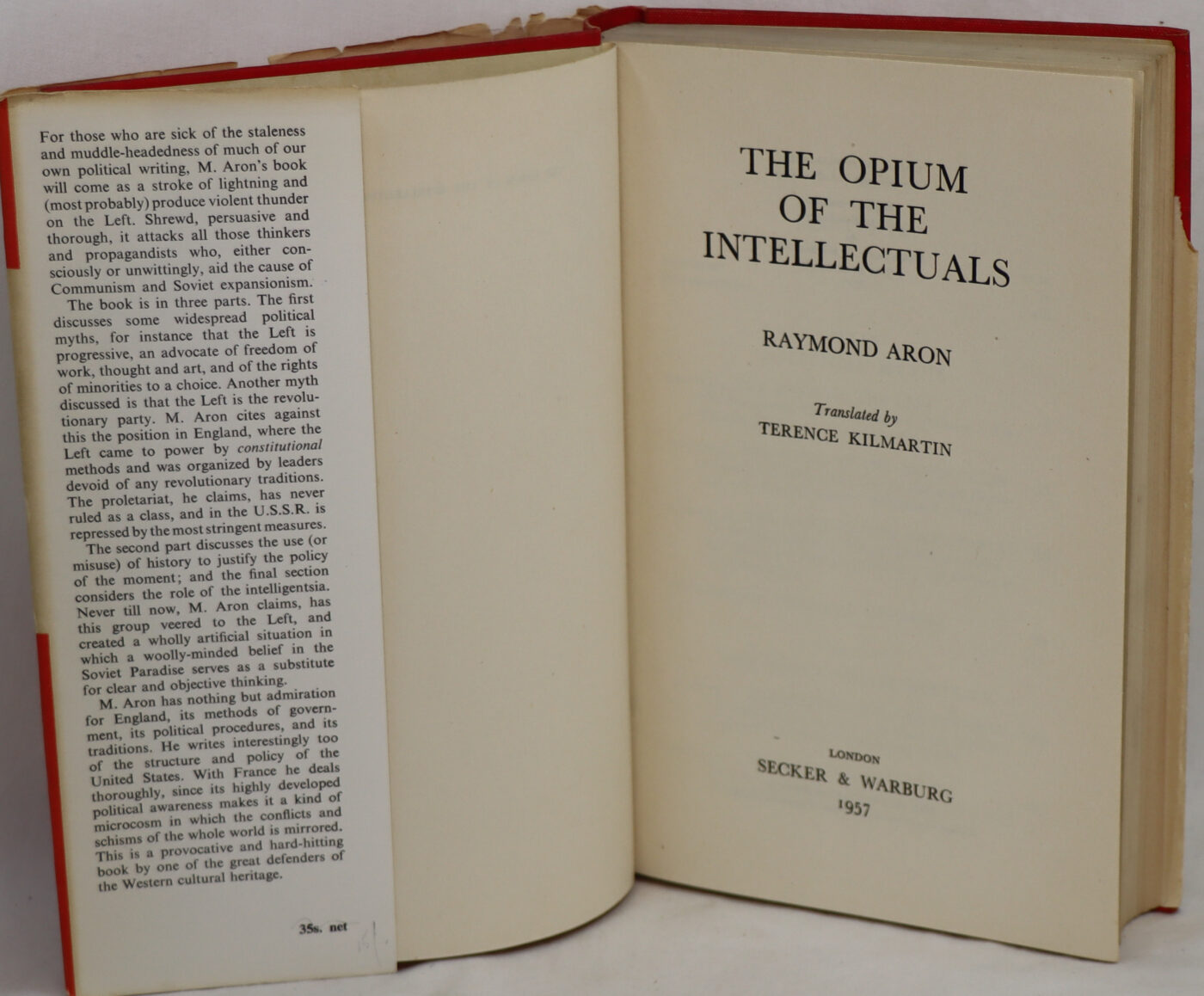
The Opium of the Intellectuals.
By Raymond Aron
Printed: 1957
Publisher: Secker & Warburg. London
Edition: 1st edition
| Dimensions | 13 × 22 × 3 cm |
|---|---|
| Language |
Language: English
Size (cminches): 13 x 22 x 3
Condition: Good (See explanation of ratings)
£94.00
Buy Now
Your items

Item information
Description
In the original dust jacket. Red cloth binding with gilt title on the spine.
We provide an in-depth photographic presentation of this item to stimulate your feeling and touch. More traditional book descriptions are immediately available.
- Note: This book carries a £5.00 discount to those that subscribe to the F.B.A. mailing list
Please view our photographs. It appears you have shared the detailed cataloging specifications for a collectible first English edition of Raymond Aron’s seminal work, The Opium of the Intellectuals.
Here is a summary and verification of the book’s details:
Book Title: The Opium of the Intellectuals
Author: Raymond Aron
Publisher: Secker & Warburg, London (The prominent British publisher known for distributing key 20th-century political and literary works)
Year Printed: 1957 (The true first English edition, translated from the original 1955 French publication, L’opium des intellectuels)
Edition: 1st English Edition
Language: English
Dimensions: 5.2 x 8.8 x 1.2 inches (A standard octavo size common for UK hardcovers of this era)
Condition: Good (Typically indicates that the book shows signs of wear, but remains completely intact with clean pages and a solid binding)
Aron’s focus is upon his criticism of the widespread intellectual adherence in his time to Marxism. The title of the book is an inversion of Karl Marx’s famous dictum that religion is the opium of the people, and is a derivation from Simone Weil’s quotation that “Marxism is undoubtedly a religion, in the lowest sense of the word. … [I]t has been continually used … as an opiate for the people.”
Aron was critical of Marxism in that he saw it as reneging on some of the basic advances made by human civilisations, such as the freedom of enquiry, freedom of controversy, freedom of criticism, and the vote.
In particular, Aron considered that there was a form of intellectual dishonesty or hypocrisy at work in his time period, where some people were extremely critical of certain forms of government or society (such as capitalist democracy) but forgiving towards crimes and infractions committed in societies claiming to manifest the ‘correct’ ideology. He was, therefore, deeply critical of what he perceived as a form of intellectual dogmatism and fanaticism that held to a fixed framework of thought regardless of empirical evidence in opposition to it – a process akin to the creation of a kind of secular religion or faith system.
A major focus of the criticism in the book is the work of a thinker such as Jean-Paul Sartre, as well as the general tendency to fuse Marxist patterns of thought with Nietzschean and existentialist thinking that relegated prudence from politics.
Aron’s focus was chiefly upon the nature of contemporaneous French intellectual thought to the general exclusion of consideration of other cultures such as the Anglo-American.
Aron’s broad celebration of what he perceived of as the virtues of liberal democracy also went hand-in-hand with an opposition to the kind of endemic anti-Americanism that was a hallmark of post-war French Leftist ideology, a fact which helped Aron to make many significant contacts within the United States.
A very collectible first English edition of Raymond Aron’s seminal work, The Opium of the Intellectuals.
An individual 1957 first English edition of The Opium of the Intellectuals, published by Secker & Warburg in Good condition, generally holds a retail market value between £45 and £90
A breakdown of how specific factors influence its valuation shows why the price can vary:
Key Valuation Factors
- The Dust Jacket Premium: Rare book pricing is heavily dependent on the presence of the original dust jacket. Without a Dust Jacket: A copy in “Good” condition usually sells closer to the £45 to £65 range. With a Dust Jacket: Even a slightly worn or clipped original jacket can instantly bump the value up to £80 to £120+.
- Condition Nuances: “Good” in the antiquarian book trade is a mid-tier grade. If the spine is faded, the cloth is lightly soiled, or there is previous owner writing/underlining, it will trade at the lower end of the spectrum. If the binding is tight and the pages are crisp and unmarked, it commands the higher end.
- Cultural Relevance: As a seminal text of 20th-century political philosophy, this first English translation remains a highly sought-after volume for collectors of Cold War history and political theory.
Condition notes
Dust jacket torn
Want to know more about this item?
We are happy to answer any questions you may have about this item. In addition, it is also possible to request more photographs if there is something specific you want illustrated.
Ask a question
Related products


Share this Page with a friend
