
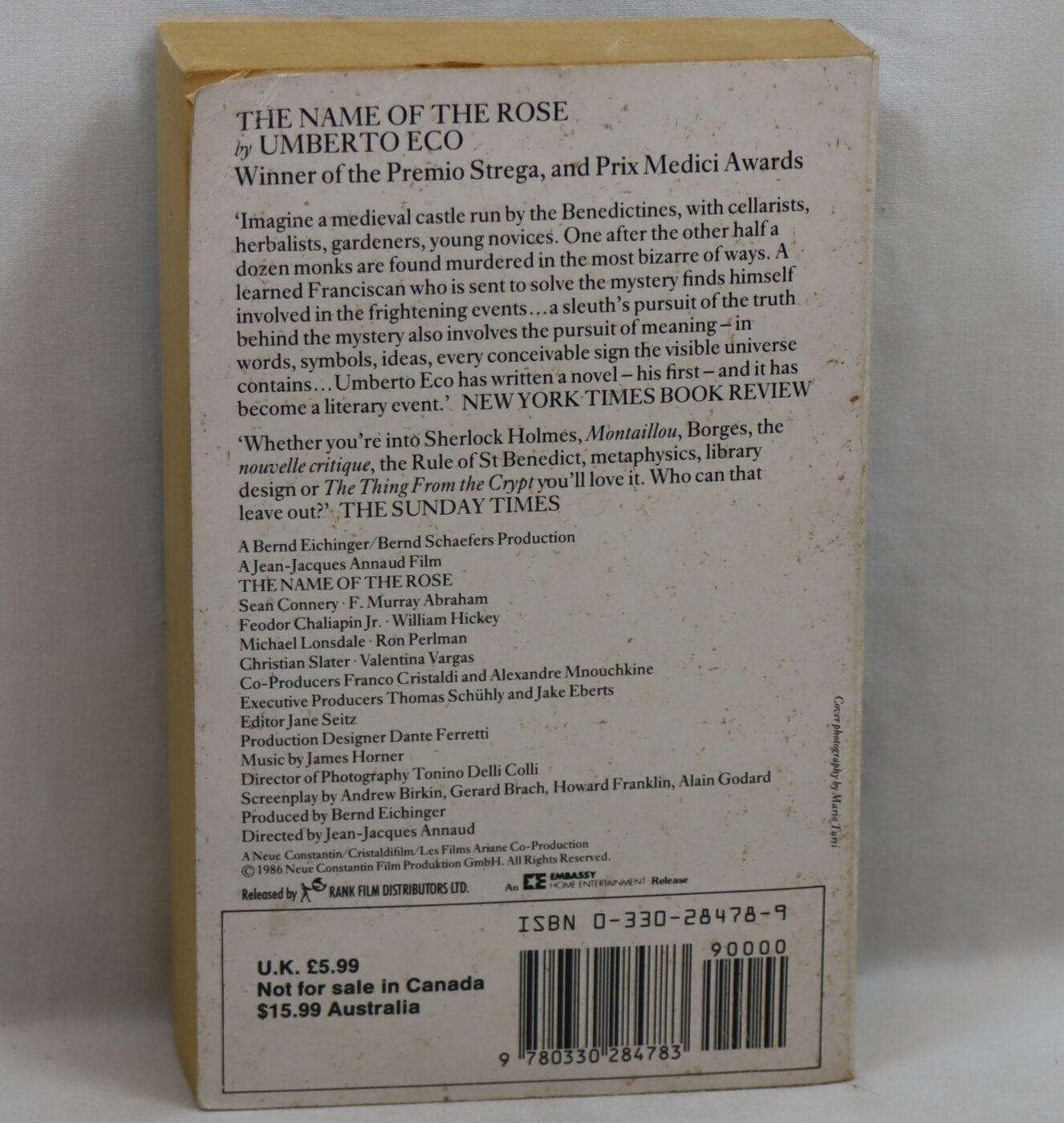
The Name of the Rose.
By Umberto Eco
ISBN: 9780151446476
Printed: 1984
Publisher: Picador. London
| Dimensions | 11 × 18 × 3 cm |
|---|---|
| Language |
Language: English
Size (cminches): 11 x 18 x 3
Condition: Fair (See explanation of ratings)
£6.00
Buy Now

Item information
Description
Paperback. White cover with gilt title.
We provide an in-depth photographic presentation of this item to stimulate your feeling and touch. More traditional book descriptions are immediately available
-
THIS FROST PAPERBACK is a USED book which a member of the Frost family has checked for condition, cleanliness, completeness and readability. When the buyer collects their book from Frost’s shop, the delivery charge of £3.00 is deducted
For conditions, please view our photographs. An original book from the library gathered by the famous Cambridge Don, computer scientist, food and wine connoisseur, Jack Arnold LANG.
The Name of the Rose is the 1980 debut novel by Italian author Umberto Eco. It is a historical murder mystery set in an Italian monastery in 1327, and an intellectual mystery combining semiotics in fiction, biblical analysis, medieval studies, and literary theory. It was translated into English by William Weaver in 1983.
The novel has sold over 50 million copies worldwide, becoming one of the best-selling books ever published. It has received many international awards and accolades, such as the Strega Prize in 1981 and Prix Medicis Étranger in 1982, and was ranked 14th on Le Monde’s 100 Books of the Century list.
Review: This is an amazing story, in any binding. But I enjoy reading from previously-owned books. This came very quickly in the mail, and is exactly as described. It has a lived-in feel and I love carrying it around as I absorb this fantastic tale.
Umberto Eco OMRI (5 January 1932 – 19 February 2016) was an Italian medievalist, philosopher, semiotician, novelist, cultural critic, and political and social commentator. In English, he is best known for his popular 1980 novel The Name of the Rose, a historical mystery combining semiotics in fiction with biblical analysis, medieval studies and literary theory, as well as Foucault’s Pendulum, his 1988 novel which touches on similar themes.
Eco wrote prolifically throughout his life, with his output including children’s books, translations from French and English, in addition to a twice-monthly newspaper column “La Bustina di Minerva” (Minerva’s Matchbook) in the magazine L’Espresso beginning in 1985, with his last column (a critical appraisal of the Romantic paintings of Francesco Hayez) appearing 27 January 2016. At the time of his death, he was an Emeritus professor at the University of Bologna, where he taught for much of his life. In the 21st century, he has continued to gain recognition for his 1995 essay “Ur-Fascism”, where Eco lists fourteen general properties he believes comprise fascist ideologies.
Want to know more about this item?
We are happy to answer any questions you may have about this item. In addition, it is also possible to request more photographs if there is something specific you want illustrated.
Ask a question
Related products
Share this Page with a friend
