
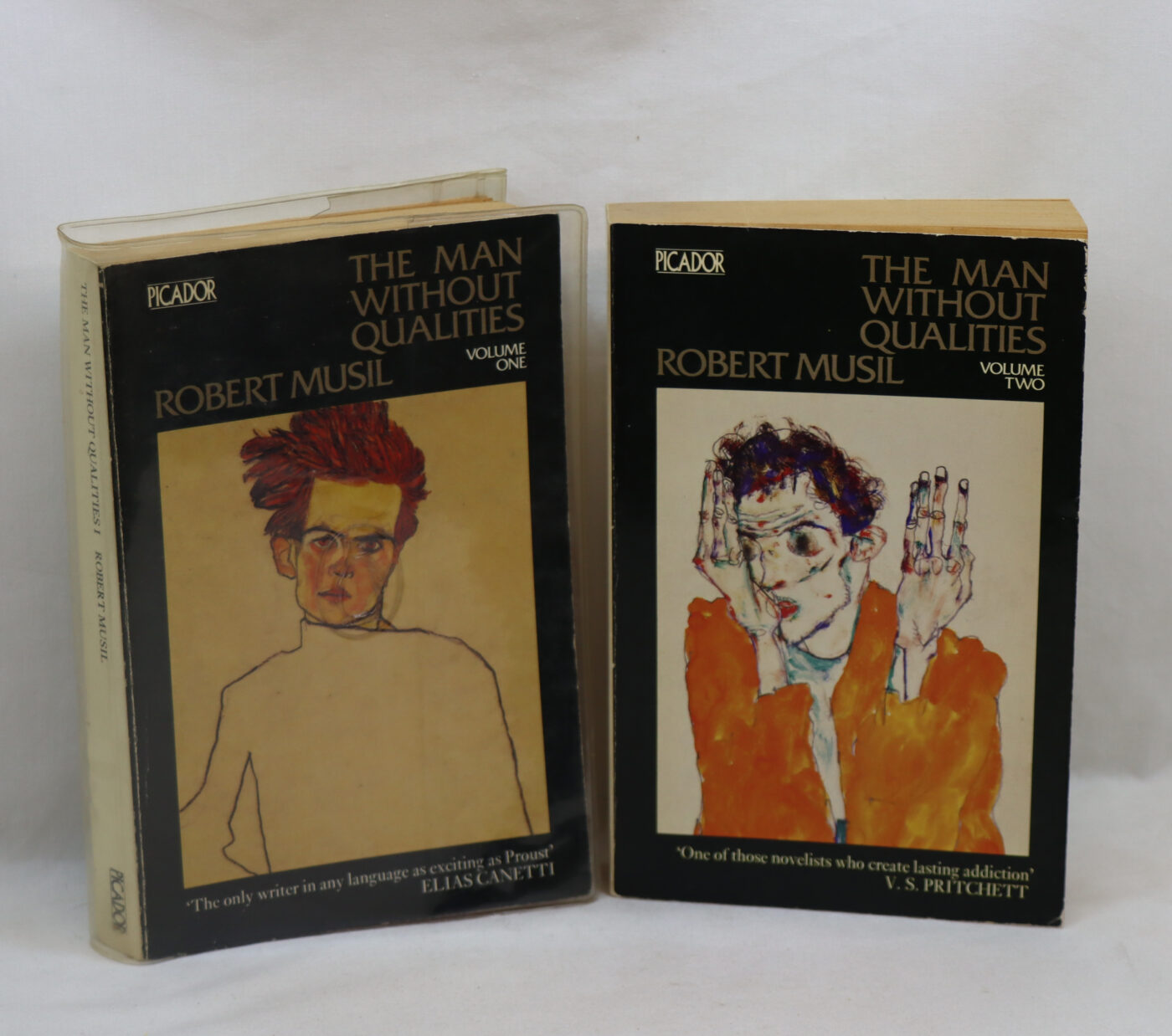
The Man Without Qualities. Volumes 1 & 2.
By Robert Musil
ISBN: 9780679768029
Printed: 1979
Publisher: Picador. London
| Dimensions | 14 × 20 × 3 cm |
|---|---|
| Language |
Language: English
Size (cminches): 14 x 20 x 3
Condition: Good (See explanation of ratings)
£24.00
Buy Now

Item information
Description
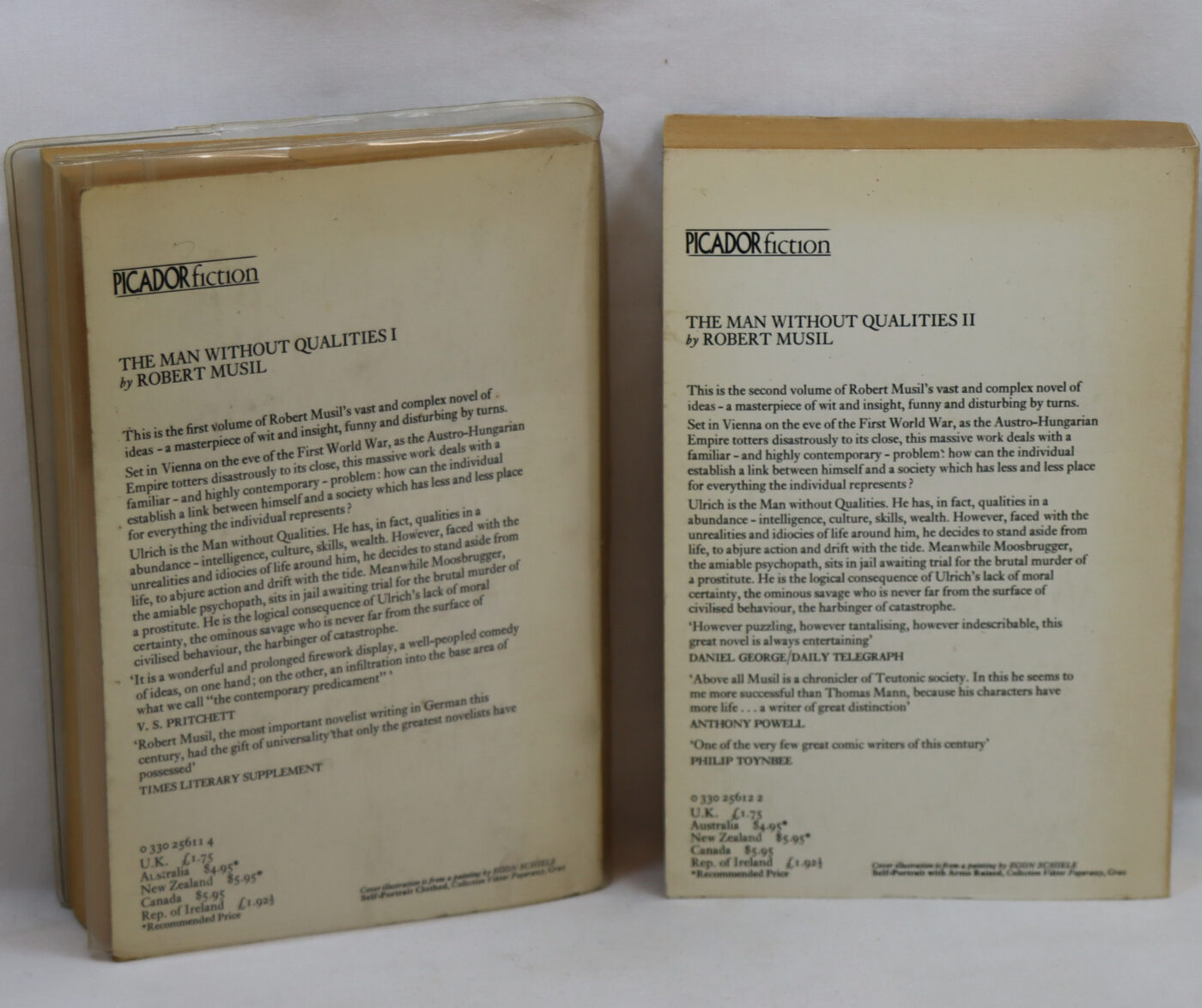
Paperback. black cover with brown title and portrait image. Dimensions are for one volume.
We provide an in-depth photographic presentation of this item to stimulate your feeling and touch. More traditional book descriptions are immediately available
- Note: This book carries a £5.00 discount to those that subscribe to the F.B.A. mailing list
For conditions, please view our photographs. A nice clean original book (in two parts) from the library gathered by the famous Cambridge Don, computer scientist, food and wine connoisseur, Jack Arnold LANG.
The Man Without Qualities (German: Der Mann ohne Eigenschaften; 1930–1943) is an unfinished modernist novel in three volumes and various drafts, by the Austrian writer Robert Musil. The novel is a “story of ideas”, which takes place in the time of the Austro-Hungarian monarchy’s last days. The plot often veers into allegorical digressions on a wide range of existential themes concerning humanity and feelings. It has a particular concern with the values of truth and opinion and how society organizes ideas about life and society. The book is well over a thousand pages long in its entirety, and no one single theme dominates.
Robert Musil (6 November 1880 – 15 April 1942) was an Austrian philosophical writer. His unfinished novel, The Man Without Qualities (German: Der Mann ohne Eigenschaften), is generally considered to be one of the most important and influential modernist novels.
Musil worked on the novel for more than twenty years. He started in 1921 and spent the rest of his life writing it. When he died in 1942, the novel had not been completed. The 1,074-page Volume 1 (Part I: A Sort of Introduction, and Part II: The Like of It Now Happens) and 605-page Volume 2 (Part III: Into the Millennium (The Criminals)) were published in 1930 and 1933 respectively in Berlin. Part III did not include 20 chapters withdrawn from Vol. 2 of 1933 while in printer’s galley proofs. From 1933 until death, Musil was working on Part III. In 1943 in Lausanne, Musil’s widow Martha published a 462-page collection of material from literary remains including the 20 galley chapters withdrawn from Part III, as well as drafts of the final incomplete chapters and notes on the development and direction of the novel.
Musil’s almost daily preoccupation with writing left his family in dire financial straits. The book brought neither fame nor fortune to him or his family. This was one of the reasons why he felt bitter and unrecognized during the last two decades of his life. The combination of poverty and a multitude of ideas is one of the most striking characteristics of Musil’s biography. There are strong autobiographical features to be found in the text as the main characters’ ideas and attitudes are believed to be those of Musil. Most of the aspects of the Viennese life in the novel are based on history and Musil’s life. The plot and the characters (with the exception of a short appearance of the Austrian emperor Franz Joseph I) are invented (although some of them had inspirations in eminent Austrians and Germans). Elsa (Berta) von Czuber, whom Musil met while he studied in Brno between 1889 and 1901, inspired him with the image of Ulrich’s sister Agathe. Donath and Alice Charlemont, Musil’s friends, were models of Walter and Clarisse and Viennese socialite Eugenie Schwarzwald gave birth to the character of Diotima. Arnheim may have been based on Walther Rathenau and Thomas Mann.
His detailed portrait of a decaying fin de siècle world is similar to those of Hermann Broch’s The Sleepwalkers, Karl Kraus’ The Last Days of Mankind or Stefan Zweig’s The World of Yesterday.
Want to know more about this item?
We are happy to answer any questions you may have about this item. In addition, it is also possible to request more photographs if there is something specific you want illustrated.
Ask a question
Related products


Share this Page with a friend
