
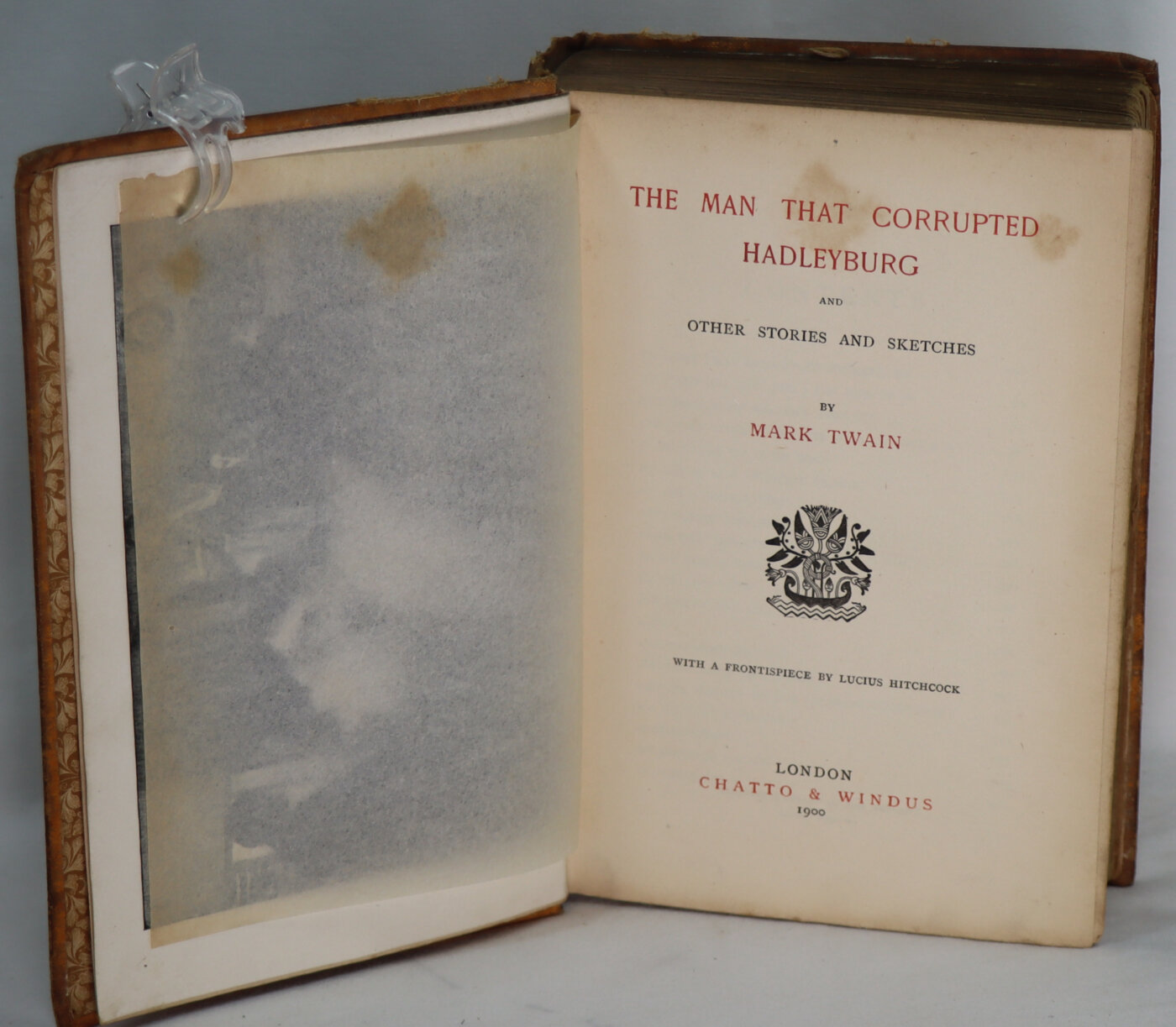
The Man that Corrupted Hadleyburg Etc.
By Mark Twain
Printed: 1900
Publisher: Chatto & Windus. London
| Dimensions | 14 × 20 × 4 cm |
|---|---|
| Language |
Language: English
Size (cminches): 14 x 20 x 4
Condition: Good (See explanation of ratings)
£69.00
Buy Now
Your items

Item information
Description
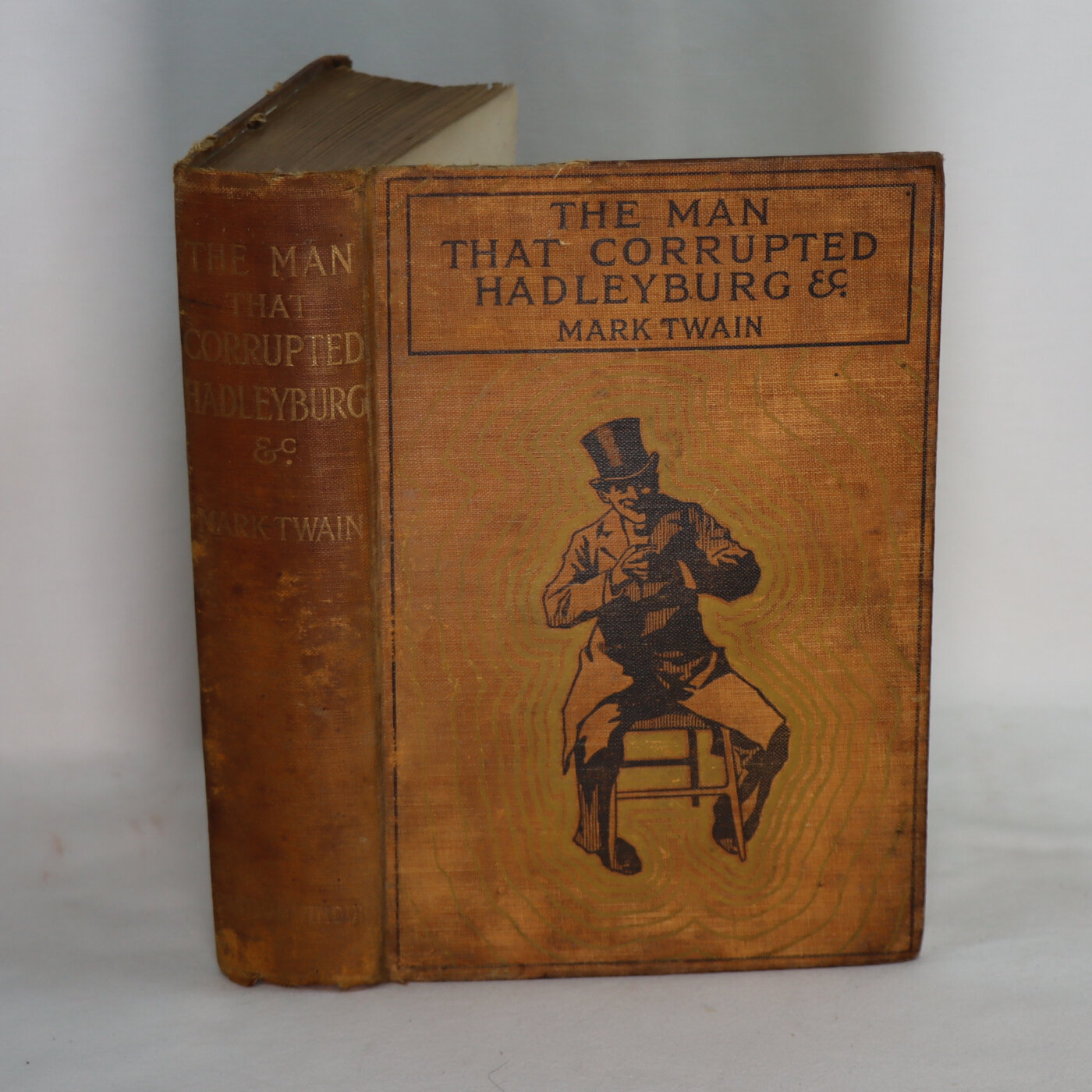
Tan cloth binding with gilt title on the spine. Black title on the front board.
-
We provide an in-depth photographic presentation of this item to stimulate your feeling and touch. More traditional book descriptions are immediately available.
-
Note: This book carries the £5.00 discount to those that subscribe to the F.B.A. mailing list.
Hardcover. First U.K. Edition. 414p; 32p advertisements. A golden-yellow cloth hardcover book in acceptable condition. The binding is still quite secure for normal handling. Text unmarked. The first UK edition, first state, with advertisements dated June 1900.
“The Man That Corrupted Hadleyburg” is a piece of short fiction by Mark Twain. It first appeared in Harper’s Monthly in December 1899, and was subsequently published by Harper & Brothers in the collection The Man That Corrupted Hadleyburg and Other Stories and Essays (1900). Some see this story “as a replay of the Garden of Eden story”, and associate the corrupter of the town with Satan.
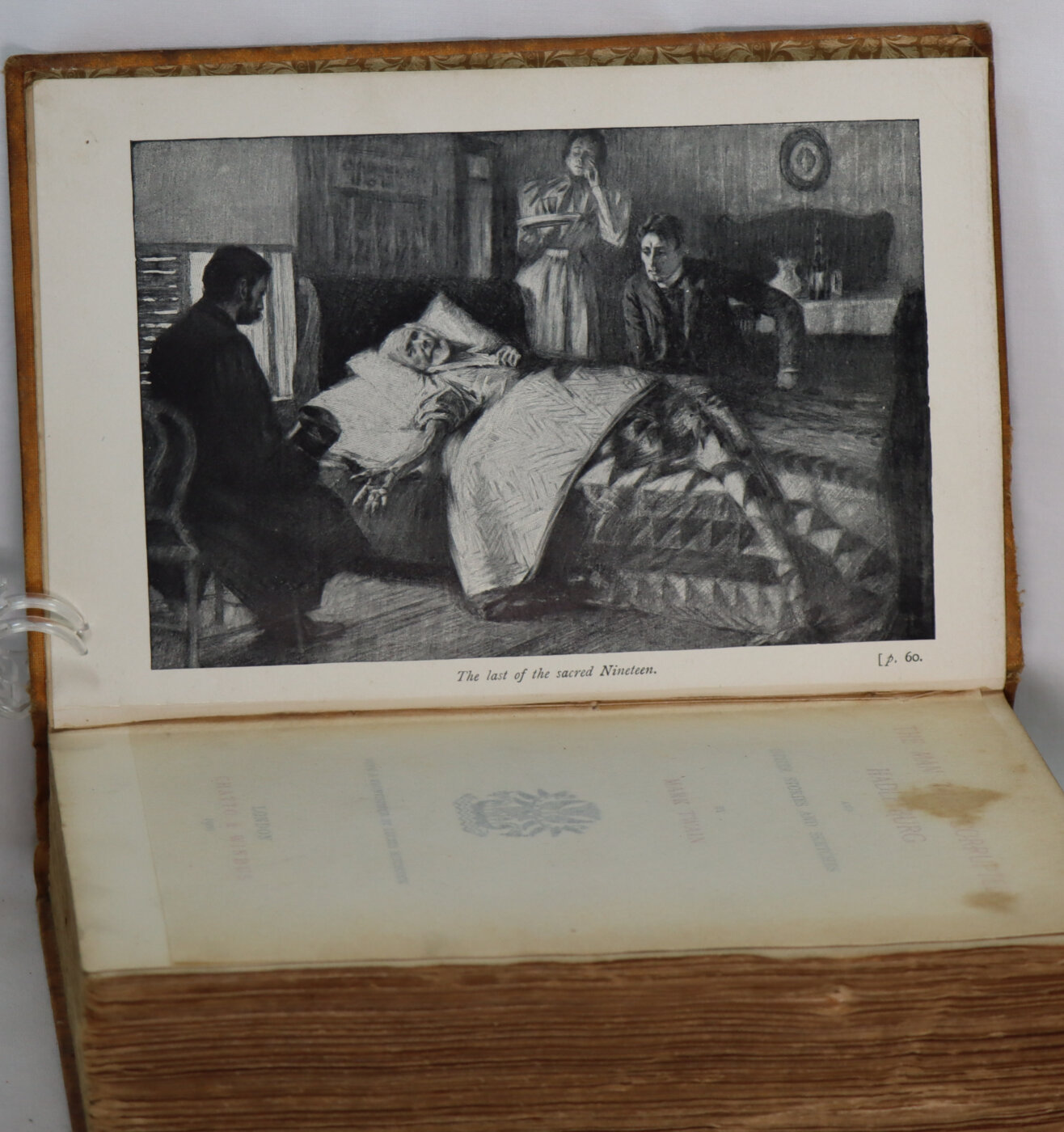
In the story, a town has gained a reputation for incorruptibility. Its population is trained to avoid temptation. An offended stranger seeks revenge against the town’s population, and starts tempting them with a reward in gold coins for a supposedly forgotten act of kindness. After receiving anonymous tips from the stranger, nineteen of the town’s most prominent couples claim the reward under false pretenses. Their dishonesty becomes evident in a public meeting, and they are publicly shamed. The stranger observes that the townspeople were actually easier than usual to corrupt, because their resolve had never been tested. The town’s reputation is further ruined by an unintentional side-effect of the original plan.
Samuel Langhorne Clemens (November 30, 1835 – April 21, 1910), known by the pen name Mark Twain, was an American writer, humorist, and essayist. He was praised as the “greatest humorist the United States has produced,” with William Faulkner calling him “the father of American literature.” Twain’s novels include The Adventures of Tom Sawyer (1876) and its sequel, Adventures of Huckleberry Finn (1884), with the latter often called the “Great American Novel.” He also wrote A Connecticut Yankee in King Arthur’s Court (1889) and Pudd’nhead Wilson (1894), and co-wrote The Gilded Age: A Tale of Today (1873) with Charles Dudley Warner.
Twain was raised in Hannibal, Missouri, which later provided the setting for both Tom Sawyer and Huckleberry Finn. He served an apprenticeship with a printer early in his career, and then worked as a typesetter, contributing articles to his older brother Orion Clemens’ newspaper. Twain then became a riverboat pilot on the Mississippi River, which provided him the material for Life on the Mississippi (1883). Soon after, Twain headed west to join Orion in Nevada. He referred humorously to his lack of success at mining, turning to journalism for the Virginia City Territorial Enterprise.
Twain first achieved success as a writer with the humorous story “The Celebrated Jumping Frog of Calaveras County,” which was published in 1865; it was based on a story that he heard at Angels Hotel in Angels Camp, California, where Twain had spent some time while he was working as a miner. The short story brought Twain international attention. He wrote both fiction and non-fiction. As his fame grew, Twain became a much sought-after speaker. His wit and satire, both in prose and in speech, earned praise from critics and peers, and Twain was a friend to presidents, artists, industrialists, and European royalty.
Although Twain initially spoke out in favor of American interests in the Hawaiian Islands, he later reversed his position, going on to become vice president of the American Anti-Imperialist League from 1901 until his death in 1910, coming out strongly against the Philippine-American War and American colonialism. Twain published a satirical pamphlet, “King Leopold’s Soliloquy”, in 1905 about Belgian atrocities in the Congo Free State.
Twain earned a great deal of money from his writing and lectures, but invested in ventures that lost most of it, such as the Paige Compositor, a mechanical typesetter that failed because of its complexity and imprecision. He filed for bankruptcy in the wake of these financial setbacks, but in time overcame his financial troubles with the help of Standard Oil executive Henry Huttleston Rogers. Twain eventually paid all his creditors in full, even though his declaration of bankruptcy meant he was not required to do so. Twain was born shortly after an appearance of Halley’s Comet, and predicted that his death would accompany it as well, dying a day after the comet was at its closest to Earth.
Condition notes
Binding has staining
Want to know more about this item?
We are happy to answer any questions you may have about this item. In addition, it is also possible to request more photographs if there is something specific you want illustrated.
Ask a question
Related products





Share this Page with a friend
