
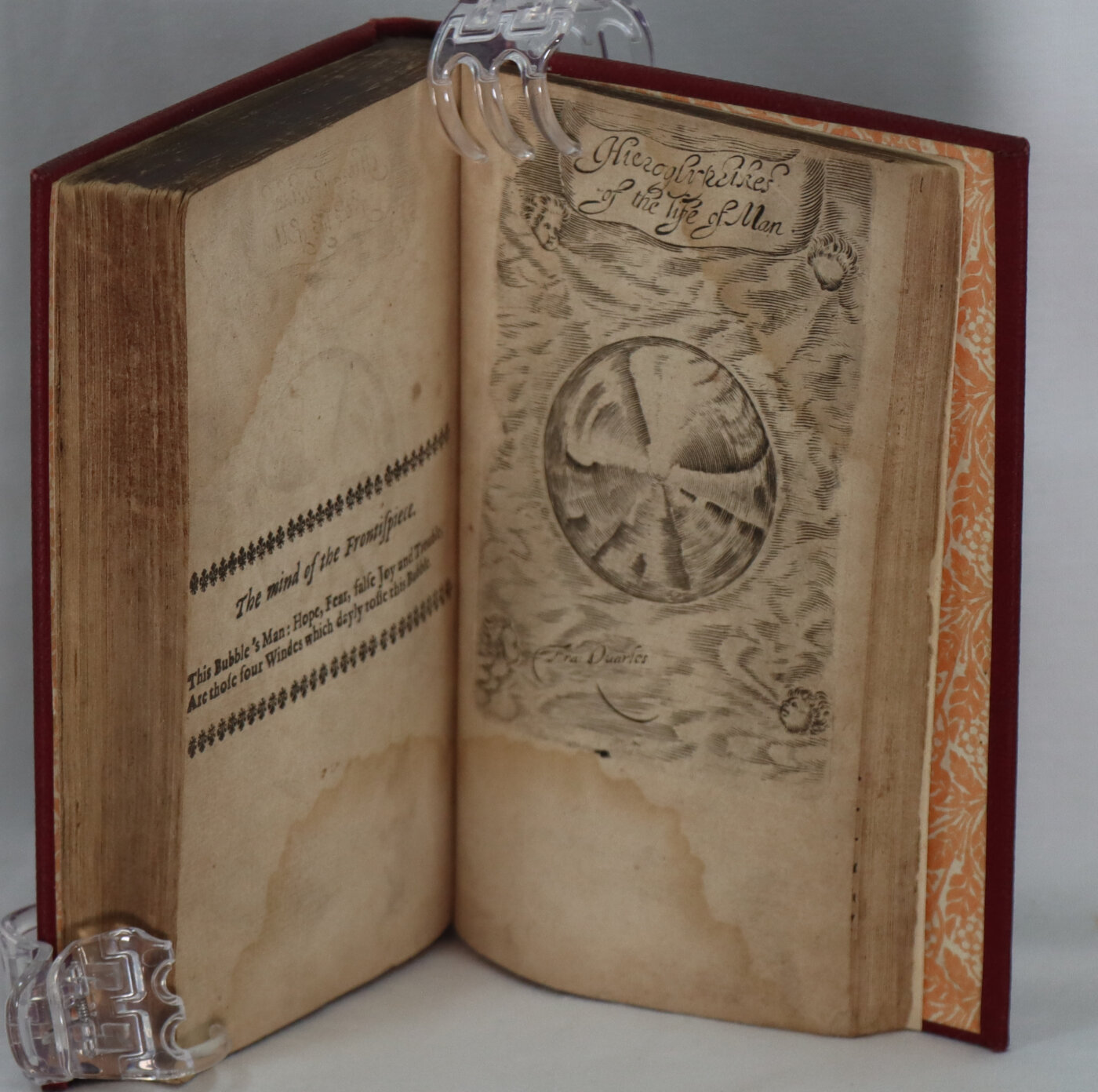
EMBLEMES (1634). Hieroglyphikes of the Life of Man (1638).
By Francis Quarles
Printed: 1634 & 1638
Publisher: Edward Benlowes
| Dimensions | 10 × 14 × 3 cm |
|---|---|
| Language |
Language: English
Size (cminches): 10 x 14 x 3
Condition: Very good (See explanation of ratings)
THIS ITEM WILL BE AVAILABLE SOON
SORRY, THIS ITEM HAS SOLD
Item information
Description
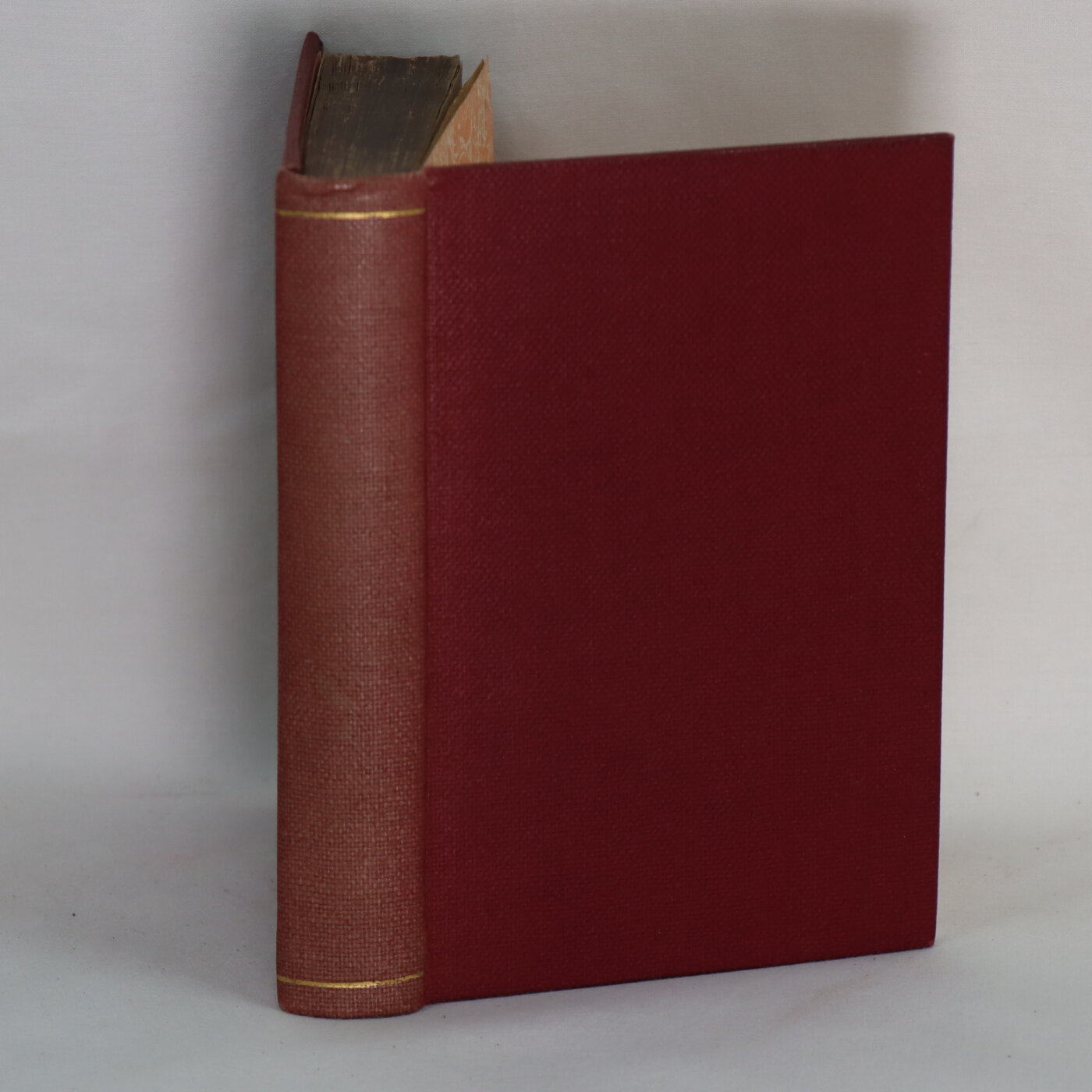
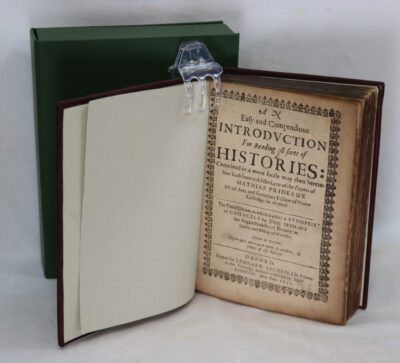
Rebound with maroon cloth with gilt banding on the spine.
We provide an in-depth photographic presentation of this item to stimulate your feeling and touch. More traditional book descriptions are immediately available.
Note: These books carry the £5.00 discount to those that subscribe to the F.B.A. mailing list.
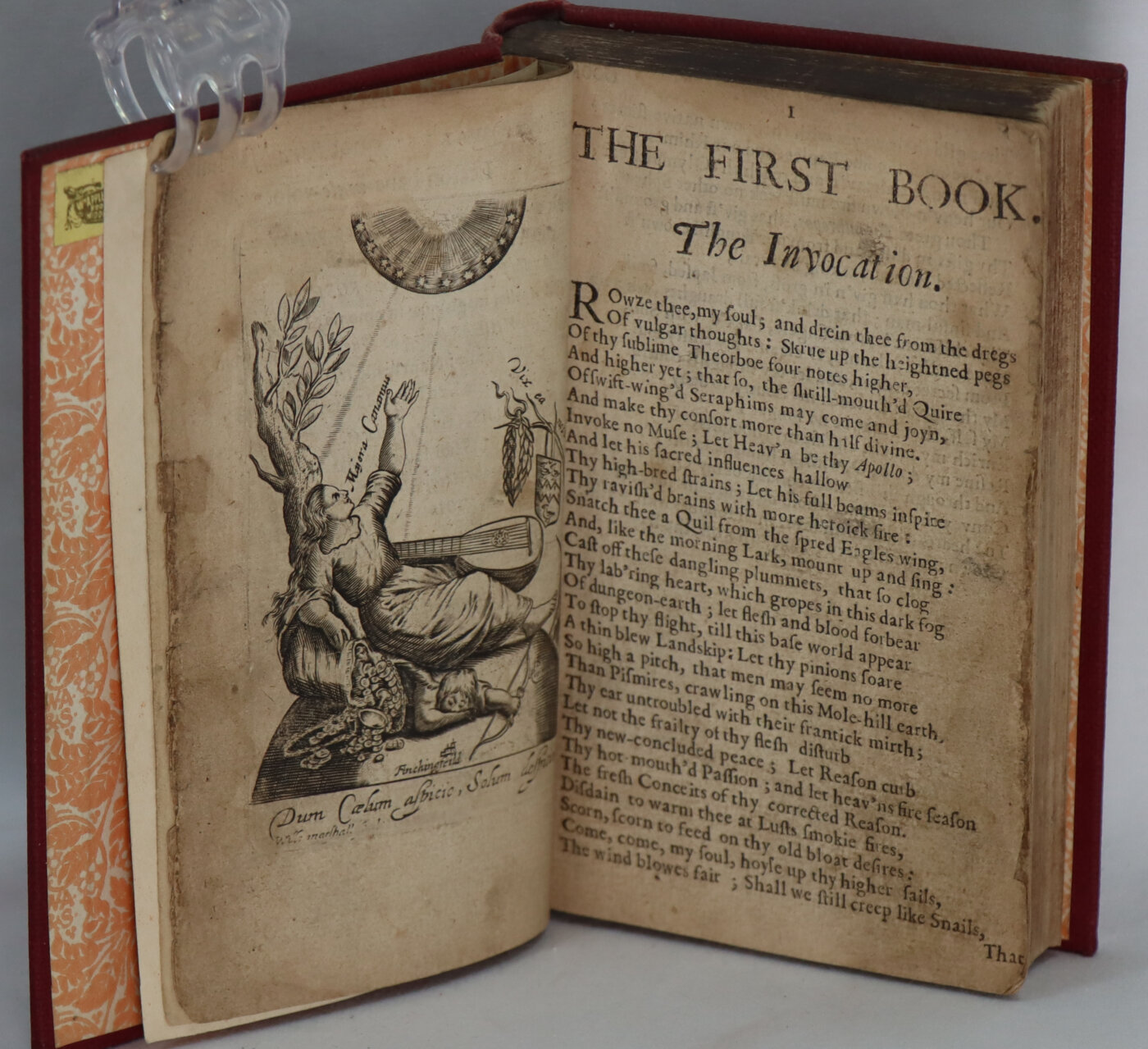
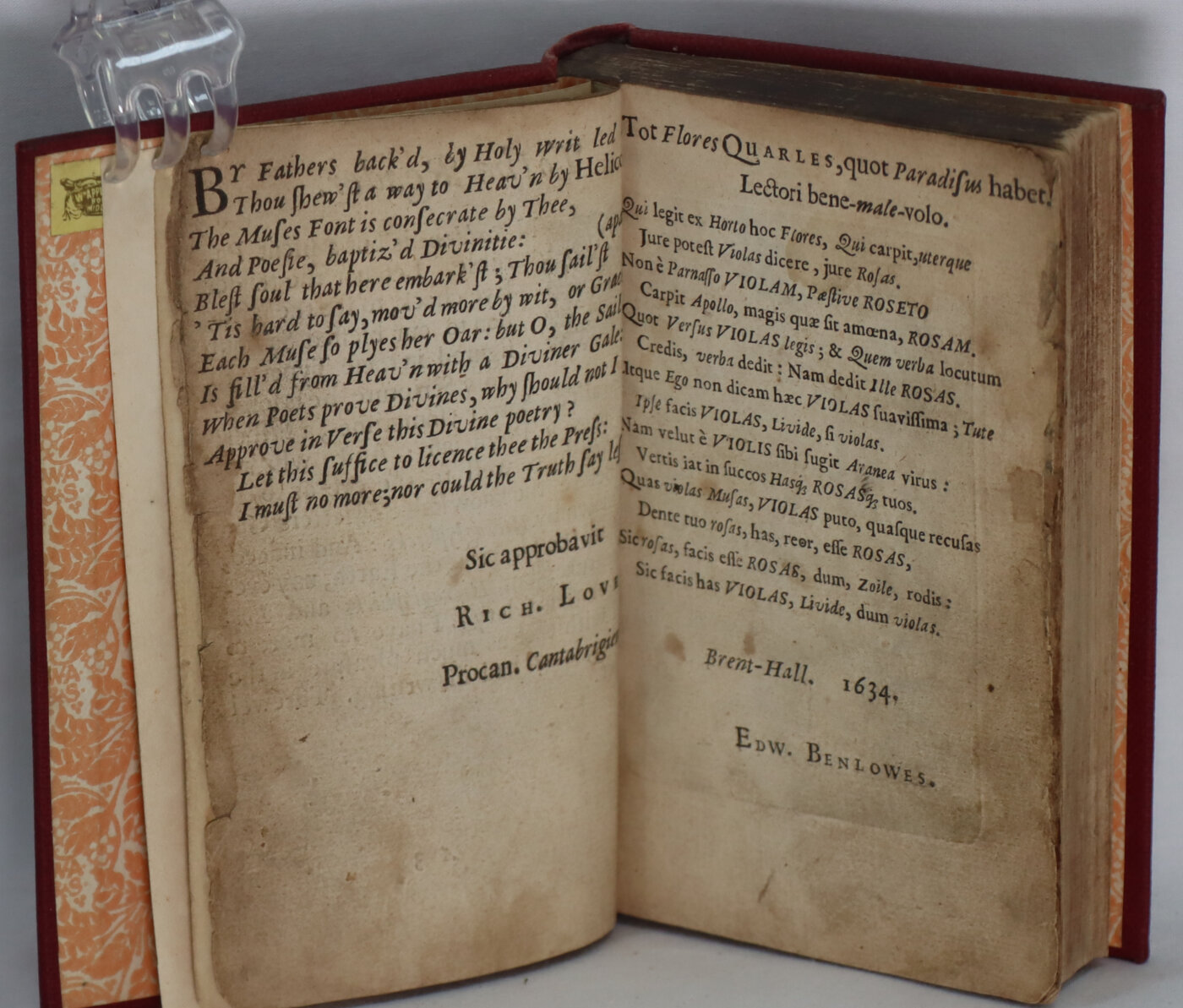
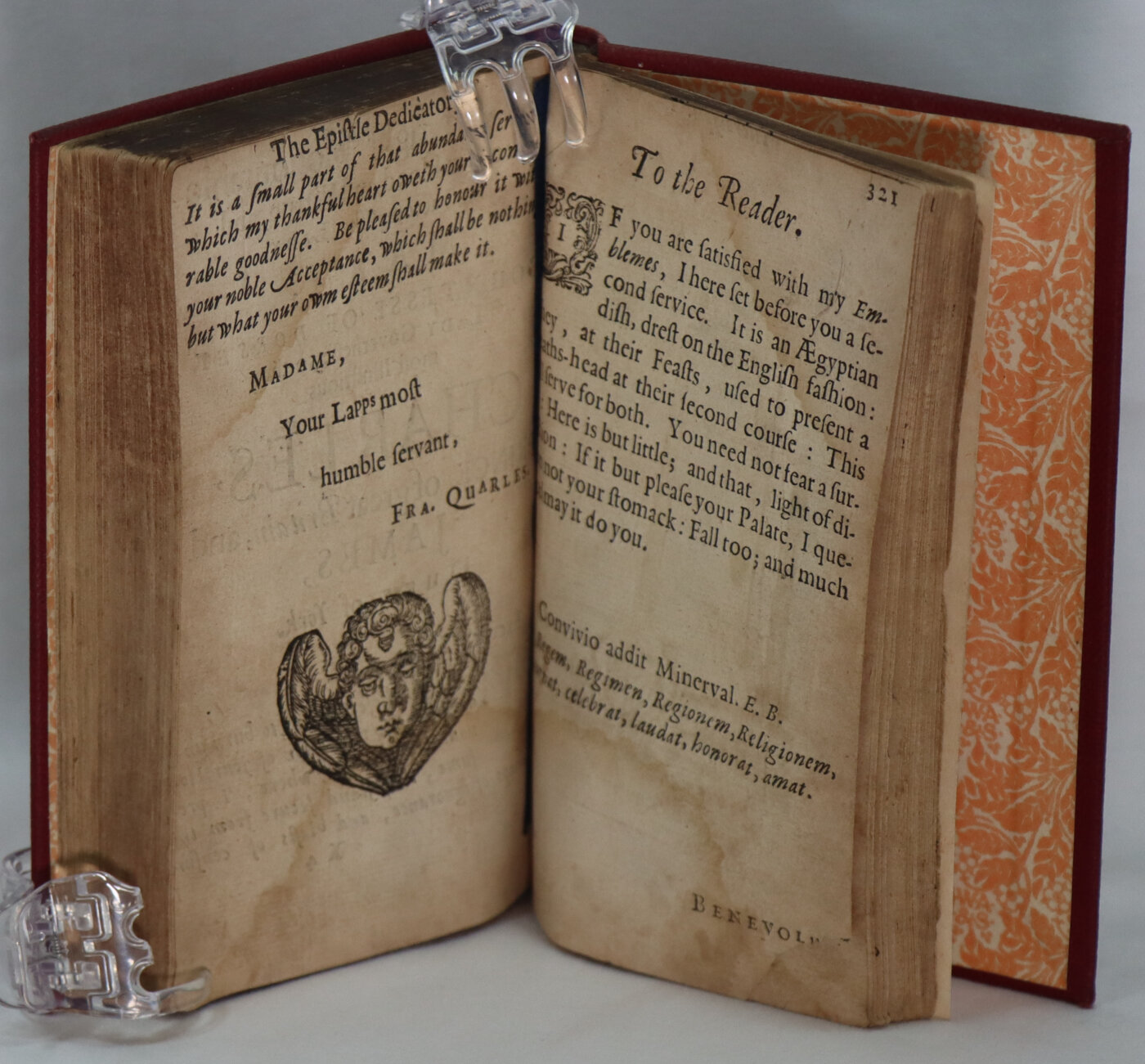
These very rare ‘emblem’ volumes are precursors to: ‘Loves Sacrifice’. A Divine Poem produced by Edward Benlowes, Poet & Mystic. They are two superb First edition 17th century books by Francis Quarles bound together after World War II. Currently, these books are being rebound by Mr Brian Cole and boxed as a presentation set. Both books were printed by Edward Benlowes on his own printing machine at Benlowes’s home, Brent Hall.
Francis Quarles (about 8 May 1592 – 8 September 1644) was an English poet most notable for his emblem book entitled Emblems. Francis Quarles was born in Romford, Essex, and baptized there on 8 May 1592. His family had a long history of royal service. His great-grandfather, George Quarles, was Auditor to King Henry VIII, and his father, James Quarles, was Clerk of the Green Cloth, and Purveyor of the Navy, in Queen Elizabeth’s reign. His mother, Joan Dalton, was the daughter and heiress of Eldred Dalton of Mores Place, Hadham. Francis grew up in the Manor of Stewards. There were eight children in the family; the eldest, Sir Robert Quarles, was knighted by James I in 1608.
Francis Quarles was enrolled at Christ’s College, Cambridge, in 1608, and subsequently joined Lincoln’s Inn to read for the bar. In 1613, when Princess Elizabeth married Frederick V of the Electoral Palatinate, Quarles was made her cupbearer and went with her to the continent, remaining in post for some years.
Some time before 1629, Quarles was appointed as secretary to James Ussher, Archbishop of Armagh and primate of all Ireland.
About 1633, Quarles returned to England, and spent the next two years in the preparation of his Emblems. In 1639 he was made city chronologist, a post in which Ben Jonson and Thomas Middleton had preceded him. At the outbreak of the Civil War, he took the Royalist side, drawing up three pamphlets in 1644 in support of the king’s cause. It is said that his house was searched and his papers destroyed by the Parliamentarians as a consequence of these publications.
Quarles married Ursula Woodgate in 1618, by whom he had eighteen children. His son, John Quarles (1624–1665), was exiled to Flanders for his Royalist sympathies and was the author of Fons Lachrymarum (1648) and other poems.
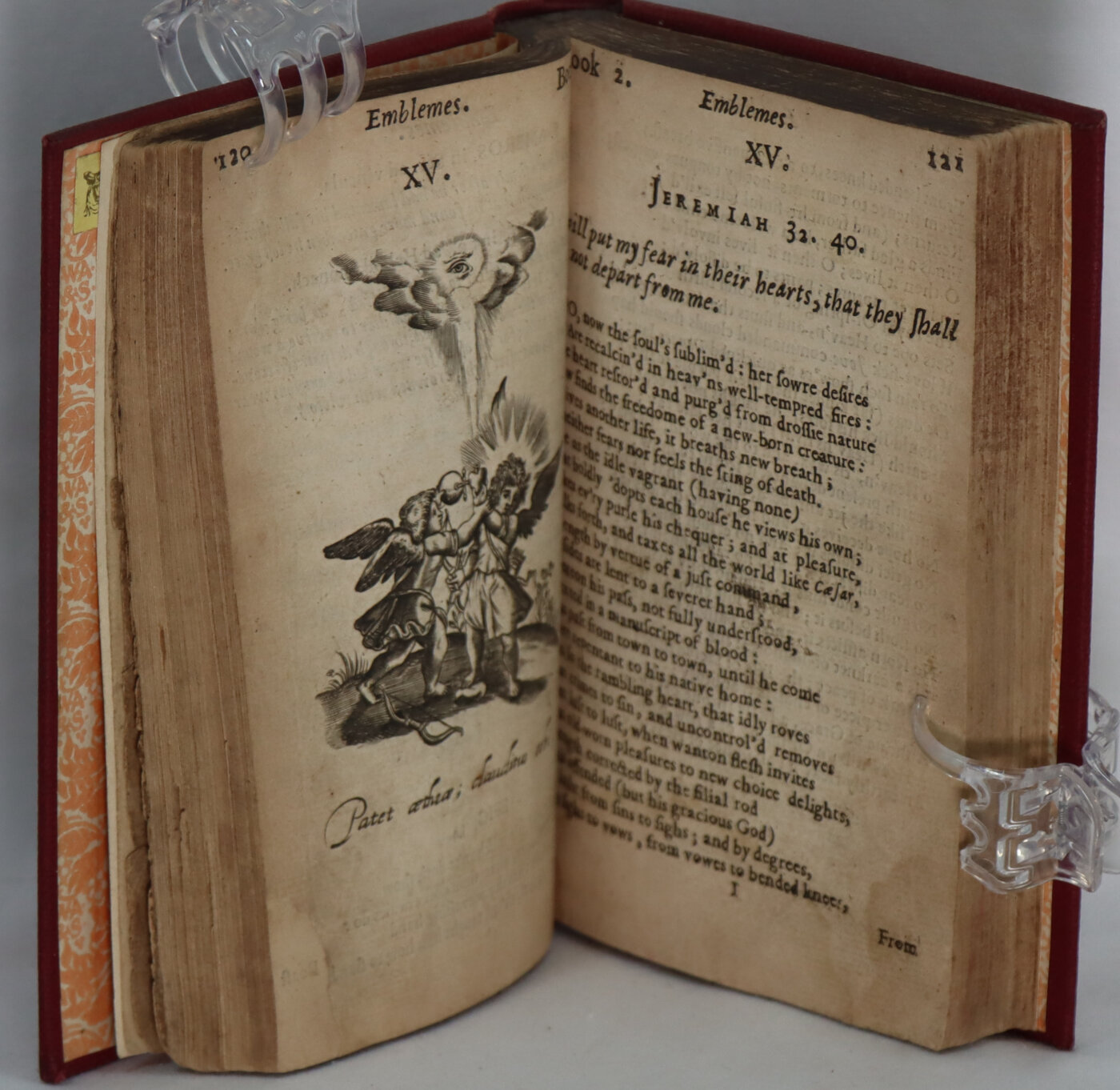
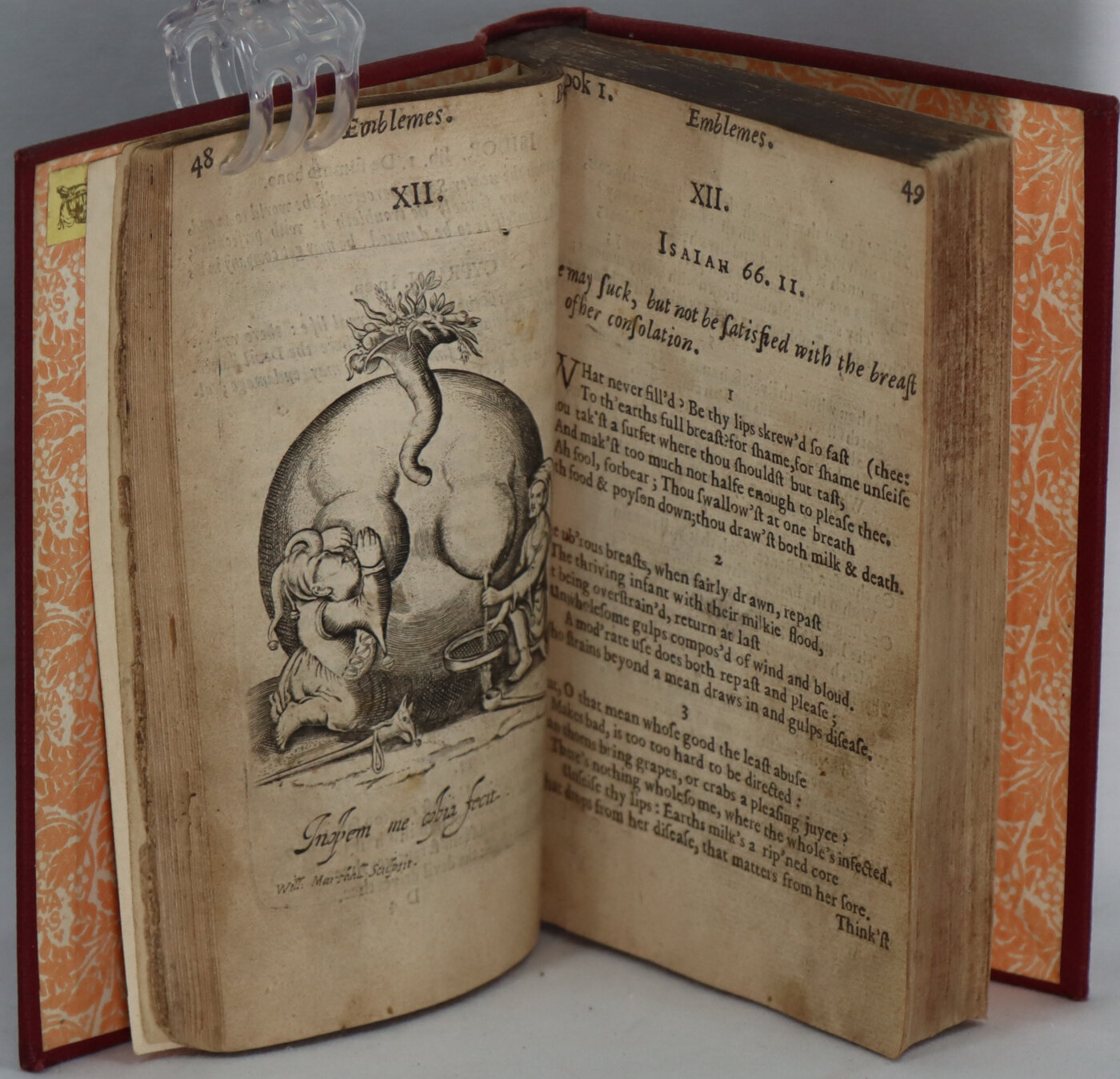
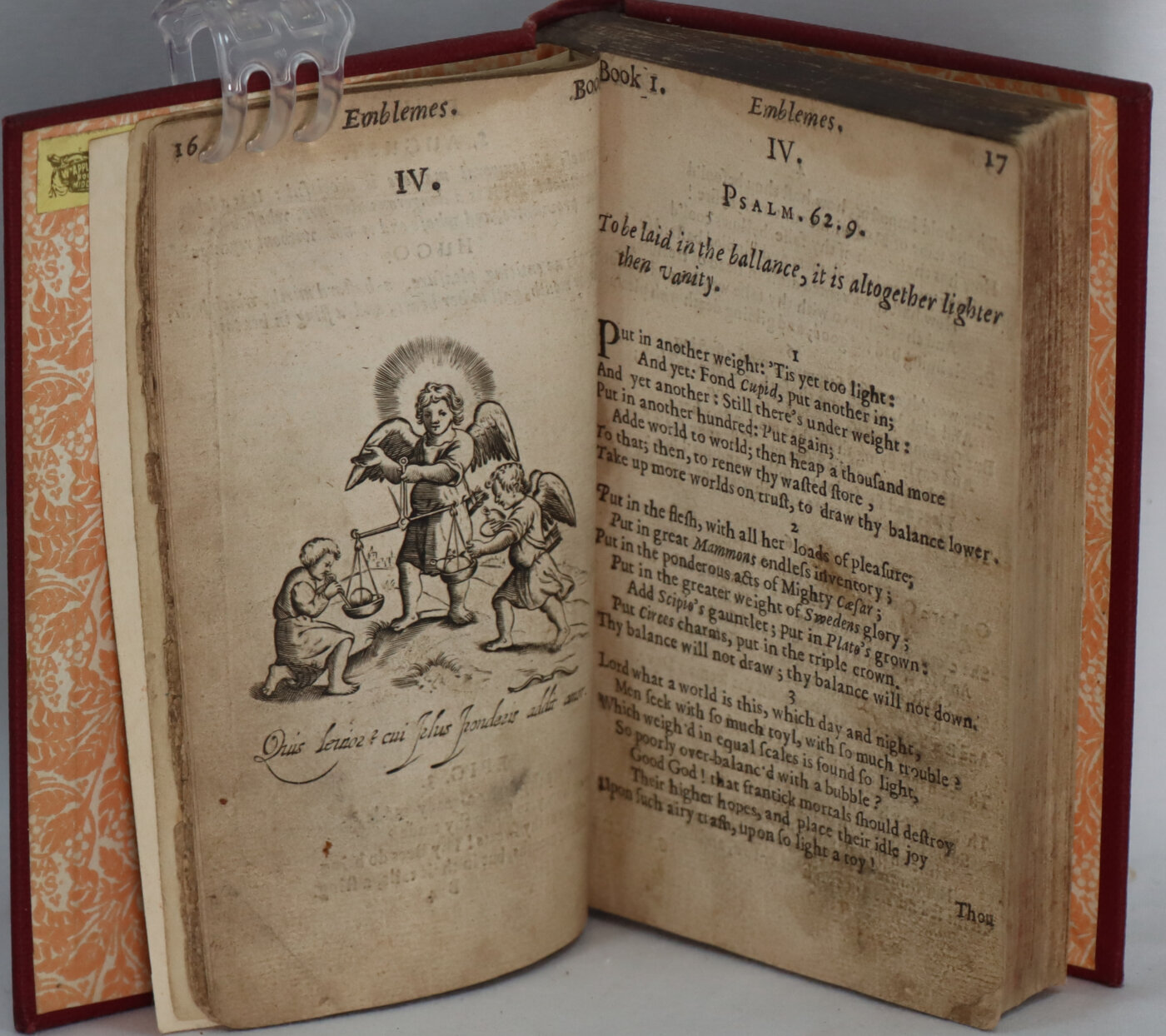
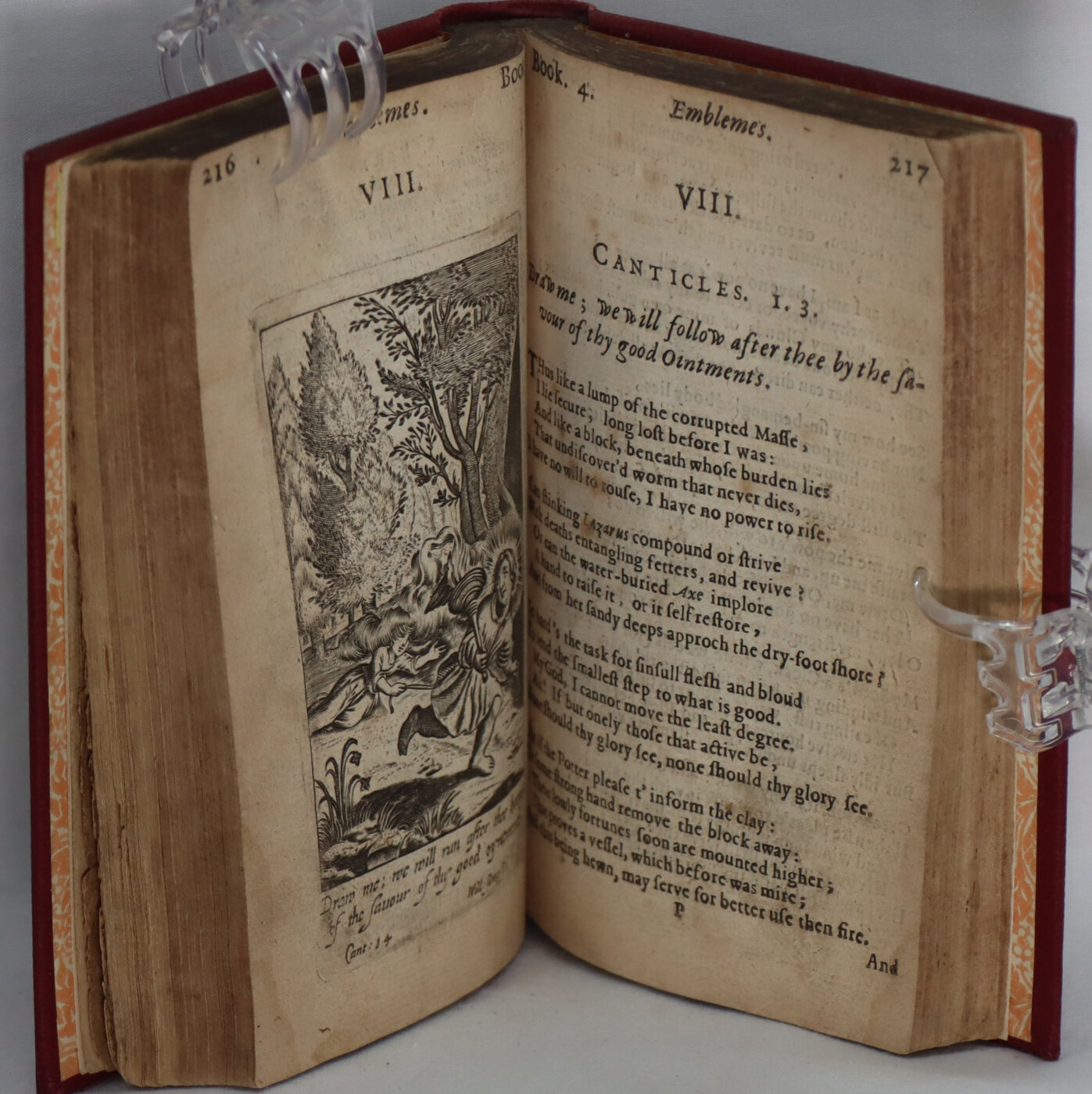
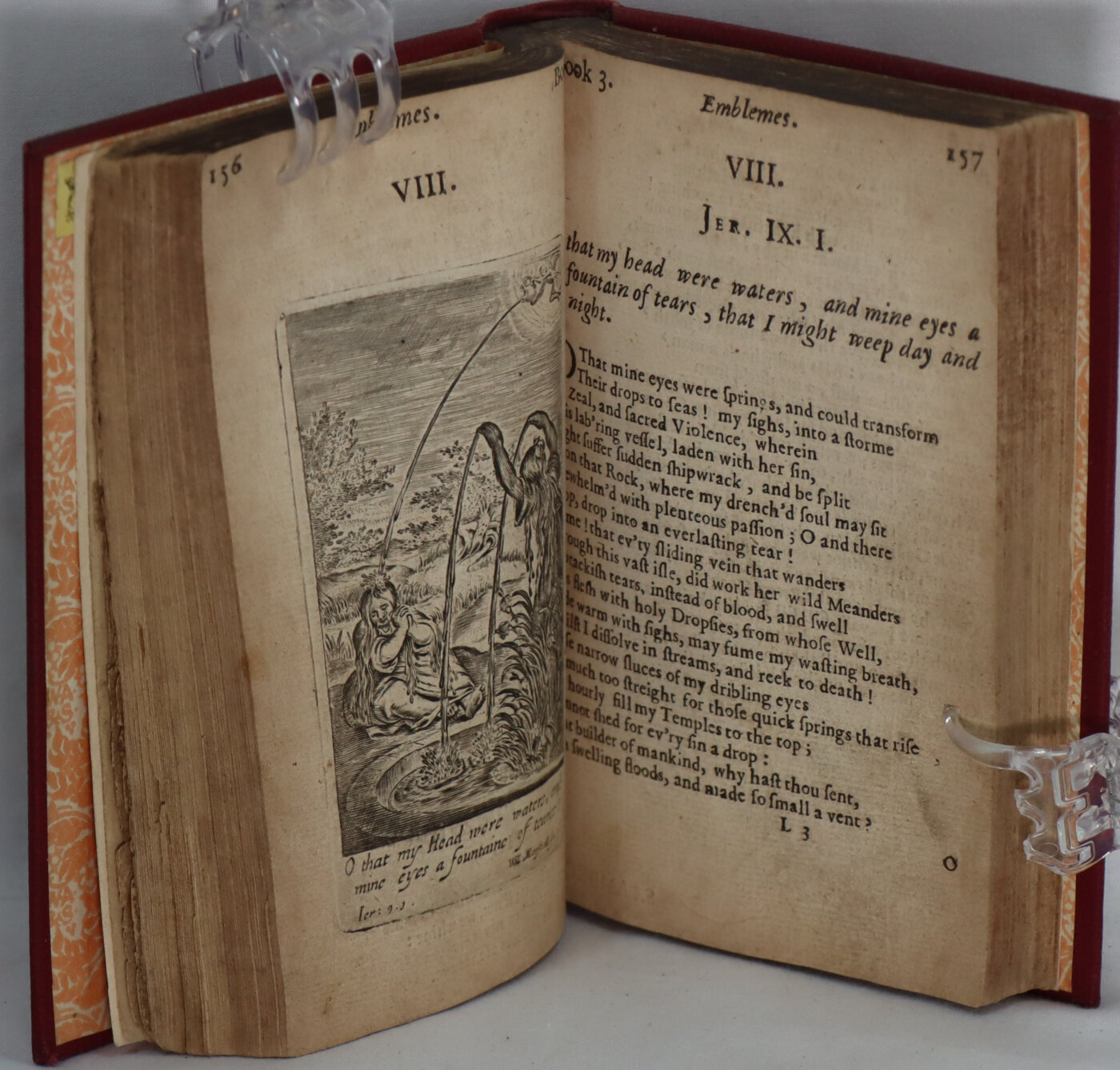
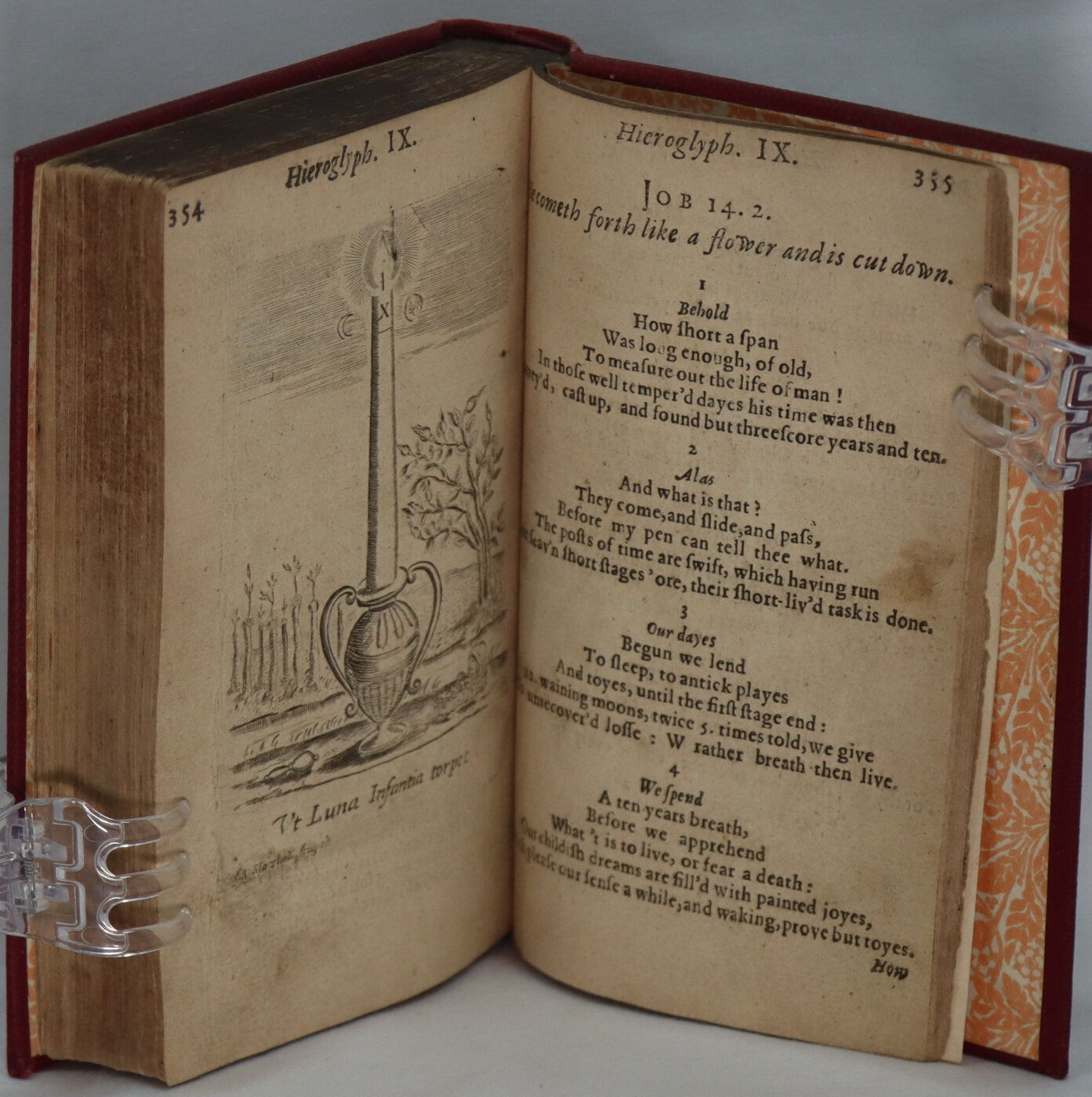
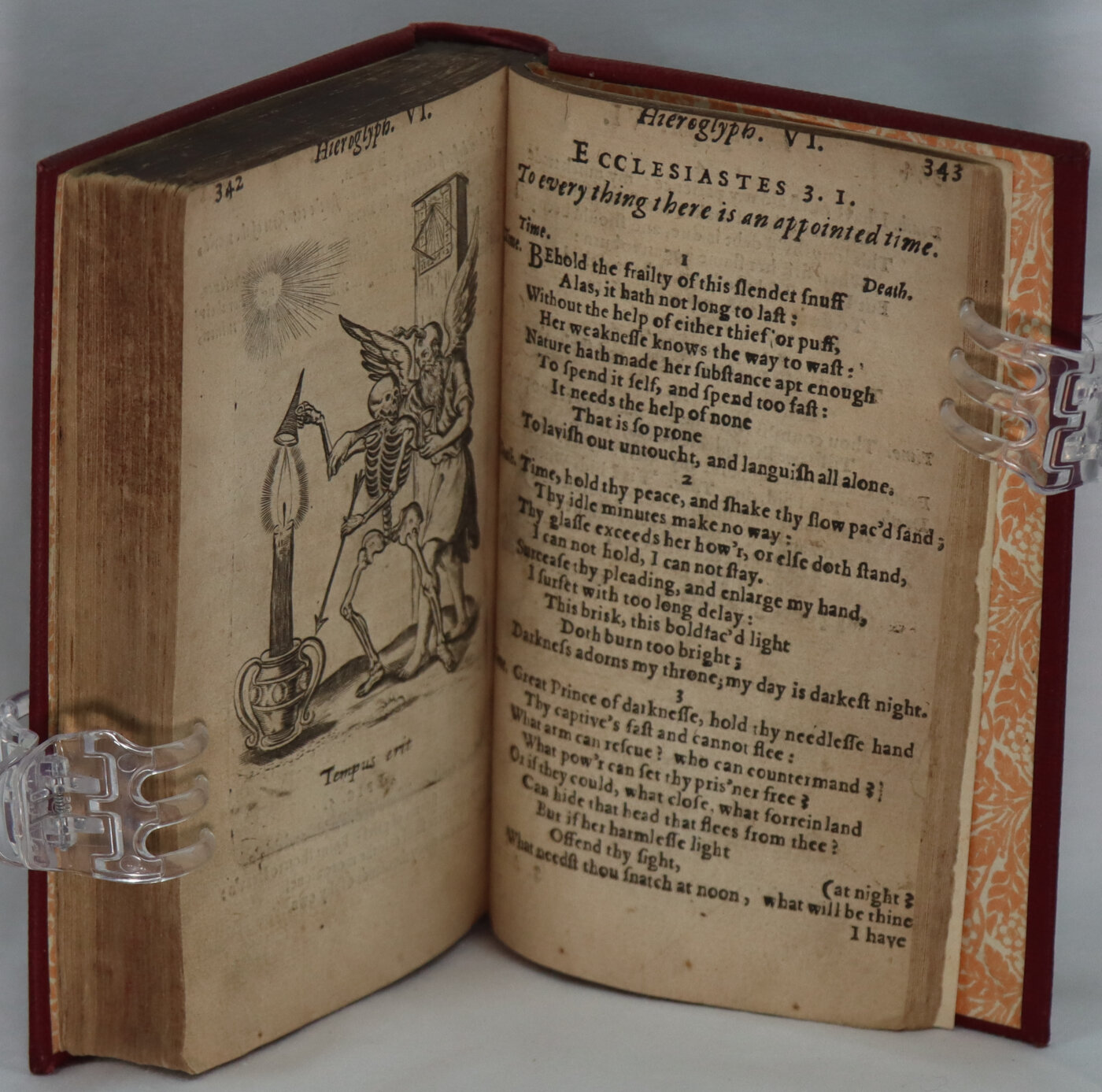
The work by which Quarles is best known, the Emblems, was originally published in 1634, with grotesque illustrations engraved by William Marshall and others. The forty-five prints in the last three books are borrowed from the designs by Boetius à Bolswert for the Pia Desideria (Antwerp, 1624) of Herman Hugo. Each “emblem” consists of a paraphrase from a passage of Scripture, expressed in ornate and metaphorical language, followed by passages from the Christian Fathers, and concluding with an epigram of four lines.
The Emblems was immensely popular with readers, but the critics of the 17th and 18th centuries had no mercy on Quarles. Sir John Suckling in his Sessions of the Poets disrespectfully alluded to him as he “that makes God speak so big in’s poetry.” Pope in the Dunciad spoke of the Emblems, “Where the pictures for the page atone And Quarles is saved by beauties not his own.”
In 2022 some kitchen refitters found murals in a flat on Micklegate in York city centre. Now fully uncovered, they are thought to be based on scenes from Quarles’s Emblems.
Edward Benlowes (12 July 1603 – 18 December 1676) was an English poet, mystic, and benefactor. The son of Andrew Benlowes of Brent Hall, Essex, he matriculated at St John’s College, Cambridge, on 8 April 1620. On leaving the university he travelled with a tutor on the continent, visiting seven courts of princes. Wood says that he returned tinged with Romanism; but according to Cole he had been bred in the Roman Catholic religion from his earliest years. In later life he converted to Protestantism. On the death of his father he became possessed of the estate of Brent Hall, but being a man of a very liberal disposition he contrived “to squander it mostly away on poets, flatterers (which he loved), in buying of curiosities (which some called baubles), on musicians, buffoons, &c.” (Wood). He often gave his bond for the payment of debts contracted by his friends, and on one occasion, being unable to meet the obligation he had incurred, was committed to prison at Oxford. To his niece at her marriage, he granted a handsome portion, and many poor scholars experienced his bounty. When he left Cambridge he made a valuable donation of books to St. John’s College. Among his friends, he numbered many distinguished men. In 1638, Phineas Fletcher dedicated to him The Purple Island. Sir William Davenant, Francis Quarles, Payne Fisher, and others, dedicated works to him or complimented him in epigrams. Benlowes spent the last eight years of his life at Oxford, studying much in the Bodleian Library, and enjoying “conversation with ingenious.” He died, in great poverty, after he marched off in a cold season, on 18 December 1676, at eight o’clock at night.
Benlowes’ chief work is entitled Theophila, or Love’s Sacrifice, a divine poem. Written by E. B. Esq. Several parts thereof set to fit aires, by Mr. J. Jenkins, 1652. It deals with mystical religion, telling how the soul, represented by Theophila, ascends by humility, zeal and contemplation, and triumphs over the sins of the senses. The poem is divided into thirteen cantos, most of which are preceded by large plates of Hollar and others. Prefixed to the first canto, which is entitled the Prelibation to the Sacrifice, is an engraving of a full-length figure (presumably the author) seated at a writing-table. The volume is greatly valued for the engravings. Later writers, including Samuel Butler, Alexander Pope and William Warburton, were exceedingly severe on Benlowes’s poetry.
An emblem book is a book collecting emblems (allegorical illustrations) with accompanying explanatory text, typically morals or poems. This category of books was popular in Europe during the 16th and 17th centuries. Emblem books are collections of sets of three elements: an icon or image, a motto, and text explaining the connection between the image and motto.The text ranged in length from a few lines of verse to pages of prose. Emblem books descended from medieval bestiaries that explained the importance of animals, proverbs, and fables. In fact, writers often drew inspiration from Greek and Roman sources such as Aesop’s Fables and Plutarch’s Lives.
William Marshall (fl. 1617–1649) was a seventeenth-century British engraver and illustrator, mostly known for his allegorical portrait of King Charles I of England as a Christian martyr, which was published as the frontispiece to the Eikon Basilike.
Marshall created forty-one of the seventy-nine plates in Francis Quarles’s Emblems of the life of man.
Boetius à Bolswert (also Boetius Adamsz Bolswert, Bodius; c. 1585, – late 1633) was a Flemish engraver of Friesland origin. In his time the paintings of Peter Paul Rubens called forth new endeavours by engravers to imitate or reproduce the breadth, density of mass and dynamic illumination of those works. Boetius Bolswert was an important figure in this movement, not least because he was the elder brother and instructor of the engraver Schelte à Bolswert, whose reproductions of Rubens’s landscapes were most highly esteemed in their own right.
Want to know more about this item?
We are happy to answer any questions you may have about this item. In addition, it is also possible to request more photographs if there is something specific you want illustrated.
Ask a question
Related products

Share this Page with a friend
