
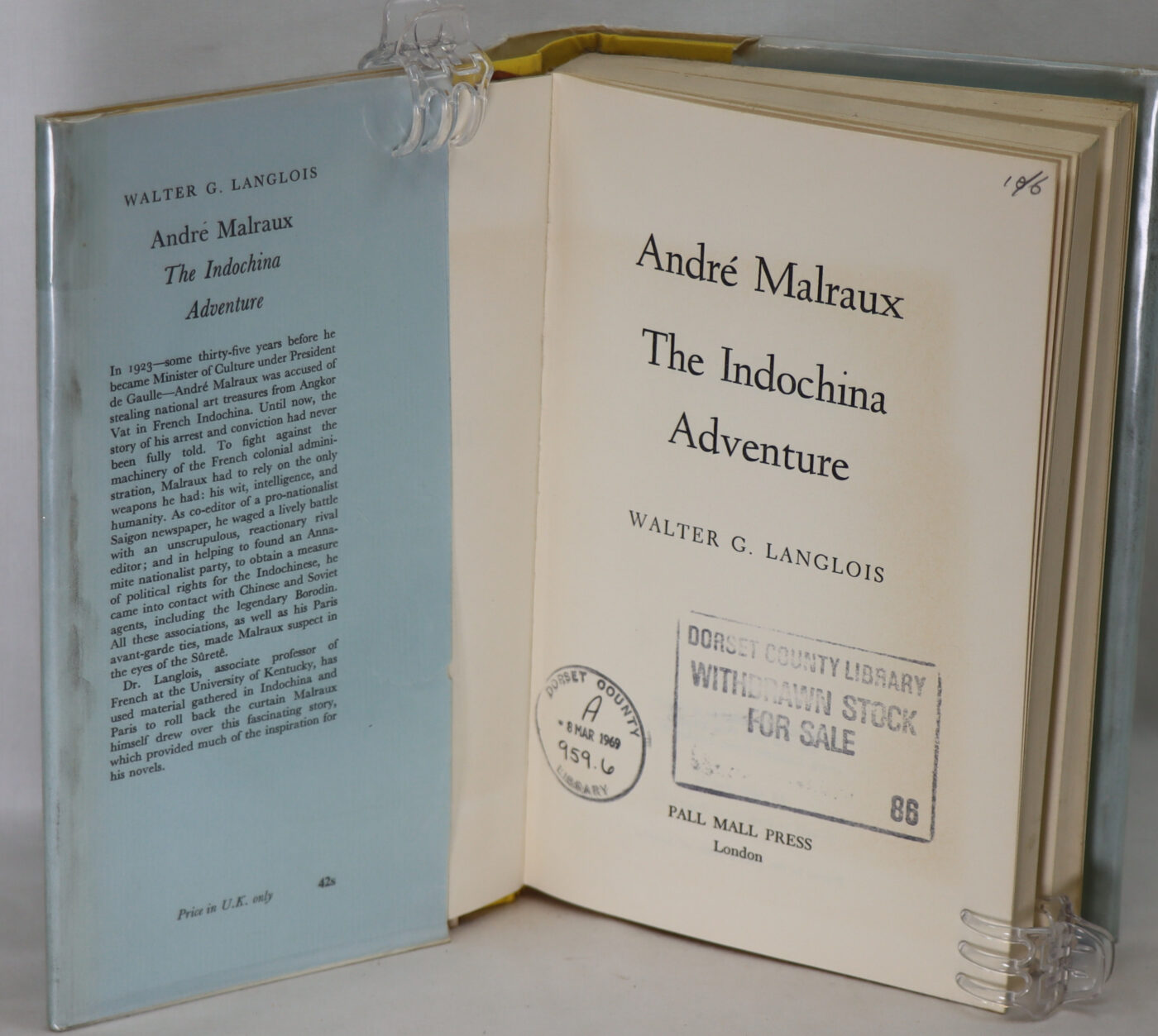
The Indochina Adventure.
By Andre Malraux
Printed: 1966
Publisher: Pall Mall Press. London
| Dimensions | 24 × 31 × 3 cm |
|---|---|
| Language |
Language: English
Size (cminches): 24 x 31 x 3
Condition: Good (See explanation of ratings)
£22.00
Buy Now
Your items


Item information
Description
In the original dust jacket. Yellow cloth binding.
We provide an in-depth photographic presentation of this item to stimulate your feeling and touch. More traditional book descriptions are immediately available
- Note: This book carries a £5.00 discount to those that subscribe to the F.B.A. mailing list
For conditions, please view the photographs. In 1923, aged 22, Malraux and Clara left for the French Protectorate of Cambodia. Angkor Wat is a huge 12th century temple situated in the old capital of the Khmer Empire. Angkor (Yasodharapura) was “the world’s largest urban settlement” in the 11th and 12th centuries supported by an elaborate network of canals and roads across mainland Southeast Asia before decaying and falling into the jungle. The discovery of the ruins of Angkor Wat by Westerners (the Khmers had never fully abandoned the temples of Angkor) in the jungle by the French explorer Henri Mouhot in 1861 had given Cambodia a romantic reputation in France, as the home of the vast, mysterious ruins of the Khmer empire. Upon reaching Cambodia, Malraux, Clara and friend Louis Chevasson undertook an expedition into unexplored areas of the former imperial settlements in search of hidden temples, hoping to find artifacts and items that could be sold to art collectors and museums. At about the same time archaeologists, with the approval of the French government, were removing large numbers of items from Angkor – many of which are now housed in the Guimet Museum in Paris. On his return, Malraux was arrested and charged by French colonial authorities for removing a bas-relief from the exquisite Banteay Srei temple. Although he was guilty, his arrest and imprisonment were deemed inappropriate – for the crime was of no consequence. Clara, his wife, started a campaign for his acquittal and a number of notable arts and literary figures signed a petition defending Malraux: among them were François Mauriac, André Breton and André Gide. Malraux had his sentence reduced to a year, and then suspended.
Malraux’s experiences in Indochina led him to become highly critical of the French colonial authorities there. In 1925, with Paul Monin, a progressive lawyer, he helped to organize the Young Annam League and founded a newspaper L’Indochine to champion Vietnamese independence. After falling foul of the French authorities, Malraux claimed to have crossed over to China where he was involved with the Kuomintang and their then allies, the Chinese Communists, in their struggle against the warlords in the Great Northern Expedition before they turned on each other in 1927, which marked the beginning of the Chinese Civil War that was to last on and off until 1949. In fact, Malraux did not first visit China until 1931 and he did not see the bloody suppression of the Chinese Communists by the Kuomintang in 1927 first-hand as he often implied that he did, although he did do much reading on the subject.
Georges André Malraux (3 November 1901 – 23 November 1976) was a French novelist, member of the French Resistance, art theorist, and minister of cultural affairs. Malraux’s novel La Condition Humaine (Man’s Fate) (1933) won the Prix Goncourt. He was appointed by President Charles de Gaulle as information minister (1945–46) and subsequently as France’s first cultural affairs minister during de Gaulle’s presidency (1959–1969).
Condition notes
Ex library
Want to know more about this item?
We are happy to answer any questions you may have about this item. In addition, it is also possible to request more photographs if there is something specific you want illustrated.
Ask a question
Related products
Share this Page with a friend
