
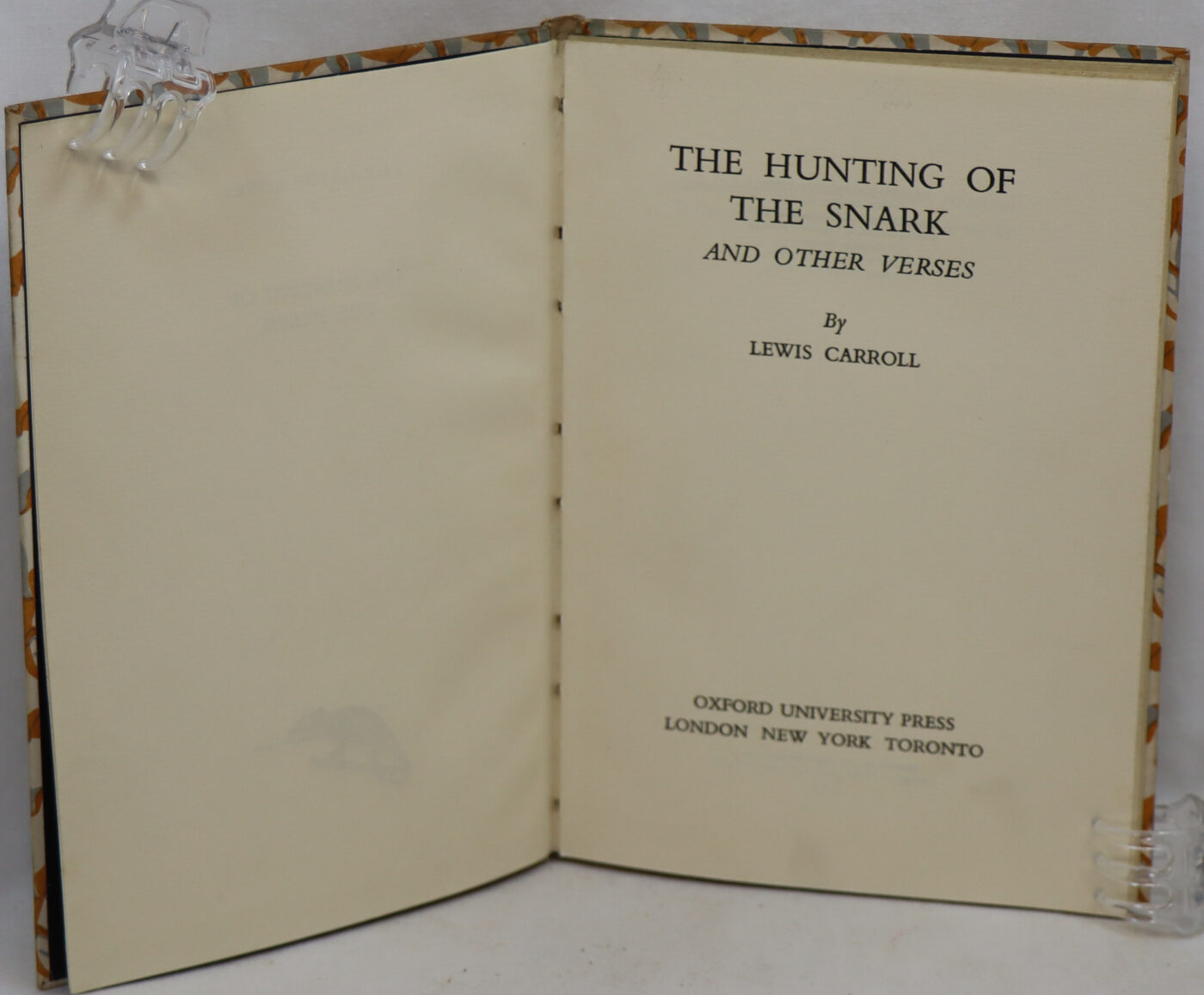
The Hunting of the Snark & Other Lewis Carroll Verses.
By Lewis Carroll
Printed: 1939
Publisher: Oxford University Press.
Edition: First edition
| Dimensions | 13 × 19 × 0.5 cm |
|---|---|
| Language |
Language: English
Size (cminches): 13 x 19 x 0.5
Condition: Very good (See explanation of ratings)
£45.00
Buy Now

Item information
Description
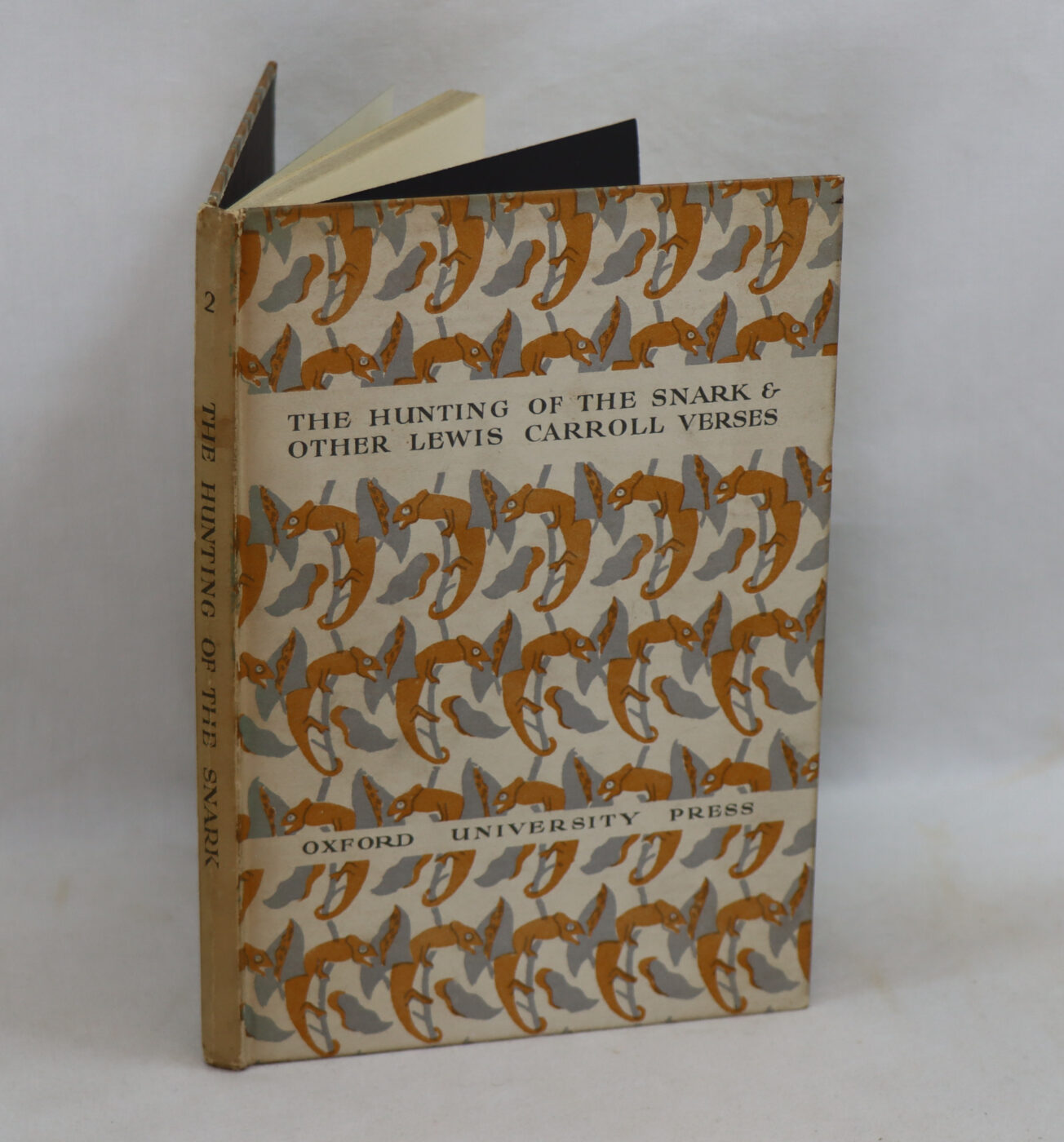
Paperback. Orange patterned cover with black title.
Empathy: NICE: This is a ‘lovely heart warming’ book.
Please view the photographs
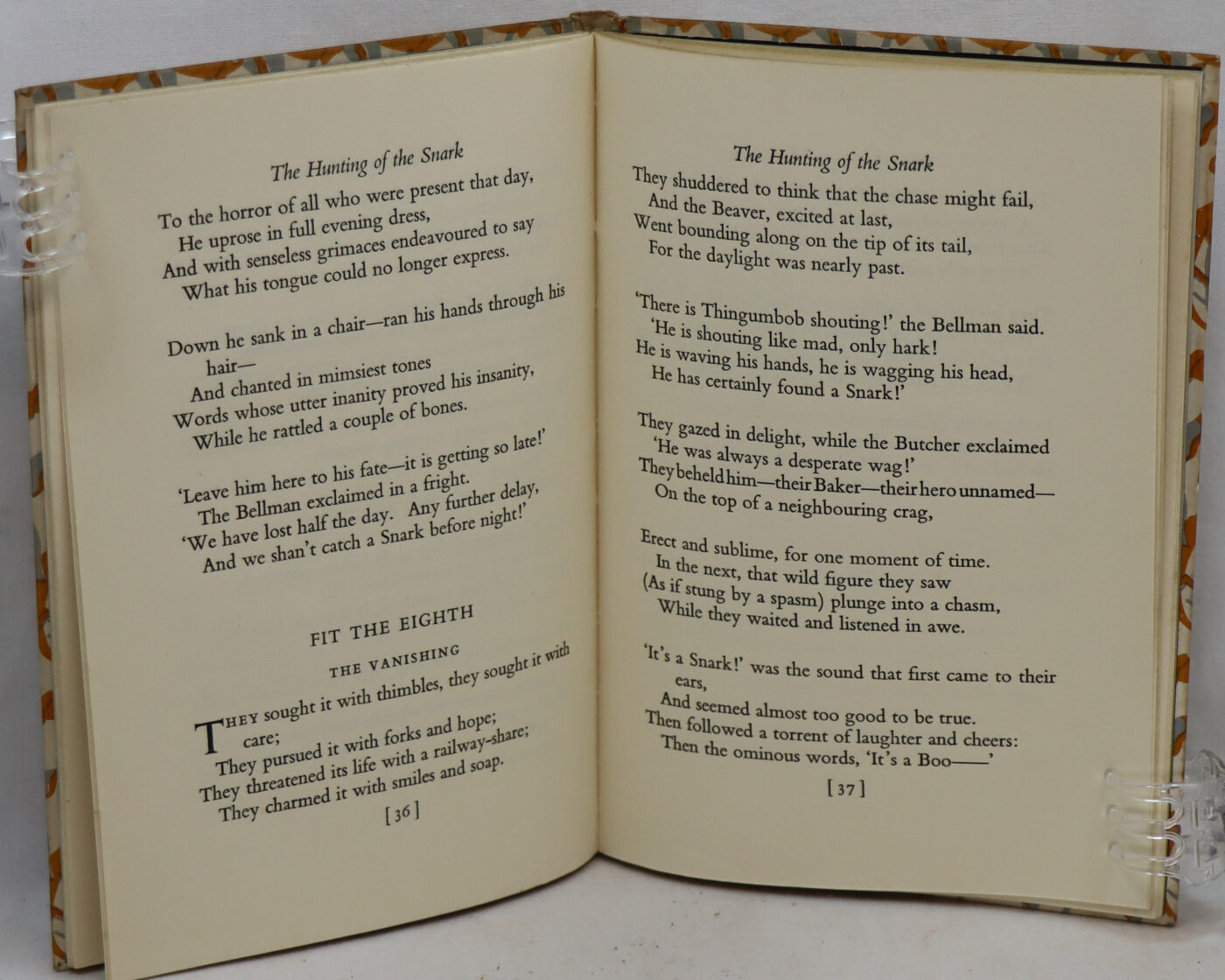
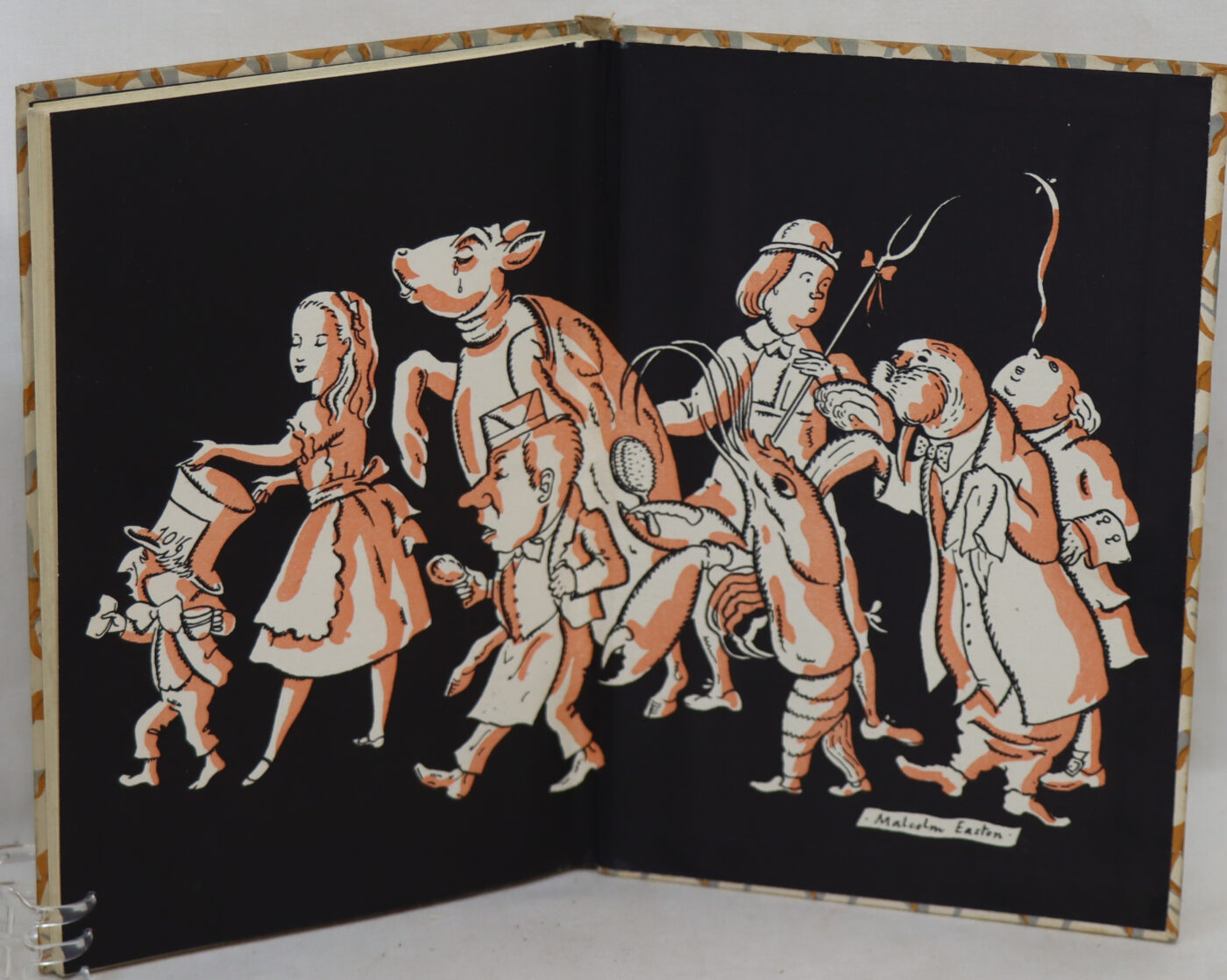
Hardcover. No Dust Jacket: Very Good. 1st Edition. True first British printing of this edition, 1939. The second title in ‘The Chameleon Series’ of books. In addition to ‘The Hunting of the Snark’, this book contains all the original verse from the ‘Alice’ books, and also the ‘I Thought I Saw’ poems from Sylvie and Bruno. Pages are generally clean and the binding is tight.
The Hunting of the Snark, subtitled An Agony, in Eight Fits, is a poem by the English writer Lewis Carroll. It is typically categorised as a nonsense poem. Written between 1874 and 1876, it borrows the setting, some creatures, and eight portmanteau words from Carroll’s earlier poem “Jabberwocky” in his children’s novel Through the Looking-Glass (1871). Macmillan published The Hunting of the Snark in the United Kingdom at the end of March 1876, with nine illustrations by Henry Holiday. It had mixed reviews from reviewers, who found it strange. The first printing of the poem consisted of 10,000 copies. There were two reprints by the end of the year; in total, the poem was reprinted 17 times between 1876 and 1908. The poem also has been adapted for musicals, movies, opera, plays, and music. The narrative follows a crew of ten trying to hunt the Snark, a creature which may turn out to be a highly dangerous Boojum. The only crew member to find the Snark quietly vanishes, leading the narrator to explain that the Snark was a Boojum after all.
Carroll dedicated the poem to young Gertrude Chataway, whom he met in the English seaside town Sandown on the Isle of Wight in 1875. Included with many copies of the first edition of the poem was Carroll’s religious tract, An Easter Greeting to Every Child Who Loves “Alice”.Various meanings in the poem have been proposed, among them existential angst, an allegory for tuberculosis, and a mockery of the Tichborne case. While Carroll denied knowing the meaning behind the poem, he agreed in an 1897 reply to a reader’s letter with an interpretation of the poem as an allegory for the pursuit of happiness. Henry Holiday, the illustrator of the poem, considered the poem a “tragedy”.
Charles Lutwidge Dodgson (27 January 1832 – 14 January 1898), better known by his pen name Lewis Carroll, was an English author, poet, mathematician, photographer and reluctant Anglican deacon. His most notable works are Alice’s Adventures in Wonderland (1865) and its sequel Through the Looking-Glass (1871), some of the most important examples of Victorian literature. He was noted for his facility with word play, logic, and fantasy. His poems Jabberwocky (1871) and The Hunting of the Snark (1876) are classified in the genre of literary nonsense. Some of Alice’s nonsensical wonderland logic reflects his published work on mathematical logic. Carroll came from a family of high-church Anglicans and pursued his clerical training at Christ Church, Oxford, where he lived for most of his life as a scholar, teacher and (necessarily for his academic fellowship at the time) Anglican deacon. Alice Liddell – a daughter of Henry Liddell, the Dean of Christ Church – is widely identified as the original inspiration for Alice in Wonderland, although Carroll always denied this.
An avid puzzler, Carroll created the word ladder puzzle, which he called “Doublets”, which was published in Vanity Fair magazine between 1879 and 1881. In 1982 a memorial stone to Carroll was unveiled at Poets’ Corner in Westminster Abbey. There are societies in many parts of the world dedicated to the enjoyment and promotion of his works.
Want to know more about this item?
We are happy to answer any questions you may have about this item. In addition, it is also possible to request more photographs if there is something specific you want illustrated.
Ask a question
Related products
Share this Page with a friend
