
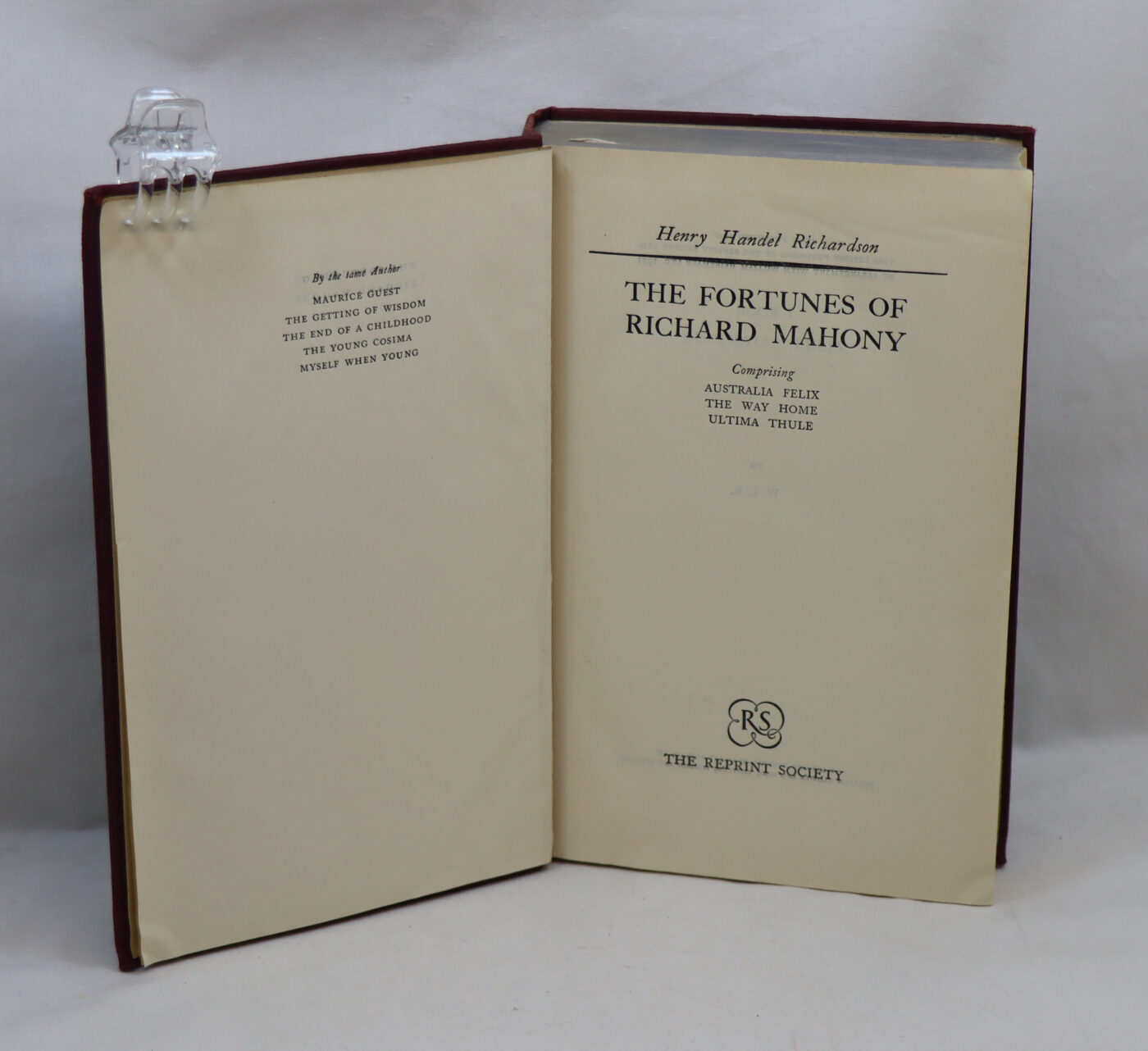
The Fortunes of Richard Mahony.
By Henry Handel Richardson
Printed: 1954
Publisher: The Reprint Society. London
| Dimensions | 16 × 22 × 3 cm |
|---|---|
| Language |
Language: English
Size (cminches): 16 x 22 x 3
Condition: Good (See explanation of ratings)
£34.00
Buy Now

Item information
Description
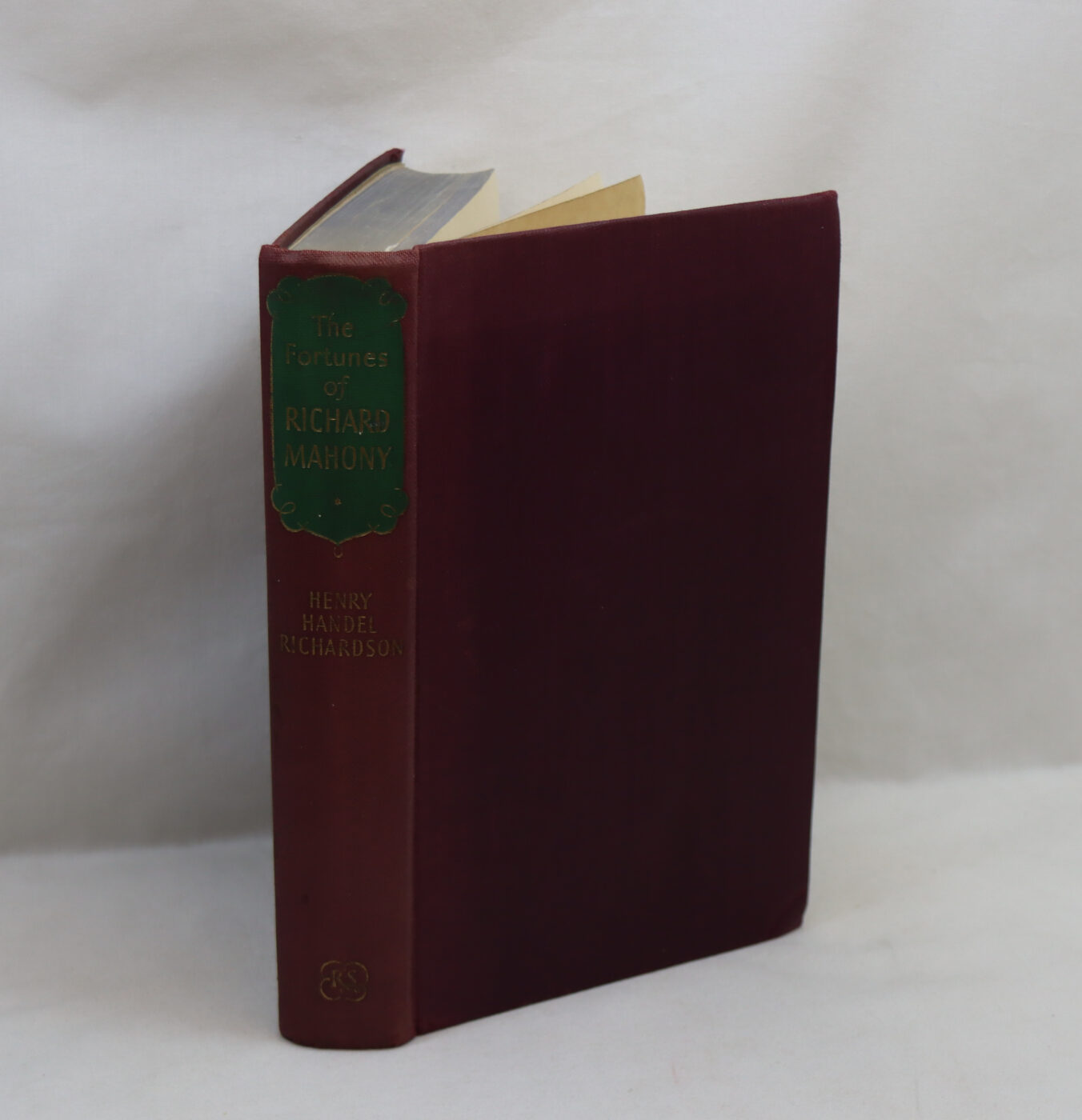
Maroon cloth binding with green title plate and gilt title on the spine.
We provide an in-depth photographic presentation of this item to stimulate your feeling and touch. More traditional book descriptions are immediately available
- Note: This book carries a £5.00 discount to those that subscribe to the F.B.A. mailing list
For conditions, please view our photographs. A nice clean reprint of the original book from the library gathered by the famous Cambridge Don, computer scientist, food and wine connoisseur, Jack Arnold LANG.
The Fortunes of Richard Mahony, by Henry Handel Richardson, is a celebrated Australian novel (actually a trilogy: Australia Felix, The Way Home, Ultima Thule) about an Irish doctor’s ambitious rise and tragic decline during Australia’s 19th-century gold rush, exploring themes of migration, materialism, and family struggle, based loosely on Richardson’s own father, and published in a collected edition by The Reprint Society in 1954.
Key Aspects of the Novel
-
Epic Scope: A sweeping narrative chronicling a family’s fortunes and misfortunes in colonial Australia, notes this Amazon UK review.
-
Real-Life Basis: The story draws from the experiences of Henry Handel Richardson’s father, a doctor who experienced both success and decline.
-
Themes: Explores the migrant experience, the clash of cultures, personal dissatisfaction, the allure and pitfalls of wealth, and the impact of materialism on family life.
-
Themes: Explores the migrant experience, the clash of cultures, personal dissatisfaction, the allure and pitfalls of wealth, and the impact of materialism on family life.
Literary Significance: Considered a masterpiece and a cornerstone of Australian literature, often called the “Great Australian Novel” by critics.
Ethel Florence Lindesay Richardson (3 January 1870 – 20 March 1946), known by her pen name Henry Handel Richardson, was an Australian author. The Fortunes of Richard Mahony is Richardson’s famous trilogy about the slow decline, owing to character flaws and an unnamed brain disease, of a successful Australian physician and businessman and the emotional/financial effect on his family. It was highly praised by Sinclair Lewis, among others, and was inspired by Richardson’s own family experiences. The central characters were based loosely on her own parents. Richardson also produced a single volume of short stories and an autobiography that greatly illuminates the settings of her novels, although her Australian Dictionary of Biography entry doubts that it is reliable.
Want to know more about this item?
We are happy to answer any questions you may have about this item. In addition, it is also possible to request more photographs if there is something specific you want illustrated.
Ask a question
Related products



Share this Page with a friend
