
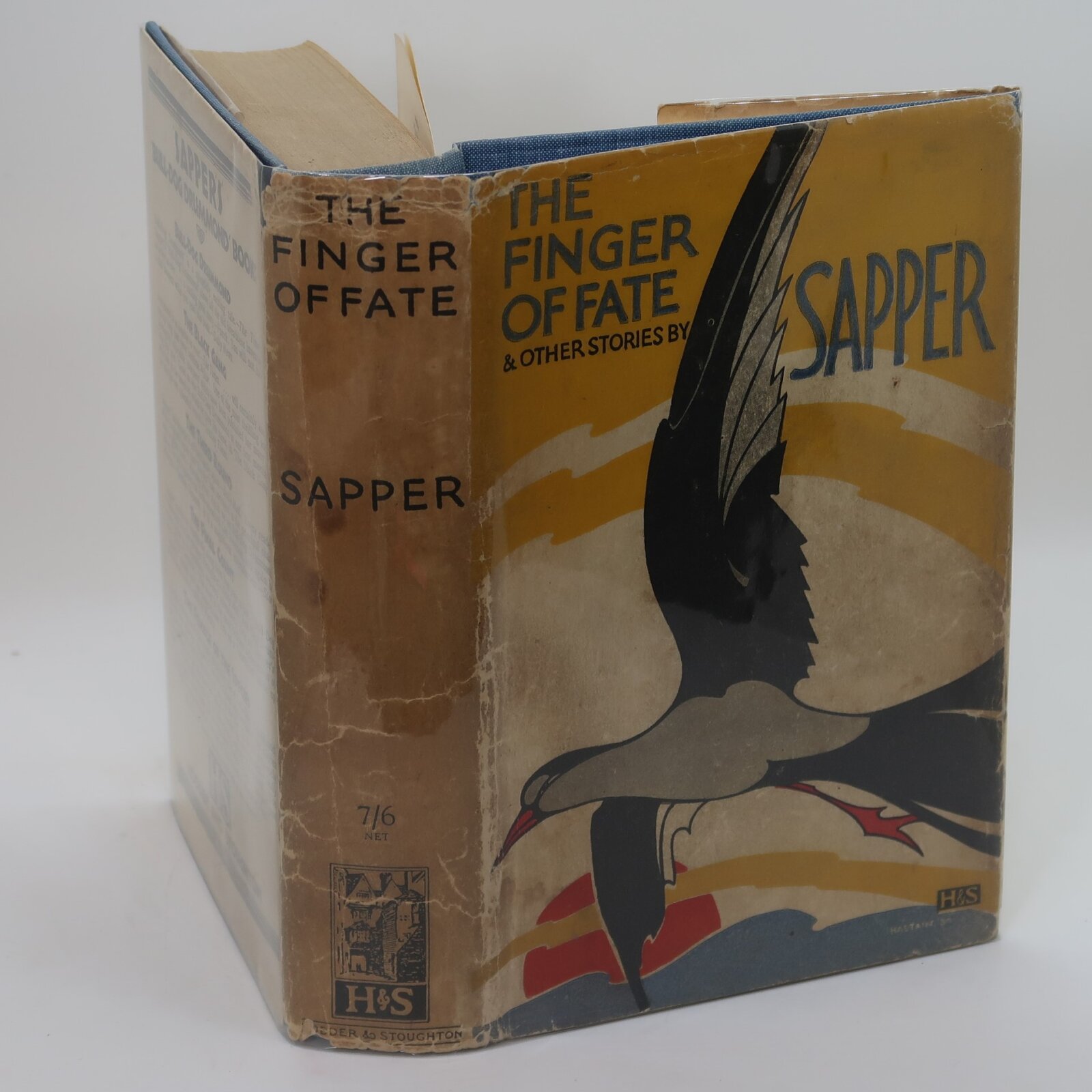
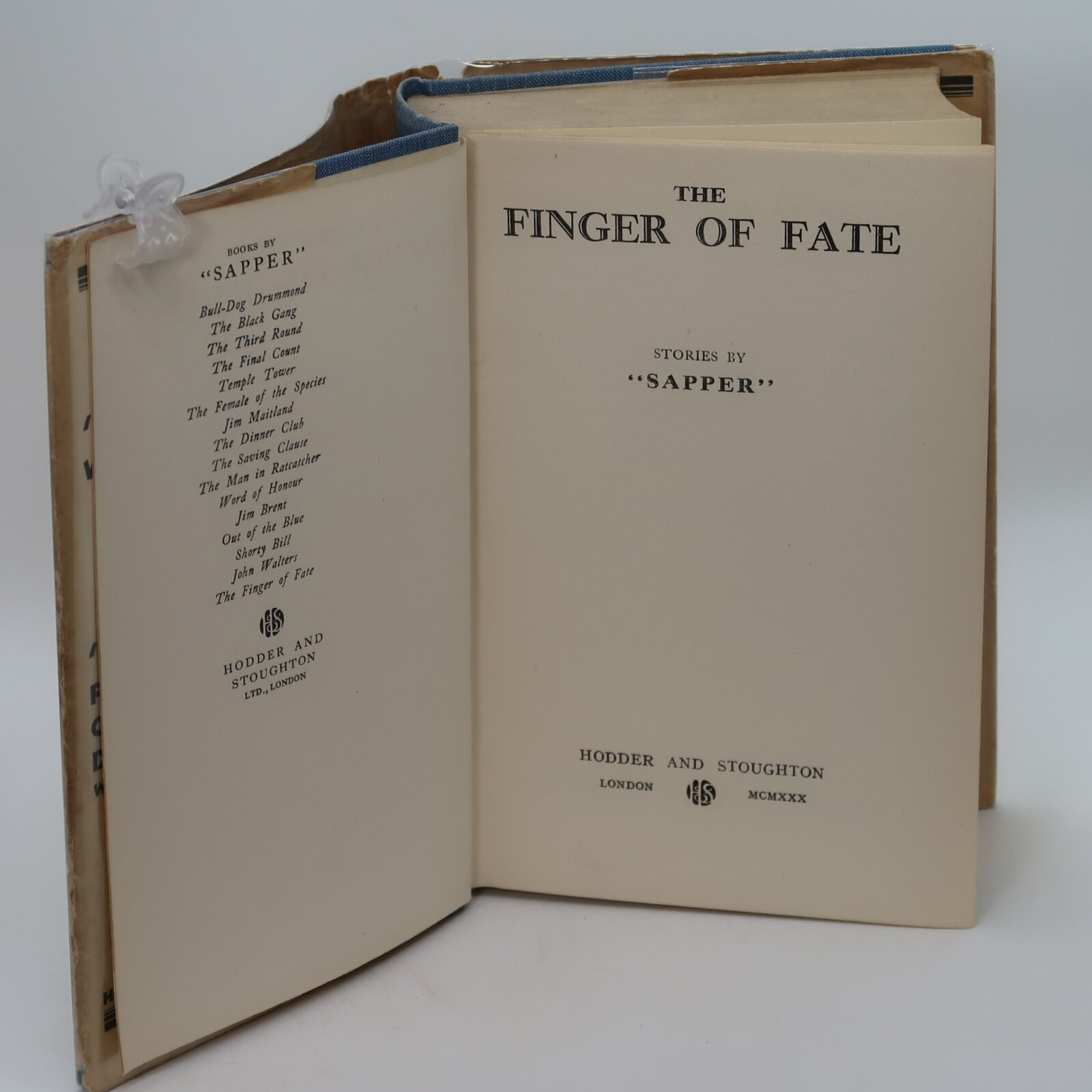
The Finger of Fate. Sapper.
By Sapper
Printed: 1930
Publisher: Hodder & Stroughton. London
Edition: first edition
| Dimensions | 14 × 20 × 4 cm |
|---|---|
| Language |
Language: English
Size (cminches): 14 x 20 x 4
Condition: Fine (See explanation of ratings)
£318.00
FREE shipping
Buy Now

Item information
Description
In original dust sheet.
FIRST EDITION 1930 Sapper
Herman Cyril McNeile, MC (28 September 1888 – 14 August 1937), commonly known as Cyril McNeile and publishing under the name H. C. McNeile or the pseudonym Sapper, was a British soldier and author. Drawing on his experiences in the trenches during the First World War, he started writing short stories and getting them published in the Daily Mail. As serving officers in the British Army were not permitted to publish under their own names, he was given the pen name “Sapper” by Lord Northcliffe, the owner of the Daily Mail; the nickname was based on that of his corps, the Royal Engineers.
After the war McNeile left the army and continued writing, although he changed from war stories to thrillers. In 1920 he published Bulldog Drummond, whose eponymous hero became his best-known creation. The character was based on McNeile himself, on his friend Gerard Fairlie and on English gentlemen generally. McNeile wrote ten Bulldog Drummond novels, as well as three plays and a screenplay.
McNeile interspersed his Drummond work with other novels and story collections that included two characters who appeared as protagonists in their own works, Jim Maitland and Ronald Standish. He was one of the most successful British popular authors of the inter-war period before his death in 1937 from throat cancer, which has been attributed to damage sustained from a gas attack in the war.
McNeile’s stories are either directly about the war or contain people whose lives have been shaped by it. His thrillers are a continuation of his war stories, with upper class Englishmen defending England from foreigners plotting against it. Although he was seen at the time as “simply an upstanding Tory who spoke for many of his countrymen”, after the Second World War his work was criticised as having fascist overtones, while also displaying the xenophobia and anti-semitism apparent in some other writers of the period.
Want to know more about this item?
We are happy to answer any questions you may have about this item. In addition, it is also possible to request more photographs if there is something specific you want illustrated.
Ask a question
Related products



Share this Page with a friend
