
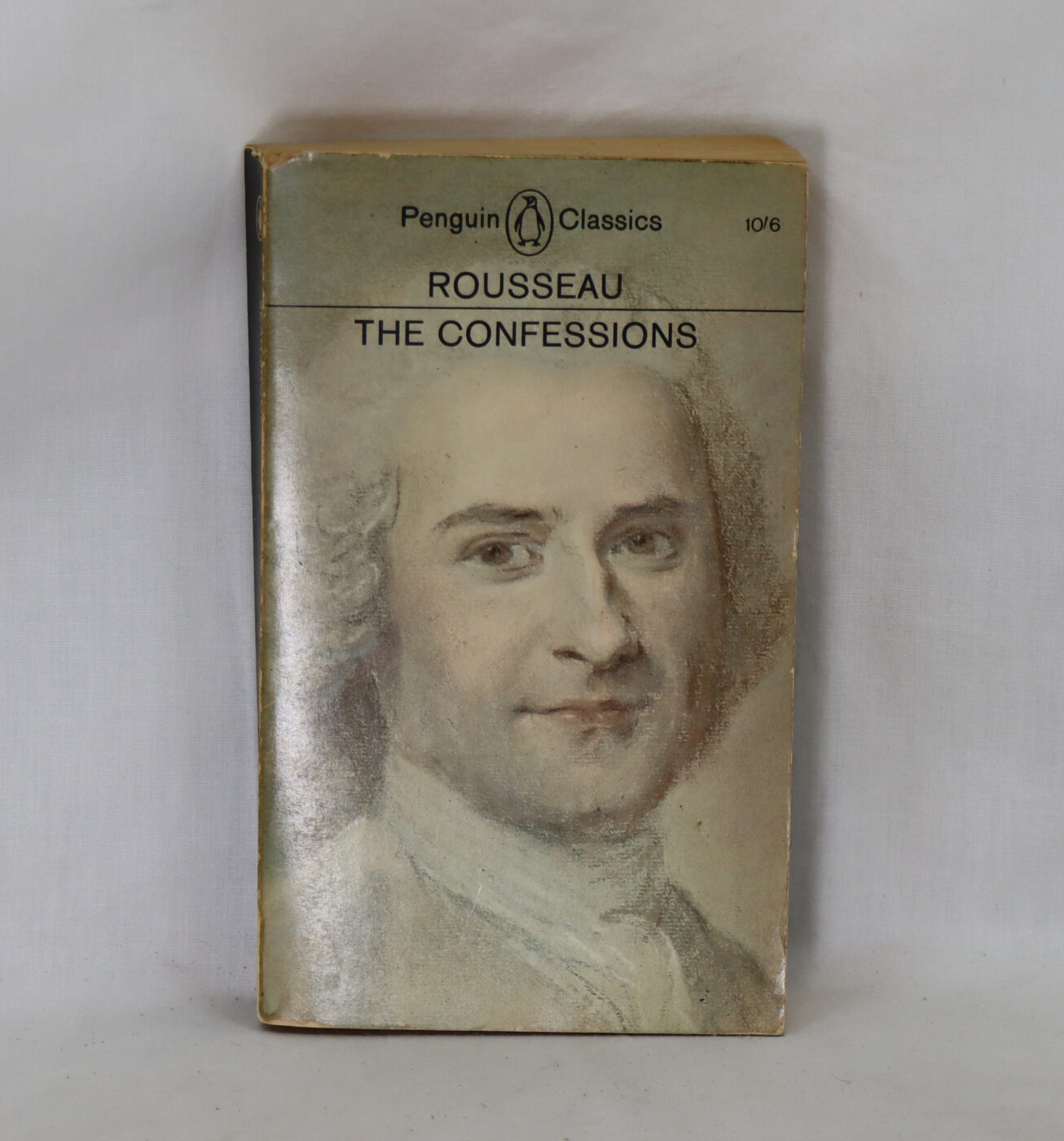
The Confessions.
By Jean-Jacques Rousseau
Printed: 1967
Publisher: Penquin Books. London
| Dimensions | 11 × 18 × 2 cm |
|---|---|
| Language |
Language: English
Size (cminches): 11 x 18 x 2
Condition: Fair (See explanation of ratings)
£7.00
Buy Now
Item information
Description
Paperback. Black cover with white title.
We provide an in-depth photographic presentation of this item to stimulate your feeling and touch. More traditional book descriptions are immediately available
A FROST PAPERBACK is a loved book which a member of the Frost family has checked for condition, cleanliness, completeness and readability. When the buyer collects their book, the delivery charge of £3.00 is not made
Widely regarded as the first modern autobiography, The Confessions is an astonishing work of acute psychological insight. Jean-Jacques Rousseau (1712-78) argued passionately against the inequality he believed to be intrinsic to civilized society. In his Confessions he relives the first fifty-three years of his radical life with vivid immediacy – from his earliest years, where we can see the source of his belief in the innocence of childhood, through the development of his philosophical and political ideas, his struggle against the French authorities and exile from France following the publication of Émile. Depicting a life of adventure, persecution, paranoia, and brilliant achievement, The Confessions is a landmark work by one of the greatest thinkers of the Enlightenment, which was a direct influence upon the work of Proust, Goethe and Tolstoy among others.
Review: In his posthumously published Confessions Jean-Jacques Rousseau (1712-78) describes the first fifty-three years of his life. With a frankness at times almost disconcerting, but always refreshing, he set out to reveal the whole truth about himself to the world and succeeded in producing a masterpiece which has left its indelible imprint on the literature of successive generations, influencing among others Proust, Goethe and Tolstoy.
Jean-Jacques Rousseau was born in Geneva in 1712. Abandoned by his father at the age of ten, he left the city in 1728 and from then on wandered Europe, searching for happiness. In 1732 he settled for eight years at Les Charmettes, remembered in his book Confessions. In 1741 he moved to Paris where he met Diderot, in the meantime fathering five children, all of whom he abandoned. His crowning achievement is his work of political philosophy, The Social Contract, which was published in 1762. He died in 1778.
Want to know more about this item?
We are happy to answer any questions you may have about this item. In addition, it is also possible to request more photographs if there is something specific you want illustrated.
Ask a question
Related products

Share this Page with a friend
