
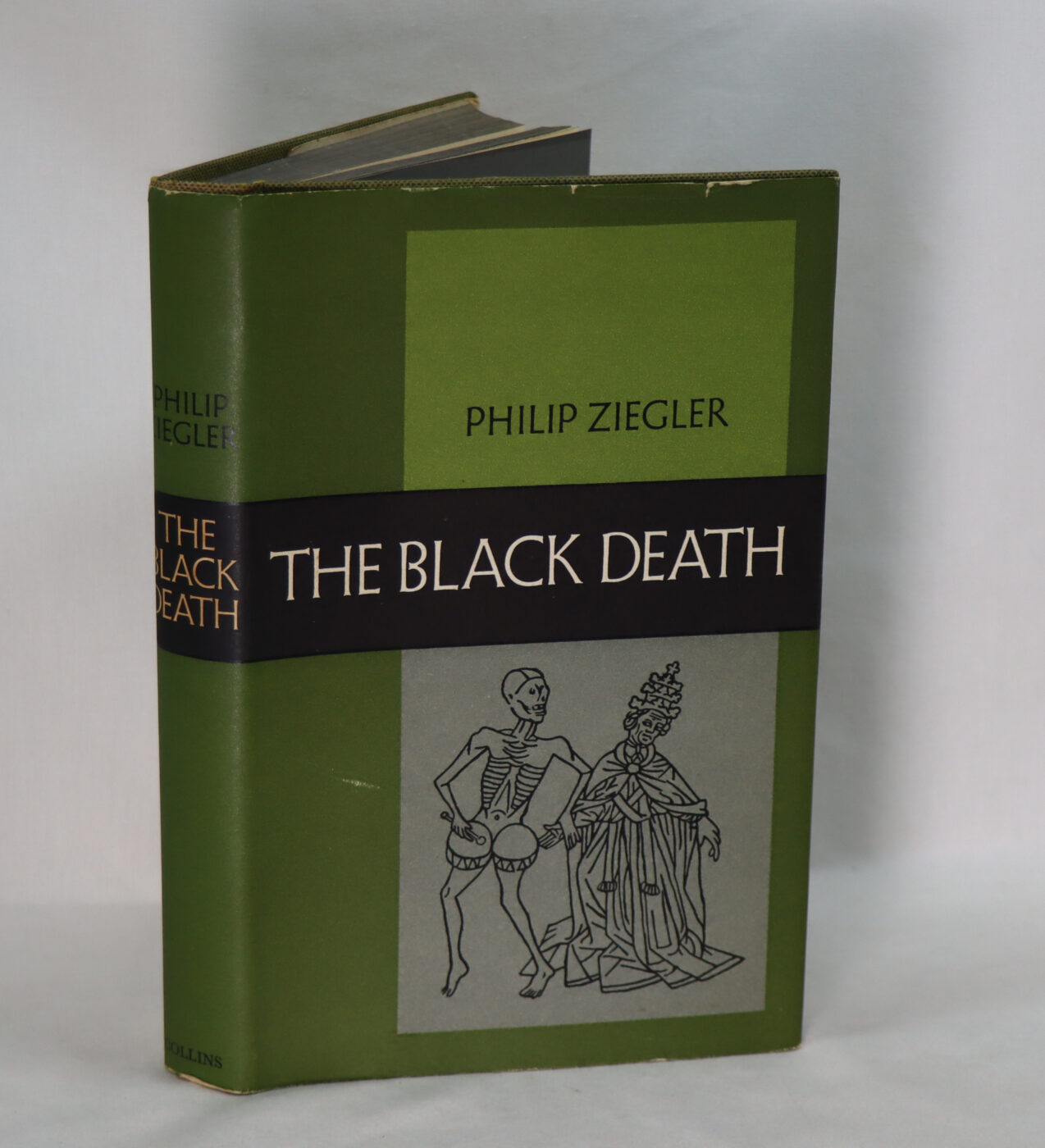
The Black Death.
By Philip Ziegler
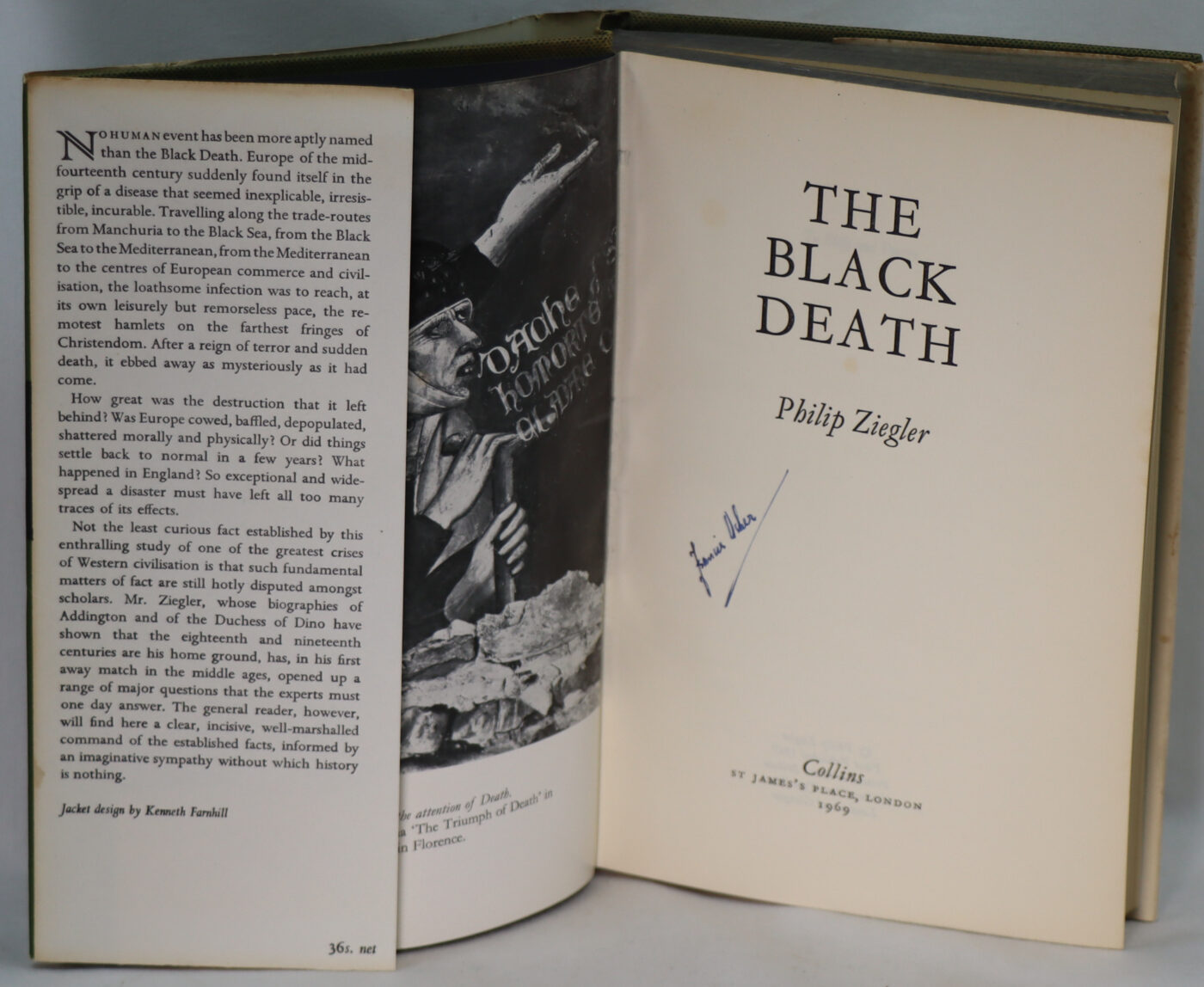
Printed: 1969
Publisher: Collins. London
| Dimensions | 15 × 22 × 3 cm |
|---|---|
| Language |
Language: English
Size (cminches): 15 x 22 x 3
Condition: Very good (See explanation of ratings)
£17.00
Buy Now

Item information
Description
In the original dust jacket. Green cloth binding with gilt title on the spine.
We provide an in-depth photographic presentation of this item to stimulate your feeling and touch. More traditional book descriptions are immediately available
-
Note: This book carries a £5.00 discount to those that subscribe to the F.B.A. mailing list
Please view the photographs: A well kept edition.
A series of natural disasters in the Orient during the fourteenth century brought about the most devastating period of death and destruction in European history. The epidemic killed one-third of Europe’s people over a period of three years, and the resulting social and economic upheaval was on a scale unparalleled in all of recorded history. Synthesizing the records of contemporary chroniclers and the work of later historians, Philip Ziegler offers a critically acclaimed overview of this crucial epoch in a single masterly volume. The Black Death vividly and comprehensively brings to light the full horror of this uniquely catastrophic event that hastened the disintegration of an age.
Reviews:
-
“Fascinating. . . . There’s nothing like reading about people being entombed to put your own problems in perspective.” — Bill Bryson
-
“As exciting and readable an account as you could wish.” — The Guardian
-
“The clarity and restraint on every page produce a most potent cumulative effect.” — Michael Foot, Evening Standard
-
“A welcome and much needed synthesis. . . . Ziegler writes in a precise and judicious style…illuminating his readers with the full impact of the plague.” — Choice
-
A series of natural disasters in the Orient during the fourteenth century brought about the most devastating period of death and destruction in European history. The epidemic killed one-third of Europe’s people over a period of three years, and the resulting social and economic upheaval was on a scale unparalleled in all of recorded history. Synthesizing the records of contemporary chroniclers and the work of later historians, Philip Ziegler offers a critically acclaimed overview of this crucial epoch in a single masterly volume. The Black Death vividly and comprehensively brings to light the full horror of this uniquely catastrophic event that hastened the disintegration of an age.
-
This book is getting on for fifty years old now, and I fear it’s starting to show. As a single-volume, pan-European introduction to the Black Death of the fourteenth century it is still admirably worthy of praise, but the years do tell. Some of the language and attitude, some of the pro-English, almost imperialist asides, the Anglo-centric focus, all definitely date it. But as I said, it still has its place in the Plague literature – and the Anglo-centric focus is excusable given the embarrassment of riches this country possesses in the way of surviving medieval archives comparable to countries on the continent. Philip Ziegler is a biographer, not a medievalist, as himself states from the outset – but for a non-historian, for the general interested reader, that is not necessarily a bad thing. Historians will look for facts and figures, statistical analysis, thematic breakdowns – the average reader prefers narrative and human interest. Luckily both are present here. Ziegler takes a relatively chronological approach, tracing the spread of the Black Death from its roots somewhere in Asia, through the Mediterranean and on into continental Europe, focusing particularly on Italy, Germany, France, and most particularly on England. In fact, once the chapters on the former countries are dealt with the rest of the book is exclusively on England; and the concluding chapters analysing how much of a role the Black Death played in the collapse of the feudal system and the Peasants Revolt makes no mention of the situation in Europe at all. And that arguably is my main criticism of this book – but perhaps it is an unfair one. I recognise that England possesses a great wealth of medieval records, a result of our lack of invasion and disruption over the years and also a testament to the love of record-keeping and bureaucracy that clearly runs deep in our roots. But any book purporting to be a history of the Black Death, rather than a history of the Black Death in England, needs more than just a single chapter each on a handful of European countries and scarcely a page or two on Scotland, Wales and Ireland. So I’m not entirely sure, as good and as readable as it was, I could recommend this now, so many years on. It has been overtaken in the years since by other books with both a narrower, purely English focus, or a wider global approach.
Philip Ziegler was educated at Eton and New College, Oxford. A former member of the diplomatic service, he has written biographies of King William IV, Lord Melbourne, Lady Diana Cooper, Lord Mountbatten, King Edward VIII, Harold Wilson, and Osbert Sitwell. His most recent book is Legacy: Cecil Rhodes, the Rhodes Trust and Rhodes Scholarships. He is at work on the official biography of Prime Minister Edward Heath. Mr. Ziegler lives with his wife in Kensington, London.
Want to know more about this item?
We are happy to answer any questions you may have about this item. In addition, it is also possible to request more photographs if there is something specific you want illustrated.
Ask a question
Related products

Share this Page with a friend
