
The Battle of Britain.
ISBN: 9780393322972
Printed: 2022
Publisher: Enthralling History.
| Dimensions | 16 × 23 × 1 cm |
|---|---|
| Language |
Language: English
Size (cminches): 16 x 23 x 1
Condition: As new (See explanation of ratings)
£10.00
Buy Now
Your items


Item information
Description
Paperback. Brown cover with tan title.
We provide an in-depth photographic presentation of this item to stimulate your feeling and touch. More traditional book descriptions are immediately available.
- A £2 reduction when collected from FBA shop
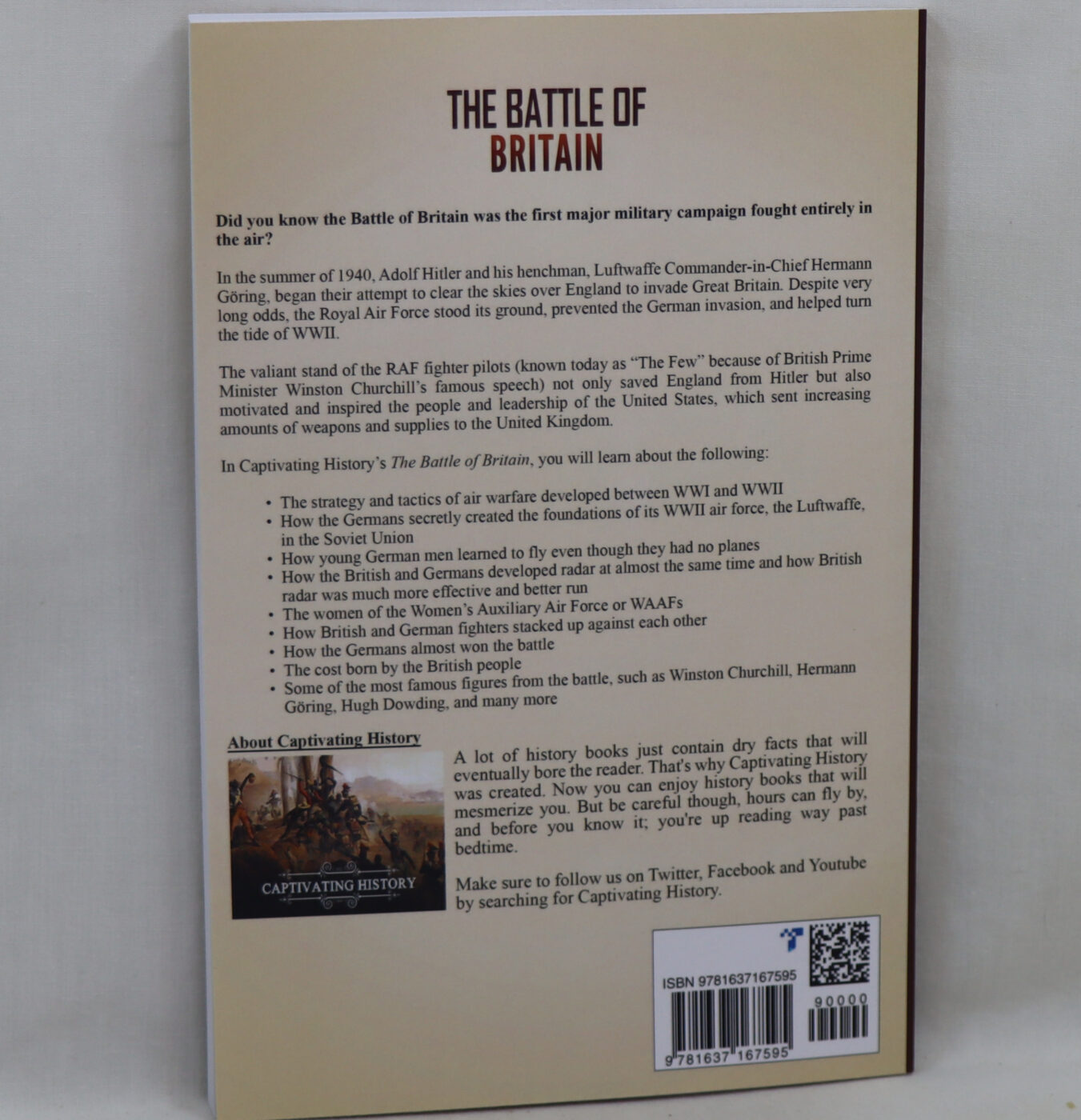
The Battle of Britain: The Myth and the Reality
“A concise, penetrating account….This stirring book inspires an admiration for British courage.”―New York Times Book Review
The Battle of Britain pitted the Hurricanes and Spitfires of the Royal Air Force against the Messerschmitts of Hitler’s Luftwaffe in the skies over England in 1940. It was immortalized in Churchill’s words, “Never in the field of human conflict was so much owed by so many to so few,” but it has since been debunked by revisionists as an inconclusive and even strategically flawed encounter for the British. In this assessment of the battle, Richard Overy restores the historical balance. He delivers shrewd judgments on the critical elements for both sides, from strategy to leadership, command organization, communications, and training to the technology of fighters, bombers, and radar. Overy shows that even if the popular myth overshoots the mark, the significance of the battle remains undiminished in the light of realistic judgments. A necessary battle, it marked the end of Germany’s string of victories, forestalled a German invasion, and kept Britain in the war. Tables and maps.
Review: One of the most controversial and yet simply disarming facts about the short-lived but furiously fought air battle over the skies of England in the summer and early fall of 1940 , according to famed British historian Richard Overy in this diverting and captivating study of the now-fabled Battle Of Britain is that it was in reality not so much the marvelous and unequivocal victory as it is now regarded much as it was a stalemate. A wondrous, unlikely and fateful stalemate, to be sure, one on which the future of the so-called free world hung in the balance, but in reality it was also much more a war of perceptions and brinksmanship than has been commonly acknowledged or understood.
In fact, according to Overy, the air battle over Britain was never likely to have been followed by a Nazi invasion force, for the German forces lacked all the necessary marine transportation and logistics support to prosecute such an attempt to invade Britain. As William Shirer pointed out long ago in “The Rise And Fall Of The Third Reich”, Hitler never had much stomach for a cross-channel invasion, and the German General Staff never ordered all the necessary shipbuilding needed to mount a serious invasion attempt. In addition, the forces of the British realm were never so badly outnumbered as was previously believed, and the Royal Air Force (RAF) in fact had superior fighters and better logistics support that did their German opponents, not to mention the limited battle time for German pilots who had to ferry themselves back over the channel after doing battle, which provided the RAF with a key tactical advantage.
Yet Overy’s purpose here is clearly not intended to denigrate or downplay the outright heroism, courage, and sacrifice of the RAF in its service to the English people over the skies of Britain that fateful year, but rather to celebrate the actual, fact-based history of those fateful events. Here in the Battle of Britain we find the first signs that the famed “unstoppable” Nazi juggernaut was not infallible, that it could be met on its own terms and defeated, plane by plane, raid by raid, and campaign by campaign, and denied its aggressive objectives by a determined and resourceful opponent. Also, by denying the Nazis the complete victory over its western European rivals it desired, the British forced Hitler into making a fatal blunder by opening up a two-front war with the invasion of the Soviet Union the next spring, forcing him to leave millions of troops along the western wall he could have otherwise used against the Russians in Operation Barbarossa.
Also, as Overy illustrates so convincingly, the British actions in the skies over their homeland convinced many in the American Government to take up Britain’s cause, and this too had fateful consequences for the eventual outcome of the war. Finally, he argues that the consequences of turning back the attempts by the Nazis to gain air superiority over the skies of Britain galvanized and energized the British people with a new sense of vigor and purpose, and this was tremendously important in helping them to stay the course during a very difficult and trying period of time following the end of the battle of Britain itself. This is a great addition to the volumes of material already available on the Battle Of Britain, and presents the facts in a new and interesting way that makes it an important work which acts to clarify and modify what we already know about the events of 1940. I recommend this book, and hope you enjoy it as much as I did.
Richard Overy is the author of many outstanding histories of World War II, including Rain of Ruin: Tokyo, Hiroshima, and the Surrender of Japan. His study of Hitler and Stalin, The Dictators, won the Wolfson History Prize. He lives in England and Italy.
Want to know more about this item?
We are happy to answer any questions you may have about this item. In addition, it is also possible to request more photographs if there is something specific you want illustrated.
Ask a question
Related products






Share this Page with a friend
