
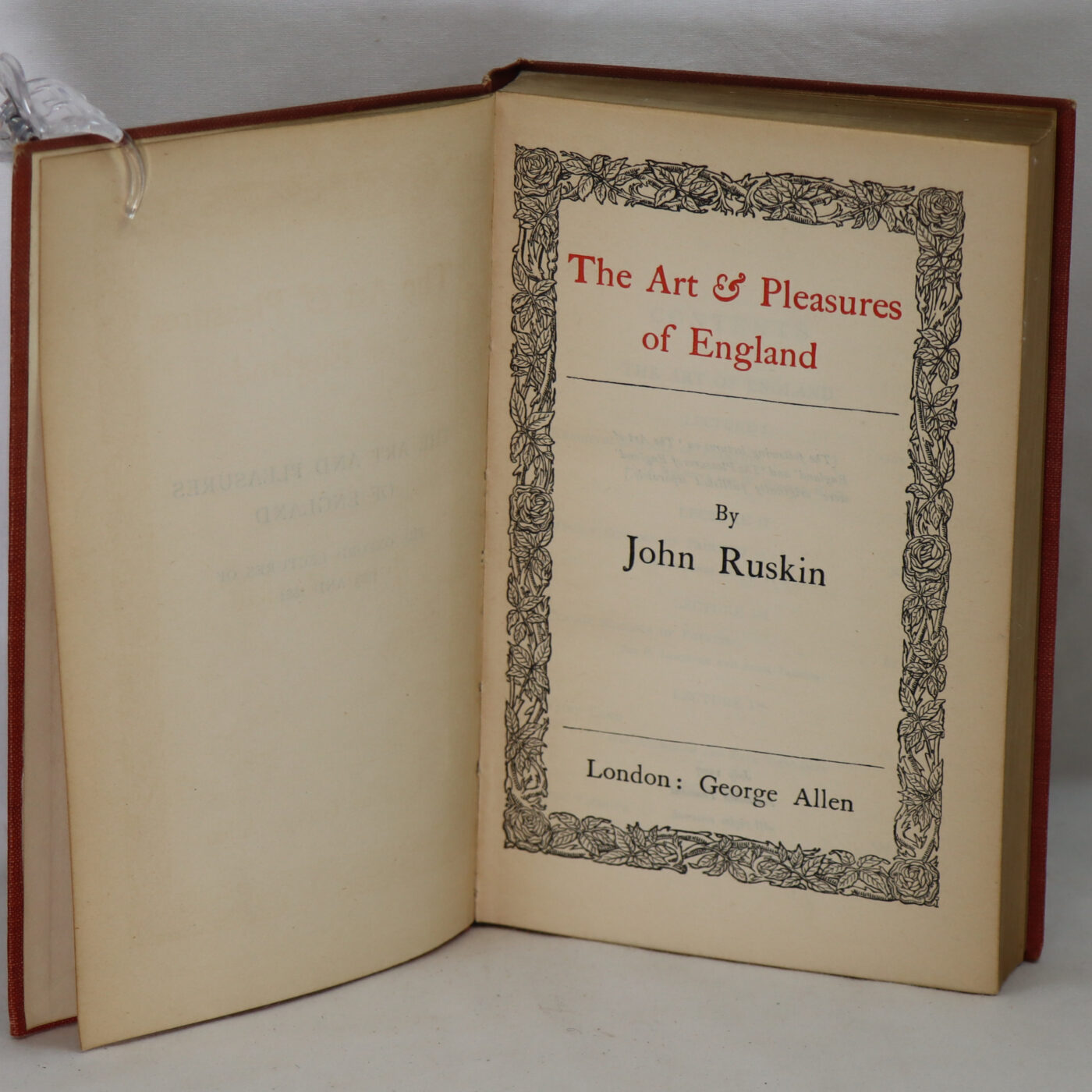
The Art and Pleasures of England.
By John Ruskin
Printed: 1907
Publisher: George Allen. London
| Dimensions | 11 × 17 × 2 cm |
|---|---|
| Language |
Language: English
Size (cminches): 11 x 17 x 2
Condition: Very good (See explanation of ratings)
£46.00
Buy Now

Item information
Description
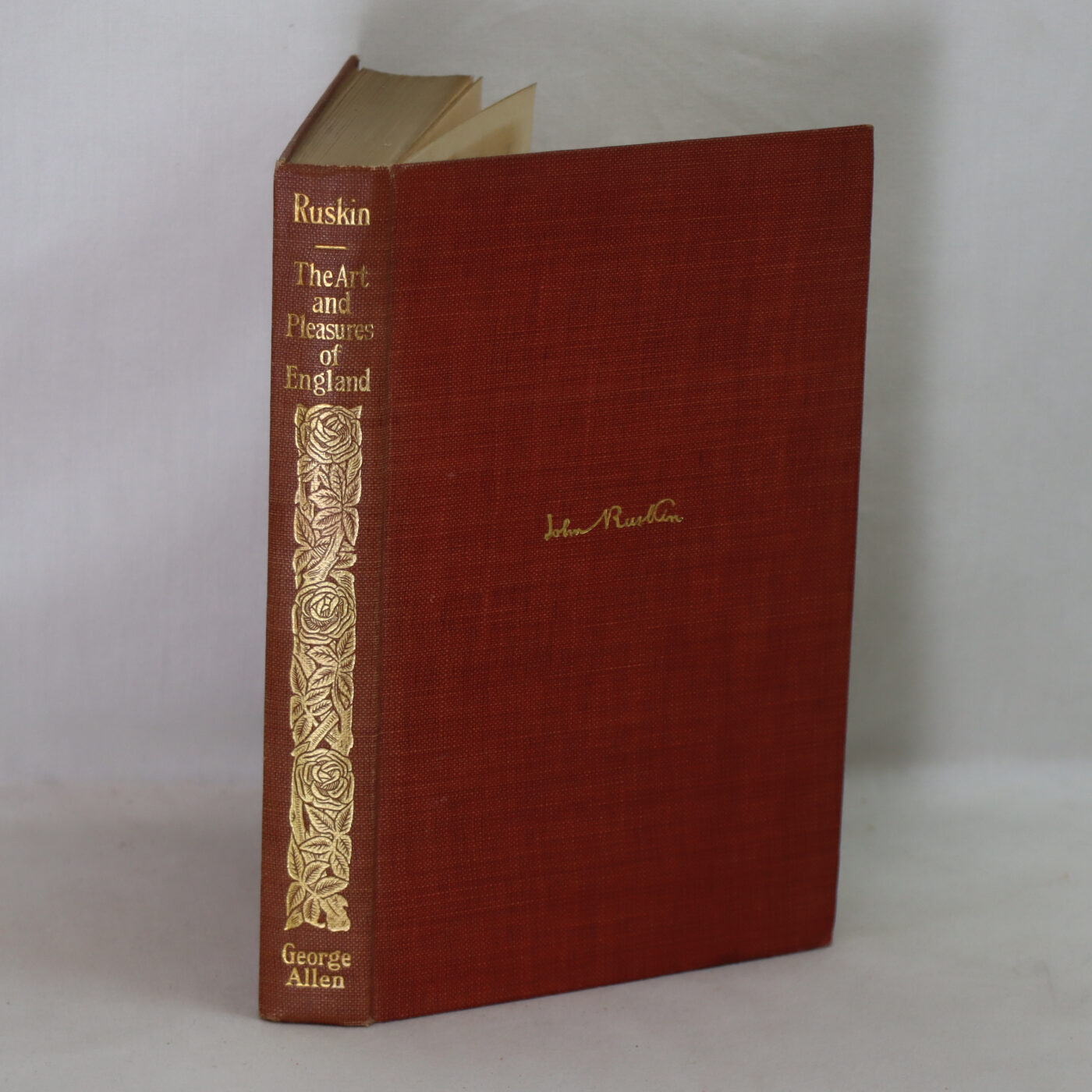
Hardcover. Tan cloth binding with gilt title and decoration on the spine.
We provide an in-depth photographic presentation of this item to stimulate your feeling and touch. More traditional book descriptions are immediately available
- £46.00
- Note: This book carries a £5.00 discount to those that subscribe to the F.B.A. mailing list
For conditions, please view our photographs. A nice clean copy from the library gathered by the famous Cambridge Don, computer scientist, food and wine connoisseur, Jack Arnold LANG. Jack founded the Midsummer House, Cambridge’s paramount restaurant. This dining experience is hidden amongst the grassy pastures and grazing cattle of Midsummer Common and perched on the banks of the River Cam.
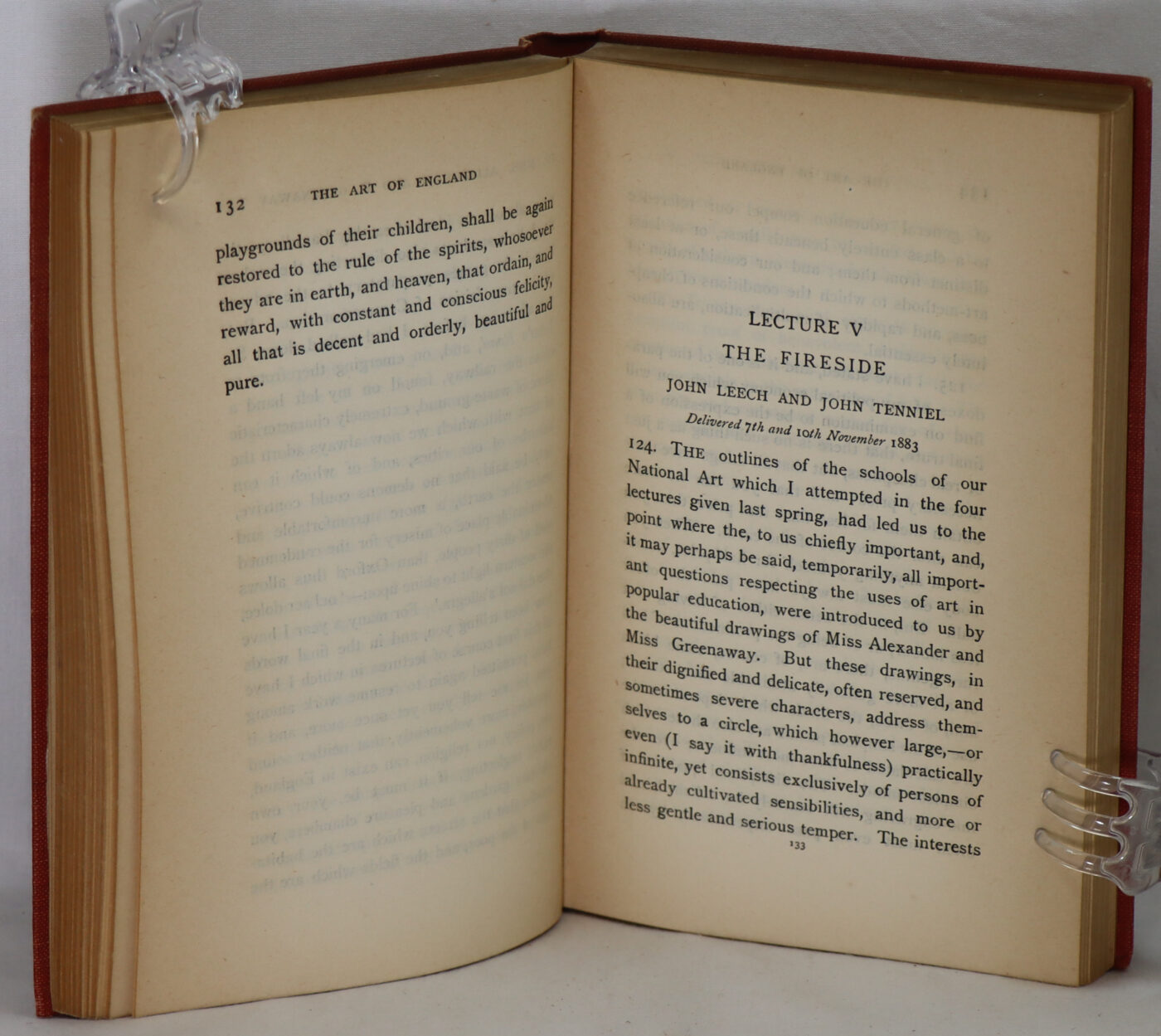
The Art Of England, from Rossetti to Copley Fielding, and The Pleasures Of England, lectures on ‘The Pleasures Of Learning’ Bertha to Osburga, ‘The Pleasures Of Faith’ Alfred to The Confessor, ‘The Pleasures Of Deed’, Alfred to Richard’ and ‘The Pleasures Of Fancy’ Richard to Elizabeth. A nice book, very readable Ruskin.
John Ruskin (8 February 1819 – 20 January 1900) was an English polymath – a writer, lecturer, art historian, art critic, draughtsman and philanthropist of the Victorian era. He wrote on subjects as varied as art, architecture, political economy, education, museology, geology, botany, ornithology, literature, history, and myth. Ruskin’s writing styles and literary forms were equally varied. He wrote essays and treatises, poetry and lectures, travel guides and manuals, letters and even a fairy tale. He also made detailed sketches and paintings of rocks, plants, birds, landscapes, architectural structures and ornamentation. The elaborate style that characterised his earliest writing on art gave way in time to plainer language designed to communicate his ideas more effectively. In all of his writing, he emphasised the connections between nature, art and society. Ruskin was hugely influential in the latter half of the 19th century and up to the First World War. After a period of relative decline, his reputation has steadily improved since the 1960s with the publication of numerous academic studies of his work. Today, his ideas and concerns are widely recognised as having anticipated interest in environmentalism, sustainability, ethical consumerism, and craft. Ruskin first came to widespread attention with the first volume of Modern Painters (1843), an extended essay in defence of the work of J. M. W. Turner in which he argued that the principal duty of the artist is “truth to nature”. This meant rooting art in experience and close observation. From the 1850s, he championed the Pre-Raphaelites, who were influenced by his ideas. His work increasingly focused on social and political issues. Unto This Last (1860, 1862) marked the shift in emphasis. In 1869, Ruskin became the first Slade Professor of Fine Art at the University of Oxford, where he established the Ruskin School of Drawing. In 1871, he began his monthly “letters to the workmen and labourers of Great Britain”, published under the title Fors Clavigera (1871–1884). In the course of this complex and deeply personal work, he developed the principles underlying his ideal society. Its practical outcome was the founding of the Guild of St George, an organisation that endures today.
Want to know more about this item?
We are happy to answer any questions you may have about this item. In addition, it is also possible to request more photographs if there is something specific you want illustrated.
Ask a question
Related products



Share this Page with a friend
