
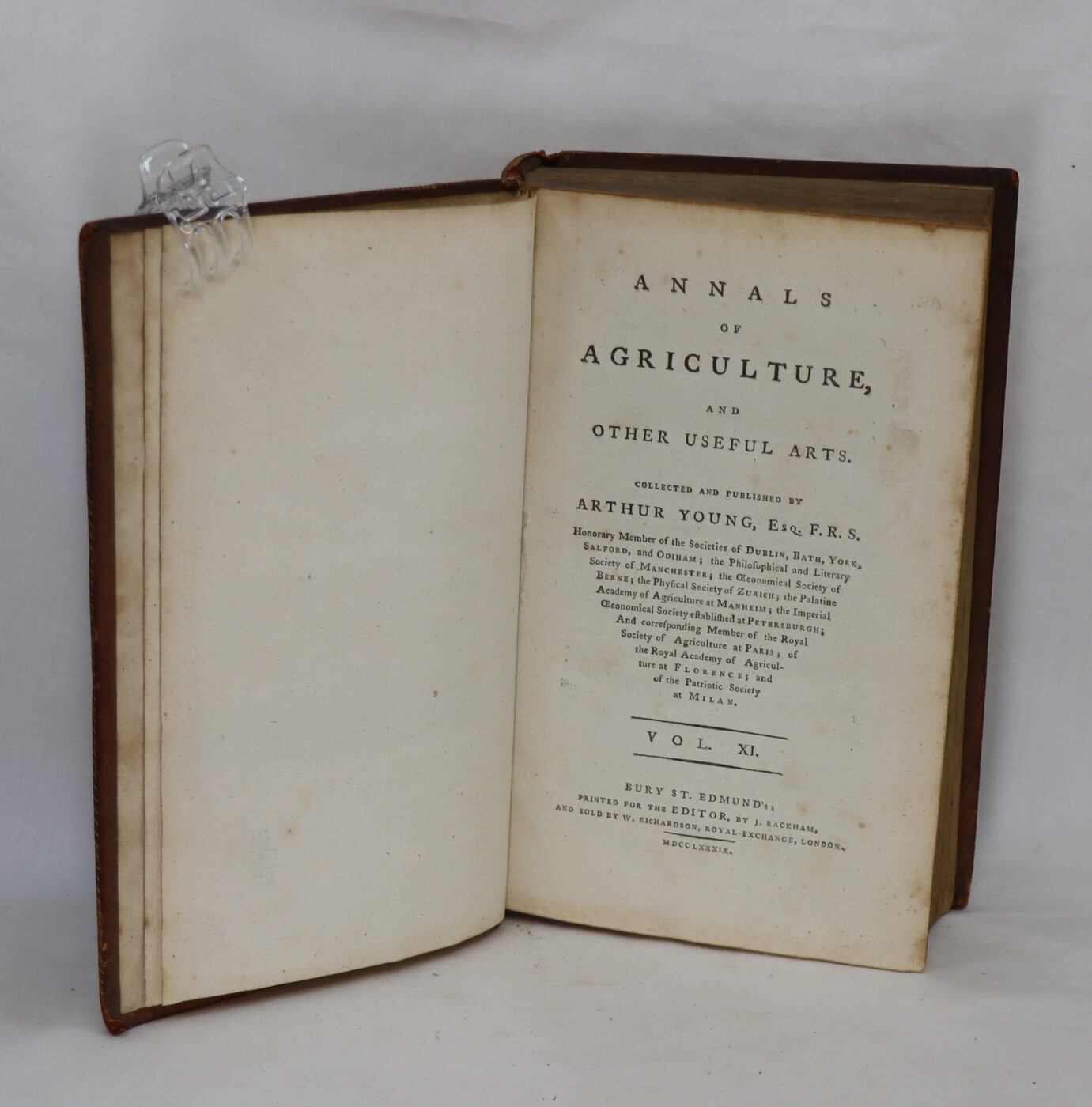
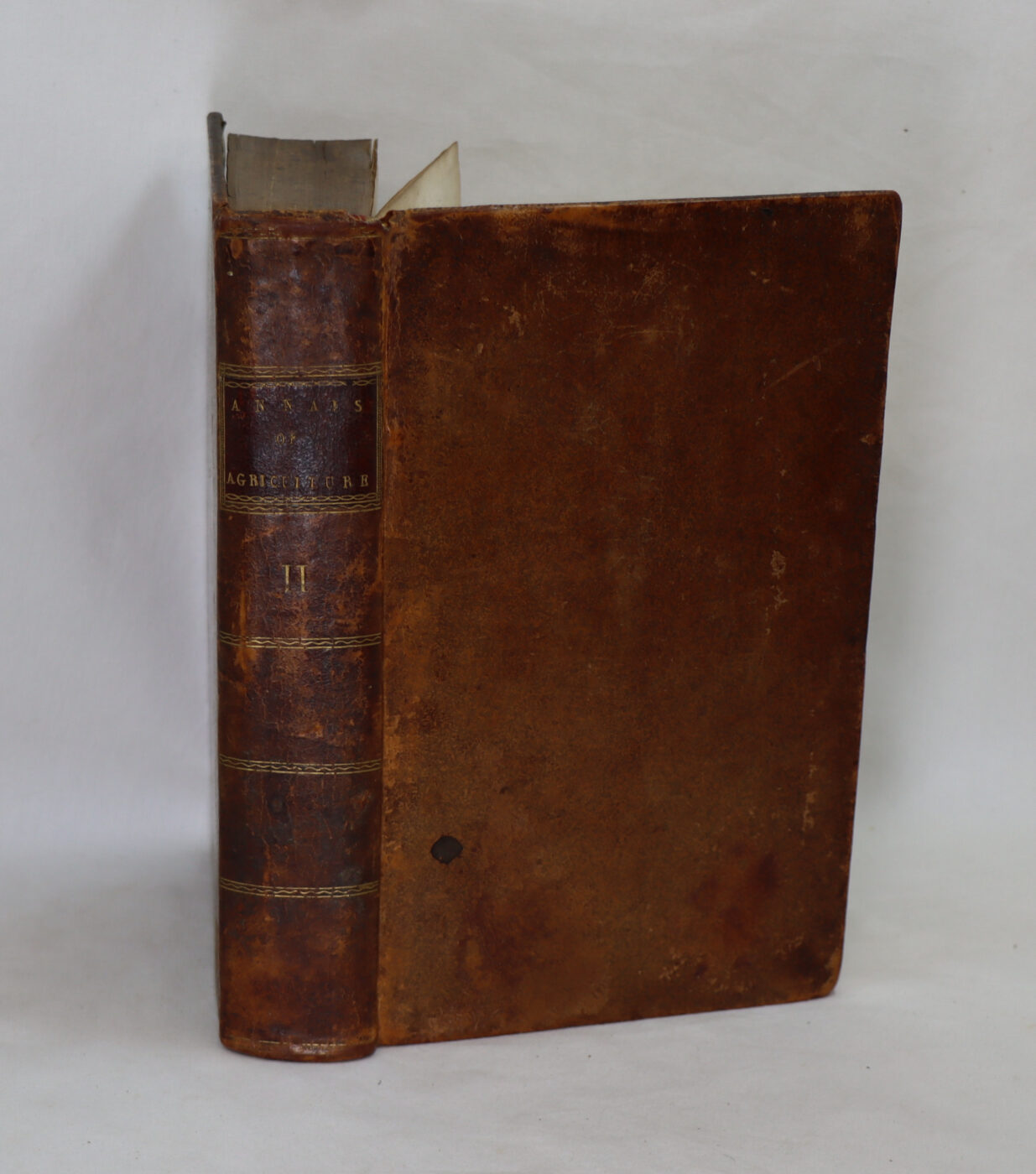
The Annuals of Agriculture. Volume XI.
By Arthur Young
Printed: 1789
Publisher: Arthur Young. London
| Dimensions | 14 × 22 × 4 cm |
|---|---|
| Language |
Language: English
Size (cminches): 14 x 22 x 4
Condition: Good (See explanation of ratings)
£144.00
Buy Now
Your items

Item information
Description
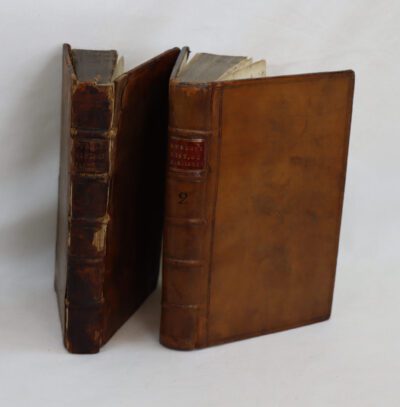
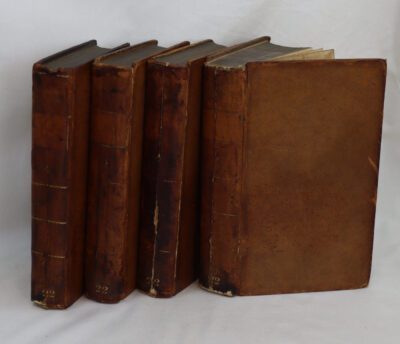
Brown leather binding with red title plate, gilt banding and title on the spine.
We provide an in-depth photographic presentation of this item to stimulate your feeling and touch. More traditional book descriptions are immediately available.
- Note: This book carries a £5.00 discount to those that subscribe to the F.B.A. mailing list
Please view our photographs. Still a tidy book, very legible with tight bindings. All in all a solid buy. This is the only really successful and long-lived agricultural periodical. It only ended when Young’s failing eyesight compelled him to abandon it. Many eminent persons of the day were among the contributors, including George III himself, and Jeremy Bentham, and Young is reckoned to have written at least a third of it with his own hand. Nearly every volume contains notes on short journeys into some rural district or other, and taken together these brief tours cover a very respectable proportion of the whole country.’- Fussell.
Arthur Young FRS (11 September 1741 – 12 April 1820) was an English agriculturist. Not himself successful as a farmer, he built on connections and activities as a publicist a substantial reputation as an expert on agricultural improvement. After the French Revolution of 1789, his views on its politics carried weight as an informed observer, and he became an important opponent of British reformers.
Young is considered a major English writer on agriculture and an early contributor to agricultural economics, although he is best known as a social and political observer. Also read widely were his Tour in Ireland (1780) and Travels in France (1792).
In 1767 Young took over a farm in Essex, at Sampford Hall, one reason being to move away from his mother, who was on bad terms with his wife. For financial reasons he had to move on in 1768 to Bradmore Farm, North Mymms, in Hertfordshire. There he engaged in experiments described in A Course of Experimental Agriculture (1770). Though these were generally unsuccessful, they gave him a working knowledge of agriculture. He acted as parliamentary reporter for the London Morning Post from 1773.
Young was elected a Fellow of the Royal Society in 1774; but the Society refused a number of his papers on agricultural topics, which always had critics, such as James Anderson of Hermiston. In 1784 Young began the publication of the Annals of Agriculture, which ran for 45 volumes: contributors included King George III, writing under the pseudonym “Ralph Robinson”, and Robert Andrews, whom Young took as a model farmer. Young’s figures for the total area of England and Wales, and total cultivated area, were serious overestimates. In a work from 1799, during wartime and fiscal strain on the national budget, Henry Beeke gave more reliable figures, showing Young had erred.
Young was appointed secretary of the Board of Agriculture in 1793, just after it was formed under the presidency of Sir John Sinclair. In that capacity he worked on collecting and preparing the General View of Agriculture county surveys. The Annals of Agriculture began to wind down in 1803, when John Rackham of Bury St Edmunds, who printed it, found the copy was lacking and pressed Young, who padded out the pages with old notes. Richard Phillips took it on for volume 41, and saw the publication out, the final volume 45 appearing in 1808.
Economic historians Robert C. Allen and Cormac Ó Gráda have challenged some of Young’s conclusions.
Want to know more about this item?
We are happy to answer any questions you may have about this item. In addition, it is also possible to request more photographs if there is something specific you want illustrated.
Ask a question
Related products
Share this Page with a friend
