
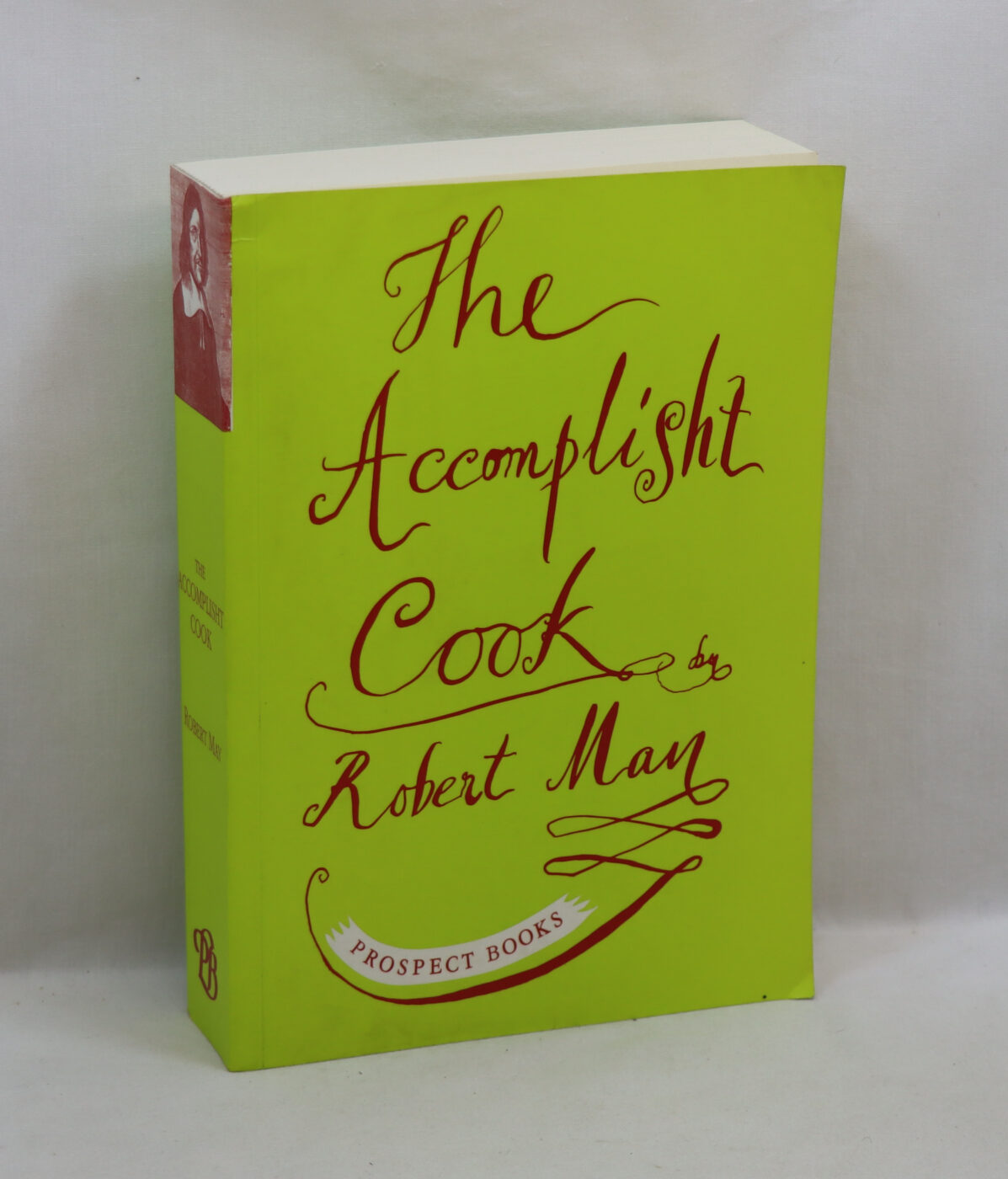
The Accomplisht Cook.
By Robert May
ISBN: 9783752435641
Printed: 2000
Publisher: Prospect Books. Totnes
| Dimensions | 15 × 21 × 4 cm |
|---|---|
| Language |
Language: English
Size (cminches): 15 x 21 x 4
Condition: Very good (See explanation of ratings)
£48.00
Buy Now

Item information
Description
Paperback. Green cover with red title.
We provide an in-depth photographic presentation of this item to stimulate your feeling and touch. More traditional book descriptions are immediately available
- Note: This book carries a £5.00 discount to those that subscribe to the F.B.A. mailing list
For conditions, please view our photographs. A great book from the library gathered by the famous Cambridge Don, computer scientist, food and wine connoisseur, Jack Arnold LANG.
Jack founded the Michelin Guide ‘Midsummer House’- Cambridge’s paramount restaurant. This dining experience is hidden amongst the grassy pastures and grazing cattle of Midsummer Common and perched on the banks of the River Cam. The Midsummer House experience is imaginatively curated to delight and amaze.
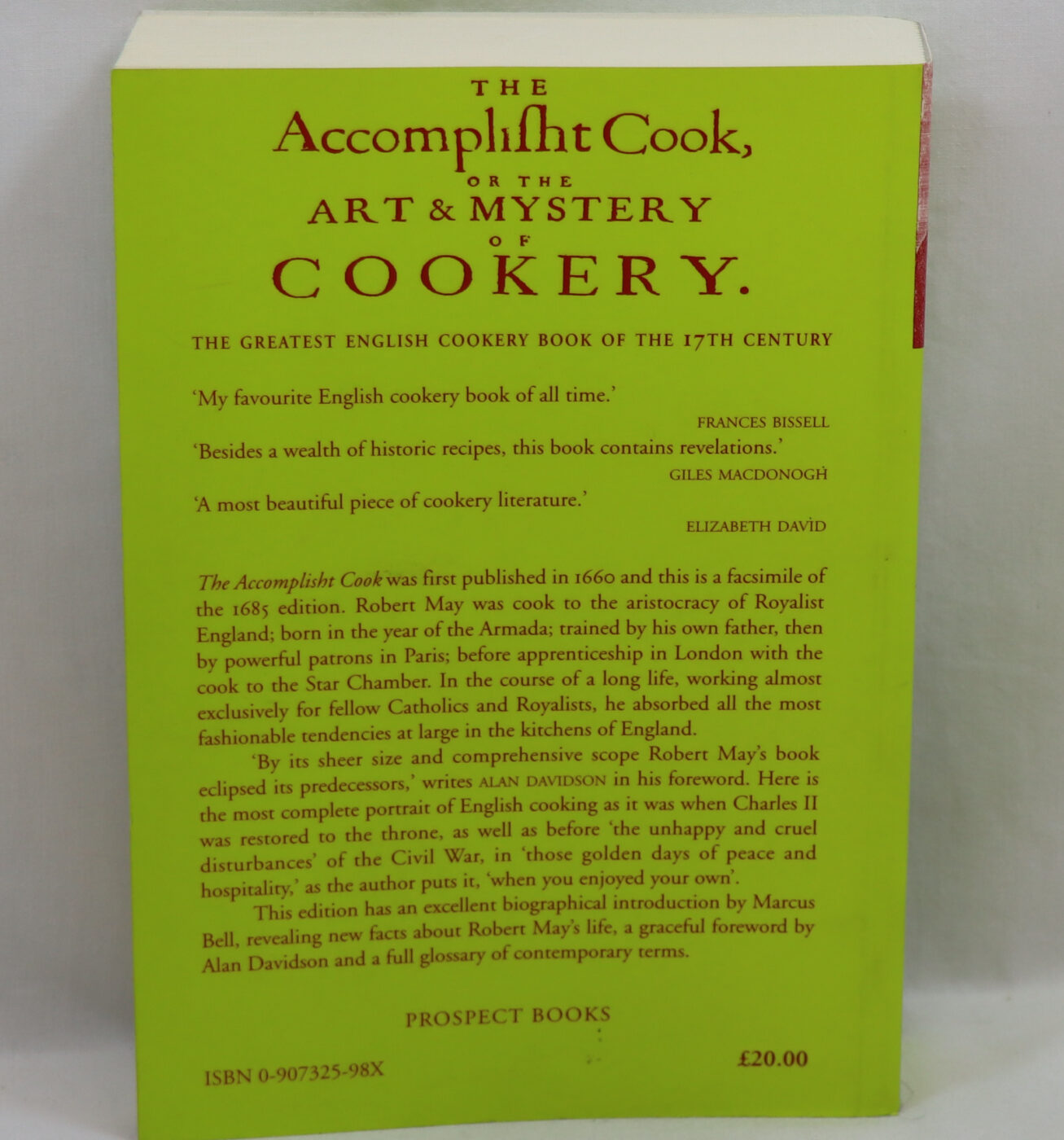
Considered A most beautiful piece of cookery literature by Elizabeth David, The Accomplisht Cook was first published in 1660. Robert May was cook to the aristocracy of Royalist England; born in the year of the Armada; trained by his own father, then by powerful patrons in Paris; before apprenticeship in London with the cook to the Star Chamber. In the course of a long life, working almost exclusively for fellow Catholics and Royalists, he absorbed all the most fashionable tendencies at large in the kitchens of England. ‘By its sheer size and comprehensive scope Robert May’s book eclipsed its predecessors, ‘ writes Alan Davidson in his foreword. Here is the most complete portrait of English cooking as it was when Charles II was restored to the throne, as well as before ‘the unhappy and cruel disturbances’ of the Civil War, in ‘those golden days of peace and hospitality, ‘ as the author puts it, ‘when you enjoyed your own.’ The Accomplisht Cook was first published in 1660 by Nathanial Brooke at the Angel in Cornhill. An improved second edition was published in 1665, and it was this text that Obadiah Blagrave at St Paul’s published as the fifth edition in 1685. The present edition is a facsimile of the fifth edition with a biographical introduction by Marcus Bell, revealing new facts about Robert May’s life, a foreword by Alan Davidson and a full glossary of contemporary terms.
Old school. Quite nice for the cook (serious cook) in your circle. I saw excerpts in the dessert area of Bern’s Steakhouse in Tampa, wanted it, so bought it as a gift for a family member cook. Time is precious…I know. But why not plan a meal with the instruction that cooks use the recipes within? Could be apportioned for several to prepare one meal, or one preps the entire meal, then a few weeks later it be someone else’s turn.
Review: My wife tells me the book was “life altering and the most incredible piece of knowledge of 17th century cooking by an English chef”. She takes the book on public transportation to work and back every day, given she’s a professional trained chef for a catering company.
Robert May (1588 – in or after 1664) was an English professional chef who trained in France and worked in England. He is best known for writing and publishing the 1660 cookbook The Accomplisht Cook. It was the first major book of English recipes, and contains instructions for many soups and broths, as well as recipes for both sweet and savoury pies. The Accomplisht Cook is an English cookery book published by the professional cook Robert May in 1660, and the first to group recipes logically into 24 sections. It was much the largest cookery book in England up to that time, providing numerous recipes for boiling, roasting, and frying meat, and others for salads, puddings, sauces, and baking. Eight of the sections are devoted to fish, with separate sections for carp, pike, salmon, sturgeon, and shellfish. Another section covers only eggs; and the next only artichokes. The book was one of the few cookery books published during the Commonwealth of Oliver Cromwell, and free of the plagiarism common at its time. It made early use of two ingredients brought to Europe from the Americas, the potato and the turkey. Robert May was from the age of ten a cook, working for aristocratic Roman Catholic and royalist employers beginning with Lady Dormer. She sent him to study cooking for five years in France, after which he served a seven-year apprenticeship in London. He became known for his book The Accomplisht Cook, which dwarfed earlier cookery texts by its size and scope. Despite the Catholic context, the book does not place special emphasis on Catholic fast and feast days; nor, despite May’s training, is it heavy with French influence, though Alan Davidson notes that he borrowed 35 recipes for eggs from François Pierre La Varenne’s Le Cuisinier françois. May’s text became widely available with the 1994 reprint in facsimile of the 1685 edition, and its historical introduction by Marcus Bell. May’s recipes included customs from the Middle Ages, alongside European dishes such as French bisque and Italian brodo (broth), with about 20 percent of the book devoted to soups. May provides a large number of recipes for venison, as for sturgeon, but balances his more elaborate and costly recipes with some for simple dishes. The book contains no fewer than sixteen recipes for eel. The recipes are presented entirely as instructions, without lists of ingredients, and not necessarily in order; he can write “Then have a rost Capon minced”, requiring the cook to have already taken, prepared and roasted the capon, a process that takes some hours, in the middle of a recipe (for Olio Podrida). Quantities, if given, are mentioned in passing. Thus he may mention “put them a boiling in a Pipkin of a Gallon”, or “the juyce of two or three Oranges”, or he may write “and put into beaten Butter”, leaving the cook to judge the quantity required.
Want to know more about this item?
We are happy to answer any questions you may have about this item. In addition, it is also possible to request more photographs if there is something specific you want illustrated.
Ask a question
Related products
Share this Page with a friend
