
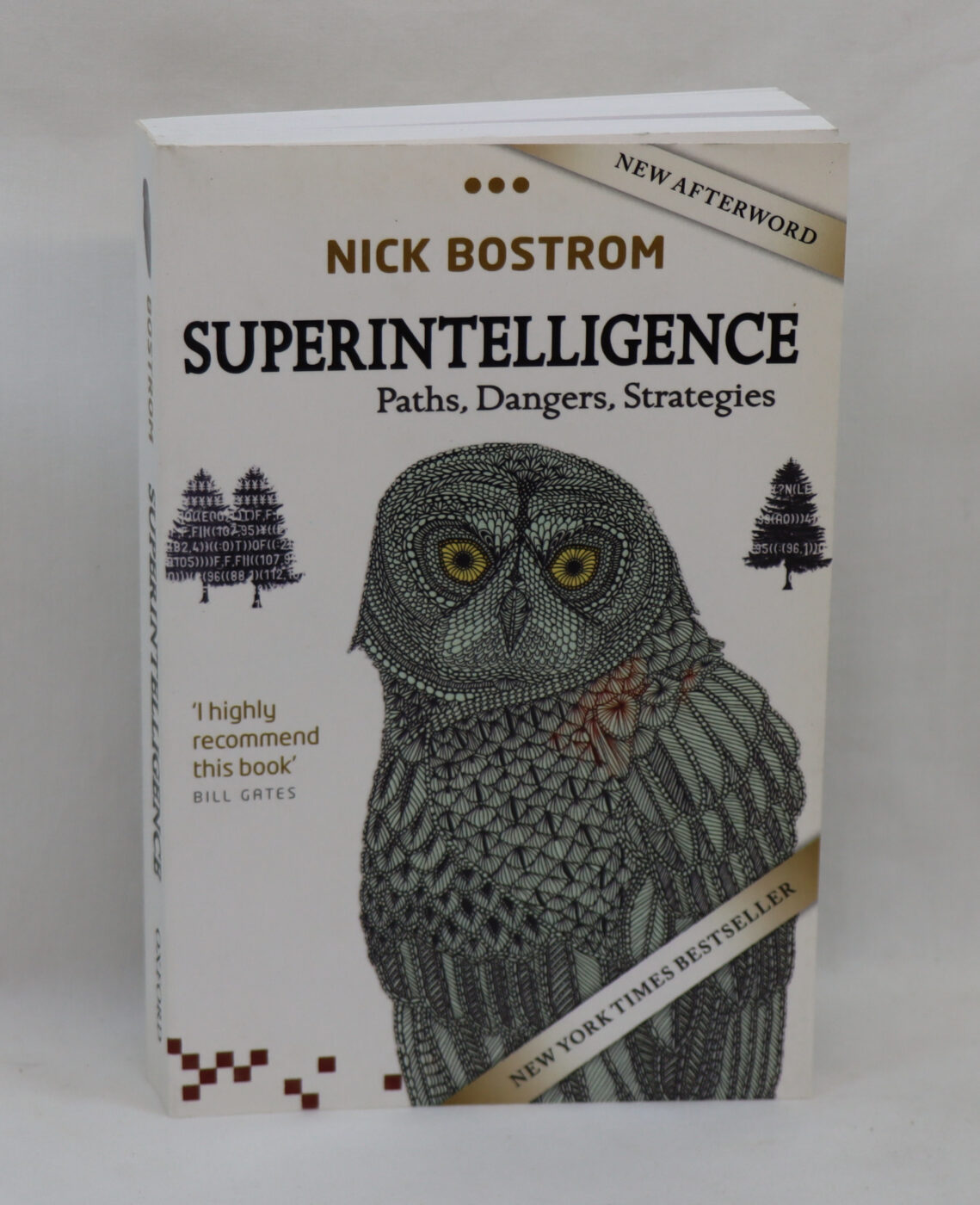
Superintelligence.
By Nick Bostrom
ISBN: 9780199678112
Printed: 2016
Publisher: Oxford University Press.
| Dimensions | 13 × 19 × 2 cm |
|---|---|
| Language |
Language: English
Size (cminches): 13 x 19 x 2
Condition: Very good (See explanation of ratings)
£8.00
Buy Now
Your items
Item information
Description
Paperback. White cover with a black title owl image.
We provide an in-depth photographic presentation of this item to stimulate your feeling and touch. More traditional book descriptions are immediately available.
A £2 reduction when collected from FBA shop
Folk find this book to be one of the best on the subject of super intelligence, providing an engaging account of the future of artificial intelligence. The writing style and readability receive mixed reactions – while some find it well written and interesting, others describe it as difficult to read. The technical content is also mixed, with some finding it detailed while others consider it overly technical.
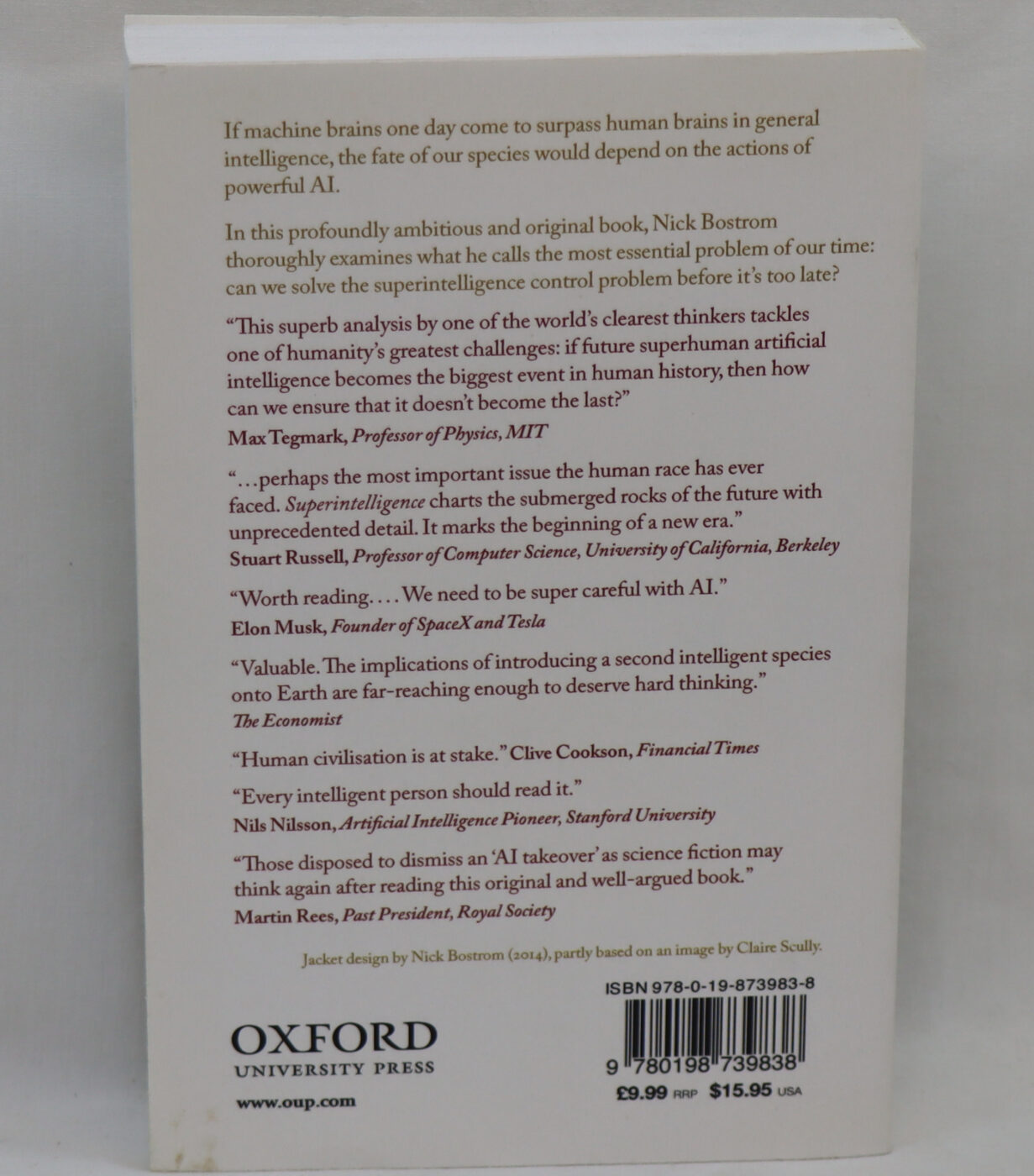
The human brain has some capabilities that the brains of other animals lack. It is to these distinctive capabilities that our species owes its dominant position. Other animals have stronger muscles or sharper claws, but we have cleverer brains. If machine brains one day come to surpass human brains in general intelligence, then this new superintelligence could become very powerful. As the fate of the gorillas now depends more on us humans than on the gorillas themselves, so the fate of our species then would come to depend on the actions of the machine superintelligence. But we have one advantage: we get to make the first move. Will it be possible to construct a seed AI or otherwise to engineer initial conditions so as to make an intelligence explosion survivable? How could one achieve a controlled detonation? To get closer to an answer to this question, we must make our way through a fascinating landscape of topics and considerations. Read the book and learn about oracles, genies, singletons; about boxing methods, tripwires, and mind crime; about humanity’s cosmic endowment and differential technological development; indirect normativity, instrumental convergence, whole brain emulation and technology couplings; Malthusian economics and dystopian evolution; artificial intelligence, and biological cognitive enhancement, and collective intelligence.
This profoundly ambitious and original book picks its way carefully through a vast tract of forbiddingly difficult intellectual terrain. Yet the writing is so lucid that it somehow makes it all seem easy. After an utterly engrossing journey that takes us to the frontiers of thinking about the human condition and the future of intelligent life, we find in Nick Bostrom’s work nothing less than a reconceptualization of the essential task of our time.
Reviews:
-
- Worth reading. ― Elon Musk, Founder of SpaceX and Tesla
- I highly recommend this book ― Bill Gates
- very deep … every paragraph has like six ideas embedded within it. ― Nate Silver
- Nick Bostrom makes a persuasive case that the future impact of AI is perhaps the most important issue the human race has ever faced. Instead of passively drifting, we need to steer a course. Superintelligence charts the submerged rocks of the future with unprecedented detail. It marks the beginning of a new era ― Stuart Russell, Professor of Computer Science, University of California, Berkley
- Those disposed to dismiss an ‘AI takeover’ as science fiction may think again after reading this original and well-argued book ― Martin Rees, Past President, Royal Society
- This superb analysis by one of the worlds clearest thinkers tackles one of humanity’s greatest challenges: if future superhuman artificial intelligence becomes the biggest event in human history, then how can we ensure that it doesn’t become the last? ― Max Tegmark, Professor of Physics, MIT
- Terribly important … groundbreaking… extraordinary sagacity and clarity, enabling him to combine his wide-ranging knowledge over an impressively broad spectrum of disciplines – engineering, natural sciences, medicine, social sciences and philosophy – into a comprehensible whole… If this book gets the reception that it deserves, it may turn out the most important alarm bell since Rachel Carson’s Silent Spring from 1962, or ever ― Olle Haggstrom, Professor of Mathematical Statistics
- Valuable. The implications of introducing a second intelligent species onto Earth are far-reaching enough to deserve hard thinking ― The Economist
- There is no doubting the force of [Bostrom’s] arguments the problem is a research challenge worthy of the next generations best mathematical talent. Human civilisation is at stake ― Financial Times
- His book Superintelligence: Paths, Dangers, Strategies became an improbable bestseller in 2014 ― Alex Massie, Times (Scotland)
- Ein Text so nüchtern und cool, so angstfrei und dadurch umso erregender, dass danach das, was bisher vor allem Filme durchgespielt haben, auf einmal höchst plausibel erscheint. A text so sober and cool, so fearless and thus all the more exciting that what has until now mostly been acted through in films, all of a sudden appears most plausible afterwards. (translated from German) ― Georg Diez, DER SPIEGEL
- Worth reading…. We need to be super careful with AI. Potentially more dangerous than nukes ― Elon Musk, Founder of SpaceX and Tesla
- A damn hard read ― Sunday Telegraph
- I recommend Superintelligence by Nick Bostrom as an excellent book on this topic ― Jolyon Brown, Linux Format
- Every intelligent person should read it. ― Nils Nilsson, Artificial Intelligence Pioneer, Stanford University
- An intriguing mix of analytic philosophy, computer science and cutting-edge science fiction, Nick Bostrom’s Superintelligence is required reading for anyone seeking to make sense of the recent surge of interest in artificial intelligence (AI). ― Colin Garvey, Icon
- Bostrom lays a foundation for understanding the future of humanity and intelligent life.
- Superintelligence, Paths, Dangers, Strategies by Nick Bostrom, 2016 edition. A rigorous philosophical and ethical treatment of the subject. It demands quite an effort from the reader but the more you are willing to make the more the reward. The formalist style and maths gives it a textbook feel. Some of it was over my head but don’t be put off, the great majority of the book is accessible to lay readers although some background in the subject would obviously help. A strong theme is the need for some overreaching systems of control to protect us from undesirable behavior by super-intelligent machines lest they misunderstand, whether accidentally or deliberately, the goals we set them. If that sounds too much like science fiction then reading the book might change your mind. Among the many topics addressed I found the whole brain emulation idea quite fascinating, also the notion of “mind crime” where inside a super-intelligent machine there is some kind of sentient being which could be exposed to mental suffering. That gives one pause for thought. I was expecting more about the architectures and software methods that are currently showing the most promise but these are only mentioned indirectly, they are not the subject of this book. While I am in awe of the huge intellectual depth and span of this work, I reluctantly drop half a star (rounded to one) because of the almost obsessional academic style which starts to feel tedious and repetitive at times. I felt that he could get some of his arguments across more economically to greater effect. But the book is nevertheless a masterpiece on this subject and will likely be a reference for many years to come.
Nick Bostrom is Professor in the Faculty of Philosophy at Oxford University and founding Director of the Future of Humanity Institute and of the Programme on the Impacts of Future Technology within the Oxford Martin School. He is the author of some 200 publications, including Anthropic Bias (Routledge, 2002), Global Catastrophic Risks (ed., OUP, 2008), and Human Enhancement (ed., OUP, 2009). He previously taught at Yale, and he was a Postdoctoral Fellow of the British Academy. Bostrom has a background in physics, computational neuroscience, and mathematical logic as well as philosophy.
Want to know more about this item?
We are happy to answer any questions you may have about this item. In addition, it is also possible to request more photographs if there is something specific you want illustrated.
Ask a question
Related products






Share this Page with a friend
