
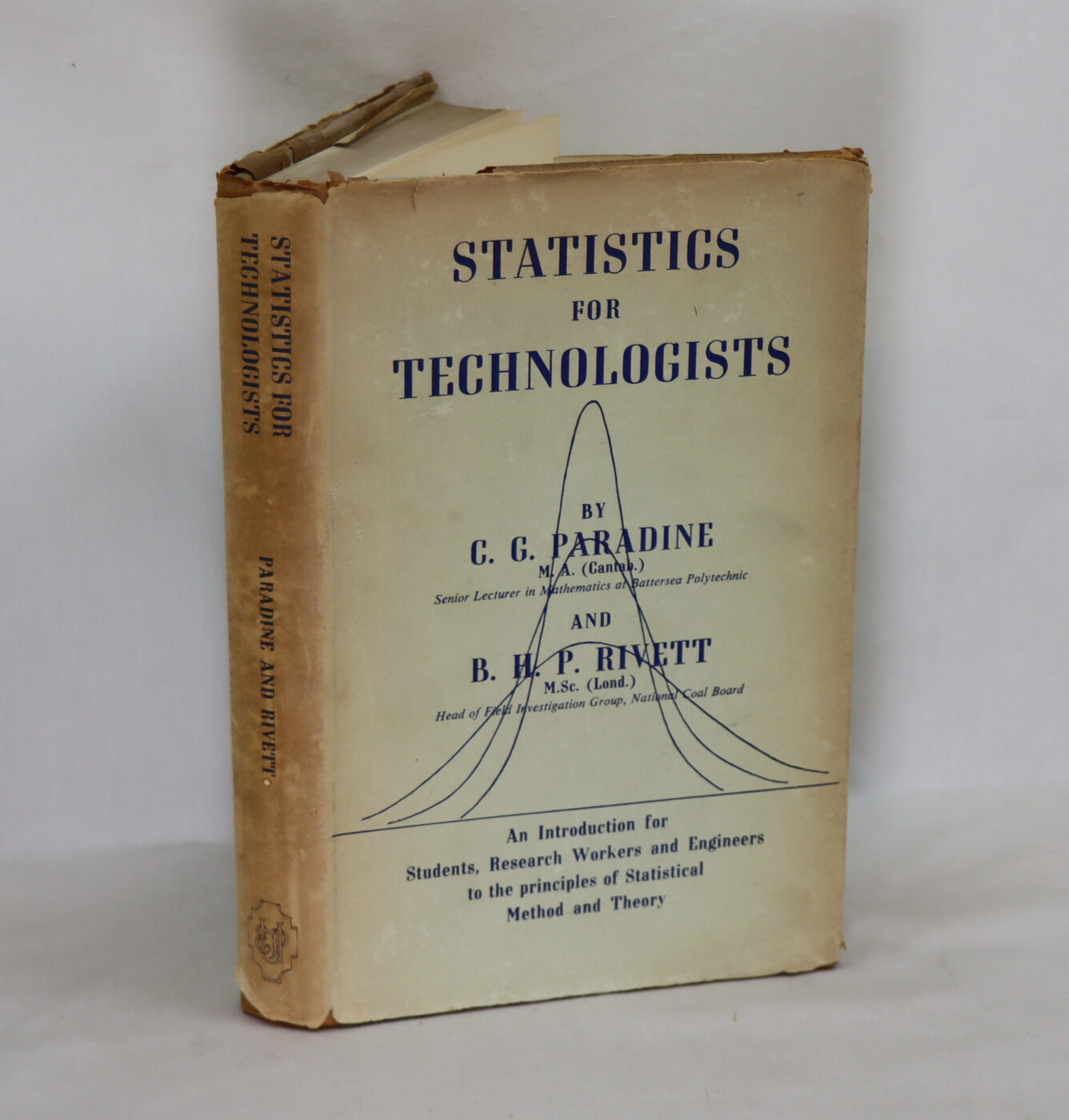
Statistics for Technologists.
By C G Paradine & B H P Rivett
Printed: 1953
Publisher: English Universities Press. London
| Dimensions | 15 × 22 × 2 cm |
|---|---|
| Language |
Language: English
Size (cminches): 15 x 22 x 2
Condition: Very good (See explanation of ratings)
£266.00
FREE shipping
Buy Now
Your items


Item information
Description
In the original dust jacket. Grey cloth binding with green title on the spine.
We provide an in-depth photographic presentation of this item to stimulate your feeling and touch. More traditional book descriptions are immediately available
- Note: This book carries a £5.00 discount to those that subscribe to the F.B.A. mailing list
For conditions, please view our photographs. A very rare original book from the library gathered by the famous Cambridge Don, computer scientist, food and wine connoisseur, Jack Arnold LANG. View this book’s dust cover for further details. This book is of historical interest as it set the standards for much of our current practice: a true collectors edition.
This first edition was acquired by Jack’s distinguished parents, Ruth and Herbert Lang.
Statistical methods are techniques for collecting, analyzing, interpreting, and presenting data to find patterns, test theories, and make informed decisions, broadly categorized into Descriptive Statistics (summarizing data like mean/median) and Inferential Statistics (drawing conclusions about populations from samples). Key tools include hypothesis testing, regression, correlation, and predictive models, vital across science, business, and research for extracting meaning from numbers.
Main Categories of Statistical Methods:
- Descriptive Statistics: Summarizes key features of a dataset.
- Examples: Mean, median, mode (measures of central tendency) and standard deviation (measures of spread).
- Inferential Statistics: Makes predictions or inferences about a large population from a smaller sample.
- Examples: T-tests, ANOVA, regression analysis, confidence intervals.
- Predictive Analysis: Uses historical data to forecast future outcomes.
- Prescriptive Analysis: Suggests actions to achieve desired results.
Common Statistical Techniques:
- Hypothesis Testing: Statistically testing a claim or idea about a population (e.g., t-tests, chi-squared).
- Regression Analysis: Examines relationships between variables to predict outcomes.
- Correlation Analysis: Measures the strength and direction of relationships between variables (without implying causation).
- Exploratory Data Analysis (EDA): Uncovering patterns and anomalies in data.
How They Are Used:
- Research: Designing studies, testing treatment effectiveness, generalizing findings.
- Business: Understanding customers, making strategic decisions, monitoring performance, leveraging big data.
- Science: Analyzing experimental results, identifying trends, ensuring robust sample sizes.
Want to know more about this item?
We are happy to answer any questions you may have about this item. In addition, it is also possible to request more photographs if there is something specific you want illustrated.
Ask a question
Related products







Share this Page with a friend
