
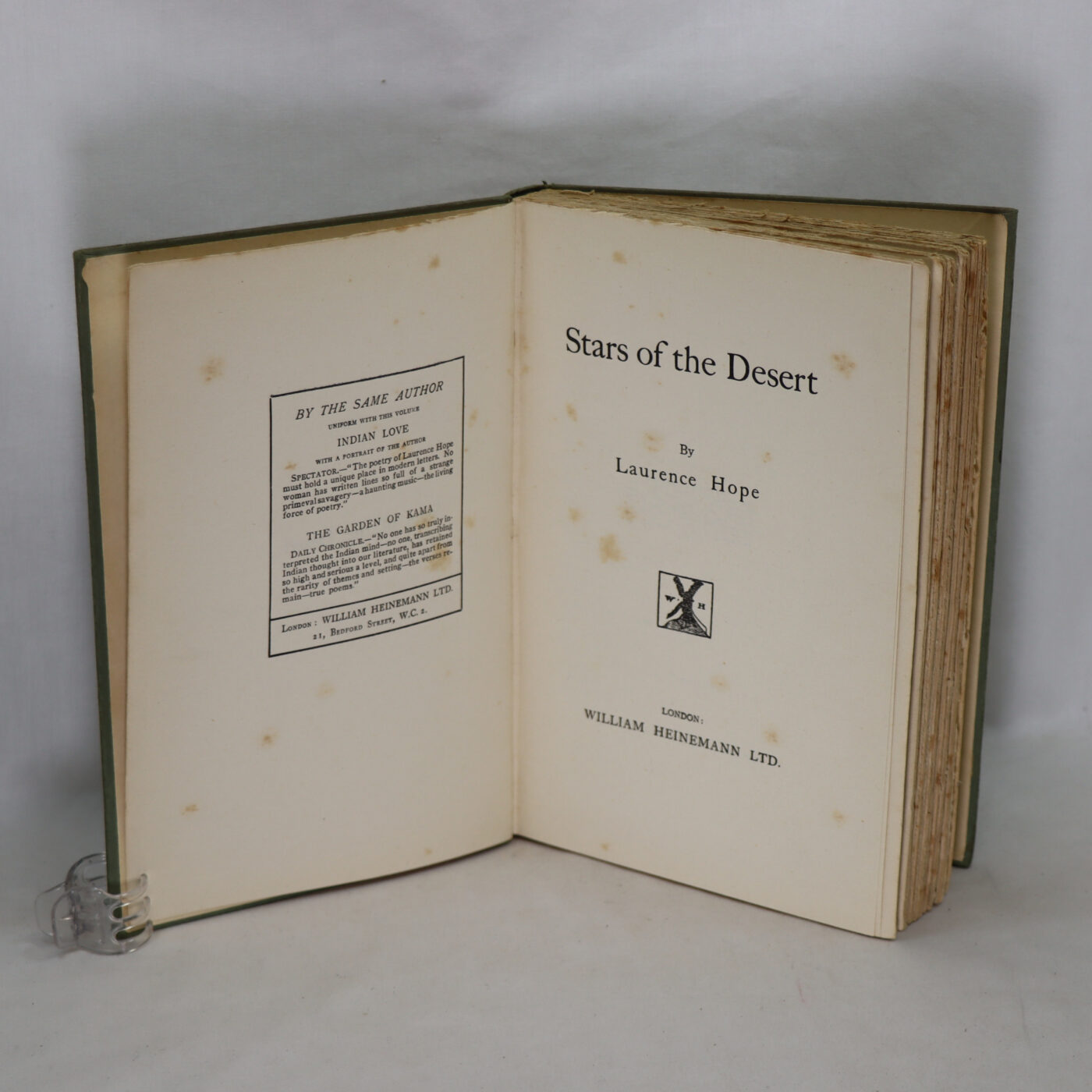
Stars of the Desert.
By Laurence Hope
Printed: 1925
Publisher: William Heinemann. London
| Dimensions | 15 × 22 × 2 cm |
|---|---|
| Language |
Language: English
Size (cminches): 15 x 22 x 2
Condition: Very good (See explanation of ratings)
£130.00
Buy Now
Your items

Item information
Description
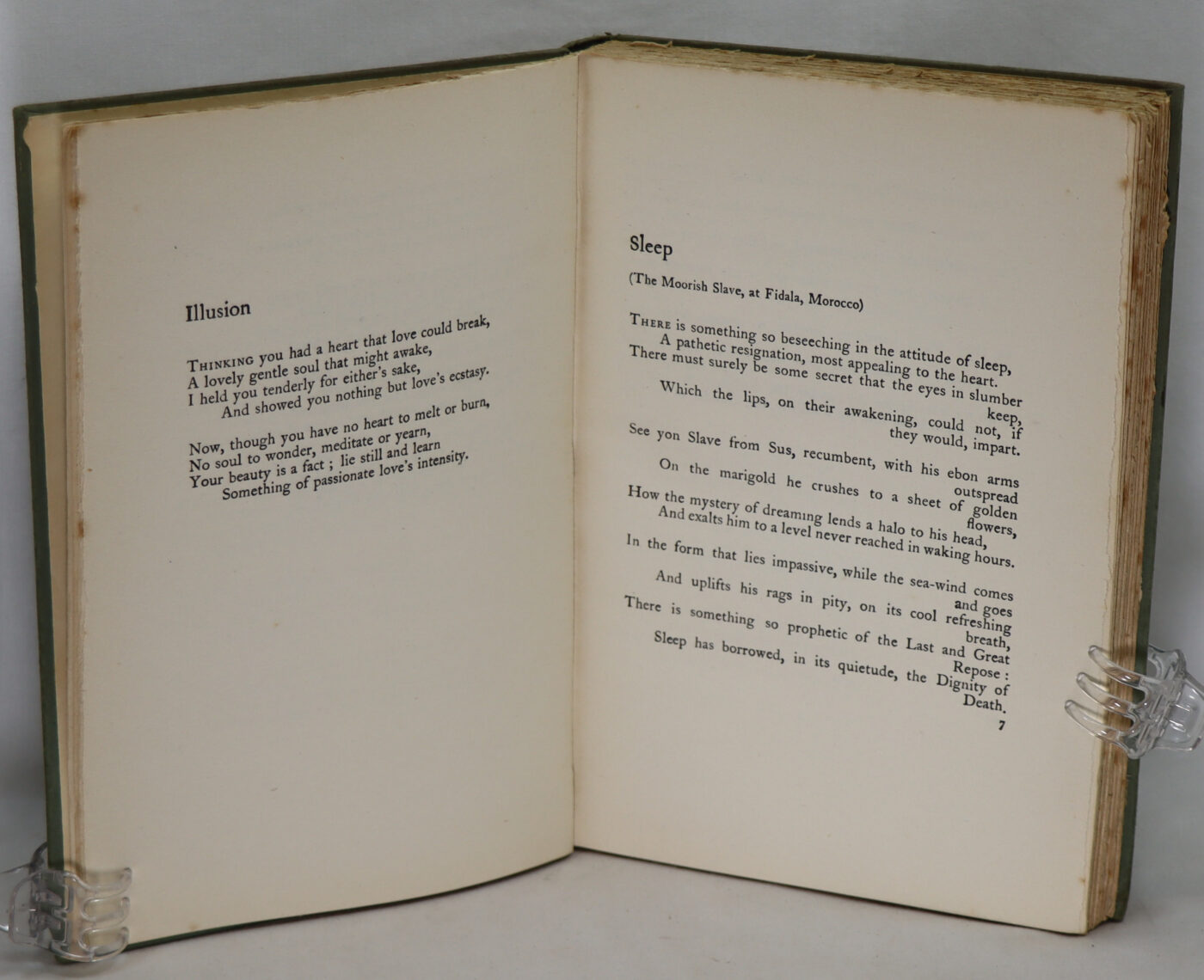
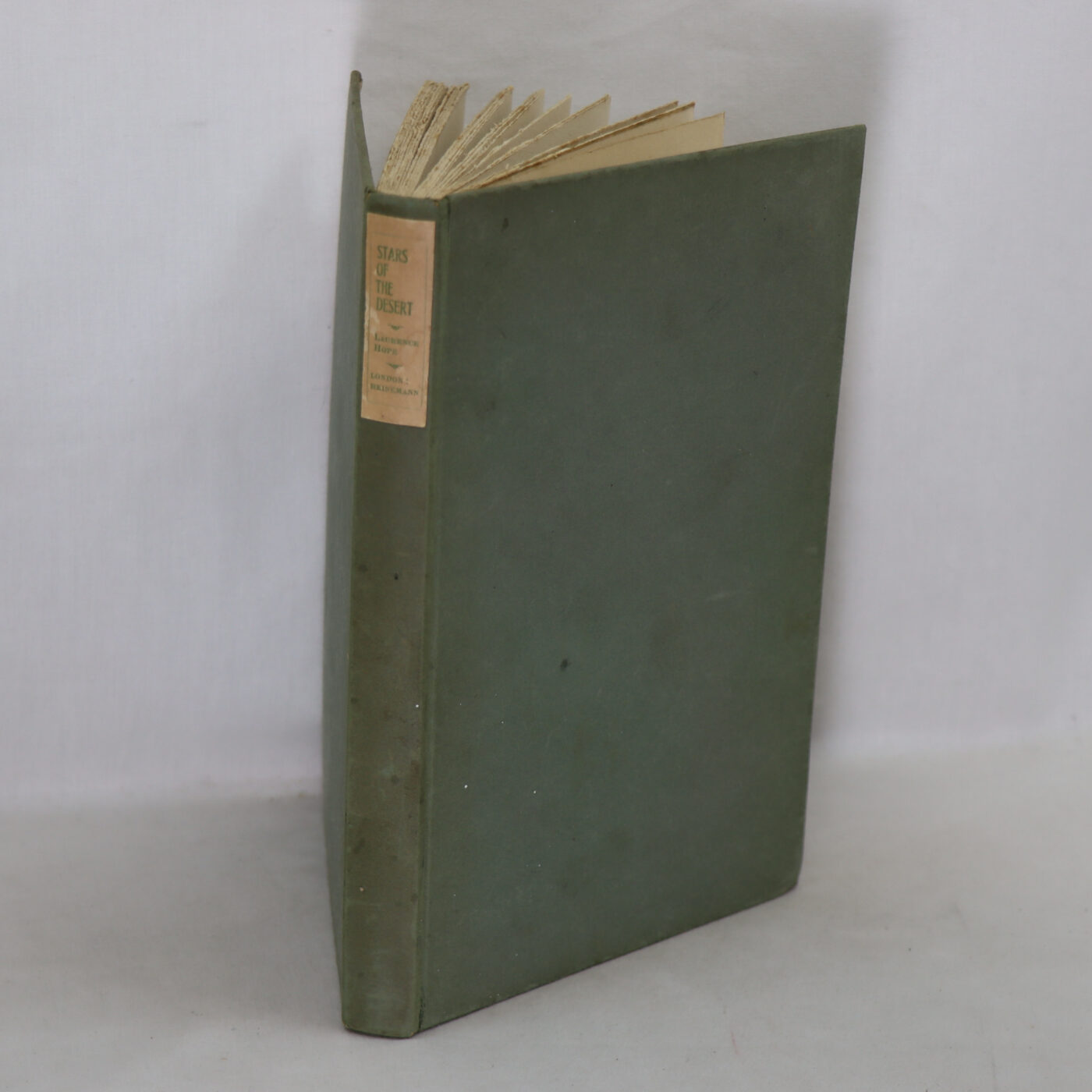
Hardback. Green board binding with cream title on the spine.
We provide an in-depth photographic presentation of this item to stimulate your feeling and touch. More traditional book descriptions are immediately available
- Note: This book carries a £5.00 discount to those that subscribe to the F.B.A. mailing list
For conditions, please view our photographs. A nice clean very rare copy from the library gathered by the famous Cambridge Don, computer scientist, food and wine connoisseur, Jack Arnold LANG. This lovely book was the property of Jack’s grandmother who was a great fan of the ‘Cory’ family. The three daughters Violet, Annie, and Isabel Cory were famous writers on Indian culture, though they were eclipsed by their Nobel Prize winner friend Rudyard Kipling.
Violet Nicolson (9 April 1865 – 4 October 1904), otherwise known as Adela Florence Nicolson (née Cory), was an English poet who wrote under the pseudonym Laurence Hope. In the early 1900s, she became a best-selling author. She was born on 9 April 1865 at Stoke Bishop, Gloucestershire, the second of three daughters to Colonel Arthur Cory and Fanny Elizabeth Griffin. Her father was employed in the British army at Lahore, and thus she was brought up by her relatives back in England. She left for India in 1881 to join her father. Her father was editor of the Lahore arm of The Civil and Military Gazette, and it was he who in all probability gave Rudyard Kipling (a contemporary of his daughter) his first employment as a journalist. Her sisters Annie Sophie Cory and Isabel Cory also pursued writing careers: Annie wrote popular, racy novels under the pseudonym “Victoria Cross,” while Isabel assisted and then succeeded their father as editor of the Sind Gazette.
Adela married Colonel Malcolm Hassels Nicolson, who was then twice her age and commandant of the 3rd Battalion, the Baluch Regiment in April 1889. He had apparently gained a reputation for derring do, once crossing the Mango Pir River by hopping from one crocodile’s back to another. A talented linguist, he introduced her to his love of India and native customs and food, which she began to share. This widely gave the couple a reputation for being eccentric. On the Zhob Valley expedition of 1890 she followed her husband through the passes of the Afghan border disguised as a Pathan boy. They lived in Mhow from 1895 until early 1900. After he died in a prostate operation, Adela, who had been prone to depression since childhood, committed suicide by poisoning herself and died at the age of 39 on 4 October 1904 in Madras. Her son Malcolm published her Selected Poems posthumously in 1922.
The life and poetry of Adela Nicolson have inspired a wide range of adaptations, beginning with British composer Amy Woodforde-Finden’s musical settings of four of the lyrics from The Garden of Kama to music. The most popular of these was Kashmiri Song. After the songs proved a critical success, Woodforde-Finden added four settings of lyrics from Nicolson’s 1903 book Stars of the Desert. African-American composer Harry Burleigh published Five Songs of Laurence Hope in 1915. African-American composer Marques L.A. Garrett adapted Burleigh’s compositions for mixed choir in 2020.
-
The Mary Pickford film Less Than the Dust (1916) was ostensibly inspired by the poem and song of the same title. Stoll Pictures released a film entitled The Indian Love Lyrics in 1923.
-
Fictional literary works based on Nicolson’s life or poetry include Somerset Maugham’s The Colonel’s Lady (Creatures of Circumstance, 1947). This was also adapted into a segment of the film Quartet (1948). Later fictional works include Mary Talbot Cross’s Fate Knows no Tears (1996) and Tim Orchard’s That Bloody Female Poet (a book before Google) (2011).
-
In the 1910s and 1920s, dances based on The Garden of Kama were created and performed by Ruth St. Denis and Ted Shawn, Martha Graham and Michio Ito.
Want to know more about this item?
We are happy to answer any questions you may have about this item. In addition, it is also possible to request more photographs if there is something specific you want illustrated.
Ask a question
Related products

Share this Page with a friend
