
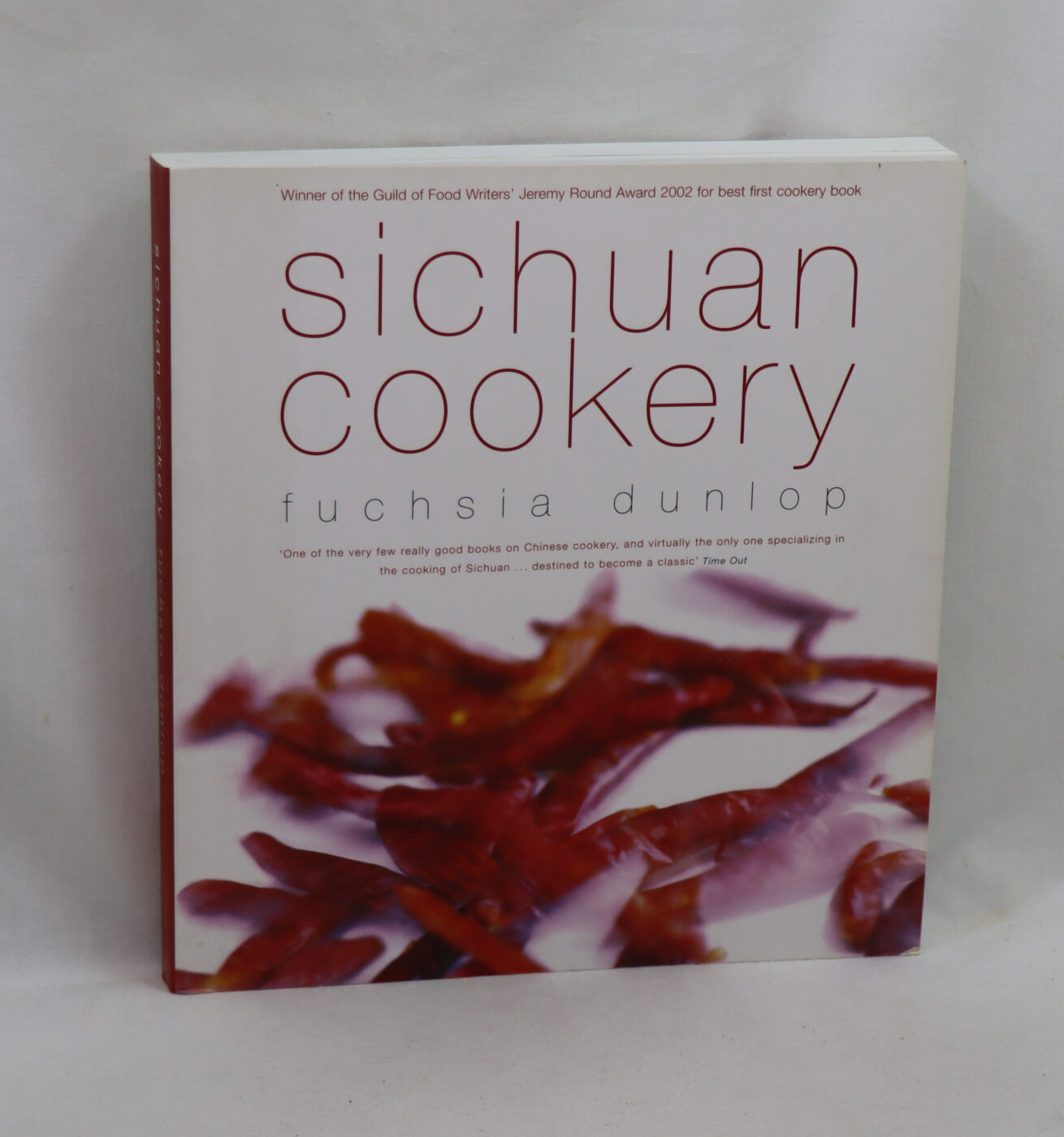
Sichuan Cookery.
By Fuchsia Dunlop
ISBN: 9781526617866
Printed: 2003
Publisher: Penguin Books. London
| Dimensions | 20 × 21 × 2 cm |
|---|---|
| Language |
Language: English
Size (cminches): 20 x 21 x 2
Condition: Very good (See explanation of ratings)
£19.00
Buy Now

Item information
Description
Paperback. White cover with red title.
We provide an in-depth photographic presentation of this item to stimulate your feeling and touch. More traditional book descriptions are immediately available.
- Note: This book carries a £5.00 discount to those that subscribe to the F.B.A. mailing list
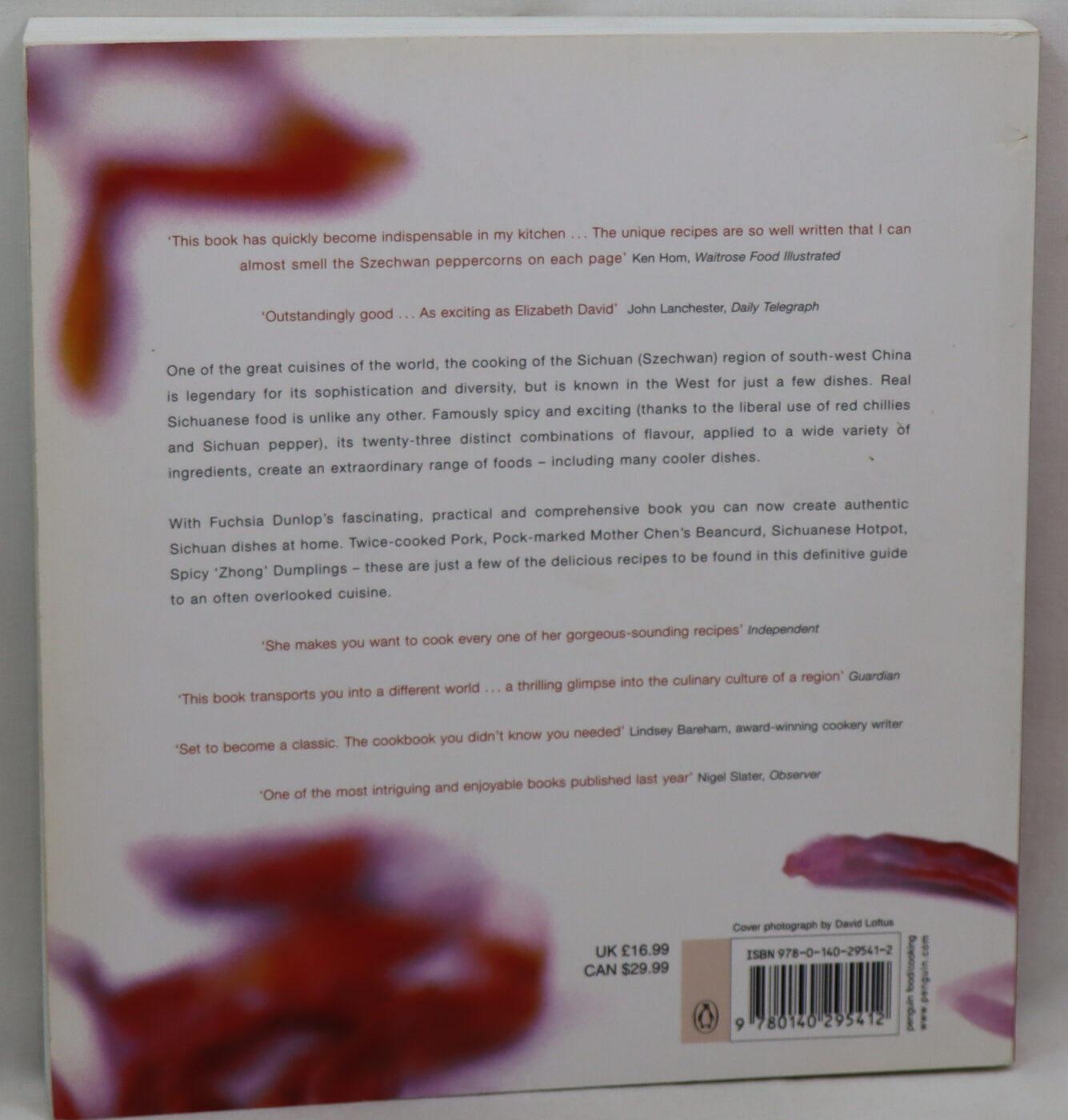
Sichuan food is one of the great unknown cuisines of the world, famous in Chinese history and legendary for its extraordinary variety and richness. Chinese people say that China is the place for food, but Sichuan is the place for flavour, and local gourmets claim the region boasts 5000 different dishes. This book includes sections on the history of Sichuan cooking, the 23 flavours of Sichuan, the region’s culinary culture, the art of cutting, presentation and nutrition, ingredients and methods for a whole range of recipes, from home peasant cooking to banquet dishes of the highest quality. Full of intriguing anecdotes and packed with the most delicious recipes, this book is an absolute must for those interested in this wonderful cuisine.
Review: As a Mandarin Chinese speaker who has worked in China and travelled there regularly, and spent time in Chengdu and Sichuan Province, I had eaten pretty much all of the dishes in this cookbook. Since buying it, I have cooked pretty much all of the recipes too. This is a wonderful cookbook. The recipes are straightforward and when followed closely, produce dishes that taste very much like the meals you get in good Sichuan restaurants in China itself. The acid test for me was mapo doufu, which is rarely done well in the UK, and yet is one of the signature dishes of Sichuan cooking (best eaten at the three Chen Mapo Doufu restaurants in Chengdu). Fuchsia Dunlop’s recipe delivers the end product, tasting the same as you would get in those restaurants. The dumplings taste like those you get in Longshaochou, a wonderful ‘small eats’ restaurant in the middle of Chengdu, and even the hotpot takes me back to places in that city and Chongqing (if you are travelling or living there, I recommend huangcheng laoma in southern Chengdu on the second ringroad, both for the food and the decor). Indeed, each recipe delivers real Sichuan cooking, with clear instructions. My only, very minor, gripe is that with some the quantities are on the previous page, so you flick backwards and forwards when cooking quickly with a very hot wok. For a future edition, I would recommend the whole recipe on a single opened out spread rather than across pages. So, to sum up: recipes that produce food you would get in China as authentic Sichuan food, clearly and well written with precise guidance that delivers outstanding results each time. Buy it and cook EVERY recipe – you won’t regret it.
Fuchsia Dunlop studied Sichuan cookery at the Sichuan Culinary Institute in Chengdu, where she lived from 1994-96. She is an East Asia specialist at the BBC World Service, and writes about Chinese food for Time Out magazine and guides.
NOTE: This is an original book from the library gathered by the famous Cambridge Don, computer scientist, food and wine connoisseur, Jack Arnold LANG. Note: Jack founded the Michelin Guide ‘Midsummer House’- Cambridge’s paramount restaurant. This dining experience is hidden amongst the grassy pastures and grazing cattle of Midsummer Common and perched on the banks of the River Cam.
In 2008, Jack was one of the co-founders of the Raspberry Pi Foundation, alongside other members of the Department, and acted as the Foundation’s Chair. The project’s original goals were modest: to build and distribute low-cost computers for prospective applicants to our Computer Science degree. Initially the project was a “success disaster”, as Jack would say, as demand far outstripped the low-scale manufacturing plans. Ultimately the Raspberry Pi became the UK’s most successful computer with more than 60 million sold to date. Jack was drawn to the educational possibilities of the Raspberry Pi, its potential uses in emerging economies and the way it could support self-directed learning.
Want to know more about this item?
We are happy to answer any questions you may have about this item. In addition, it is also possible to request more photographs if there is something specific you want illustrated.
Ask a question
Related products
Share this Page with a friend
