
Selective Writing of Emerson.
By Emerson
Printed: 1888
Publisher: Walter Scott. London
| Dimensions | 13 × 17 × 2 cm |
|---|---|
| Language |
Language: English
Size (cminches): 13 x 17 x 2
Condition: Very good (See explanation of ratings)
£488.00
FREE shipping
Buy Now
Your items

Item information
Description
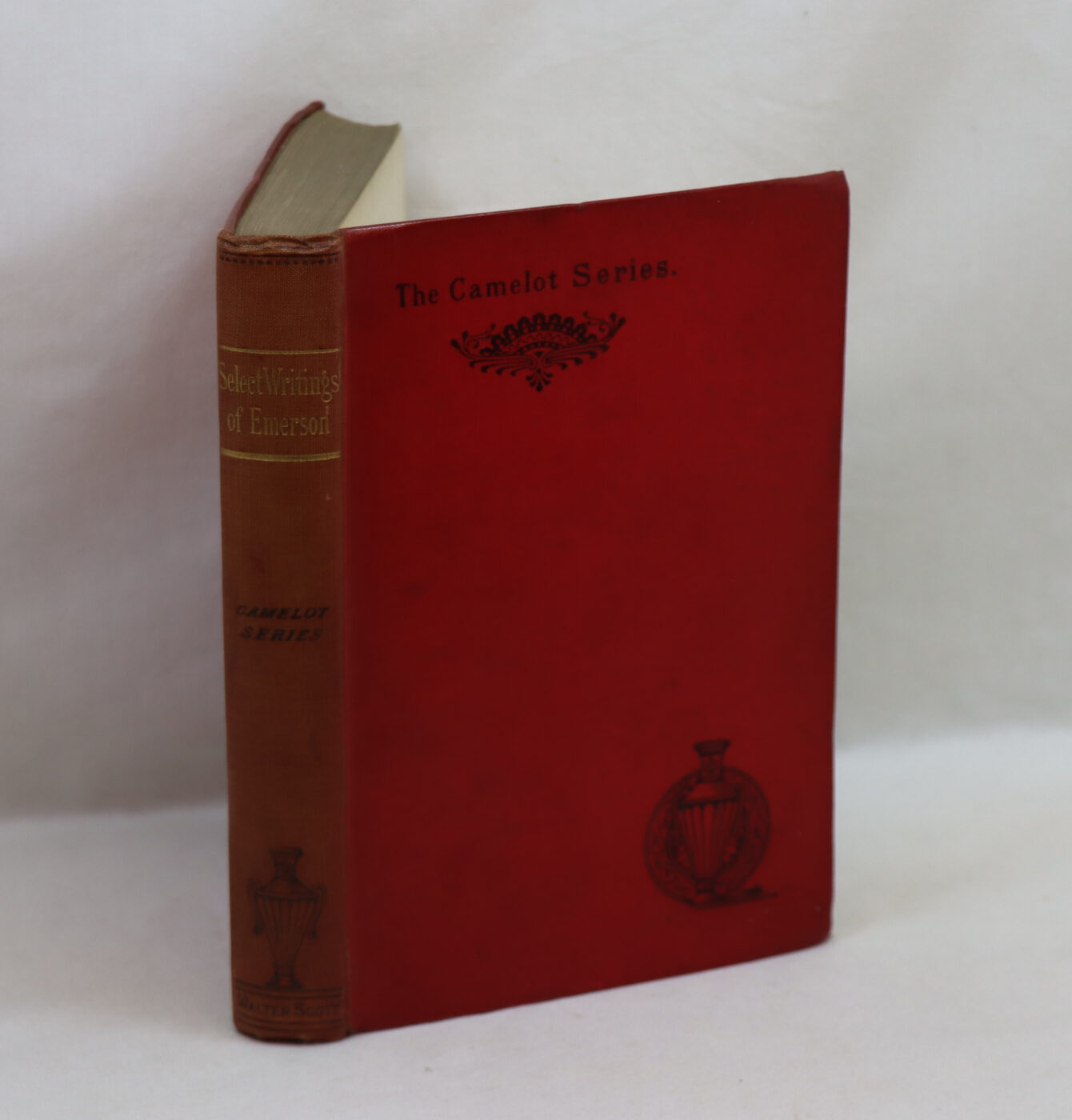
Red cloth binding with gilt title on the spine.
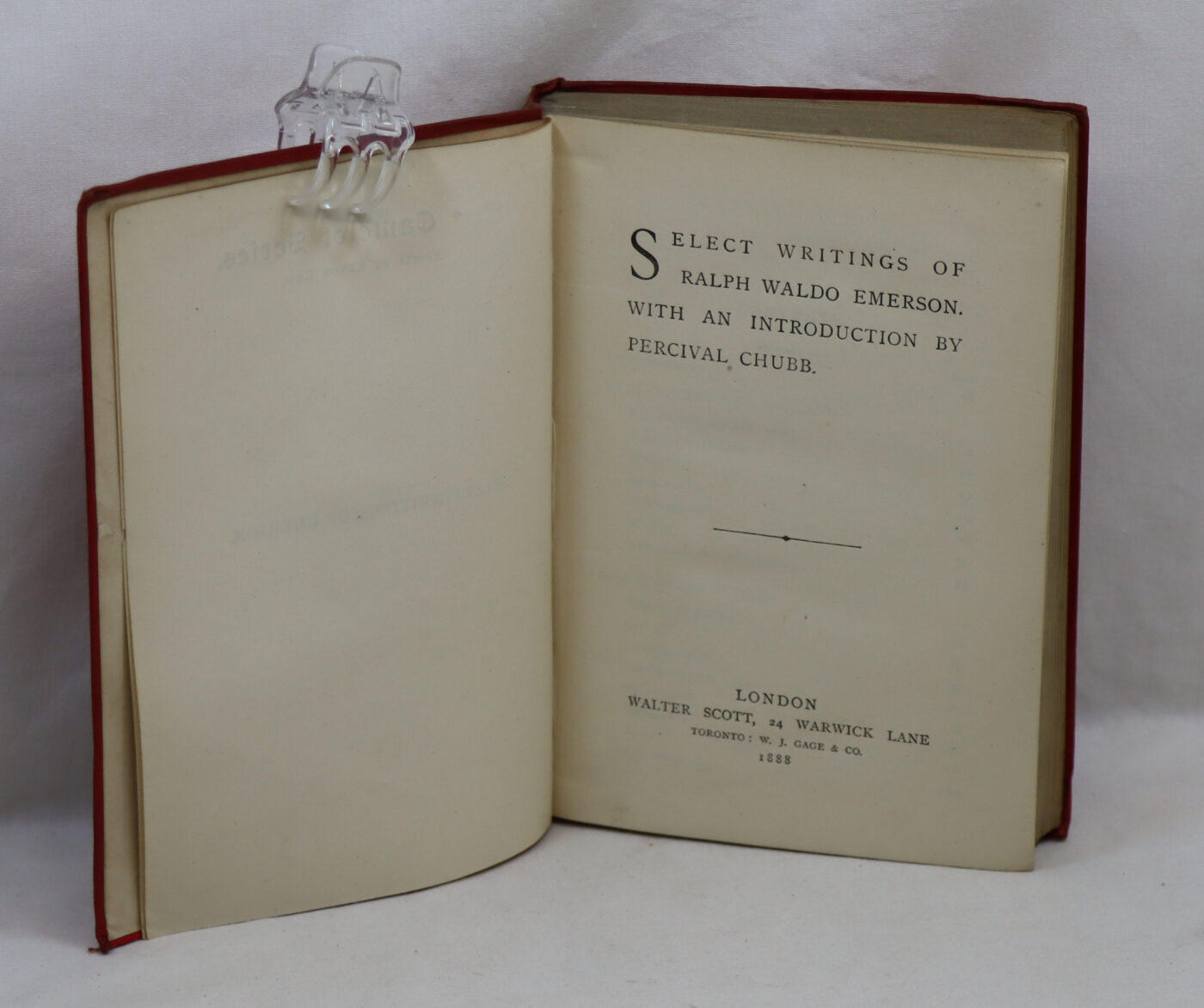
We provide an in-depth photographic presentation of this item to stimulate your feeling and touch. More traditional book descriptions are immediately available
- Note: This book carries a £5.00 discount to those that subscribe to the F.B.A. mailing list
For conditions, please view our photographs. A clean extremely rare original book from the library of the famous Cambridge Don, computer scientist, food and wine connoisseur, Jack Arnold LANG. Contains the nameplate of his father.
First Edition of Percival Chubb’s selection and analysis thereto of the writings of Ralph Waldo Emerson. Chubb’s work helped make Emerson’s writings accessible and contextualized them for new readers in the late 19th and early 20th centuries. Content: These collections aimed to present Emerson’s major works, highlighting his impact on Transcendentalism and American thought, as noted in back cover descriptions. Notably in editions of Select Writings of Ralph Waldo Emerson, with early ones appearing around 1888, featuring Chubb’s insights on Emerson’s philosophy, American Transcendentalism, and his role as an American “scholar”.
Ralph Waldo Emerson (May 25, 1803 – April 27, 1882), who went by his middle name Waldo, was an American essayist, lecturer, philosopher, minister, abolitionist, and poet who led the Transcendentalist movement of the mid-19th century. He was seen as a champion of individualism and critical thinking, as well as a prescient critic of the countervailing pressures of society and conformity. Friedrich Nietzsche thought he was “the most gifted of the Americans,” and Walt Whitman called Emerson his “master”.
Emerson gradually moved away from the religious and social beliefs of his contemporaries, formulating and expressing the philosophy of Transcendentalism in his 1836 essay, Nature. His speech “The American Scholar,” given in 1837, was called America’s “intellectual Declaration of Independence” by Oliver Wendell Holmes Sr.
Emerson wrote most of his important essays as lectures and then revised them for print. His first two collections of essays, Essays: First Series (1841) and Essays: Second Series (1844), represent the core of his thinking. They include the well-known essays “Self-Reliance”, “The Over-Soul,” “Circles,” “The Poet,” and “Experience.” Together with “Nature,” these essays made the mid-1830s to the mid-1840s Emerson’s most fertile period. Emerson wrote on a number of subjects, never espousing fixed philosophical tenets. He instead developed ideas such as individuality, freedom, the ability for mankind to realize almost anything, and the relationship between the soul and the surrounding world. Emerson’s “nature” was more philosophical than naturalistic: “Philosophically considered, the universe is composed of Nature and the Soul.” Emerson is one of several figures who “took a more pantheist or pandeist approach, by rejecting views of God as separate from the world.”
He remains among the linchpins of the American romantic movement, and his work has greatly influenced the thinkers, writers, and poets that followed him. “In all my lectures,” he wrote, “I have taught one doctrine, namely, the infinitude of the private man.” Emerson is also well-known as a mentor and friend of Henry David Thoreau, a fellow Transcendentalist.
Percival Ashley Chubb (June 17, 1860 in Devonport, Plymouth –1959) was a founding member of the Fabian Society, an influential British socialist organization that aims to advance the principles of democratic socialism via gradualist and reformist effort in democracies.
Born in 1860, Chubb attended the Stationers’ School in London. He entered the civil service in 1878, joining the legal department of the Local Government Board. In 1884, he helped found the Fabian Society, calling a series of meetings that led to the organization’s founding. Two years later, he joined the Ethical Society.
In 1889, Chubb emigrated to the United States, where he took a series of teaching jobs: first, lecturer at Thomas Davidson’s School of the Cultural Sciences in Farmington, Connecticut; then lecturer at the Brooklyn Academy of Arts and Sciences (1890-1892); Head of English, Brooklyn Manual Training High School (1893-1897); second-grade principal of New York Society’s Ethical Culture School (1897); lecturer at the Pratt Institute and New York University, New York. From 1897 to 1910, he was the associate leader of the Society for Ethical Culture of New York.
He married his second wife, Anna Sheldon, the widow of Walter Sheldon, founder of the St. Louis Ethical Society, which Chubb would lead from 1911 to 1932.
Chubb was the president of the Drama League of America from 1915-1920. He retired in 1932, but served as president of the American Ethical Union from 1934 to 1939.
His publications and related work include editing John Dryden’s Palamon and Arcite, a translation of The Knight’s Tale of Chaucer (New York, 1908); On the religious frontier: from an outpost of ethical religion (Macmillan Co, New York, 1931); The teaching of English in the elementary and secondary school (Macmillan Co, New York, 1902); and Introduction to Select writings of Ralph Waldo Emerson (1888); editor of Essays of Montaigne (1893). Chubb died in 1960.
Want to know more about this item?
We are happy to answer any questions you may have about this item. In addition, it is also possible to request more photographs if there is something specific you want illustrated.
Ask a question
Related products

Share this Page with a friend
