
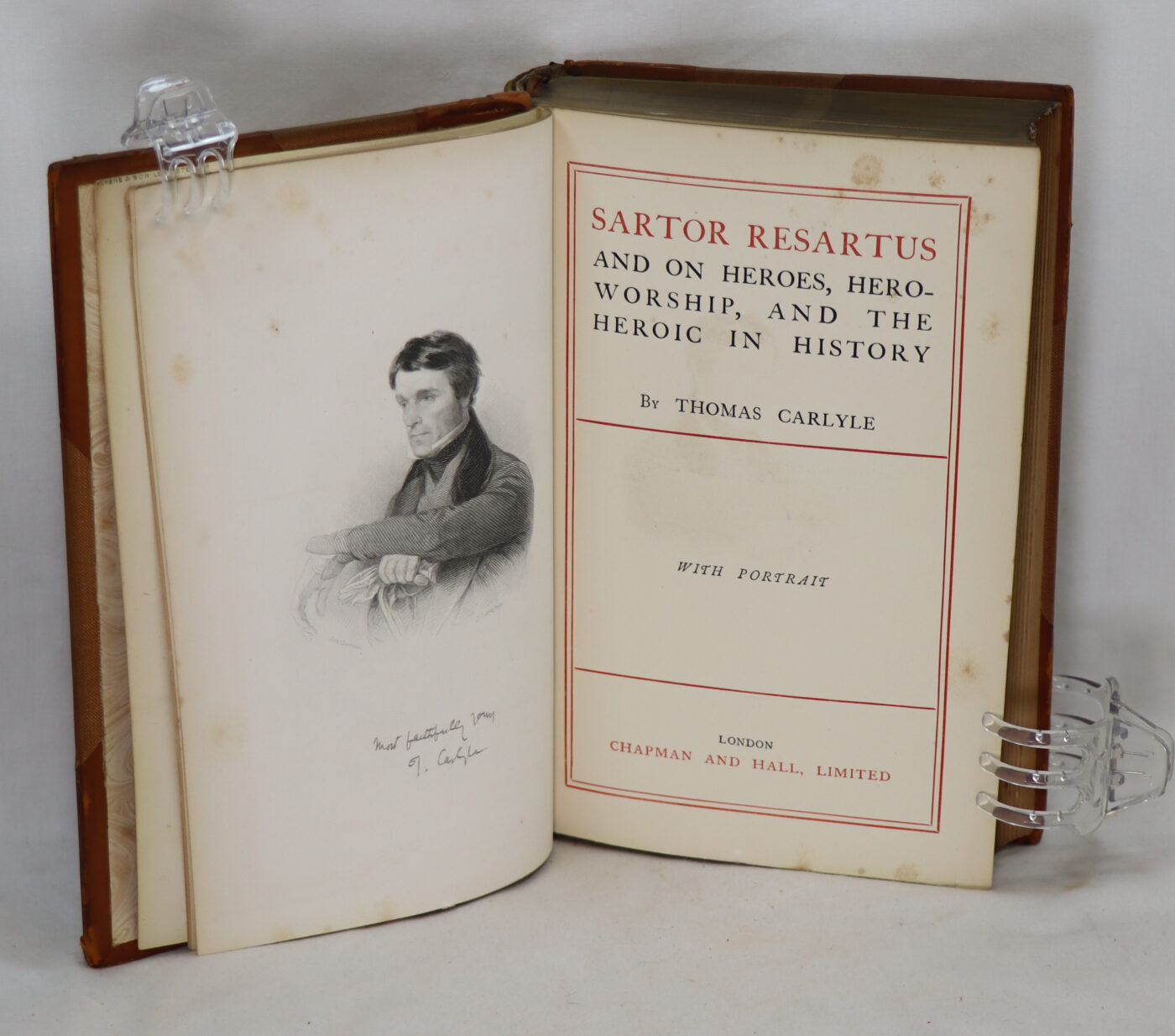
Sartor Resartus and on Heroes, Hero-worship and the Heroic in History.
By Thomas Carlyle
Printed: Circa 1858-1865
Publisher: Chapman & Hall. London
Edition: The Standard edition
| Dimensions | 15 × 22 × 4 cm |
|---|---|
| Language |
Language: English
Size (cminches): 15 x 22 x 4
Condition: Very good (See explanation of ratings)
£120.00
Buy Now
Your items

Item information
Description
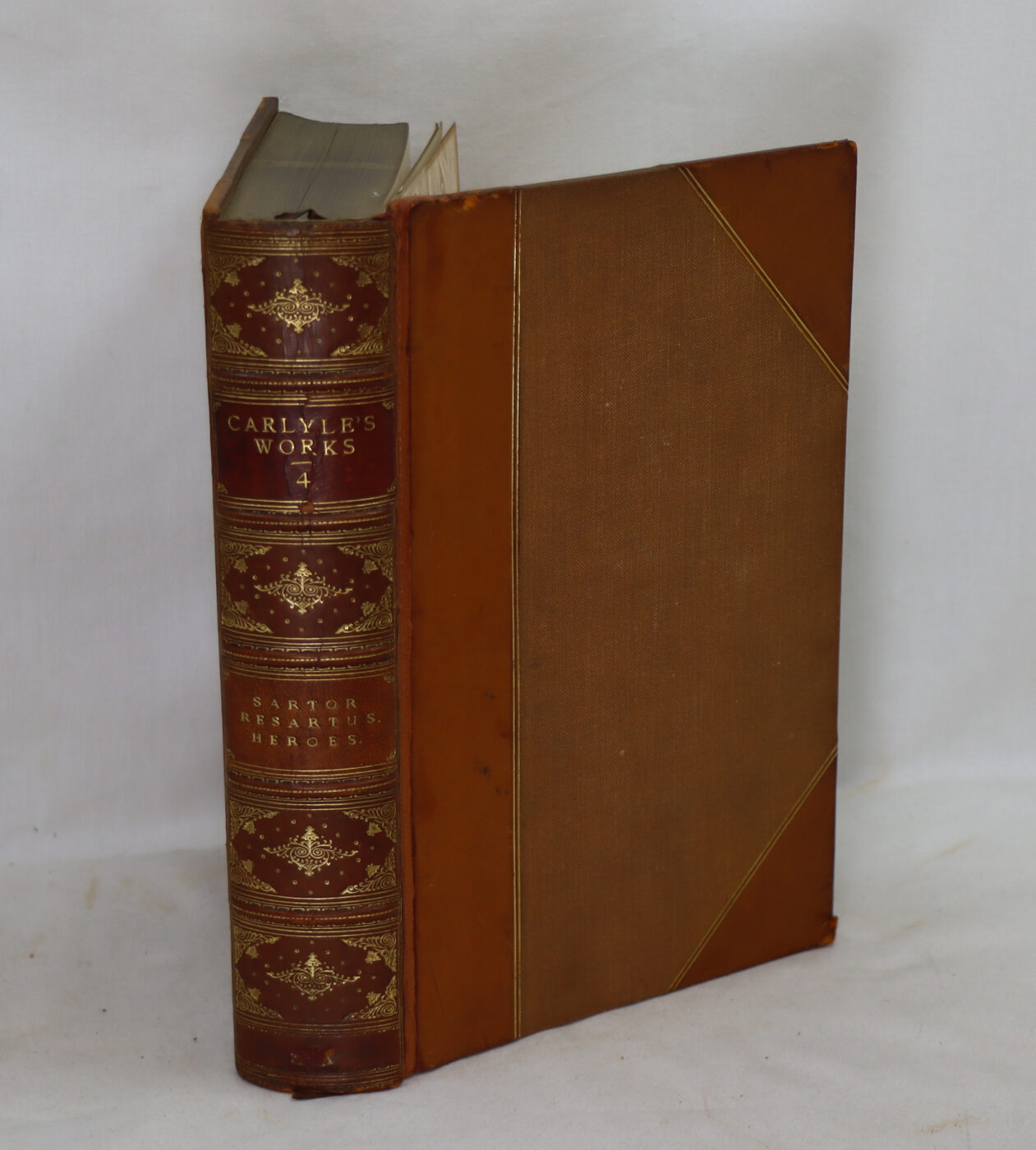
Tan calf spine with brown title plate, raised banding , gilt decoration and title. Tan cloth boards.
(Part of the Standard edition of 18 volumes). Bound by Bickers & Son. Leicester.
- Note: This book carries a £5.00 discount to those that subscribe to the F.B.A. mailing list
A great book both in content and presentation. For conditions, please view our photographs.
Sartor Resartus (1833–34) and On Heroes, Hero-Worship, and the Heroic in History (1841) are major 19th-century works by Thomas Carlyle, exploring philosophy, social critique, and historical leadership. Sartor Resartus uses a satirical “Philosophy of Clothes” to discuss existence, while On Heroes presents a six-lecture series championing the “Great Man” theory. Together, they represent a move away from 18th-century rationalism toward a Romantic, transcendentalist, and ultimately, a “reactionary” worldview that emphasized spiritual, organic, and authoritarian leadership over mechanical, democratic, or utilitarian progress.
On Heroes, Hero Worship, and the Heroic in History is a timeless masterpiece by Thomas Carlyle, a renowned Scottish historian, philosopher, and writer. The book, which is a series of six lectures by Thomas Carlyle, was published in 1841, and to date, it remains a classic exploration of the concept of heroism and its place in human history. Carlyle’s work is a captivating analysis through a series of six essays on how heroes have influenced history. He argues heroic figures have played a critical role in shaping human events. Through his insightful analysis, Carlyle provides readers with a unique perspective on the power of heroism and its ability to inspire and transform societies. In this thought-provoking book, Carlyle explores the lives of several historical figures. They include Odin, Luther, Cromwell, and Napoleon. He shows how their heroic actions and ideals have had a lasting impact on society. Carlyle’s vivid descriptions and passionate prose make this a fascinating read for anyone interested in history, philosophy, or human nature. He also delves into the psychological and spiritual aspects of hero worship and its role in shaping human identity and culture.
Thomas Carlyle (4 December 1795 – 5 February 1881) was a Scottish essayist, historian and philosopher. Known as the “sage of Chelsea”, his writings strongly influenced the intellectual and artistic culture of the Victorian era. Carlyle was born in Ecclefechan, a village in Dumfriesshire, Scotland. He attended the University of Edinburgh, where he excelled in mathematics and invented the Carlyle circle. After finishing the arts course he prepared to become a minister in the Burgher Church while working as a schoolmaster. He quit these and several other endeavours before settling on literature, writing for the Edinburgh Encyclopædia and working as a translator. He initially gained prominence in English-language literary circles for his extensive writing on German Romantic literature and philosophy. These themes were explored in his first major work, a semi-autobiographical philosophical novel entitled Sartor Resartus (1833–34).
Carlyle eventually relocated to London, where he published The French Revolution: A History (1837). Its popular success made him a celebrity, prompting the collection and reissue of his earlier essays under the title of Miscellanies. His subsequent works were highly regarded throughout Europe and North America, including On Heroes (1841), Past and Present (1843), Cromwell’s Letters (1845), Latter-Day Pamphlets (1850), and Frederick the Great (1858–65). He founded the London Library, helped to establish the National Portrait Galleries in London and in Edinburgh, became Lord Rector of the University of Edinburgh in 1865 and received the Pour le Mérite in 1874, amongst other honours.
Carlyle occupied a central position in Victorian culture, being considered the “undoubted head of English letters” and a “secular prophet”. Posthumously, a series of publications by his friend James Anthony Froude damaged Carlyle’s reputation, provoking controversy about his personal life and his marriage to Jane Welsh Carlyle in particular. His reputation further declined in the aftermaths of the First World War and the Second World War, when his philosophy was seen as a precursor of both Prussianism and fascism. Growing scholarship in the field of Carlyle studies since the 1950s has improved his standing, and although little-read today, he is yet recognised as “one of the enduring monuments of [English] literature”.
Want to know more about this item?
We are happy to answer any questions you may have about this item. In addition, it is also possible to request more photographs if there is something specific you want illustrated.
Ask a question
Related products
Share this Page with a friend
