
Riesling Renaissance.
By Freddy Price
ISBN: 9781840007770
Printed: 2004
Publisher: Mitchell Beazley. London
| Dimensions | 18 × 26 × 2 cm |
|---|---|
| Language |
Language: English
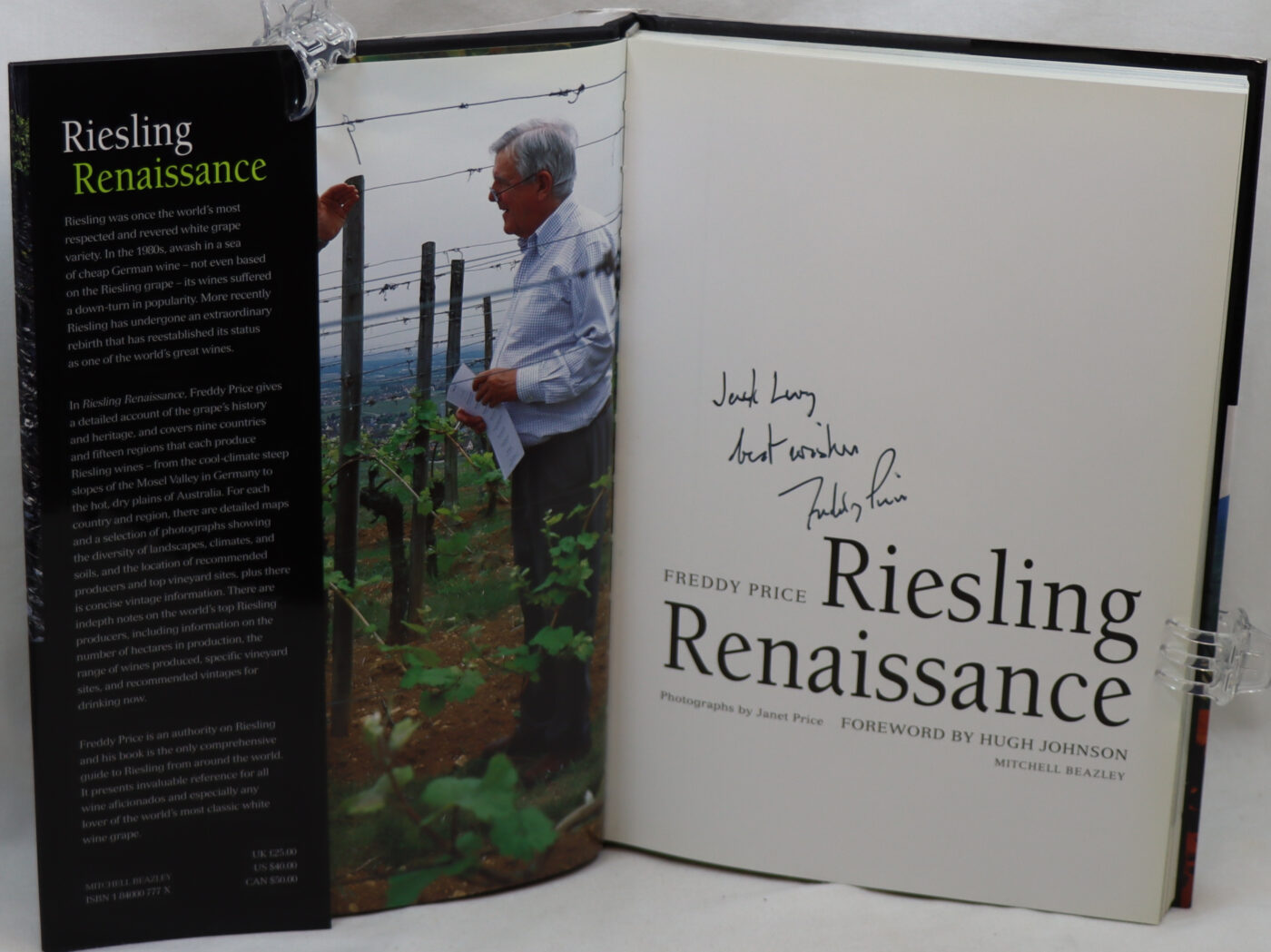
Signed by: Author
Size (cminches): 18 x 26 x 2
Condition: Very good (See explanation of ratings)
£57.00
Buy Now

Item information
Description
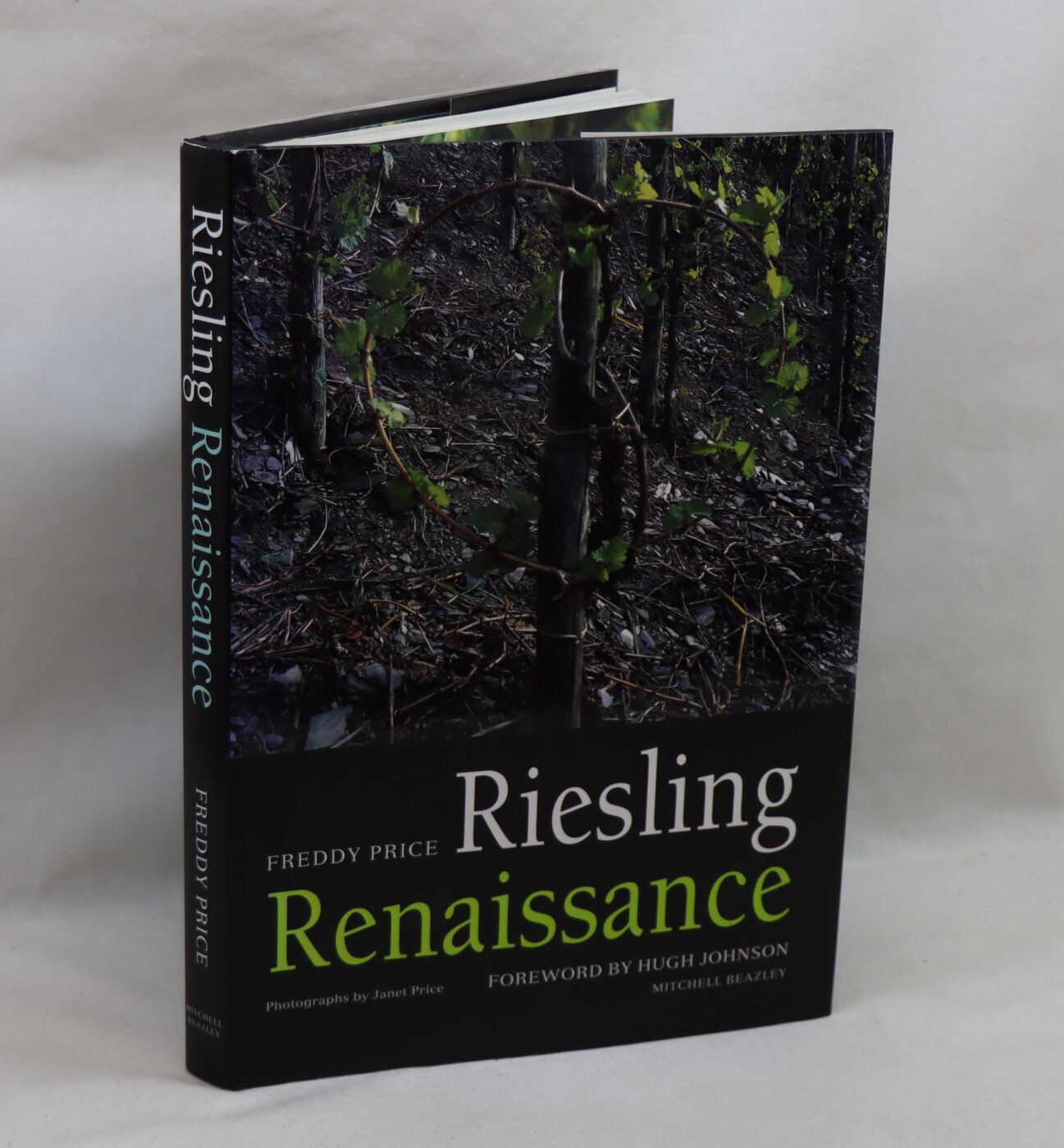
In the original dust jacket. Black board binding with silver title on the black spine.
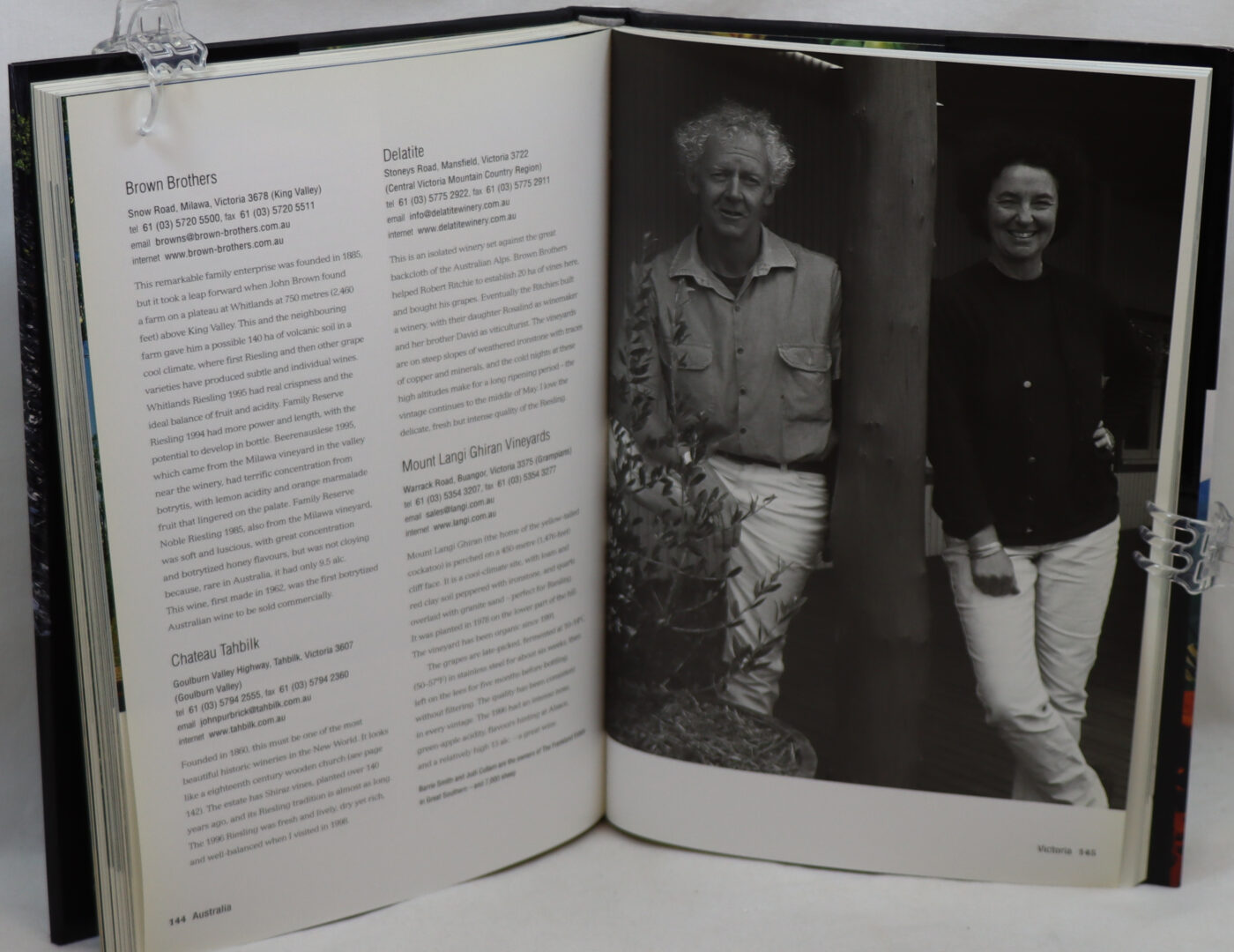
We provide an in-depth photographic presentation of this item to stimulate your feeling and touch. More traditional book descriptions are immediately available.
Note: This book carries a £5.00 discount to those that subscribe to the F.B.A. mailing list
Riesling has recently undergone an incredible leap in reputation, establishing itself once again as one of the world’s great wines. Freddy Price documents this renaissance, celebrating Riesling’s fascinating history and heritage, and covering the nine countries and fifteen regions that produce Riesling – from the cool-climate, steep slopes of the Mosel Valley to the hot, dry plains of Australia. He gives detailed accounts of the world’s top Riesling producers, including vital information on specific vineyard sites, production methods, and the range of wines produced. There are reviews of the best vintages, as well as recommendations of which wines are best to drink now. Over fifty full-colour photographs illustrate the diversity of the landscapes, and ten maps locate the top vineyard sites and the key Riesling producers.
Review: As you can gather from the title of the book, this is a book about what IMHO is the world’s best grape variety, Riesling. For a long time, it has been the favoured white wine variety of wine writers and wine nuts such as myself, probably because of three reasons: it has a lot of personality, it works well all along the scale from bone dry to intensely sweet, and it reflects “terroir” (local conditions) probably better than any other grape variety. It has been much less popular with consumers in general, but this has changed slightly in recent years, which is what the “Riesling Renaissance” is about. I suppose that the two main reasons are that German winemakers have been making a lot more of quality dry Rieslings and there is simply too much Chardonnay around.
Now, this nice book is rather about the Riesling producers and the Riesling-producing regions in general, than specifically about the Riesling Renaissance as a phonomenon. It is an encyclopaedic varietal book, not a textbook or a book with a story. After a short general introduction, we get some text about each country/region and then a list of the main Riesling producers, together with some nice illustrations. After some details/statistics, there is a short text about each producer. In many cases, we get a few short tasting notes from the author’s visit. While it gives some concrete illustration to the quality and style you can expect from each producer, these tasting notes will become outdated very quickly. I’m not sure if it’s really a good idea to include them in a book like this.
Another objection is that the book is somewhat “thin” on the general introduction and the overview of each country, and that interesting pieces of information is spread here and there in the sections, although I doubt that anyone will read a book like this from cover to cover. For example, I think that the Riesling Renaissance as such could have been given more coverage. Despite these small drawbacks, this is a good book that belongs on every Riesling fan’s bookshelf.
Freddy Price has worked as a wine merchant, agent, and consultant. In 1985, he set up the highly successful “The Magnificent Seven”, an agency representing seven major producers in Germany. He writes about German wine for Decanter and he regularly lectures and judges on tasting panels. His passion for Riesling has driven him to travel the world experiencing how it is made in different climates. Janet Price’s photographs illustrate wine books and magazines around the world. She has taken some hair-raising trips to South America, Australia, and almost every other wine-producing country in the world. Freddy and Janet live in London.
NOTE: This is an original book from the library gathered by the famous Cambridge Don, computer scientist, food and wine connoisseur, Jack Arnold LANG. Note: Jack founded the Michelin Guide ‘Midsummer House’- Cambridge’s paramount restaurant. This dining experience is hidden amongst the grassy pastures and grazing cattle of Midsummer Common and perched on the banks of the River Cam.
In 2008, Jack was one of the co-founders of the Raspberry Pi Foundation, alongside other members of the Department, and acted as the Foundation’s Chair. The project’s original goals were modest: to build and distribute low-cost computers for prospective applicants to our Computer Science degree. Initially the project was a “success disaster”, as Jack would say, as demand far outstripped the low-scale manufacturing plans. Ultimately the Raspberry Pi became the UK’s most successful computer with more than 60 million sold to date. Jack was drawn to the educational possibilities of the Raspberry Pi, its potential uses in emerging economies and the way it could support self-directed learning.e
Want to know more about this item?
We are happy to answer any questions you may have about this item. In addition, it is also possible to request more photographs if there is something specific you want illustrated.
Ask a question
Related products


Share this Page with a friend
