
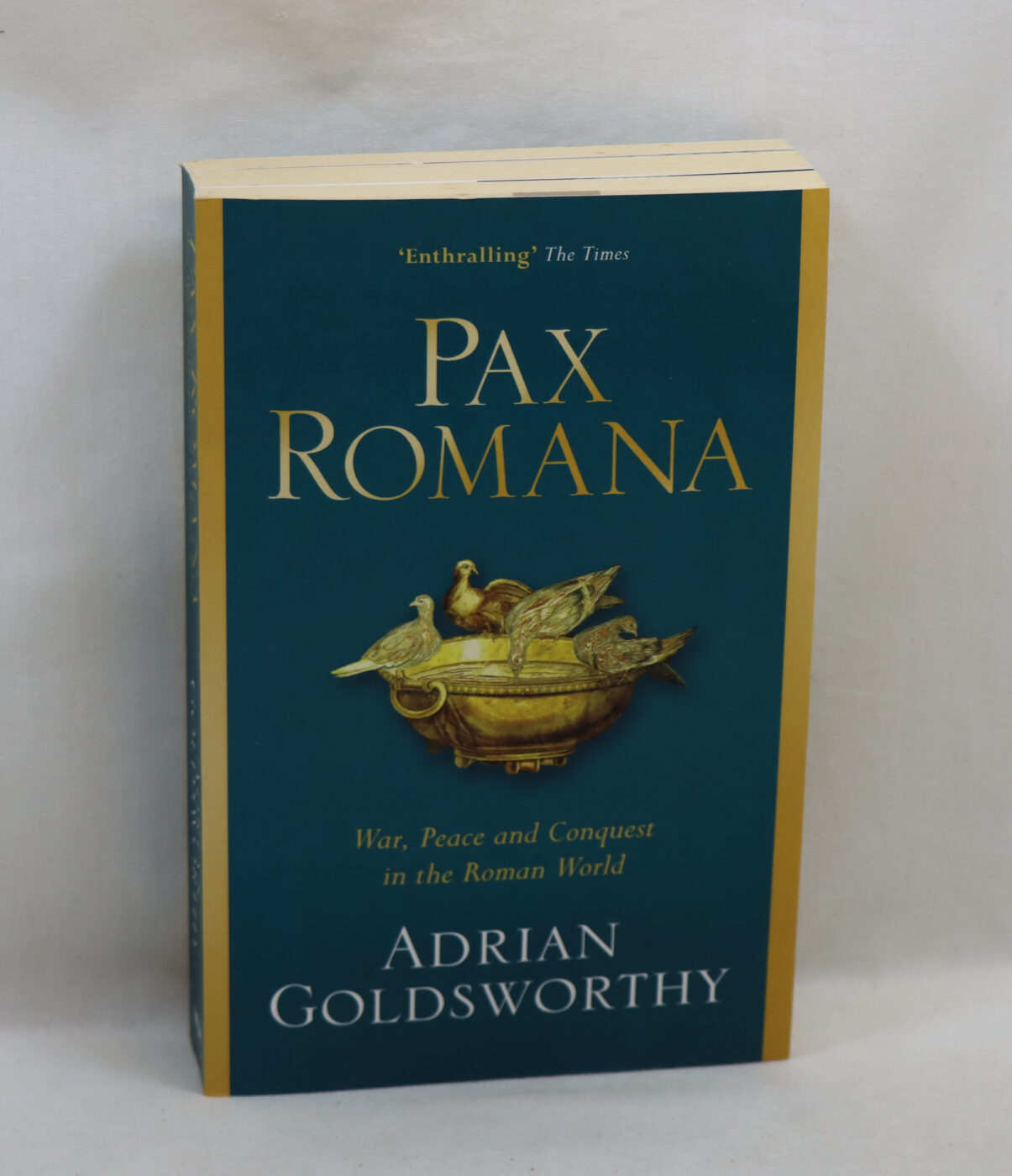
Pax Romana.
By Adrian Goldsworthy
ISBN: 9780300222265
Printed: 2017
Publisher: Weidenfeld & Nicholson. London
| Dimensions | 13 × 20 × 3 cm |
|---|---|
| Language |
Language: English
Size (cminches): 13 x 20 x 3
Condition: Very good (See explanation of ratings)
£7.00
Buy Now
Item information
Description
Paperback. Green cover with cream title.
We provide an in-depth photographic presentation of this item to stimulate your feeling and touch. More traditional book descriptions are immediately available
-
THIS FROST PAPERBACK is a USED book which a member of the Frost family has checked for condition, cleanliness, completeness and readability. When the buyer collects their book from Frost’s shop, the delivery charge of £3.00 is deducted
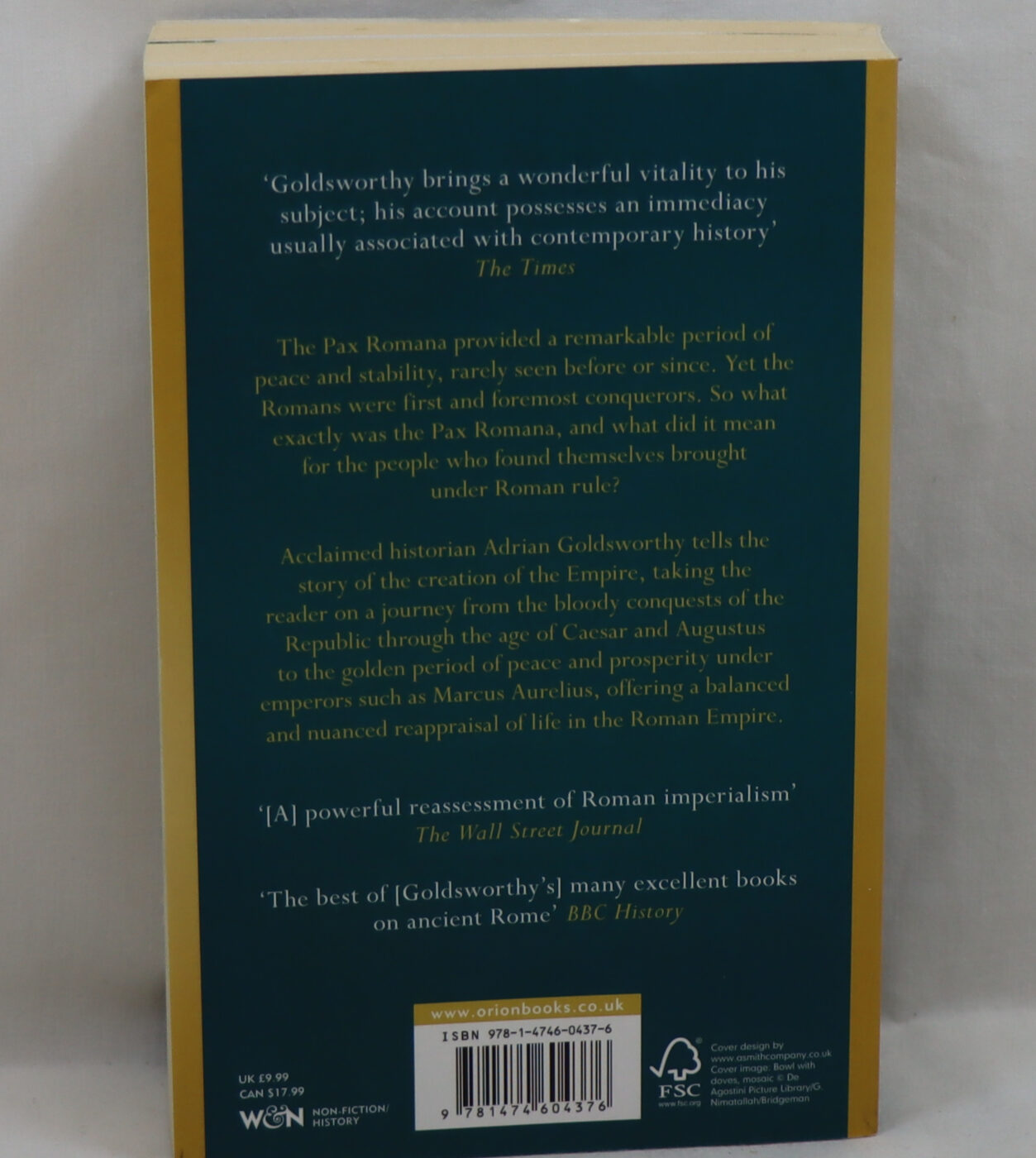
The Pax Romana is famous for having provided a remarkable period of peace and stability, rarely seen before or since. Yet the Romans were first and foremost conquerors, imperialists who took by force a vast empire stretching from the Euphrates in the east to the Atlantic coast in the west. Their peace meant Roman victory and was brought about by strength and dominance rather than co-existence with neighbours. The Romans were aggressive and ruthless, and during the creation of their empire millions died or were enslaved. But the Pax Romana was real, not merely the boast of emperors, and some of the regions in the Empire have never again lived for so many generations free from major wars. So what exactly was the Pax Romana and what did it mean for the people who found themselves brought under Roman rule? Acclaimed historian Adrian Goldsworthy tells the story of the creation of the Empire, revealing how and why the Romans came to control so much of the world and asking whether the favourable image of Roman peace is a true one. He chronicles the many rebellions by the conquered, and describes why these broke out and why most failed. At the same time, he explains that hostility was only one reaction to the arrival of Rome, and from the start there was alliance, collaboration and even enthusiasm for joining the invaders, all of which increased as resistance movements faded away. A ground-breaking and comprehensive history of the Roman Peace, Pax Romana takes the reader on a journey from the bloody conquests of an aggressive Republic through the age of Caesar and Augustus to the golden age of peace and prosperity under diligent emperors like Marcus Aurelius, offering a balanced and nuanced reappraisal of life in the Roman Empire.
Reviews:
-
Another success from one of my favourite Authors. Pax Romana delves into a world not just inhabited by Romans but one filled with various different cultures and peoples all fighting for power/glory/wealth and in some cases simply just for freedom from Rome. He shows that the Romans were not the only aggressive state/peoples in the ancient world but that they were by far the most successful of them. There are many reasons why they were more successful than other states/cultures and Adrian Goldsworthy looks and comments on these reasons with care, respect and a professionalism to not judge the Roman culture by 21st century standards (something the majority of us do when looking back through their history) It certainly appears that the PAX ROMANA did exist across the empire and existed for a long time in various places. He points out that some regions, once they had been defeated and turned into provinces or client states, experienced decades upon decades of uninterrupted peace. Now, this in itself proves the PAX ROMANA did exist, although it can be argued that various regions could or would have experienced long periods of peace if they had not been invaded and defeated by the Romans in the first place. Whatever your view on this (there will certainly be many) Adrian Goldsworthy succeeds yet again as he makes you form your own conclusions of the period. If you are a great lover of Roman history or have just started to explore the subject, PAX ROMANA has something for you. I fully recommend this book. A great read!
-
The author attempted to produce a balanced account of the Roman Empire, nevertheless he succumbed to the usual propensity of exaggerating its benefits and downplaying its drawbacks and faults, with the excuse that we cannot apply our own liberal standards to Ancient Societies. Pax Romana, like Pax Britannica, is a thesis that has acquired some authoritative validity amongst historians, based on a selective and biased interpretation of historical facts, to perpetuate the myth of a civilised benevolent Empire. It is based on the notion that the armed occupation and deployment of military might, imposed by an enlightened elite of a martial Empire, provided a great measure of security and stability in a dangerous world . A world constantly threatened by irruptions of violence perpetrated by uncivilised barbaric nations. The Roman legions by bringing law and order amongst divided and primitive warring tribes, facilitated the spread of prosperity and good governance in backward areas, and replaced the preceding insecure chaotic state of affairs. The Romans allowed their subjects some autonomy and the freedom of religious worship. There might be some validity in this analysis when applied to the Western parts of the Empire populated by fractious and unruly Celtic and Germanic tribes, but it should not be extrapolated to the East.It is a different matter when one examines the state of the East with the conquest and subjugation of sophisticated civilised ancient polities, in particular Carthage and the Hellenistic kingdoms of Greece, Asia Minor, Syria and Egypt. Even within the Italian peninsula, the hellenised Etruscan civilisation that was crushed by Rome, was vastly superior. The Roman military forays and interventions within a relatively peaceful Hellenistic World created far more instability and political disruption. The razing of Carthage, of Syracuse and of Corinth, the partial destruction of Alexandria’s library by Caesar’s troops and the destruction of the Jerusalem temple by Titus were barbaric destructive acts on a scale comparable to the ruthless pillage and rampage of the later Mongols or Tamerlane invasions. They too brought Pax Mongolica! The Empire wealth was founded on plunder for the benefit of the military and on the massive enslavement and uprooting of entire populations to work on the vast Italian estates of the senatorial elite and in the mines. The majority were brutally gang chained to labour in inhumane conditions and some were used to provide murderous gladiatorial spectacles for the benefit of the Roman populace. It is interesting to note that the gladiatorial spectacles were absent in the civilised Hellenistic parts of the Empire. Roman conceit despised the sophisticated cultured Greeks accusing them of effeminacy. It demonised the Celtic druids accusing them of presiding over human sacrifices with no archeological evidence to support it. But its venomous animosity was mostly reserved for the Jews and Christians. The plunder of conquest helped to enrich the Roman elites and funded the lavish architectural development in Rome. The glorification of the feat of arms documenting the humiliating subjugation of neighbouring foes, led to the erection of triumphal arches and columns all over the Empire, accompanied by the cult of divinised Emperors. From Rome’s beginnings internal peace was constantly disrupted by political and social strife. The Republic was repeatedly convulsed by conflict between the Plebs and the Patricians, by civil wars between Warlords; Marius versus Sulla, Pompey versus Caesar, Octavian versus Antony. It witnessed large scale slave rebellions in Italy and Sicily that were brutally suppressed. The Augustan Empire after the death of its founder, produced a series of pathologically disturbed and murderous Emperors, who were dispatched by their courtiers or Praetorian Guards. The pattern continued. Gibbon reminds us that the best period of the Empire were the few decades between the death of Domitian and the accession of Commodus. The third century witnessed a permanent constitutional crisis with a rapid succession of inept short lasting Emperors mostly recruited among the legion commanders from the frontiers. The highly prized peace was threatened by peasant rebellions, barbarian invasions, civil wars and economic collapse with the debasement of the currency aggravating the political instability. It is a miracle that the Empire survived until the reign of Diocletian, the greatest persecutor of Christians. Pax Romana relied on regular shipments of grain from Egypt and Sicily to keep the Roman populace at peace. There is a lot of truth in the adage of “ Bread and Circuses”. Rome offered the privileges of citizenship to placate the various elites of the distant Provinces who were given the task of raising taxes and recruiting auxiliary military forces. The cult of the divine Emperor, a test of loyalty, was imposed on all lands without exception, thus creating a violent rejection from the Monotheistic Jews who rebelled and took arms against this imposition. Pax Romana at best lasted a few decades, and it benefited a small portion of the population. It is a disputable notion that should be critically revised when applied to the entire historical existence of Rome.
Want to know more about this item?
We are happy to answer any questions you may have about this item. In addition, it is also possible to request more photographs if there is something specific you want illustrated.
Ask a question
Related products






Share this Page with a friend
