
Never Too Late To Mend.
By Charles Reade
Printed: Circa 1910
Publisher: The Walter Scott Publishing Co. London
| Dimensions | 14 × 19 × 3 cm |
|---|---|
| Language |
Language: English
Size (cminches): 14 x 19 x 3
Condition: Fine (See explanation of ratings)
£48.00
Buy Now

Item information
Description
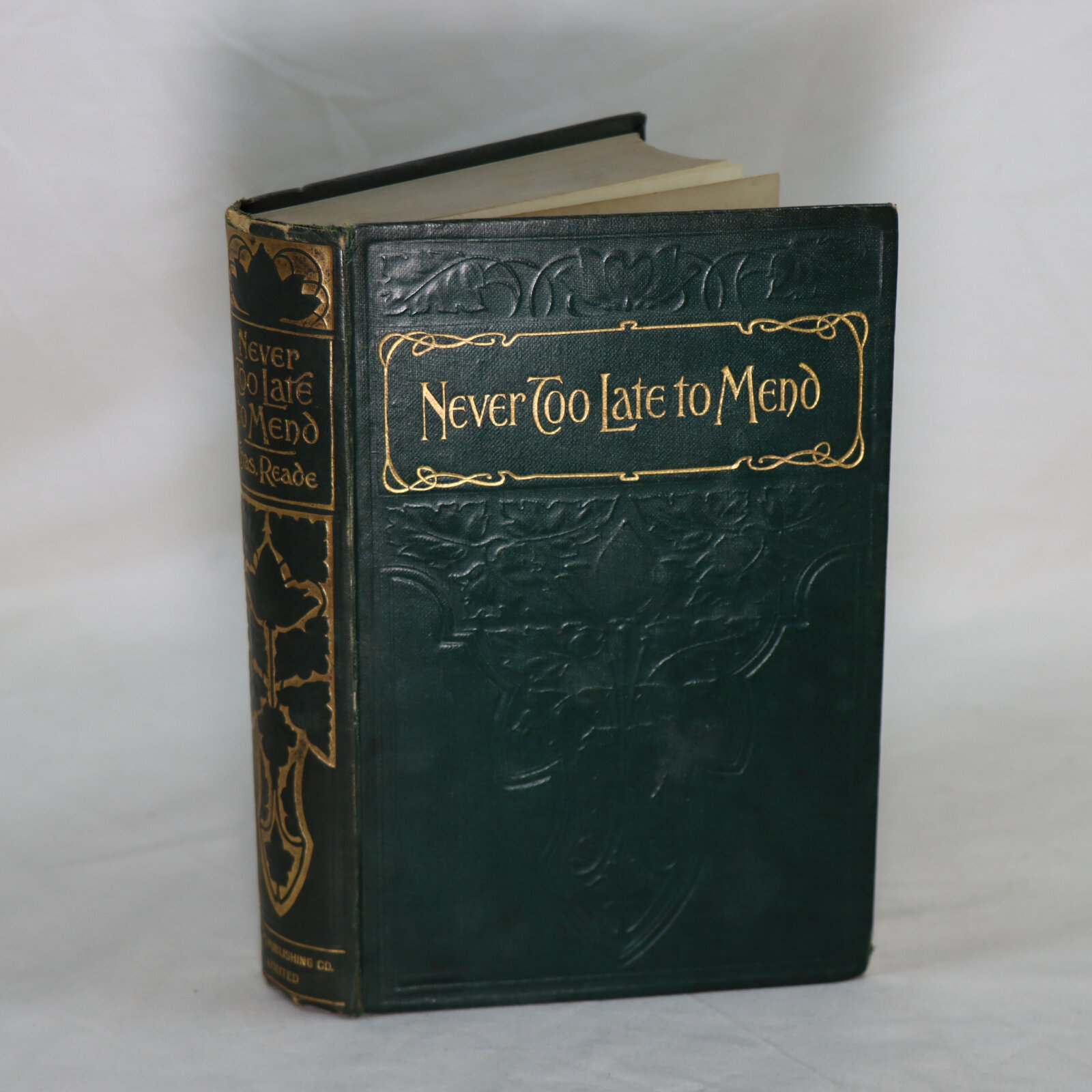
Green cloth binding with gilt title on the spine and the front board.
-
F.B.A. provides an in-depth photographic presentation of this item to stimulate your feeling and touch. More traditional book descriptions are immediately available.
-
Note: This book carries the £5.00 discount to those that subscribe to the F.B.A. mailing list.
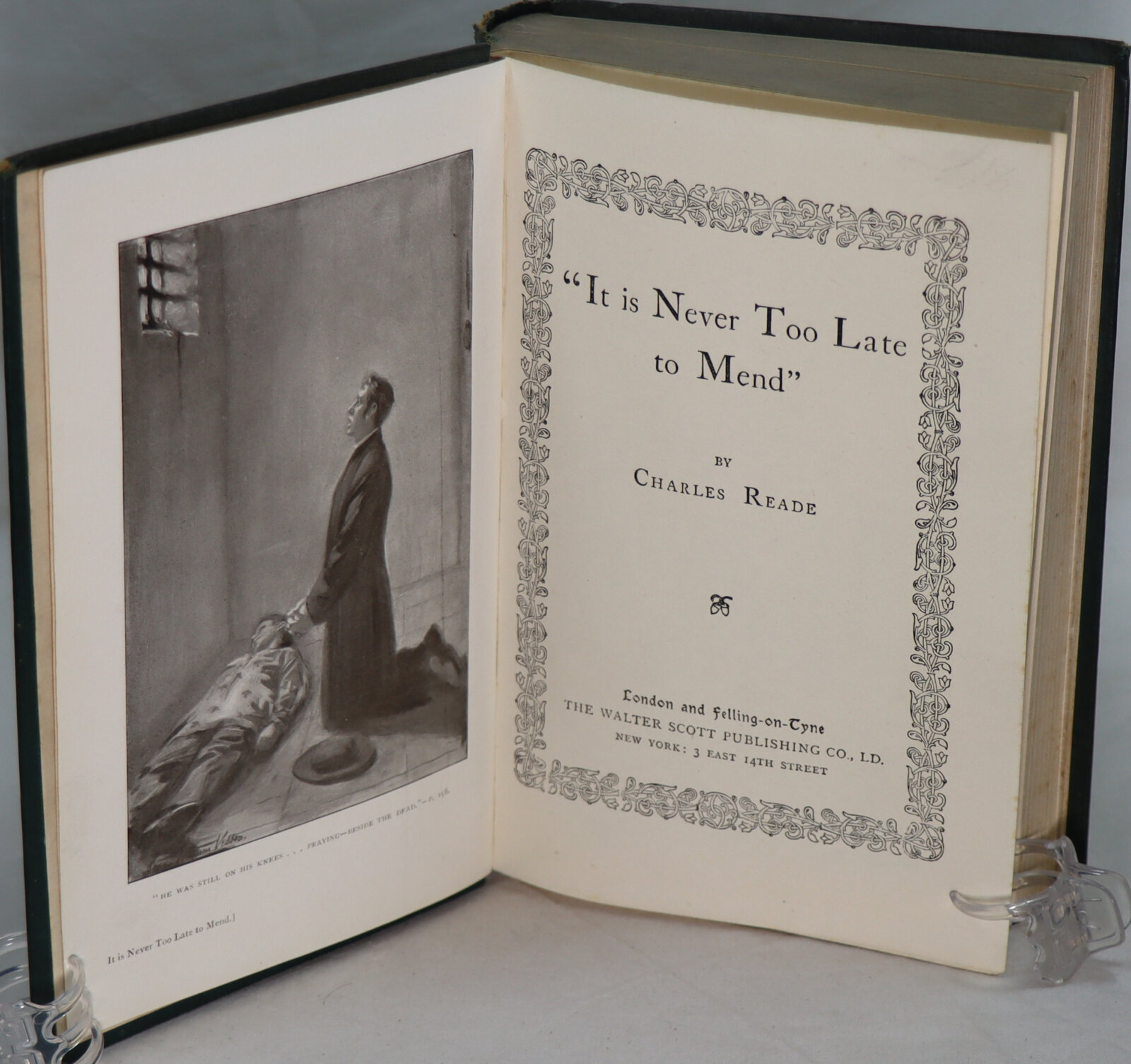
It Is Never Too Late to Mend (sometimes written as It’s Never Too Late to Mend) is an 1856 novel by the British writer Charles Reade. It was later turned into a play. A ruthless squire becomes obsessed with a younger woman and conspires to have her lover framed and sent to jail. The book is mentioned in Jack Black’s 1926 book You Can’t Win as an inspiration to Black while in prison. The Ven. George Hans Hamilton (21 Jan 1823 to 23 Sept 1905) was Chaplain of Durham Jail, and his fame concerning prison reform led to his being used as the original of the Chaplain in this book.

Reade made his name as a novelist in 1856, when he published It Is Never Too Late to Mend, a novel written to reform abuses in prison discipline and the treatment of criminals. The truth of some details was challenged, and Reade defended himself vigorously.
Reade began his literary career as a dramatist, and he chose to have “dramatist” stand first in the list of his occupations on his tombstone. As an author, he always had an eye to stage effect in scenes and situations as well as in dialogue. His first comedy, The Ladies’ Battle, appeared at the Olympic Theatre in May 1851. It was followed by Angela (1851), A Village Tale (1852), The Lost Husband (1852), and Gold (1853). But Reade’s reputation was made by the two-act comedy, Masks and Faces, in which he collaborated with Tom Taylor. It was produced in November 1852, and later was expanded into three acts. By the advice of the actress, Laura Seymour, he turned the play into a prose story which appeared in 1853 as Peg Woffington. The same year he wrote Christie Johnstone, a close study of Scottish fisher folk. In 1854 he produced, in conjunction with Tom Taylor, Two Loves and a Life, and The King’s Rival, and, unaided, The Courier of Lyons (well known under its later title, The Lyons Mail) and his adaptation of Tobias Smollett’s Peregrine Pickle. In the next year Art (1855), afterwards known as Nance Oldfield. He made his name as a novelist in 1856, when he published It Is Never Too Late to Mend, a novel written to reform abuses in prison discipline and the treatment of criminals. The truth of some details was challenged, and Reade defended himself vigorously. Five more novels followed in quick succession: The Course of True Love Never Did Run Smooth (1857), White Lies (1857), Jack of all Trades (1858), The Autobiography of a Thief (1858), and Love Me Little, Love Me Long (1859). White Lies started as a translation of Auguste Maquet’s play Le Château de Grantier. After managers declined the manuscript, Reade adapted the story, weaving it into a novel which was serialised in The London Journal and published in three volumes the same year. He produced an adaptation of this on stage as The Double Marriage in 1867.
Want to know more about this item?
We are happy to answer any questions you may have about this item. In addition, it is also possible to request more photographs if there is something specific you want illustrated.
Ask a question
Related products

Share this Page with a friend
