
Mr Punch's History of the Great War.
Printed: 1919
Publisher: Cassell & Co. London
| Dimensions | 17 × 24 × 5 cm |
|---|---|
| Language |
Language: English
Size (cminches): 17 x 24 x 5
Condition: Good (See explanation of ratings)
£38.00
Buy Now
Your items

Item information
Description
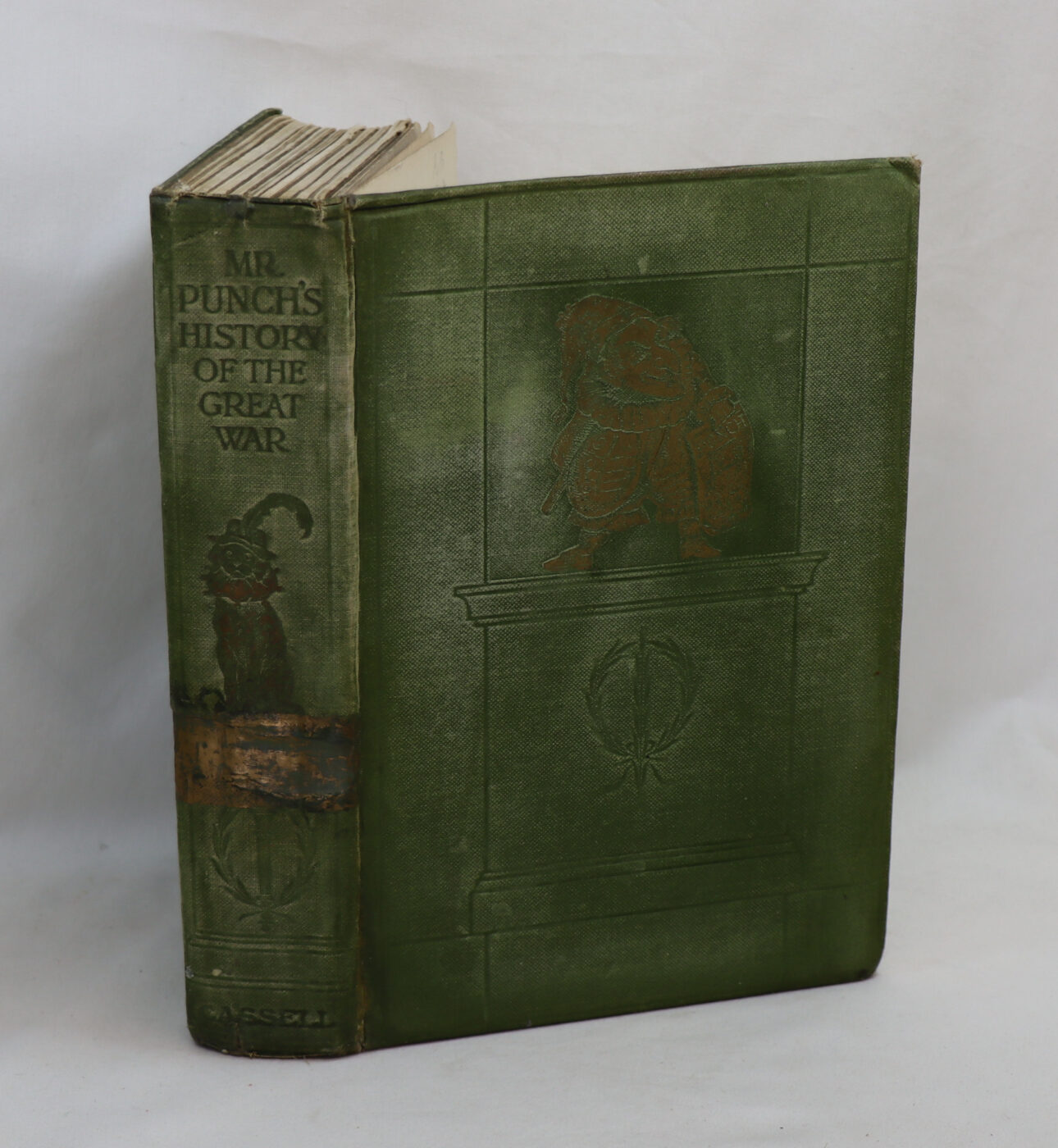
Green cloth binding with gilt title on the spine.
We provide an in-depth photographic presentation of this item to stimulate your feeling and touch. More traditional book descriptions are immediately available.
- Note: This book carries a £5.00 discount to those that subscribe to the F.B.A. mailing list
Please view our photographs. This is a historic book of British idealism when England not only ruled the world but was not ashamed to demonstrate it.
PROLOGUE TO MR PUNCH
Though a lover of peace, Mr. Punch from his earliest days has not been unfamiliar with war. He was born during the Afghan campaign; in his youth England fought side by side with the French in the Crimea; he saw the old Queen bestow the first Victoria Crosses in 1857; he was moved and stirred by the horrors and heroisms of the Indian Mutiny. A little later on, when our relations with France were strained by the Imperialism of Louis Napoleon, he had witnessed the rise of the volunteer movement and made merry with the activities of the citizen soldier of Brook Green. Later on again he had watched, not without grave misgiving, the growth of the great Prussian war machine which crushed Denmark, overthrew Austria, and having isolated France, overwhelmed her heroic resistance by superior numbers and science, and stripped her of Alsace-Lorraine.
In May, 1864, Mr. Punch presented the King of Prussia with the “Order of St. Gibbet” for his treatment of Denmark.
In August of the same year he portrayed the brigands dividing the spoil and Prussia grabbing the lion’s share, thus foreshadowing the inevitable conflict with Austria.
In the war of 1870–1 he showed France on her knees but defying the new Cæsar, and arraigned Bismarck before the altar of Justice for demanding exorbitant securities.
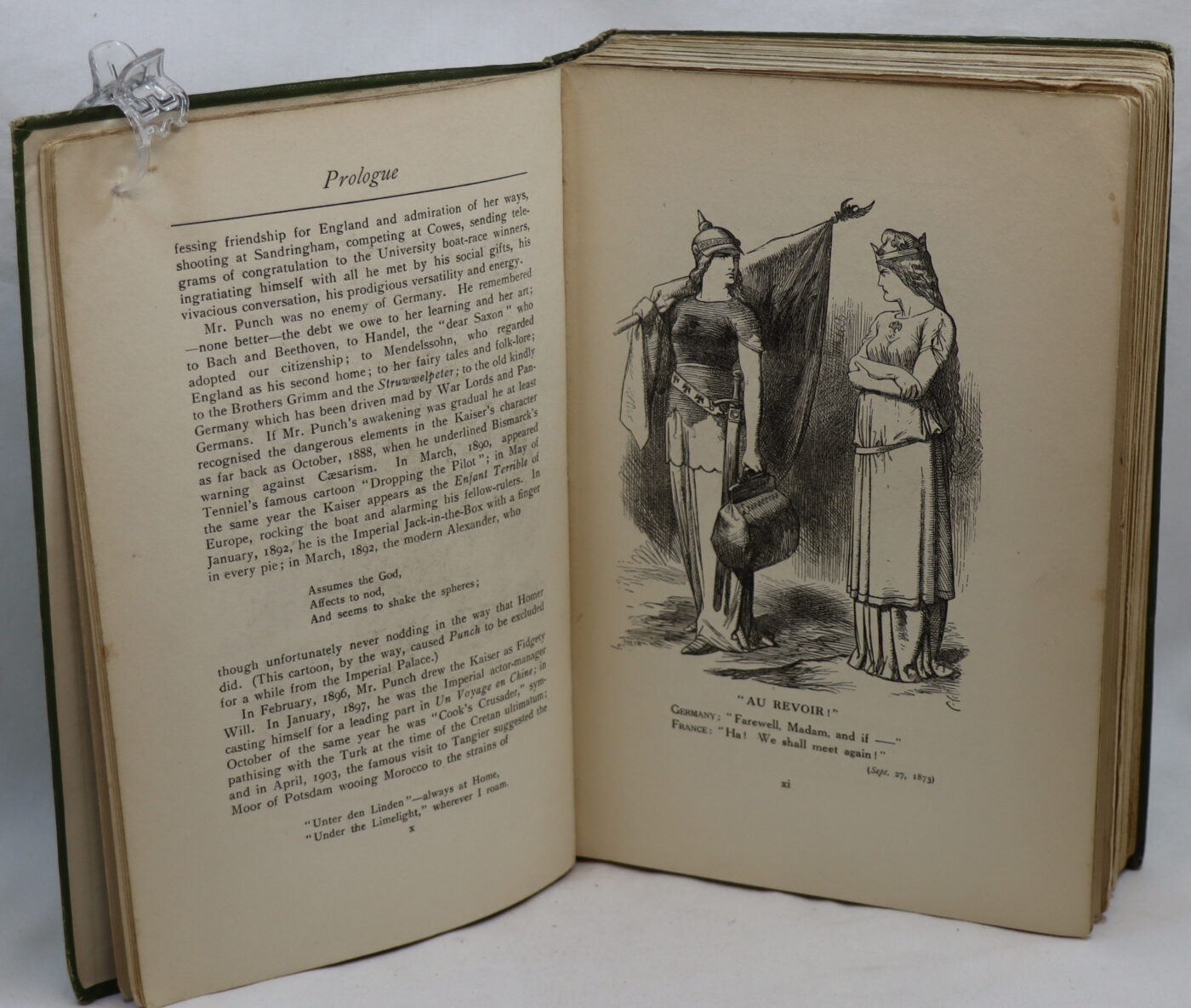
And in 1873, when the German occupation was ended by the payment of the indemnity, in a flash of prophetic vision Mr. Punch pictured France, vanquished but unsubdued, bidding her conqueror “Au revoir.”
More than forty years followed, years of peace and prosperity for Great Britain, only broken by the South African war, the wounds of which were healed by a generous settlement. But all the time Germany was preparing for “The Day,” steadily perfecting her war machine, enlarging her armies, creating a great fleet, and piling up colossal supplies of guns and munitions, while her professors and historians, harnessed to the car of militarism, inflamed the people against England as the jealous enemy of Germany’s legitimate expansion. Abroad, like a great octopus, she was fastening the tentacles of permeation and penetration in every corner of the globe, honeycombing Russia and Belgium, France, England and America with secret agents, spying and intriguing and abusing our hospitality. For twenty-five years the Kaiser was our frequent and honoured, if somewhat embarrassing, guest, professing friendship for England and admiration of her ways, shooting at Sandringham, competing at Cowes, sending telegrams of congratulation to the University boat-race winners, ingratiating himself with all he met by his social gifts, his vivacious conversation, his prodigious versatility and energy.
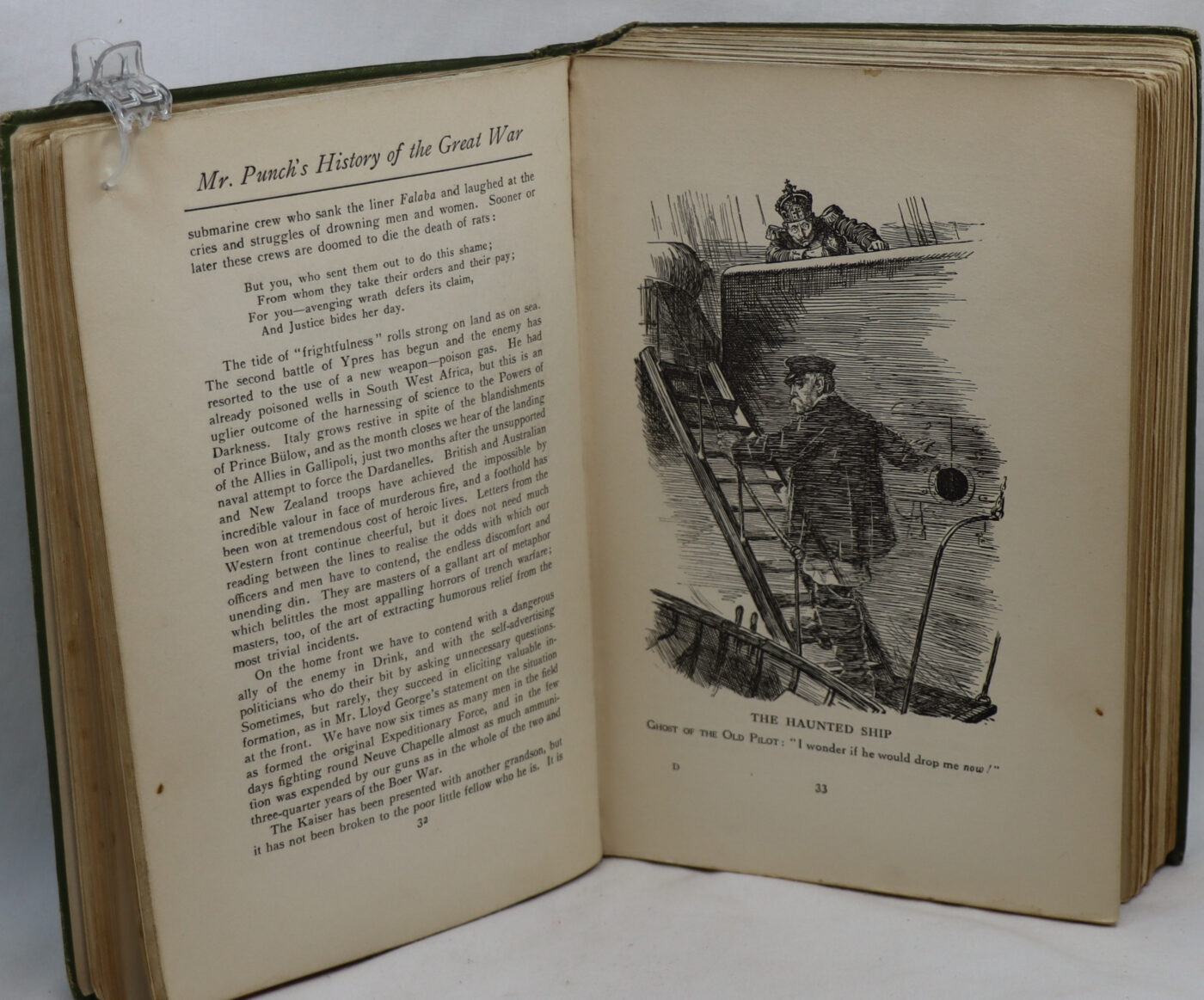
Mr. Punch was no enemy of Germany. He remembered—none better—the debt we owe to her learning and her art; to Bach and Beethoven, to Handel, the “dear Saxon” who adopted our citizenship; to Mendelssohn, who regarded England as his second home; to her fairy tales and folk-lore; to the Brothers Grimm and the Struwwelpeter; to the old kindly Germany which has been driven mad by War Lords and PanGermans. If Mr. Punch’s awakening was gradual he at least recognised the dangerous elements in the Kaiser’s character as far back as October, 1888, when he underlined Bismarck’s warning against Cæsarism. In March, 1890, appeared Tenniel’s famous cartoon “Dropping the Pilot”; in May of the same year the Kaiser appears as the Enfant Terrible of Europe, rocking the boat and alarming his fellow-rulers. In January, 1892, he is the Imperial Jack-in-the-Box with a finger in every pie; in March, 1892, the modern Alexander, who
Assumes the God,
Affects to nod,
And seems to shake the spheres;
though unfortunately never nodding in the way that Homer did. (This cartoon, by the way, caused Punch to be excluded for a while from the Imperial Palace.)
In February, 1896, Mr. Punch drew the Kaiser as Fidgety Will. In January, 1897, he was the Imperial actor-manager casting himself for a leading part in Un Voyage en Chine; in October of the same year he was “Cook’s Crusader,” sympathising with the Turk at the time of the Cretan ultimatum; and in April, 1903, the famous visit to Tangier suggested the Moor of Potsdam wooing Morocco.
In 1905 the Kaiser was “The Sower of Tares,” the enemy of Europe.
In 1910 he was Teutonising and Prussifying Turkey; in 1911 discovering to his discomfort that the Triple Entente was a solid fact.
And in September, 1913, he was shown as unable to dissemble his disappointment at the defeat of the German-trained Turkish army by the Balkan League.
So, too, with Turkey. From 1876 to 1913 Mr. Punch’s cartoons on the Near East are one continuous and illuminating commentary on Lord Salisbury’s historic admission that we had “backed the wrong horse,” culminating in the cartoon “Armageddon: a Diversion” in December, 1912, when Turkey says “Good! If only all these other Christian nations get at one another’s throats I may have a dog’s chance yet.” Throughout the entire series the Sick Man remains cynical and impenitent, blowing endless bubble-promises of reform from his hookah, bullying and massacring his subject races whenever he had the chance, playing off the jealousies of the Powers, one against the other, to further his own sinister ends.
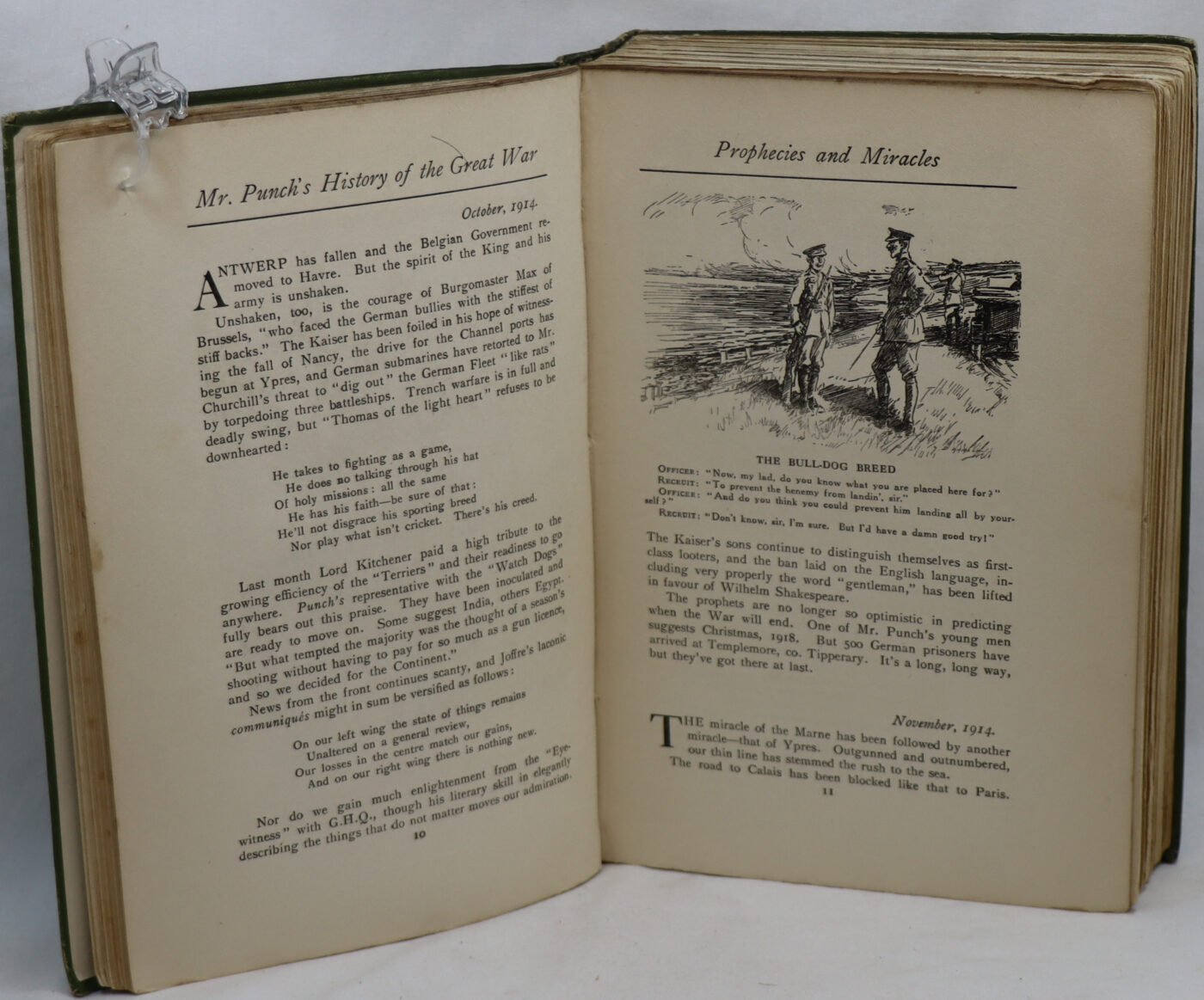
This is no formal History of the War in the strict or scientific sense of the phrase; no detailed record of naval and military operations. There have been many occasions on which silence or reticence seemed the only way to maintain the national composure. It is Mr. Punch’s History of the Great War, a mirror of varying moods, month by month, but reflecting in the main how England remained steadfastly true to her best traditions; how all sorts and conditions of men and women comported themselves throughout the greatest ordeal that had ever befallen their race.
Condition notes
spine marked
Want to know more about this item?
We are happy to answer any questions you may have about this item. In addition, it is also possible to request more photographs if there is something specific you want illustrated.
Ask a question
Related products

Share this Page with a friend
