
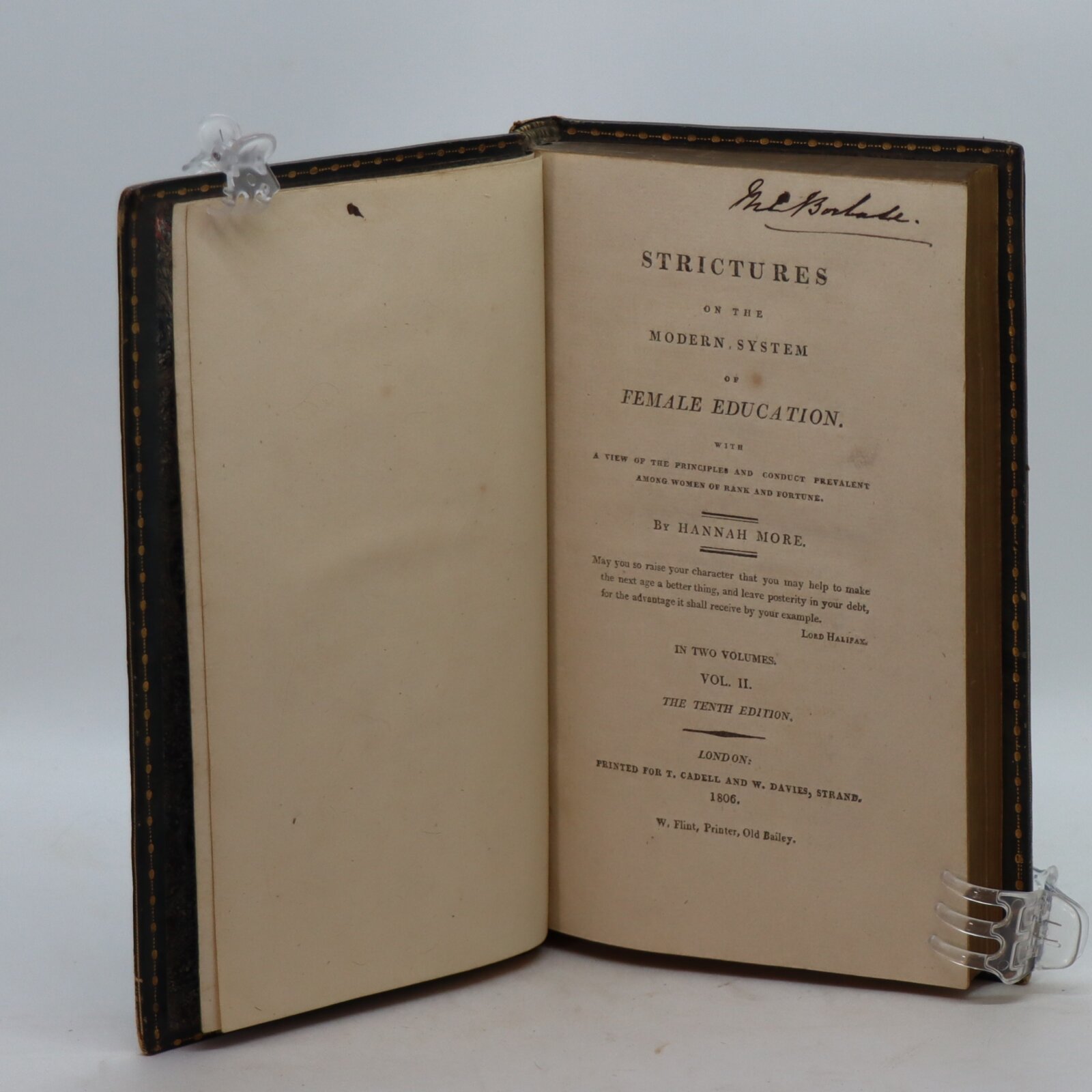
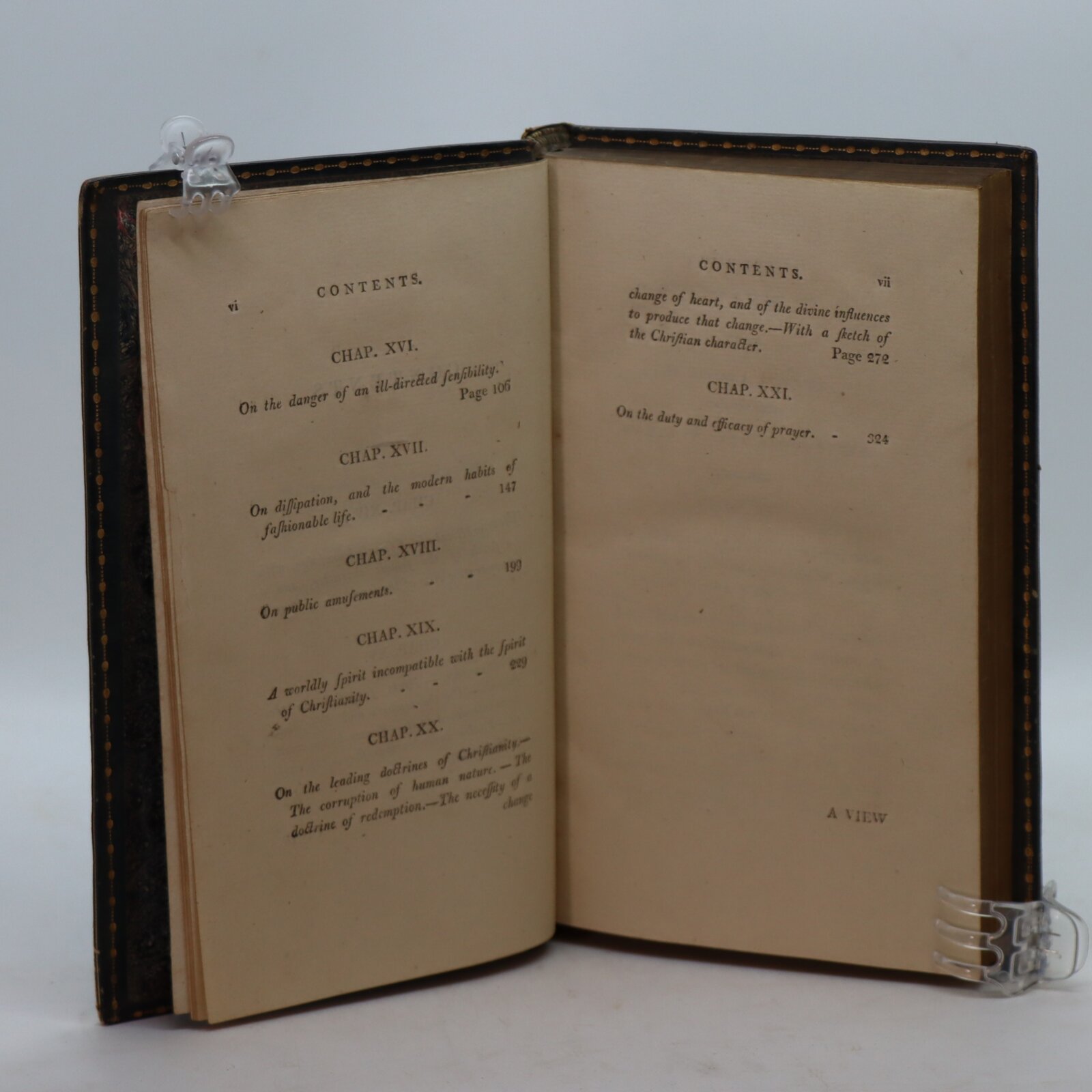
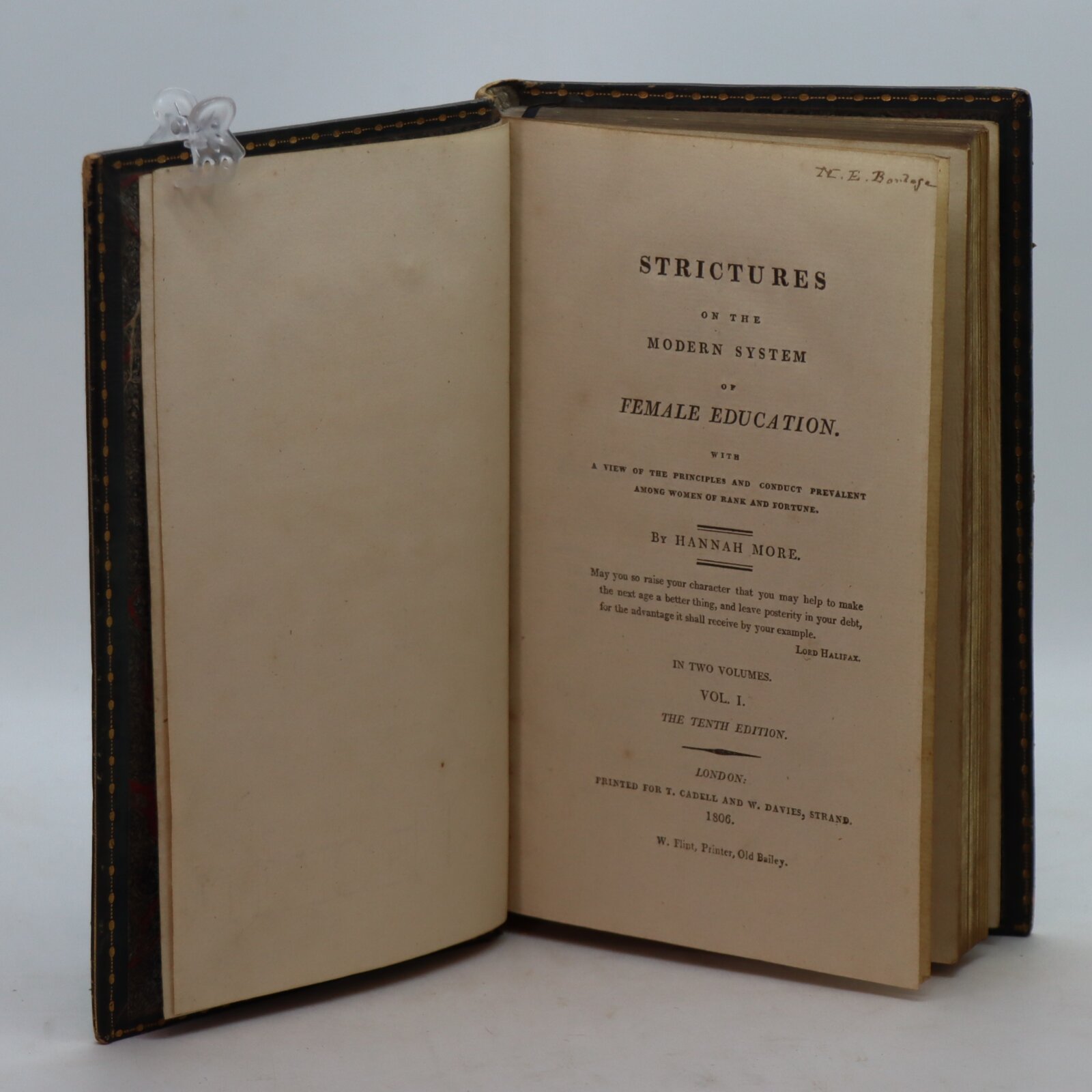
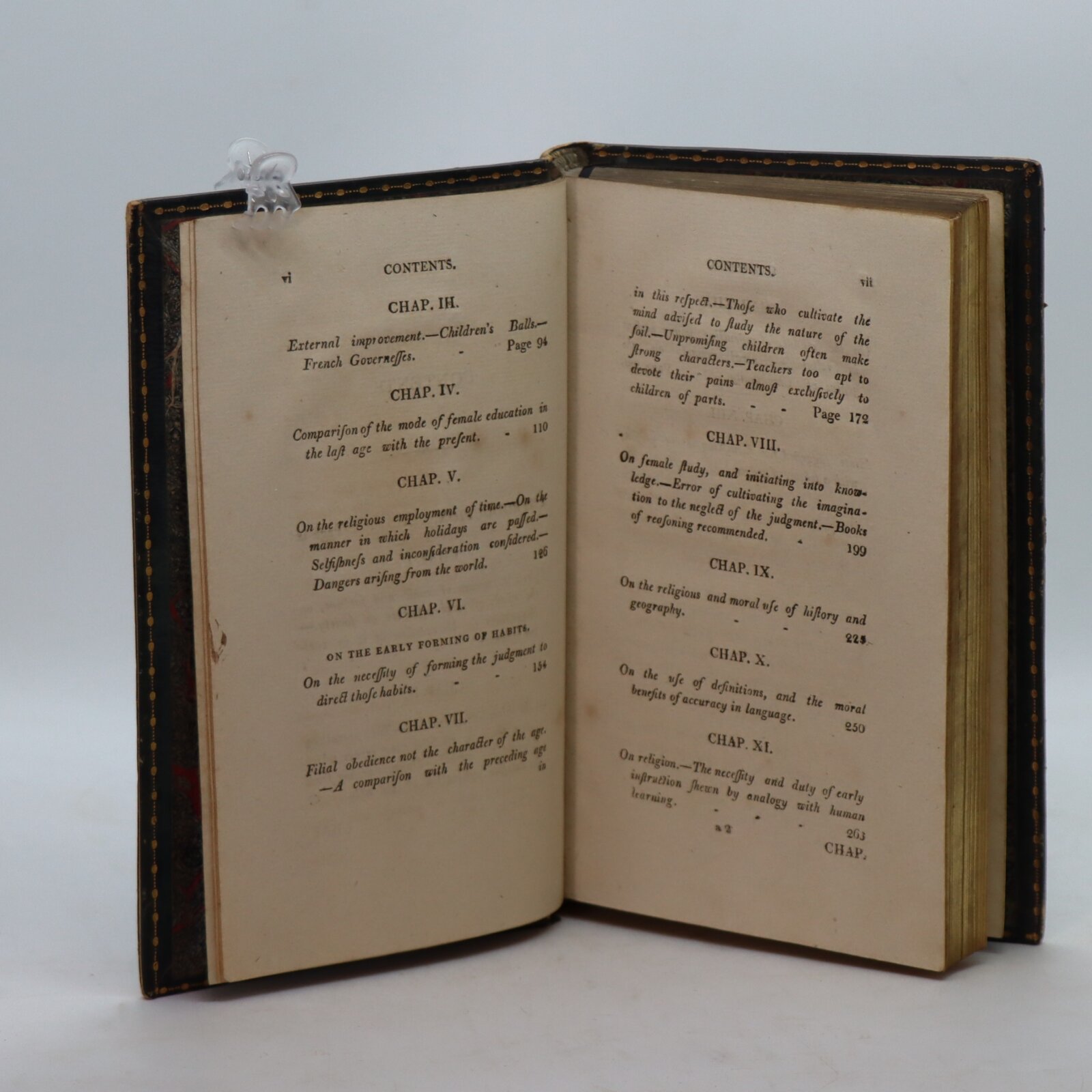
More's Strictures. Volumes I II.
By Hannah More
Printed: 1806
Publisher: T Caddell & W Davies. London
Edition: Tenth edition
| Dimensions | 13 × 20 × 3 cm |
|---|---|
| Language |
Language: English
Size (cminches): 13 x 20 x 3
Condition: Fine (See explanation of ratings)
£45.00
Buy Now

Item information
Description
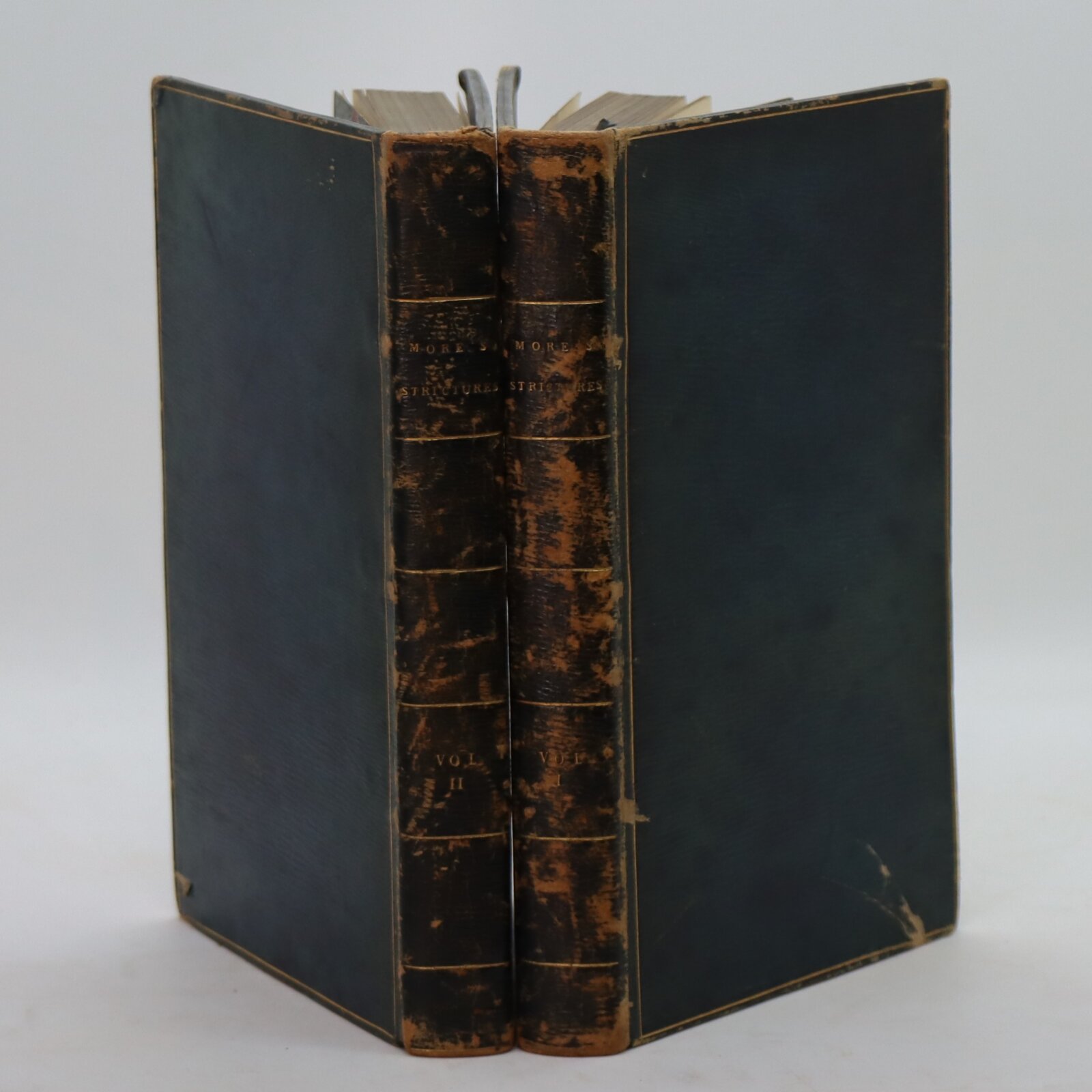
Blue leather binding with gilt edge line on both boards. Gilt title and banding on the spine. All edges gilt. Dimensions are for one volume.
F.B.A. provides an in-depth photographic presentation of this item to stimulate your feel and touch. More traditional book descriptions are immediately available
Hannah More (1745-1833) was an English religious writer and advocate of female education in England. Se was very active in literary circles in London, knowing David Garrick, Samuel Johnson and Horace Walpole and later became active in Philanthropy. ‘Female Education’ became her most famous conduct book was an early proto-feminist tract
In 1785 More bought a house at Cowslip Green, near Wrington in northern Somerset, where she settled with her sister Martha and wrote several ethical books and tracts: Strictures on the Modern System of Female Education (1799), Hints towards Forming the Character of a Young Princess (1805), Coelebs in Search of a Wife (only nominally a story, 1809), Practical Piety (1811), Christian Morals (1813), Character of St Paul (1815) and Moral Sketches (1819). She was a rapid writer. Her work, though discursive and animated, was deficient in form. Her popularity may be explained by her originality and forceful subject-matter.
Hannah More (2 February 1745 – 7 September 1833) was an English religious writer, philanthropist, poet and playwright in the circle of Johnson, Reynolds and Garrick, who wrote on moral and religious subjects. Born in Bristol, she taught at a school her father founded there and began writing plays. She became involved in the London literary elite and a leading Bluestocking member. Her later plays and poetry became more evangelical. She joined a group opposing the slave trade. In the 1790s she wrote Cheap Repository Tracts on moral, religious and political topics for distribution to the literate poor (as a retort to Thomas Paine’s Rights of Man). Meanwhile, she broadened her links with schools she and her sister Martha had founded in rural Somerset. These restricted their teaching of the poor, including limited reading but no writing. More was noted for her political conservatism, being described as an anti-feminist, or a “counter-revolutionary” or conservative feminist.
Condition notes
Spines very scuffed, old tear on one board
Want to know more about this item?
We are happy to answer any questions you may have about this item. In addition, it is also possible to request more photographs if there is something specific you want illustrated.
Ask a question
Related products



Share this Page with a friend
