
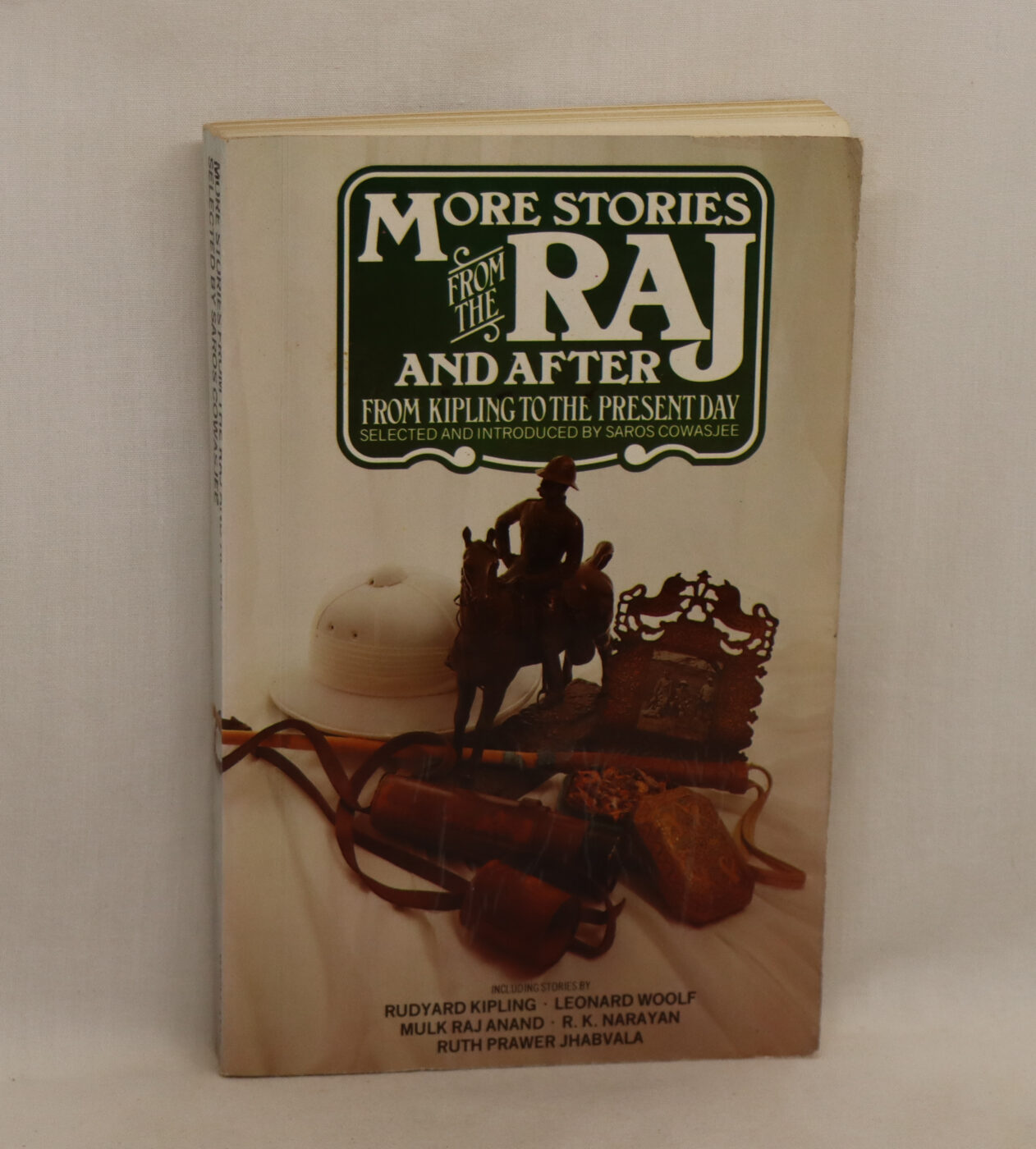
More Stories from the Raj and After.
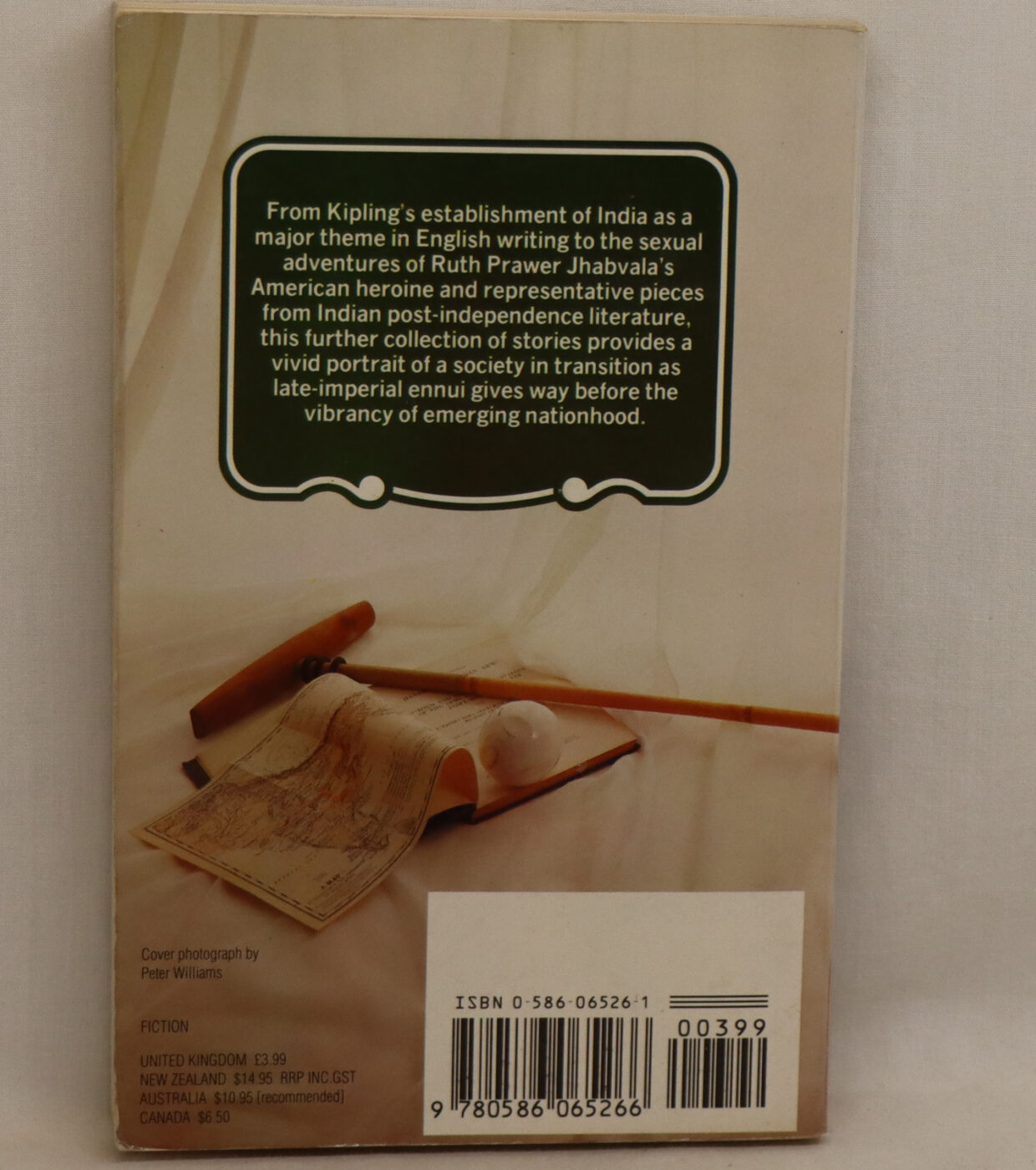
ISBN: 9789819600458
Printed: 1986
Publisher: Grafton. London
| Dimensions | 11 × 18 × 1 cm |
|---|---|
| Language |
Language: English
Size (cminches): 11 x 18 x 1
Condition: Good (See explanation of ratings)
£16.00
Buy Now
Your items

Item information
Description
Paperback. Cream cover with black title.
We provide an in-depth photographic presentation of this item to stimulate your feeling and touch. More traditional book descriptions are immediately available
Note: This book carries a £5.00 discount to those that subscribe to the F.B.A. mailing list
A very nice copy of a most interesting book which displays a different British perspective. Please view this book’s photographic cover for further details.
The British Raj (from Hindustani rāj, ‘reign’, ‘rule’ or ‘government’) was the rule of the British Crown on the Indian subcontinent, lasting from 1858 to 1947. It is also called Crown rule in India, or direct rule in India. The region under British control was commonly called India in contemporaneous usage and included areas directly administered by the United Kingdom, which were collectively called British India, and areas ruled by indigenous rulers, but under British paramountcy, called the princely states. The region was sometimes called the Indian Empire, though not officially. As India, it was a founding member of the League of Nations and a founding member of the United Nations in San Francisco in 1945. India was a participating state in the Summer Olympics in 1900, 1920, 1928, 1932, and 1936.
This system of governance was instituted on 28 June 1858, when, after the Indian Rebellion of 1857, the rule of the East India Company was transferred to the Crown in the person of Queen Victoria (who, in 1876, was proclaimed Empress of India). It lasted until 1947 when the British Raj was partitioned into two sovereign dominion states: the Union of India (later the Republic of India) and Dominion of Pakistan (later the Islamic Republic of Pakistan and People’s Republic of Bangladesh in the 1971 Proclamation of Bangladeshi Independence). At the inception of the Raj in 1858, Lower Burma was already a part of British India; Upper Burma was added in 1886, and the resulting union, Burma, was administered as an autonomous province until 1937, when it became a separate British colony, gaining its independence in 1948. It was renamed Myanmar in 1989. The Chief Commissioner’s Province of Aden was also part of British India at the inception of the British Raj and became a separate colony known as Aden Colony in 1937 as well.
Geographical extent
The British Raj extended over almost all present-day India, Pakistan, Bangladesh and Myanmar, except for small holdings by other European nations such as Goa (Portugal) and Pondicherry (France). This area is very diverse, containing the Himalayan mountains, fertile floodplains, the Indo-Gangetic Plain, a long coastline, tropical dry forests, arid uplands, and the Thar Desert. In addition, at various times, it included Aden (from 1858 to 1937), Lower Burma (from 1858 to 1937), Upper Burma (from 1886 to 1937), British Somaliland (briefly from 1884 to 1898), and the Straits Settlements (briefly from 1858 to 1867). Burma was separated from India and directly administered by the British Crown from 1937 until its independence in 1948. To the west, from the early 20th century, the Trucial States of the Persian Gulf showed signs of more close-knit association with the government of the British Raj, which was analogous to that of the princely states.
Among other countries in the region, Ceylon (now Sri Lanka), which referred to the coastal regions and northern part of the island at that time, was ceded to Britain in 1802 under the Treaty of Amiens. These coastal regions were temporarily administered under Madras Presidency between 1793 and 1798, but, for later periods, the British governors reported to London, and it was not part of the Raj. The kingdoms of Nepal and Bhutan, having fought wars with the British, subsequently signed treaties with them and were recognised by the British as independent states. The Kingdom of Sikkim was established as a princely state after the Anglo-Sikkimese Treaty of 1861; however, the issue of sovereignty was left undefined.The Maldive Islands were a British protectorate from 1887 to 1965 but not part of British India.
NOTE: This is an original book from the library gathered by the famous Cambridge Don, computer scientist, food and wine connoisseur, Jack Arnold LANG. Note: Jack founded the Michelin Guide ‘Midsummer House’- Cambridge’s paramount restaurant. This dining experience is hidden amongst the grassy pastures and grazing cattle of Midsummer Common and perched on the banks of the River Cam.
In 2008, Jack was one of the co-founders of the Raspberry Pi Foundation, alongside other members of the Department, and acted as the Foundation’s Chair. The project’s original goals were modest: to build and distribute low-cost computers for prospective applicants to our Computer Science degree. Initially the project was a “success disaster”, as Jack would say, as demand far outstripped the low-scale manufacturing plans. Ultimately the Raspberry Pi became the UK’s most successful computer with more than 60 million sold to date. Jack was drawn to the educational possibilities of the Raspberry Pi, its potential uses in emerging economies and the way it could support self-directed learning.
Want to know more about this item?
We are happy to answer any questions you may have about this item. In addition, it is also possible to request more photographs if there is something specific you want illustrated.
Ask a question
Related products
Share this Page with a friend
