
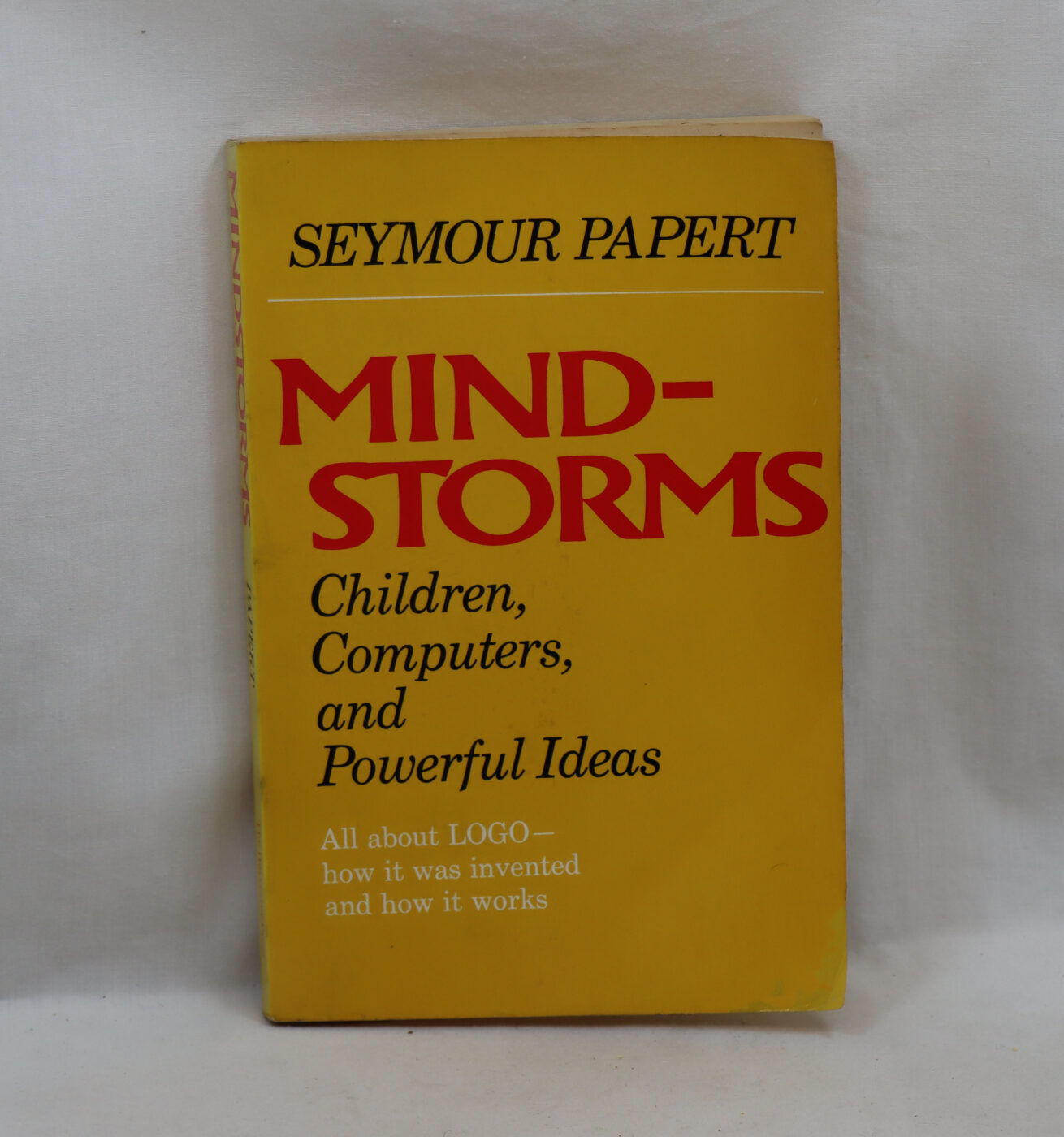
Mind-Storms.
By Seymour Papert
ISBN: 9781541675100
Printed: 1982
Publisher: The Harvester Press. Brighton
| Dimensions | 13 × 20 × 1.5 cm |
|---|---|
| Language |
Language: English
Size (cminches): 13 x 20 x 1.5
Condition: Good (See explanation of ratings)
£15.00
Buy Now
Your items

Item information
Description
Paperback. Yellow cover with black and red title.
We provide an in-depth photographic presentation of this item to stimulate your feeling and touch. More traditional book descriptions are immediately available
-
THIS FROST PAPERBACK is a USED book which a member of the Frost family has checked for condition, cleanliness, completeness and readability. When the buyer collects their book from Frost’s shop, the delivery charge of £3.00 is deducted
For conditions, please view our photographs. An original book from the library gathered by the famous Cambridge Don, computer scientist, food and wine connoisseur, Jack Arnold LANG.
This book was the property of Jack’s very clever mother.
The author, Seymour Aubrey Papert, was also a friend of Jack’s father.
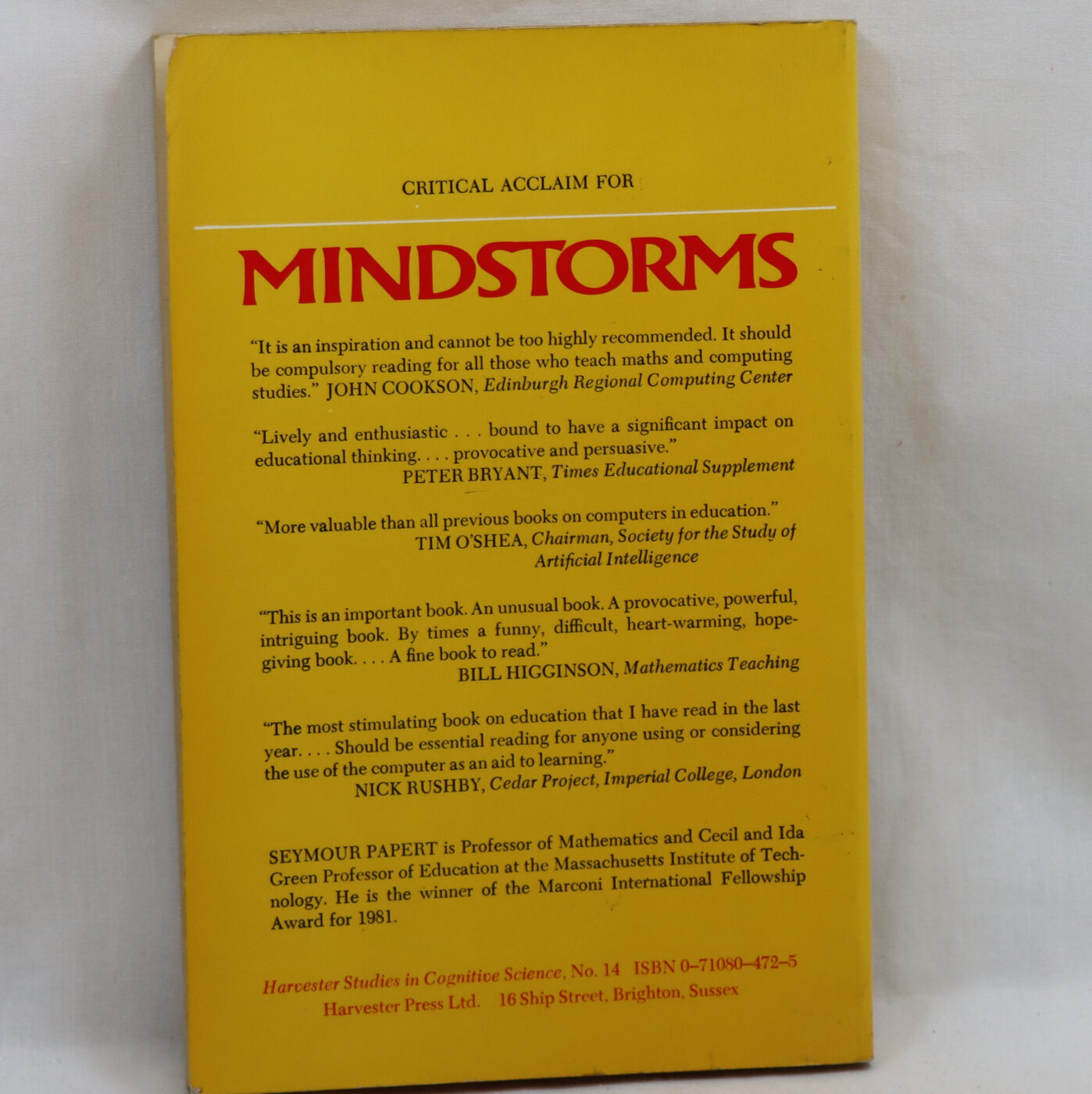
In this revolutionary book, a renowned computer scientist explains the importance of teaching children the basics of computing and how it can prepare them to succeed in the ever-evolving tech world. Computers have completely changed the way we teach children. We have Mindstorms to thank for that. In this book, pioneering computer scientist Seymour Papert uses the invention of LOGO, the first child-friendly programming language, to make the case for the value of teaching children with computers. Papert argues that children are more than capable of mastering computers, and that teaching computational processes like de-bugging in the classroom can change the way we learn everything else. He also shows that schools saturated with technology can actually improve socialization and interaction among students and between students and teachers. Technology changes every day, but the basic ways that computers can help us learn remain. For thousands of teachers and parents who have sought creative ways to help children learn with computers, Mindstorms is their bible.
Review: This is the best book I have ever read on how to assist people to learn for themselves. Papert began his work by collaborating with Jean Piaget, and then applied those perspectives in a self-programming language designed to help children learn math and physics.
Papert explains Piaget’s work and provides case studies of how the programming language, LOGO, can help. He provides a wonderful contrasting explanation of the weaknesses of how math and physics are usually taught in schools. I learned quite a few things from this that I did not know before. People are very good at developing theories about why things work the way they do. I knew that these theories are almost always wrong. What I did not realize is that if you give the person a way to test their theory, the person will keep devising new theories until they hit on one that works. What is usually missing in education is the means to allow that testing to occur. An especially imaginative part of this book were the discussions of how to create theory testing solutions that are much simpler and easier to apply than any school problem you ever saw in these subjects. Papert works from a very fundamental and deep understanding of math and physics to reach the heart of the most useful thought processes for applying these subjects. It is thrilling to read about what you have known for many years, and to suddenly see it in a totally different and improved perspective. Another benefit I got from this book were plenty of ideas for how to help my teenage daughter with her math. She is very verbal, and Papert points out that math seldom teaches a vocabulary for talking about math. As a result, she memorizes a lot and gets dissociated from the subject. I got a lot of ideas for how to encourage her to personalize the concepts and problems by moving her own body. From that I realized that I often solve the same kinds of problems by recalling physical situations I have been in. But I have failed to help her make that connection because I was unaware of it on a conscious level. If you want to improve as a learner, help others learn better and faster, or simply want to understand more about different ways to think, this is a great book. I hope that all teachers get a chance to read and apply it. Enjoy learning more!
Seymour Aubrey Papert (29 February 1928 – 31 July 2016) was a South African-born American mathematician, computer scientist, and educator, who spent most of his career teaching and researching at the Massachusetts Institute of Technology. He was one of the pioneers of artificial intelligence, and of the constructionist movement in education. He was co-inventor, with Wally Feurzeig and Cynthia Solomon, of the Logo programming language. Born to a Jewish family, Papert attended the University of the Witwatersrand, receiving a Bachelor of Arts degree in philosophy in 1949 followed by a PhD in mathematics in 1952. He then went on to receive a second doctorate, also in mathematics, at the University of Cambridge (1959), supervised by Frank Smithies.
Want to know more about this item?
We are happy to answer any questions you may have about this item. In addition, it is also possible to request more photographs if there is something specific you want illustrated.
Ask a question
Related products

Share this Page with a friend
