
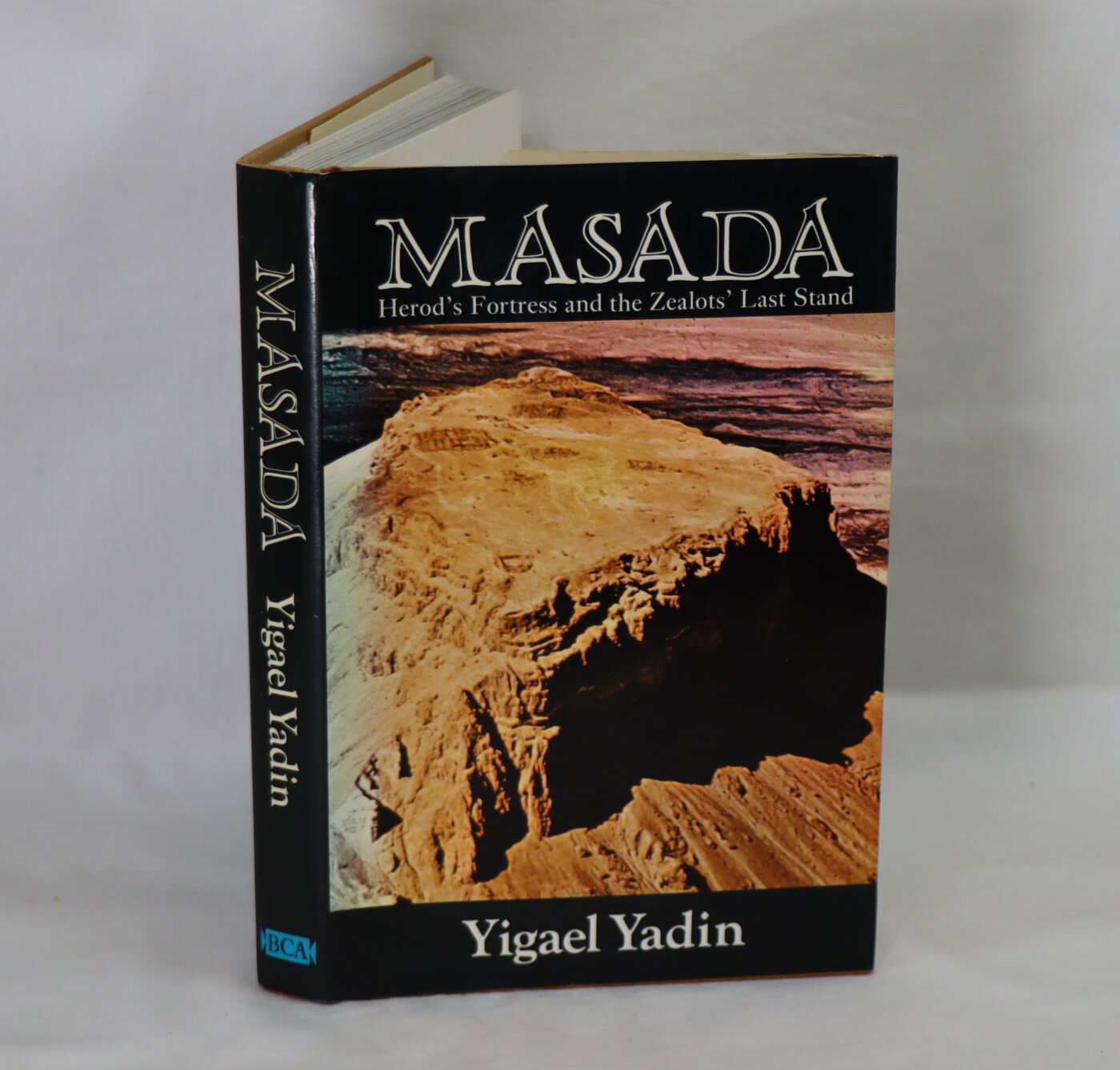
Masada.
By Yigael Yadin
ISBN: 9780351188145
Printed: 1971
Publisher: Book Club Associates.
| Dimensions | 14 × 20 × 2 cm |
|---|---|
| Language |
Language: English
Size (cminches): 14 x 20 x 2
Condition: Very good (See explanation of ratings)
£22.00
Buy Now


Item information
Description
In the original dust jacket. Tan cloth binding with gilt title on the spine.
- We provide an in-depth photographic presentation of this item to stimulate your feeling and touch. More traditional book descriptions are immediately available
Note: This book carries a £5.00 discount to those that subscribe to the F.B.A. mailing list
The author describes in clear and very readable writing, the history of the last stand of the Jewish nation against the Roman Empire with its dramatic suicidal ending then goes on the tell the story of the rediscovery and excavation of the site, from early explorers to his own definitive work on the site. Aided by volunteers from almost every corner of the earth, all paying their own travel expenses just to be involved. That is the magic of Masada. The finds reveal that the earlier chronicler Josephus Flavius (long thought to be an extravagant myth ) had indeed got it “right”.
Masada is an ancient fortification in southern Israel, situated on top of an isolated rock plateau, akin to a mesa. It is located on the eastern edge of the Judaean Desert, overlooking the Dead Sea 20 km (12 miles) east of Arad.
Herod the Great built two palaces for himself on the mountain and fortified Masada between 37 and 31 BC.
According to Josephus, the siege of Masada by Roman troops from 72 to 73 AD, at the end of the First Jewish–Roman War, ended in the mass suicide of the 960 Sicarii rebels who were hiding there. However, the archaeological evidence relevant to a mass suicide event is ambiguous at best and rejected entirely by some scholars. In modern times, the story of the siege was revived as the Masada myth, a selectively constructed narrative based on Josephus’s account. The mythical narrative became a national symbol in the early years of Israel’s nationhood.
Masada is one of Israel’s most popular tourist attractions. During 2005 to 2007 and 2009 to 2012, it was the second-most popular, behind the Jerusalem Biblical Zoo. The site attracts around 750,000 visitors a year.
Flavius Josephus was a Roman–Jewish historian and military leader. Best known for writing The Jewish War, he was born in Jerusalem—then part of the Roman province of Judea—to a father of priestly descent and a mother who claimed royal ancestry.
He initially fought against the Roman Empire during the First Jewish–Roman War as general of the Jewish forces in Galilee, until surrendering in AD 67 to the Roman army led by military commander Vespasian after the six-week siege of Yodfat. Josephus claimed the Jewish messianic prophecies that initiated the First Jewish–Roman War made reference to Vespasian becoming Roman emperor. In response, Vespasian decided to keep him as a slave and presumably interpreter. After Vespasian became emperor in AD 69, he granted Josephus his freedom, at which time Josephus assumed the Emperor’s family name of Flavius.
Flavius Josephus fully defected to the Roman side and was granted Roman citizenship. He became an advisor and close associate of Vespasian’s son Titus, serving as his translator during Titus’s protracted siege of Jerusalem in AD 70, which resulted in the near-total razing of the city and the destruction of the Second Temple.
Josephus recorded the Great Jewish Revolt (AD 66–70), including the siege of Masada. His most important works were The Jewish War (c. 75) and Antiquities of the Jews (c. 94). The Jewish War recounts the Jewish revolt against Roman occupation. Antiquities of the Jews recounts the history of the world from a Jewish perspective for an ostensibly Greek and Roman audience. These works provide insight into first-century Judaism and the background of Early Christianity. Josephus’s works are the chief source next to the Bible for the history and antiquity of ancient Israel, and provide an independent extra-biblical account of such figures as Pontius Pilate, Herod the Great, John the Baptist, James, brother of Jesus, and Jesus of Nazareth.
Want to know more about this item?
We are happy to answer any questions you may have about this item. In addition, it is also possible to request more photographs if there is something specific you want illustrated.
Ask a question
Related products








Share this Page with a friend
