
Jane Eyre.
By Charlotte Bronte
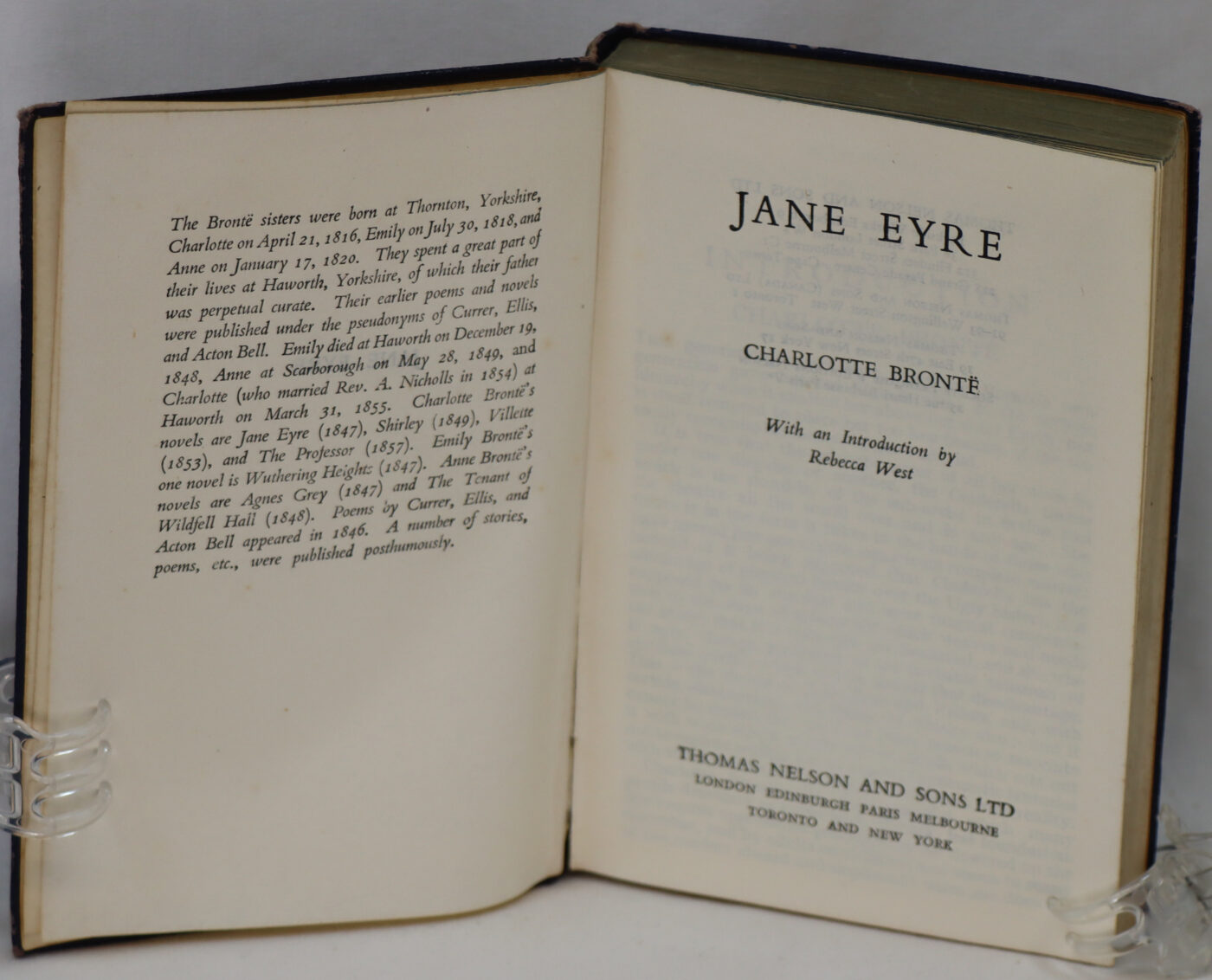
Printed: Circa 1940
Publisher: Thomas Nelson & Sons. London
| Dimensions | 13 × 16 × 2 cm |
|---|---|
| Language |
Language: English
Size (cminches): 13 x 16 x 2
Condition: Good (See explanation of ratings)
£18.00
Buy Now
Your items

Item information
Description
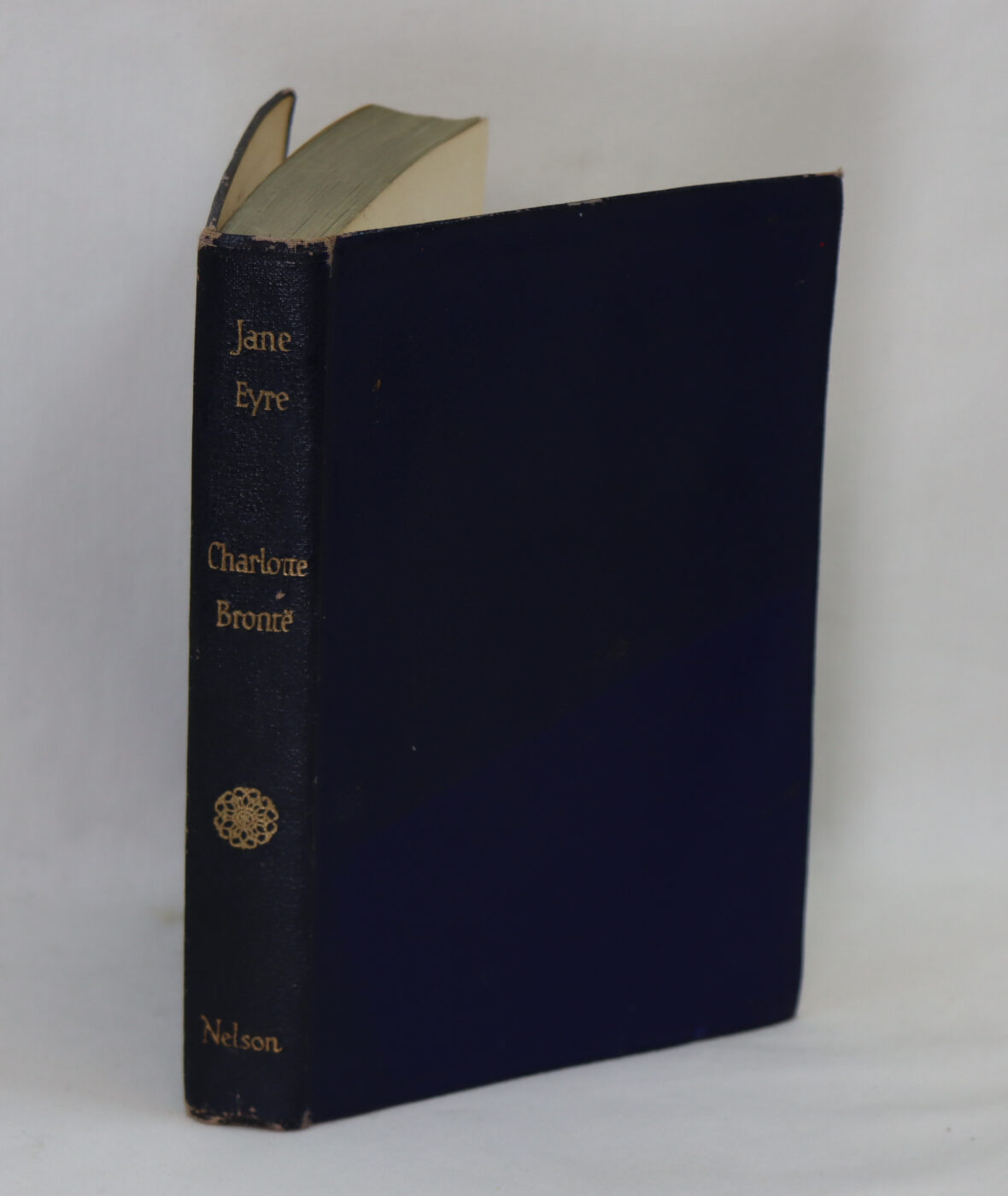
Softback. Navy leatherette cloth binding with gilt title on the spine.
We provide an in-depth photographic presentation of this item to stimulate your feeling and touch. More traditional book descriptions are immediately available.
- Note: This book carries a £5.00 discount to those that subscribe to the F.B.A. mailing list
It is a pleasure to touch and feel this lovely book. A book which has been treasured throughout its life.
Jane Eyre (originally published as Jane Eyre: An Autobiography) is a novel by the English writer Charlotte Brontë. It was published under her pen name “Currer Bell” on 19 October 1847 by Smith, Elder & Co. of London. The first American edition was published in January 1848 by Harper & Brothers of New York. Jane Eyre is a bildungsroman that follows the experiences of its eponymous heroine, including her growth to adulthood and her love for Mr Rochester, the brooding master of Thornfield Hall.
The novel revolutionised prose fiction, being the first to focus on the moral and spiritual development of its protagonist through an intimate first-person narrative, where actions and events are coloured by a psychological intensity. Literary critic Daniel S. Burt has called Charlotte Brontë “the first historian of the private consciousness” and the literary ancestor of writers such as Marcel Proust and James Joyce.
The book contains elements of social criticism with a strong sense of Christian morality at its core, and it is considered by many to be ahead of its time because of Jane’s individualistic character and how the novel approaches the topics of class, sexuality, religion and feminism. Jane Eyre, along with Jane Austen’s Pride and Prejudice, is one of the most famous romance novels. It is considered one of the greatest novels in the English language, and in 2003 was ranked as the tenth best-loved book in Britain by the BBC in The Big Read poll.
This is part of the esteemed Nelson Classics series published by Thomas Nelson & Sons, which was widely distributed in the UK during the 1930s and 1940s.
Charlotte Nicholls (21 April 1816 – 31 March 1855), commonly known by her maiden name Charlotte Brontë was an English novelist and poet, and was the elder sister of Emily, Anne and Branwell Brontë. She is best known for her novel Jane Eyre, which was first published under the pseudonym Currer Bell. Jane Eyre was a great success on publication, and has since been acknowledged as a classic of English literature.
Charlotte was the third of six siblings born to Maria Branwell and Patrick Brontë. Maria died when Charlotte was only five years old, and three years later, Charlotte was sent to the Clergy Daughters’ School at Cowan Bridge in Lancashire, along with her three sisters, Maria, Elizabeth and Emily. Conditions at the school were appalling, with frequent outbreaks of disease. Charlotte’s two elder sisters fell ill there and died shortly afterwards; Charlotte attributed her own lifelong ill-health to her time at Cowan Bridge, and later used it as the model for Lowood School in Jane Eyre.
In 1831, Charlotte became a pupil at Roe Head School in Mirfield, but left the following year to teach her sisters, Emily and Anne, at home. In 1835, Charlotte returned to Roe Head as a teacher. In 1839, she accepted a job as governess to a local family, but left after a few months. In 1842, Charlotte joined the Heger Pensionnat, a girls’ boarding school in Brussels, as a student, then later as a teacher, in the hope of acquiring the skills required to open a school of her own. However, she was obliged to leave after falling in love with the school’s director, Constantin Heger, a married man, who inspired both the character of Rochester in Jane Eyre, and Charlotte’s first novel, The Professor.
Charlotte, Emily and Anne attempted to open a school in Haworth, but failed to attract pupils. In 1846 the sisters published a collection of poems under the pseudonyms Currer, Ellis, and Acton Bell. Although Charlotte’s first novel, The Professor, was rejected by publishers, her second novel, Jane Eyre, was published in 1847, attracting both praise and controversy. The sisters’ true identities were revealed in 1848, and by the following year Charlotte was known in London literary circles. In 1854, Charlotte married Arthur Bell Nicholls, her father’s curate. She became pregnant shortly after her wedding in June 1854, but died on 31 March 1855, possibly of tuberculosis, although there is evidence that she may have died from hyperemesis gravidarum, a complication of pregnancy.
Want to know more about this item?
We are happy to answer any questions you may have about this item. In addition, it is also possible to request more photographs if there is something specific you want illustrated.
Ask a question
Related products

Share this Page with a friend
