
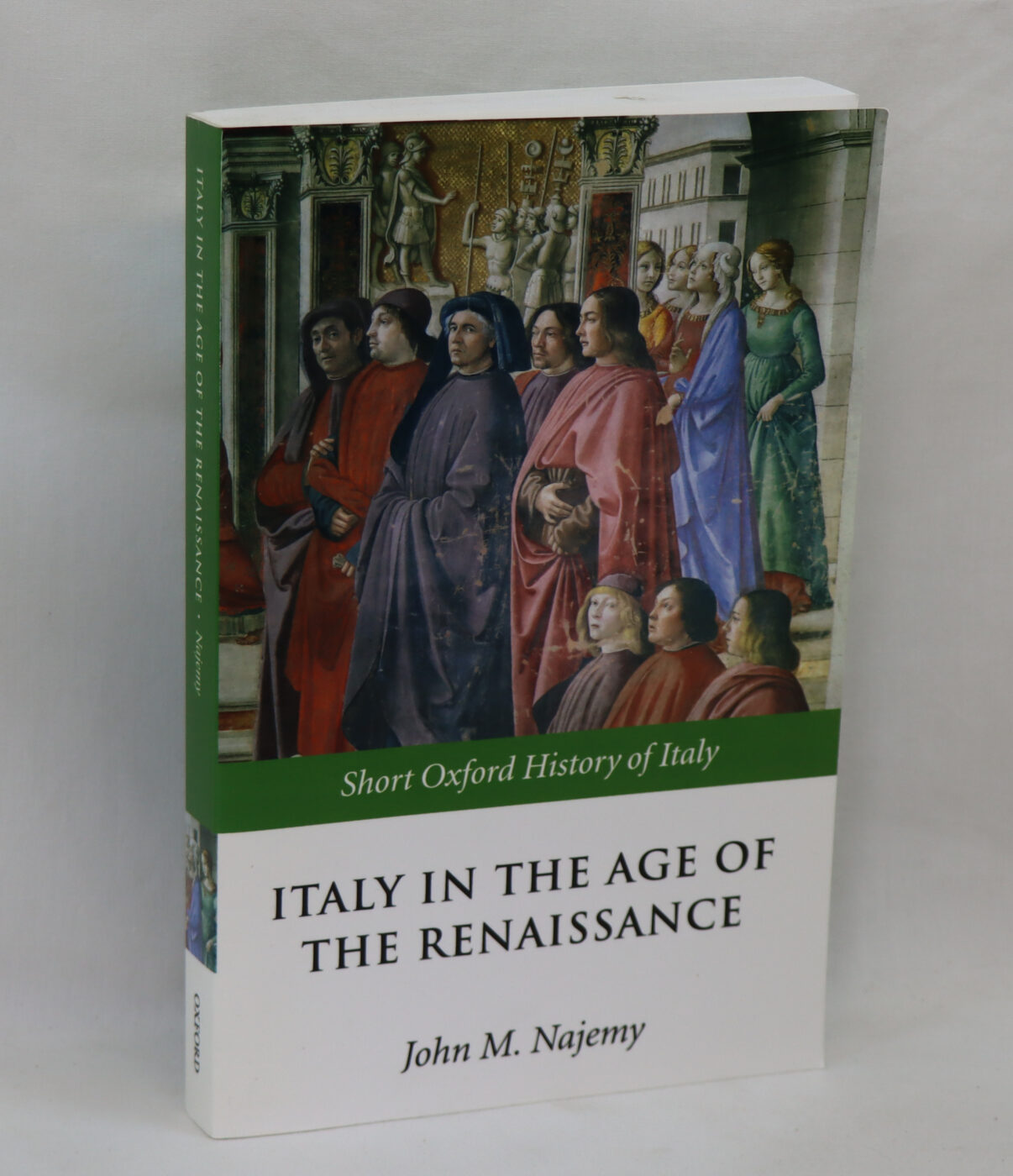
Italy in the Age of Renaissance.
By John M Najemy
Printed: 2009
Publisher: Oxford University Press.
| Dimensions | 14 × 22 × 2 cm |
|---|---|
| Language |
Language: English
Size (cminches): 14 x 22 x 2
Condition: Very good (See explanation of ratings)
£28.00
Buy Now
Your items

Item information
Description
Paperback. White and green cover with a black title.
We provide an in-depth photographic presentation of this item to stimulate your feeling and touch. More traditional book descriptions are immediately available.
Note: This book carries a £5.00 discount to those that subscribe to the F.B.A. mailing list
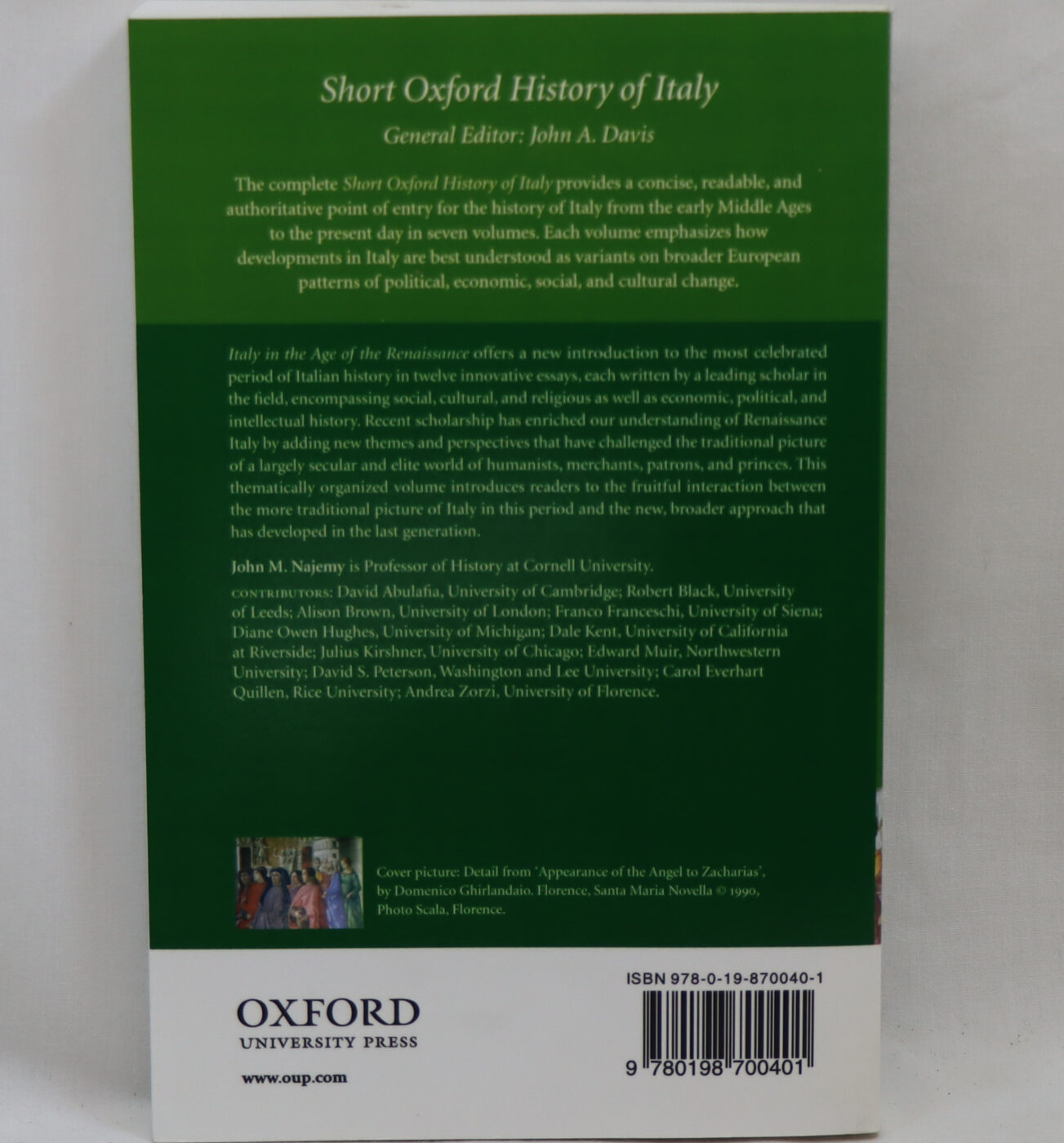
The twelve essays in this volume, each written by a leading specialist, present an accessible and comprehensive introduction to Italian Renaissance society, intellectual history, and politics, with each contribution reflecting the most recent innovations in the way that historians view and study the period.
The Italian Renaissance was a vibrant cultural and intellectual movement spanning the 14th to 16th centuries, marking the transition from the Middle Ages to modernity. Driven by a booming trade-based economy and wealthy patrons, it ignited a massive “rebirth” in art, architecture, science, and humanism.
Why Italy? The Catalyst for Rebirth
The movement began in Italy due to several unique factors:
- The Classical Legacy: Italy was the heart of the ancient Roman Empire, leaving behind visible ruins and cultural inspiration.
- Wealth and Patronage: The decline of feudalism led to the rise of wealthy city-states (like Florence, Venice, and Milan) and influential merchant families like the Medici. They used their cash reserves to commission extraordinary art as a display of power.
- Ideas and Technology: The fall of Constantinople in 1453 brought Greek scholars and ancient manuscripts to Italy. This fueled Humanism—a philosophy emphasizing human potential, reason, and individual achievement.
Key Figures & Innovations
- The Arts: Artists introduced linear perspective, realism, and naturalism. Masters like Leonardo da Vinci, Michelangelo, and Raphael revolutionized painting and sculpture.
- Literature: Writers shifted from strict Latin to vernacular Italian, with visionaries like Dante Alighieri, Petrarch, and Boccaccio paving the way.
- Science & Society: Thinkers like Niccolò Machiavelli reshaped political theory, while new technologies like the printing press allowed these ideas to sweep rapidly across Europe.
Review: A new and accessible introduction to the Italian Renaissance
John M. Najemy is a distinguished historian and Professor Emeritus of late medieval and Renaissance history at Cornell University. He is best known as the author of A History of Florence, 1200–1575 and for his award-winning studies on Machiavelli, Renaissance Italian society, and Florentine electoral politics.
Want to know more about this item?
We are happy to answer any questions you may have about this item. In addition, it is also possible to request more photographs if there is something specific you want illustrated.
Ask a question
Related products

Share this Page with a friend
