
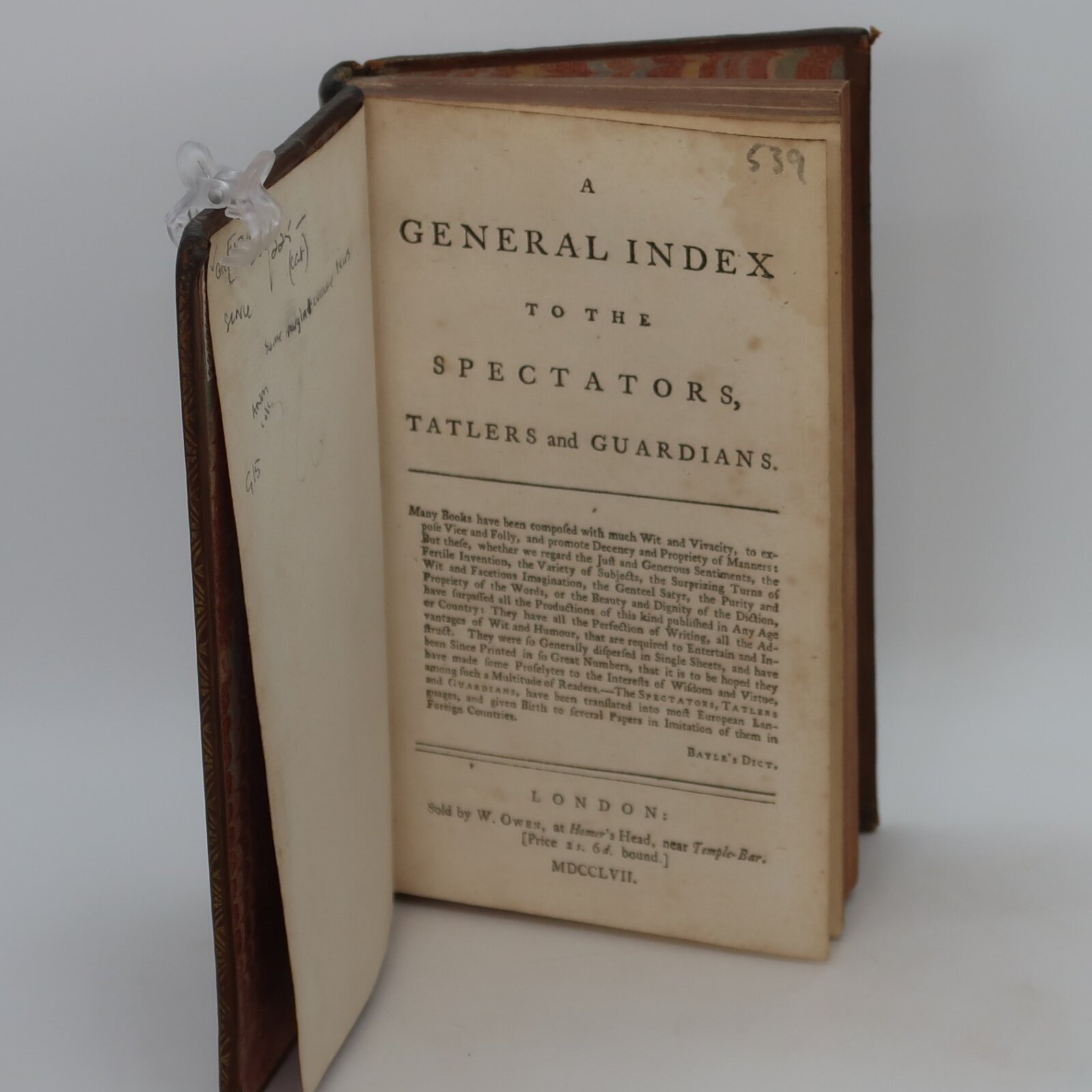
Index. Spectators, Tatlers and Guardians.
Printed: 1757
Publisher: W Owen. London
| Dimensions | 11 × 17 × 2 cm |
|---|---|
| Language |
Language: English
Size (cminches): 11 x 17 x 2
Condition: Fine (See explanation of ratings)
£295.00
FREE shipping
Buy Now
Your items

Item information
Description
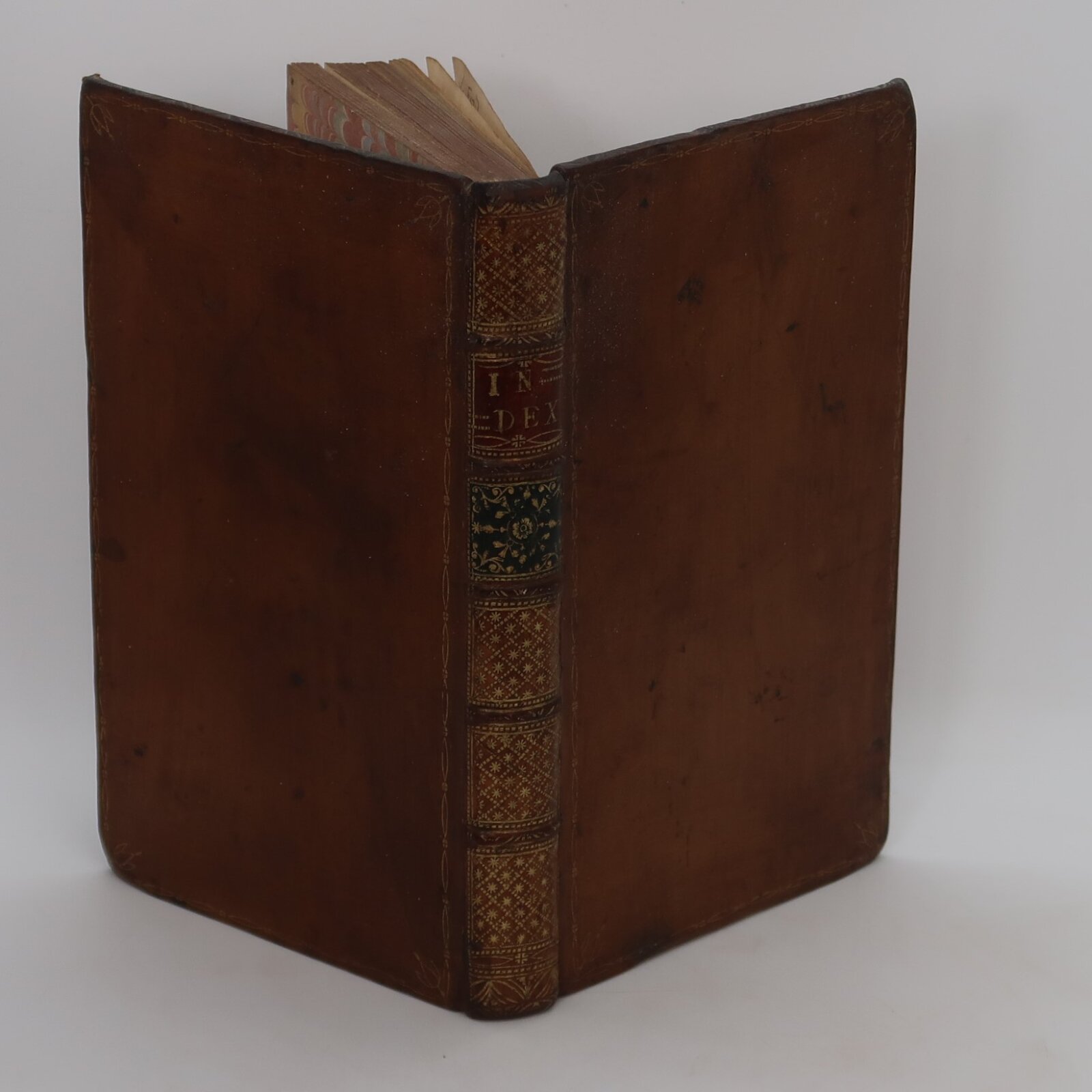
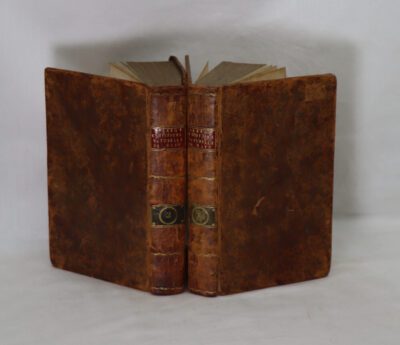
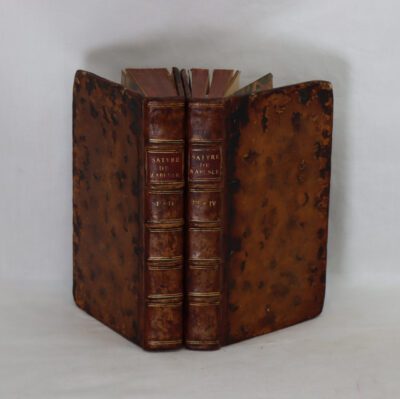
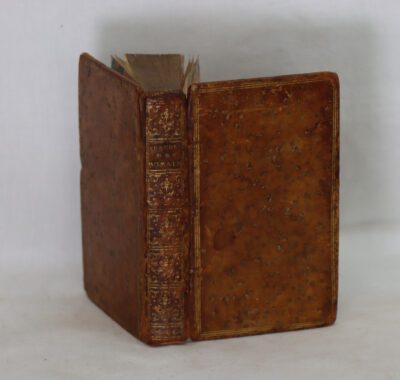
Tan leather binding with red and black title plates, gilt banding and decoration on the spine.
A general index to the Spectators, Tatlers and Guardians. London : sold by W. Owen London 1760.
The Town Talk, the Fish Pool, the Plebeian, the Old Whig, the Spinster, etc. Now First Collected with Notes and Illustrations by Authors of the Tatler, Spectator, and Guardian.
The Tatler, Steele’s first journal, first came out on 12 April 1709, and appeared three times a week: on Tuesdays, Thursdays, and Saturdays. Steele wrote this periodical under the pseudonym Isaac Bickerstaff and gave Bickerstaff an entire, fully developed personality.
Steele described his motive in writing The Tatler as “to expose the false arts of life, to pull off the disguises of cunning, vanity, and affectation, and to recommend a general simplicity in our dress, our discourse, and our behaviour”. Steele founded the magazine, and although he and Addison collaborated, Steele wrote the majority of the essays; Steele wrote roughly 188 of the 271 total and Addison 42, with 36 representing the pair’s collaborative works. While Addison contributed to The Tatler, it is widely regarded as Steele’s work.
The Tatler was closed down to avoid the complications of running a Whig publication that had come under Tory attack. Addison and Steele then founded The Spectator in 1711 and also the Guardian in 1713.
Sir Richard Steele (bap. 12 March 1672 – 1 September 1729) was an Irish writer, playwright, and politician, remembered as co-founder, with his friend Joseph Addison, of the magazine The Spectator. Steele plays a minor role in the novel The History of Henry Esmond by William Makepeace Thackeray. It is during his time with the Lifeguards, where he is mostly referred to as Dick the Scholar and makes mention of his friend “Joe Addison”. Thackeray depicts Steele in glowing terms as a warm, generous, talented mentor who befriends the title character in his youth and remains loyal to him for years despite their political differences.
Joseph Addison (1 May 1672 – 17 June 1719) was an English essayist, poet, playwright and politician. He was the eldest son of The Reverend Lancelot Addison. His name is usually remembered alongside that of his long-standing friend Richard Steele, with whom he founded The Spectator magazine. His simple prose style marked the end of the mannerisms and conventional classical images of the 17th century. He met Jonathan Swift in Ireland and remained there for a year. Later, he helped form the Kitcat Club and renewed his friendship with Richard Steele. In 1709, Steele began to publish the Tatler, and Addison became a regular contributor. In 1711 they began The Spectator; its first issue appeared on 1 March 1711. This paper, which was originally a daily, was published until 20 December 1714, interrupted for a year by the publication of The Guardian in 1713. His last publication was The Freeholder, a political paper, in 1715–16.
The Tatler was a British literary and society journal begun by Richard Steele in 1709 and published for two years. It represented a new approach to journalism, featuring cultivated essays on contemporary manners, and established the pattern that would be copied in such British classics as Addison and Steele’s Spectator, Samuel Johnson’s Rambler and Idler, and Goldsmith’s Citizen of the World. The Tatler would also influence essayists as late as Charles Lamb and William Hazlitt. Addison and Steele liquidated The Tatler in order to make a fresh start with the similar Spectator, and the collected issues of Tatler are usually published in the same volume as the collected Spectator.
The Spectator was a daily publication founded by Joseph Addison and Richard Steele in England, lasting from 1711 to 1712. Each “paper”, or “number”, was approximately 2,500 words long, and the original run consisted of 555 numbers, beginning on 1 March 1711. These were collected into seven volumes. The paper was revived without the involvement of Steele in 1714, appearing thrice weekly for six months, and these papers when collected formed the eighth volume. Eustace Budgell, a cousin of Addison’s, and the poet John Hughes also contributed to the publication.
The Guardian was a short-lived newspaper published in London from 12 March to 1 October 1713. It was founded by Richard Steele and featured contributions from Joseph Addison, Thomas Tickell, Alexander Pope and Ambrose Philips. Steele and Addison had previously collaborated on the Tatler and The Spectator (not related to the present-day Spectator or Tatler). Button’s Coffee House in Russell Street, Covent Garden, acted as an ad hoc office for the newspaper. Contributors submitted written material in a marble lion’s head letterbox, said to have been designed by the artist William Hogarth, for possible publication in The Guardian.
The Gentleman’s Magazine followed on the heels of The Guardian, being touted by Richard Steele as a sequel of it.
Want to know more about this item?
We are happy to answer any questions you may have about this item. In addition, it is also possible to request more photographs if there is something specific you want illustrated.
Ask a question
Related products
Share this Page with a friend
