
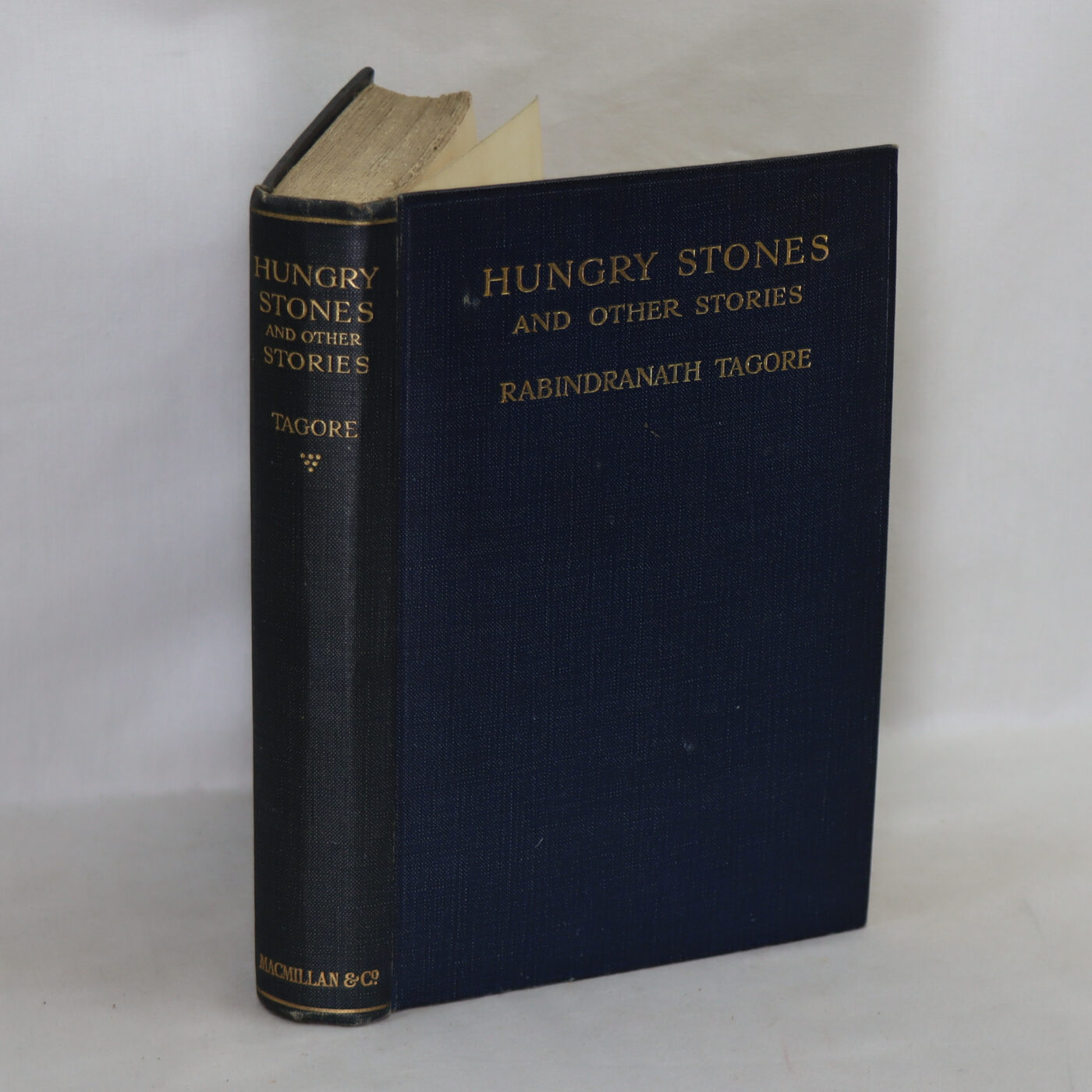
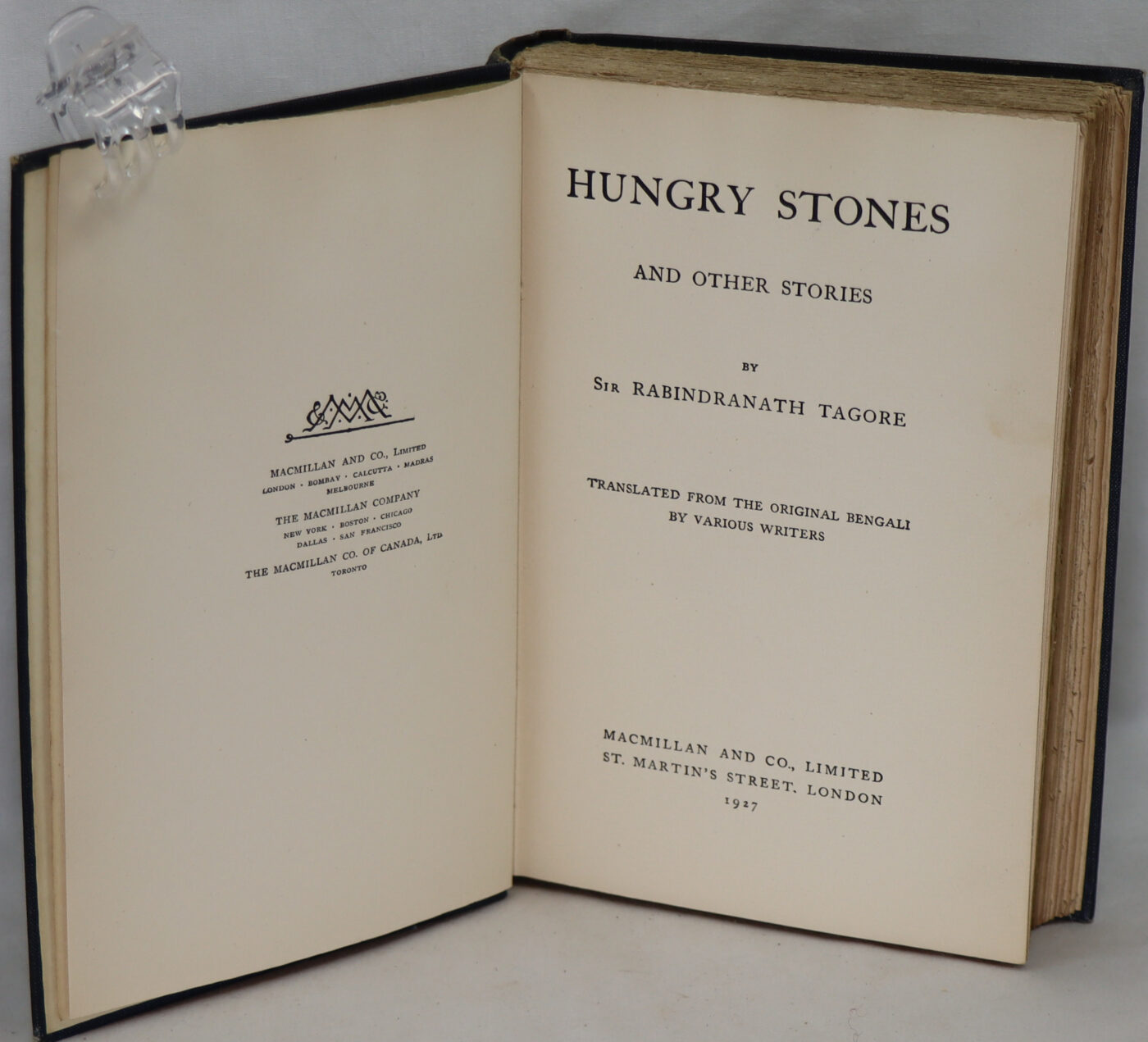
Hungry Stones and Other Stories.
By Sir Rabidranath Tagore
Printed: 1927
Publisher: Macmillan & Co. London
| Dimensions | 14 × 20 × 3 cm |
|---|---|
| Language |
Language: English
Size (cminches): 14 x 20 x 3
Condition: Good (See explanation of ratings)
£106.00
Buy Now
Your items

Item information
Description
Navy cloth binding with gilt title on the spine and front board.
We provide an in-depth photographic presentation of this item to stimulate your feeling and touch. More traditional book descriptions are immediately available
- Note: This book carries a £5.00 discount to those that subscribe to the F.B.A. mailing list
For conditions, please view our photographs. A nice clean very rare copy from the library gathered by the famous Cambridge Don, computer scientist, food and wine connoisseur, Jack Arnold LANG. Jack read this book many times.
The Hungry Stones And Other Stories is a classic collection of short stories by the great Indian writer, Rabindranath Tagore. Preface: The stories contained in this volume were translated by several hands. The version of The Victory is the author’s own work. The seven stories which follow were translated by Mr. C. F. Andrews, with the help of the author’s help. Assistance has also been given by the Rev. E. J. Thompson, Panna Lal Basu, Prabhat Kumar Mukerjii, and Sister Nivedita. Contents: The Hungry Stones The Victory Once There Was A King The Home-coming My Lord, The Baby The Kingdom Of Cards The Devotee Vision The Babus Of Nayanjore Living Or Dead? “We Crown Thee King” The Renunciation The Cabuliwallah [The Fruitseller from Cabul]
Review: Tagore (1861-1941) has been called the greatest writer in the Bengali language. India’s foremost Romantic poet, he was also the first author to elevate the Bengali short story into a serious art-form. His short stories number approximately 90. This anthology was first published in 1916 and contained 13 of the stories in English translation. Presumably the pieces were written between the 1890s and the 1910s. The translators were referred to as “several hands,” including the Englishman Charles F. Andrews and Tagore himself. It’s been claimed by some that Andrews didn’t serve Tagore well, modifying and westernizing some stories in collaboration with the author. The stories in the collection were of several types. Some were written as if narrated directly from Tagore’s own experience and were set in his native Calcutta or at his country home (“Kabuliwallah,” “The Devotee”); most of the others were in the third person. Some seemed primarily to contain criticism of the caste system or people’s lack of sufficient compassion for one another, and revolved around issues of mistaken identity or impersonation (“The Renunciation,” “My Lord, the Baby,” “The Babus of Nayanjore”). Others of this type focused somewhat melodramatically on the relations between wife and husband (“Vision”) or mother and child (“The Home-Coming”). The former tale was the only one written from a woman’s point of view. Some of the works featured a sly sense of humor, including mockery aimed at the narrator himself, women, or others. One of these poked fun at Indians who sought advancement and recognition from the English (“‘We Crown Thee King'”). Others were allegories mocking social attitudes of the time or the artist’s position in the world (“The Kingdom of Cards,” “The Victory”). In the former, three companions were shipwrecked on an island that contained a highly regulated society ruled by playing cards, who wanted most of all to know what caste they belonged to, what their clan was, and what food they would take. A few concerned ghosts or the macabre, as told by a narrator similar to Tagore (“The Hungry Stones”) or written in the third person (“Living or Dead?”). For this reader, the latter was far superior to the former, which the author appeared to not know how to end. In the stories as a whole, the author’s compassion, particularly for children and those not valued by society, came through. Many of the tales concluded sadly; six involved tragedies related to babies or young people, a misfortune the author experienced in his own life. However, there were a few happy endings (“Vision,” “The Kingdom of Cards,” “The Babus of Nayanjore”). The story seemed to combine an endless fairy tale and a narrator’s frequent intrusion into its telling to recall his grandmother’s yarns and comment on the story (“Once There Was a King”). Stories enjoyed the most included “Kabuliwallah,” in which the Tagore-like narrator glimpsed the passing of time and affirmed people’s common humanity (“I forgot that he was a poor Kabuli fruit-seller, while I was —. But no, what was I more than he? He also was a father. The impression of the hand of his little Parbati in her distant mountain home reminded me of my own little [daughter]”). And “Living or Dead?” which had a beautiful structure and showed a woman who felt caught between life and death.
For the stories in this collection, this reader sometimes got the feeling that the author was writing from a rather elevated, privileged and apolitical standpoint. Though he was certainly acquainted with tragedy, sometimes it felt as if he didn’t care to look into the darkest aspects of psychology, people or the world that were probed by later writers — Premchand, Manto, Manik Bandyopadhyay — in some of their best stories (“The Shroud,” “The Return,” “Prehistoric”).
A larger, much more recent translation of Tagore’s short stories is Selected Short Stories, edited by Sukanta Chaudhuri (Oxford University Press, 2000), with 26 works written between 1884 and 1941. Another is Selected Short Stories, edited by William Radice (Penguin Books, 1991, revised 1994), with 30 works from the 1890s.
Some excerpts from the present collection:
“Saying this, he put his hand inside his big loose robe, and brought out a small and dirty piece of paper. With great care he unfolded this, and smoothed it out with both hands on my table. It bore the impression of a little hand. Not a photograph. Not a drawing. The impression of an ink-smeared hand laid flat on the paper. This touch of his own little daughter had been always on his heart, as he had come year after year to Calcutta to sell his wares in the streets.”
“I hold tight this broken rudder of a heart till my hands bleed. The waves have become too strong for me.”
“When I heard [the greed in my husband’s voice], I wondered in my mind why God had not made me deaf as well as blind.”
“Women do not love mystery, because, though uncertainty may be transmuted into poetry, into heroism, into scholarship, it cannot be turned to account in household work. So, when a woman cannot understand a thing, she either destroys and forgets it, or she shapes it anew for her own use; if she fails to deal with it in one of these ways, she loses her temper with it.”
“At the age of fifty-five, his tender gaze still fixed on the misty peak of Raja-hood, he suddenly found himself transported to a region where earthly honours and decorations are naught, and his salaam-wearied neck found everlasting repose on the funeral pyre.”
“Whether [the main character] derived any consolation . . . he alone can tell; but we greatly doubt it. We believe, in fact, that he will become a Rai Bahadur before he has done, and [the pro-English newspapers] will write heart-rending articles lamenting his demise at the proper time. So, in the meanwhile, Three Cheers for Babu Purnendu Sekhar!”
Rabindranath Tagore was a Nobel Laureate for Literature (1913) as well as one of India’s greatest poets and the composer of independent India’s national anthem, as well as that of Bangladesh. He wrote successfully in all literary genres, but was first and foremost a poet, publishing more than 50 volumes of poetry. He was a Bengali writer who was born in Calcutta and later traveled around the world. He was knighted in 1915, but gave up his knighthood after the massacre of demonstrators in India in 1919.
Want to know more about this item?
We are happy to answer any questions you may have about this item. In addition, it is also possible to request more photographs if there is something specific you want illustrated.
Ask a question
Related products
Share this Page with a friend
