
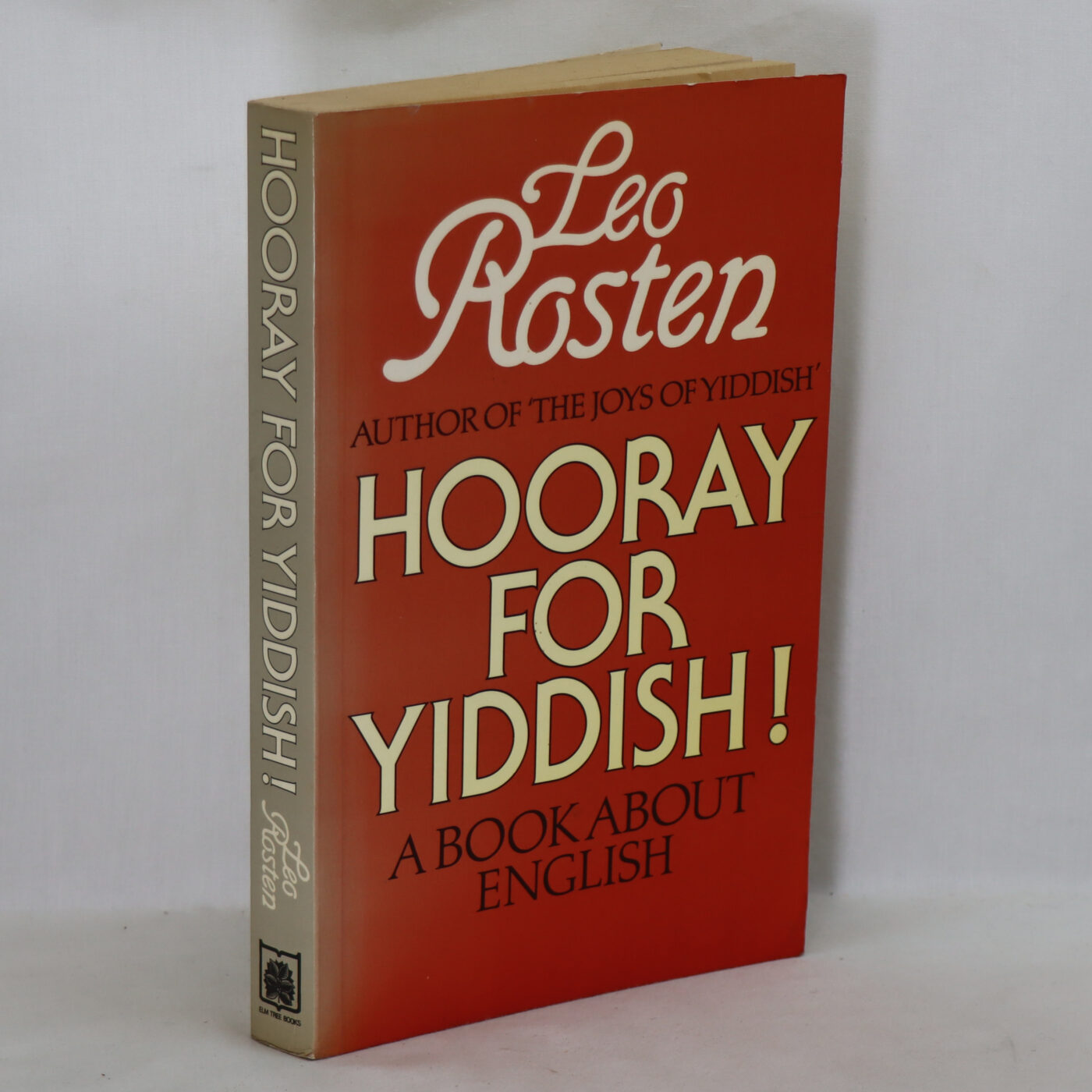
Hooray for Yiddish!
By Leo Rosten
ISBN: 9781422390542
Printed: 1983
Publisher: Elm Tree Books. London
| Dimensions | 16 × 24 × 2 cm |
|---|---|
| Language |
Language: English
Size (cminches): 16 x 24 x 2
Condition: Good (See explanation of ratings)
£24.00
Buy Now

Item information
Description
Paperback. Orange cover with white title on the spine and front board.
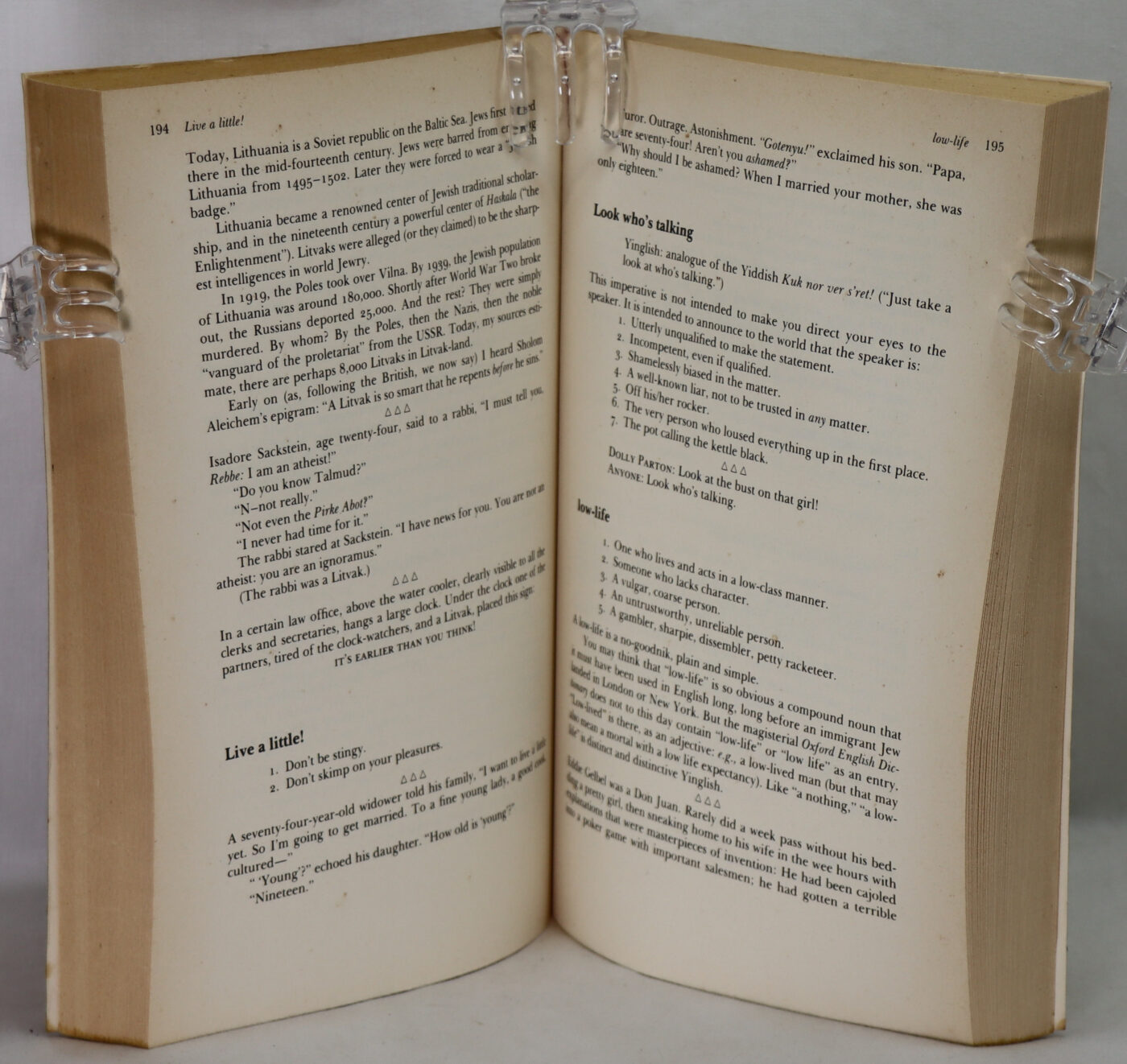
We provide an in-depth photographic presentation of this item to stimulate your feeling and touch. More traditional book descriptions are immediately available
- Note: This book carries a £5.00 discount to those that subscribe to the F.B.A. mailing list
For conditions, please view our photographs. A nice clean rare copy from the library gathered by the famous Cambridge Don, computer scientist, food and wine connoisseur, Jack Arnold LANG. A delightful compendium of Yiddish vocabulary that has seamlessly integrated into the English language, alongside English words and phrases.
Review: I’ve been intrigued by Yiddish for some time, at least since studying Judaism from novels as opposed to textbooks and since having lodged with a Jewish landlady for a while in Leeds. The paradox and sarcasm, the ironic way of looking at life and the general tone of its use shows the importance of language in conveying an attitude to life amongst people who have suffered so much in their history. The attitude to jokes which one has heard before is illuminating. ‘I’ve heard that before’. ‘So what? Do you stop a pianist who is playing Chopin because you heard that piece before?’ The mere telling of a joke is an important activity which boosts morale, increases solidarity and creates a thick-skin with which to withstand suffering. Language, says Rostein in his introduction, is the most marvellous invention for, without it, there could be no science, technology, poetry or physics. ‘In the beginning was the word.’ Rabbi Akiba’s disciples took it for granted that an alphabet existed before God made the world. It is language that separates us from the animals. It is language which conveys a whole perspective on life; like life, language is illogical, otherwise the opposite of ‘in-law’ would be ‘outlaw.’
God created Adam alone in order to teach us that whoever kills one man is as guilty as though he had slaughtered the entire human race, says an old saying. Given Paul’s belief in solidarity in the first and second Adams, this bit of living tradition sheds light on Paul’s thought. No man can say that his father is better than someone else’s father since all are descendents of the same father. Many Yiddish expressions have slipped into the English language, although most English speakers are unaware of it. Comedians like Jack Benny are largely responsible for this. Expressions like ‘Get lost’, indeed most imperatives, have a direct Yiddish descendent. Most people are unaware that at a time when 90% of the human race was illiterate every Jewish male over five years of age was learning to read and write and many were handling at least three languages – Hebrew for prayer and study of the Torah and Talmud, Yiddish, their mother’s language spoken at home, and the language of the country they lived in. Jokes about wealth and poverty, love and marriage, suffering, morality and so on show an attitude to life and a view of God — much of Jewish talking is a dialogue with God on virtually equal terms — one can be angry with God, bargain with him and so on. One stands to pray and one talks to God as a son of a father.This is a good book to dip into if one wants to understand what it means to be Jewish.
Leo Calvin Rosten (April 11, 1908 – February 19, 1997) was an American writer and humorist in the fields of scriptwriting, storywriting, journalism, and Yiddish lexicography.
Want to know more about this item?
We are happy to answer any questions you may have about this item. In addition, it is also possible to request more photographs if there is something specific you want illustrated.
Ask a question
Related products
Share this Page with a friend
