
Hood's Poetical Works.
By Thomas Hood
Printed: Circa 1890
Publisher: Ward Lock & Co. London
| Dimensions | 13 × 19 × 4.5 cm |
|---|---|
| Language |
Language: English
Size (cminches): 13 x 19 x 4.5
Condition: Fine (See explanation of ratings)
£60.00
Buy Now
Your items


Item information
Description
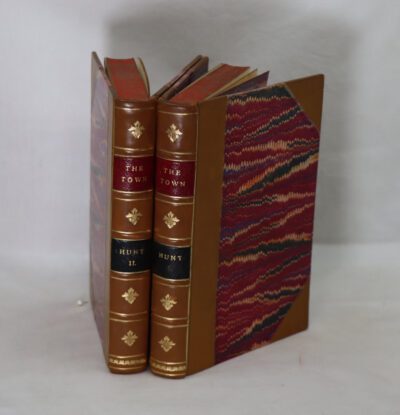
Brown morocco full binding. Embossed edging on both boards. Gilt title with embossed banding on the spine. All edges gilt.
It is the intent of F.B.A. to provide an in-depth photographic presentation of this book offered so to almost stimulate your feel and touch on the book. If requested, more traditional book descriptions are immediately available.
Thomas Hood, 1799 ?1845, was a British humorist and poet. After working in a counting house, and then studying engraving, Hood moved to Scotland, where he began to seriously write poetry. Before long Hood contributed humorous and poetical articles to the provincial newspapers and magazines. On his return to London in 1818 he applied himself to engraving, enabling him later to illustrate his various humours and fancies by quaint devices. In 1821, the editor of the London Magazine, was killed in a duel, and the periodical passed into the hands of some friends of Hood, who proposed to make him sub-editor. His installation into this post at once introduced him to the literary society of the time. In his short life Hood saw “Romantic” change into “Victorian”: he took tea with Wordsworth, dined with Dickens. Hood’s work mirrors this change. Much of his writing has intrinsic merit; some is memorable, its range impressive, its style often forward-looking, and all is valuable to anyone concerned with the transitional period, literary and social, which it reflects.” (DNB). William Michael Rossetti, 1829 ? 1919, was an English writer and critic. He was one of the seven founder members of the Pre-Raphaelite Brotherhood in 1848, and became the movement’s unofficial organizer and bibliographer. Although Rossetti worked full time as a civil servant, he maintained a prolific output of criticism and biography across a range of interests from Algernon Swinburne to James McNeill Whistler.
Paul Gustave Louis Christophe Doré (6 January 1832 – 23 January 1883) was a French artist, as a printmaker, illustrator, painter, comics artist, caricaturist, and sculptor. He is best known for his prolific output of wood-engravings, especially those illustrating classic books, including 241 illustrating the Bible. These achieved great international success, and he is the best known artist in this printmaking technique, although his role was normally as the designer only; at the height of his career some 40 block-cutters were employed to cut his drawings onto the wooden printing blocks, usually also signing the image.
In all he created some 10,000 illustrations, the most important of which were “duplicated in electrotype shells that were printed … on cylinder presses”, allowing very large print runs as steel engravings, “hypnotizing the widest public ever captured by a major illustrator”, and being published simultaneously in many countries. The drawings given to the block-cutters were often surprisingly sketch-like and free.
Although he lacked the usual training in an academy, his paintings were successful during his lifetime, but at least his early paintings of religious and mythological subjects, some extremely large, now tend to be regarded as “grandiloquent and of little merit”. From the late 1860s onwards, he painted smaller landscapes and costumed genre scenes.
Want to know more about this item?
We are happy to answer any questions you may have about this item. In addition, it is also possible to request more photographs if there is something specific you want illustrated.
Ask a question
Related products



Share this Page with a friend
