
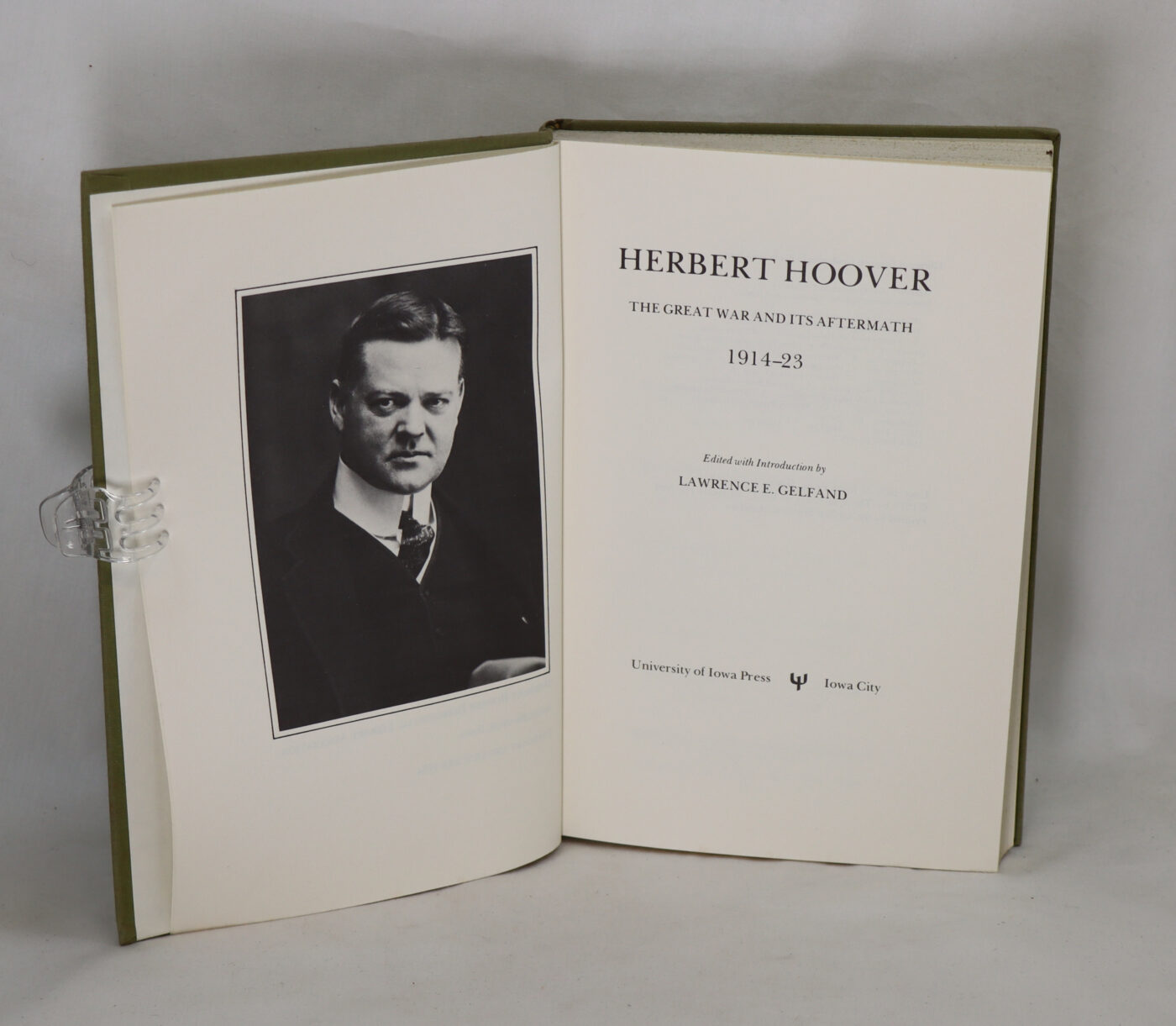
Herbert Hoover, the Great War and its Aftermath.
By Lawrence Gelfand
ISBN: 0877450951
Printed: 1979
Publisher: University of Iowa Press. Iowa
| Dimensions | 16 × 24 × 2 cm |
|---|---|
| Language |
Language: English
Size (cminches): 16 x 24 x 2
Condition: Very good (See explanation of ratings)
£44.00
Buy Now
Your items

Item information
Description
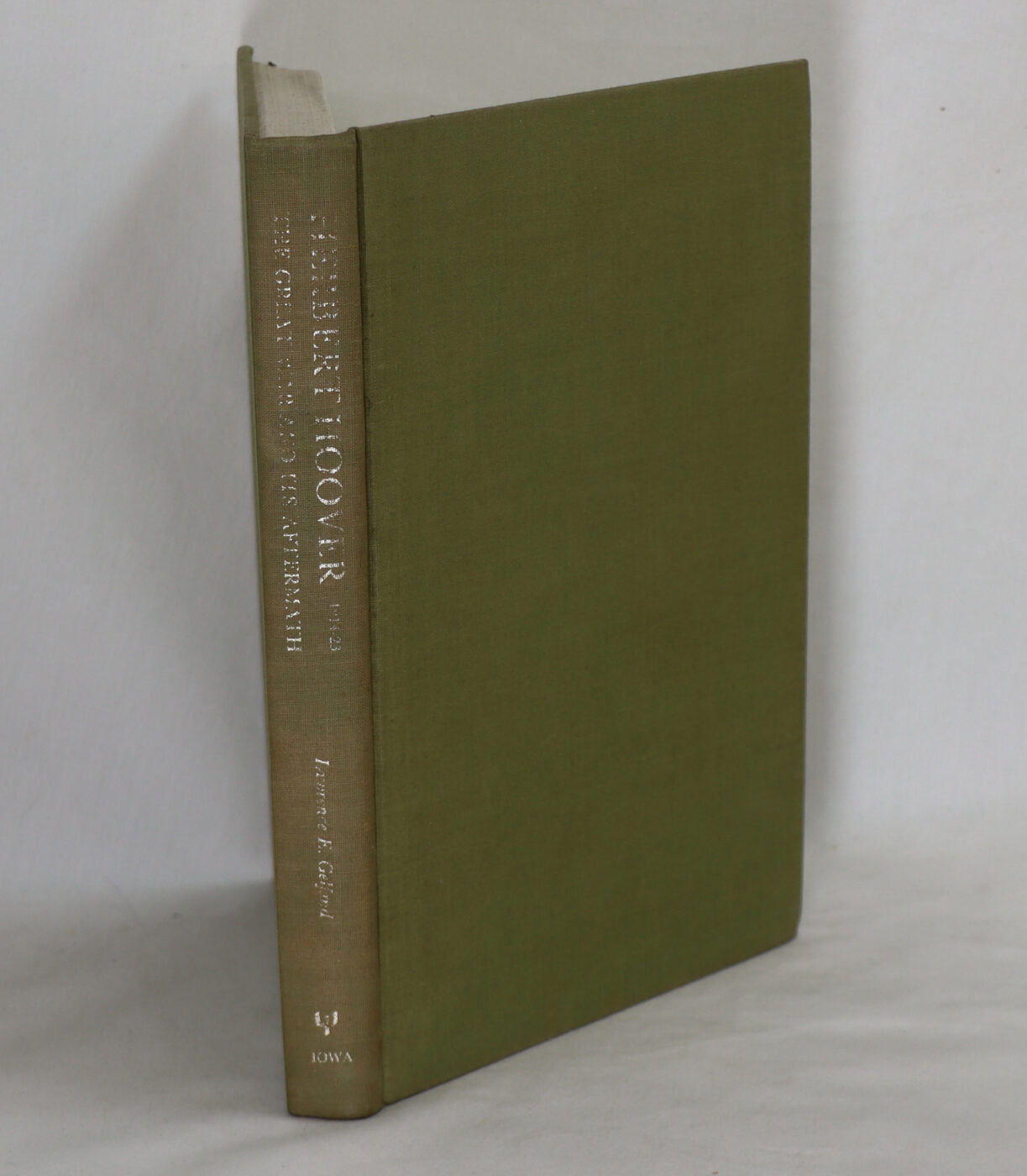
Green cloth binding with gilt title on the spine.
We provide an in-depth photographic presentation of this item to stimulate your feeling and touch. More traditional book descriptions are immediately available.
- Note: This book carries a £5.00 discount to those that subscribe to the F.B.A. mailing list
Please view our photographs. 1st edition/1st printing, unused and carefully stored, No remainder marks/tears or other defects.
Herbert Clark Hoover (August 10, 1874 – October 20, 1964) was the 31st president of the United States, serving from 1929 to 1933. Hoover’s term as president was dominated by the Great Depression, which his attempts to alleviate proved unpopular with the American people. As a result, he lost reelection to Franklin D. Roosevelt in the 1932 United States presidential election. In 1895, Hoover became one of the first graduates of the new Stanford University. He took a position with a London-based mining company working in Australia and China. Hoover rapidly became a wealthy mining engineer and businessman. In 1914, the outbreak of World War I, he organized and headed the Commission for Relief in Belgium, an international relief organization that provided food to occupied Belgium. When the U.S. entered the war in 1917, President Woodrow Wilson appointed Hoover to lead the U.S. Food Administration. He became famous as his country’s “food dictator”. After the war, Hoover led the American Relief Administration, which provided food to the starving millions in Central and Eastern Europe, especially Russia. His wartime service made him a favorite of many progressives, and he unsuccessfully sought the Republican nomination in the 1920 United States presidential election.
Hoover served as Secretary of Commerce under presidents Warren G. Harding and Calvin Coolidge. Hoover was an unusually active and visible Cabinet member, becoming known as “Secretary of Commerce and Under-Secretary of all other departments.” He was influential in the development of air travel and radio. Hoover led the federal response to the Great Mississippi Flood of 1927. He won the Republican nomination in the 1928 presidential election and defeated Democratic candidate Al Smith in a landslide. In 1929, Hoover assumed the presidency. However, during his first year in office, the stock market crashed, signaling the onset of the Great Depression. Hoover supported the Mexican Repatriation and his response to the Great Depression was widely seen as lackluster. In the midst of the Great Depression, he lost in a landslide to Democratic nominee Franklin D. Roosevelt in the 1932 presidential election. Hoover’s retirement was over 31 years long, one of the longest presidential retirements. He authored numerous works and became increasingly conservative in retirement. He strongly criticized Roosevelt’s foreign policy and the New Deal. In the 1940s and 1950s, public opinion of Hoover improved, largely due to his service in various assignments for presidents Harry S. Truman and Dwight D. Eisenhower, including chairing the influential Hoover Commission. Critical assessments of his presidency by historians and political scientists generally rank him as amongst the worst presidents in American history, although Hoover has received praise for his actions as a humanitarian and public official.
Want to know more about this item?
We are happy to answer any questions you may have about this item. In addition, it is also possible to request more photographs if there is something specific you want illustrated.
Ask a question
Related products

Share this Page with a friend
