
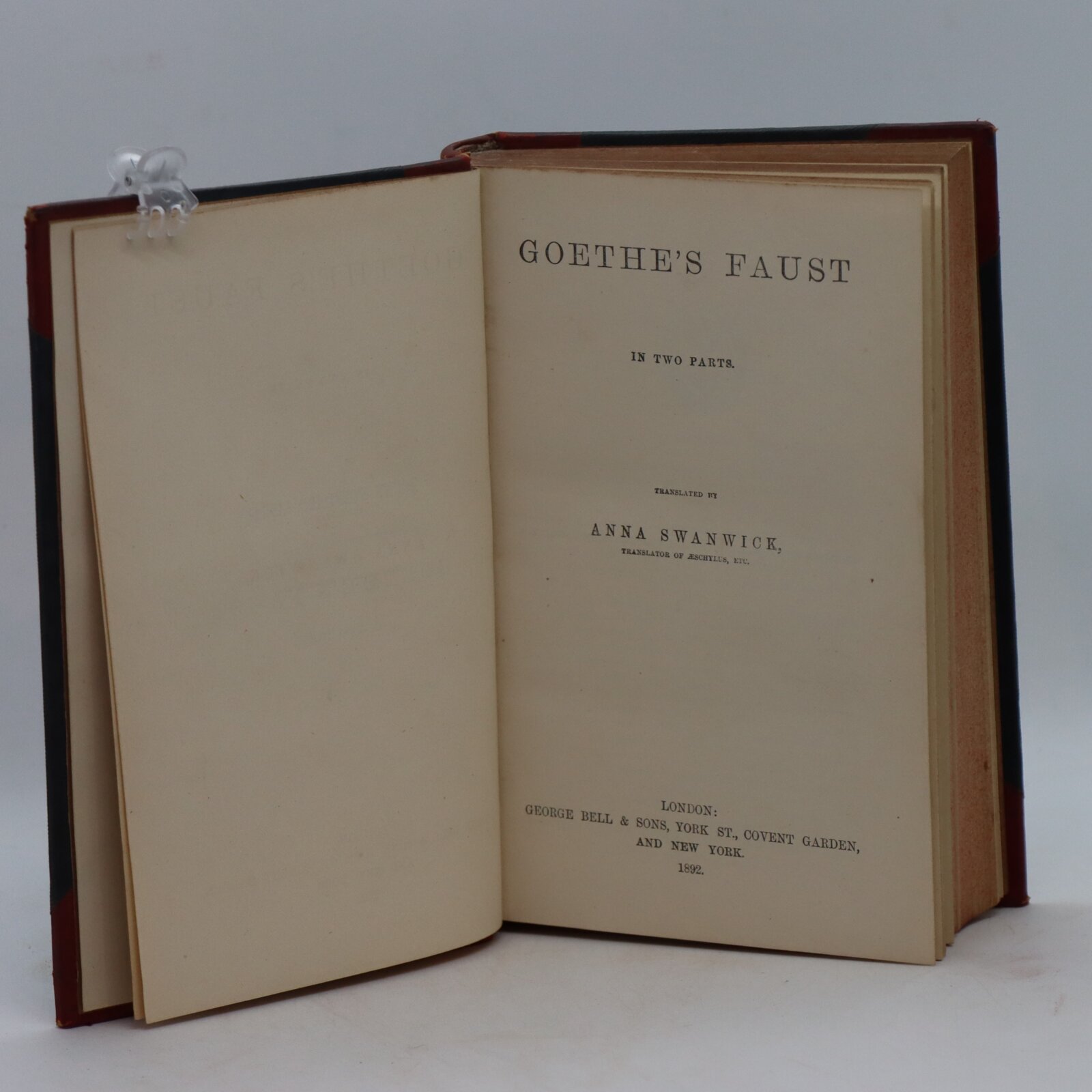
Goeth's Faust.
Printed: 1892
Publisher: George Bell & Sons. London
| Dimensions | 13 × 18 × 3 cm |
|---|---|
| Language |
Language: English
Size (cminches): 13 x 18 x 3
Condition: Fine (See explanation of ratings)
THIS ITEM WILL BE AVAILABLE SOON
SORRY, THIS ITEM HAS SOLD
Item information
Description
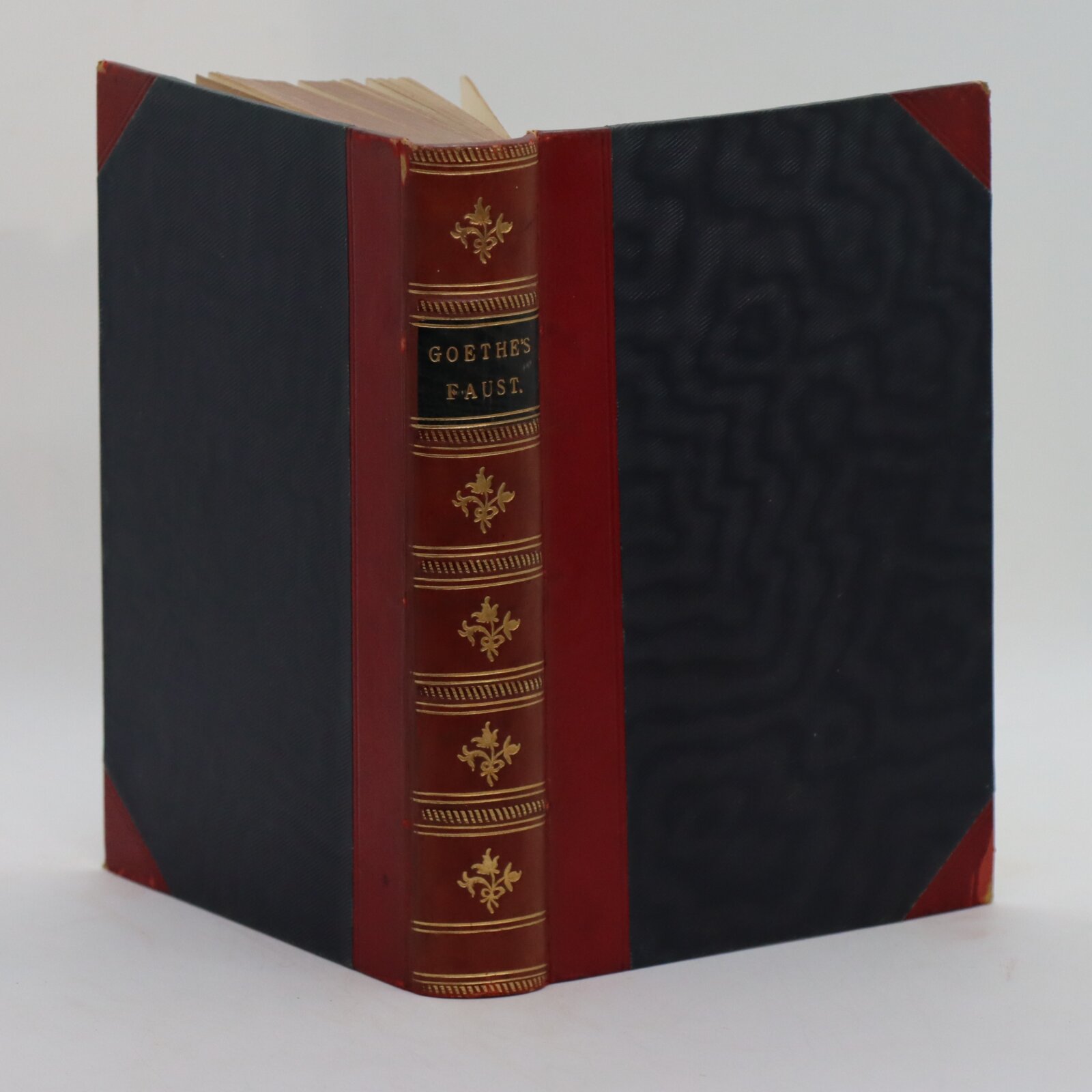
Red calf spine blue cloth boards. Gilt banding, and design on spine with black nameplate.
A beautifully bound book with Anna Swanwick’s brilliant translation
Although there is no precise classification in the overall story, the individual scenes may be loosely bound into three parts: The Prologue, Faust’s Tragedy and Gretchen’s Tragedy.
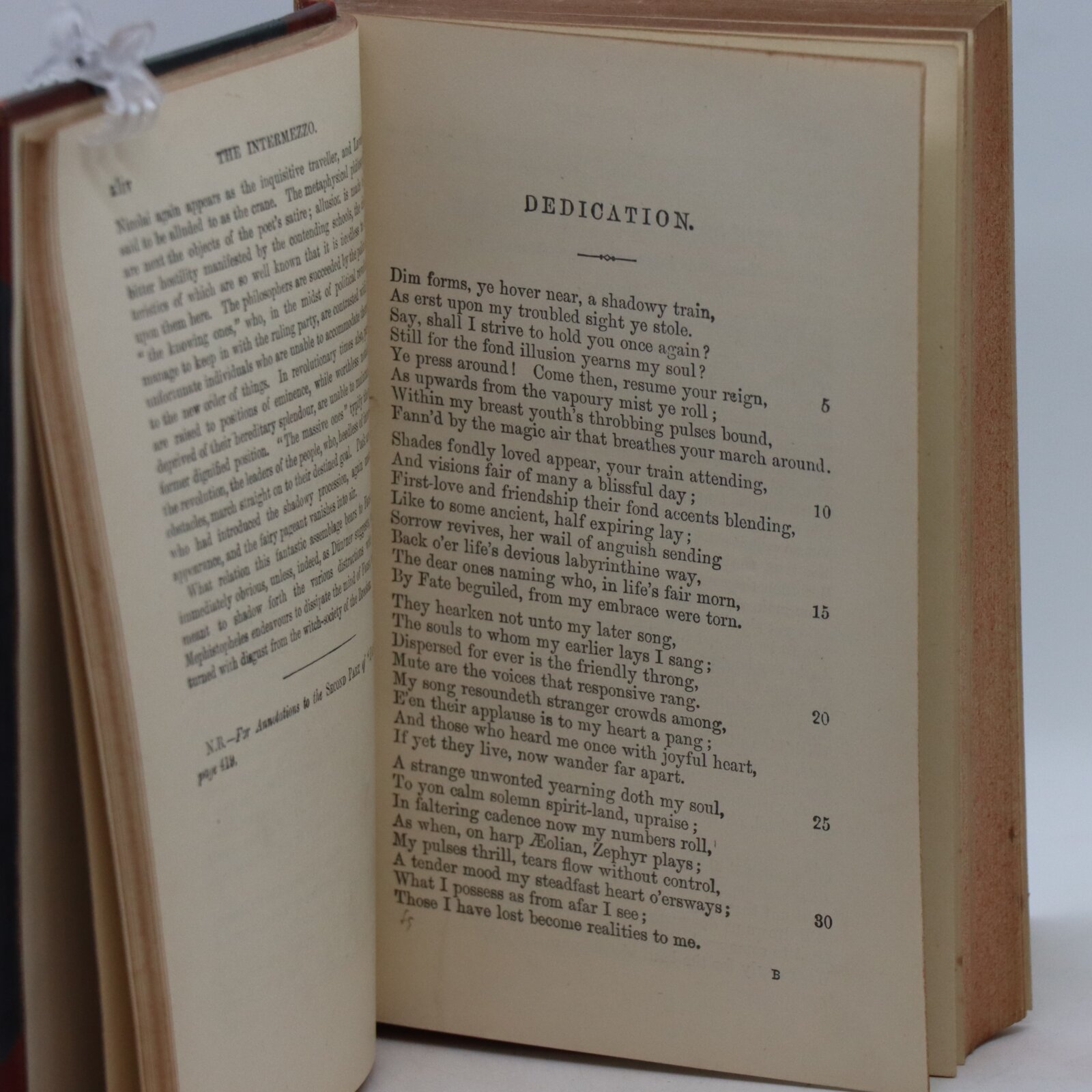
Faust is a tragic play in two parts by Johann Wolfgang von Goethe, usually known in English as Faust, Part One and Faust, Part Two. Nearly all of Part One and the majority of Part Two are written in rhymed verse. Although rarely staged in its entirety, it is the play with the largest audience numbers on German-language stages. Faust is considered by many to be Goethe’s magnum opus and the greatest work of German literature.
The earliest forms of the work, known as the Urfaust, were developed between 1772 and 1775; however, the details of that development are not entirely clear. Urfaust has twenty-two scenes, one in prose, two largely prose and the remaining 1,441 lines in rhymed verse. The manuscript is lost, but a copy was discovered in 1886.
The first appearance of the work in print was Faust, a Fragment, published in 1790. Goethe completed a preliminary version of what is now known as Part One in 1806. Its publication in 1808 was followed by the revised 1828–29 edition, the last to be edited by Goethe himself.
Goethe finished writing Faust, Part Two in 1831; it was published posthumously the following year. In contrast to Faust, Part One, the focus here is no longer on the soul of Faust, which has been sold to the devil, but rather on social phenomena such as psychology, history and politics, in addition to mystical and philosophical topics. The second part formed the principal occupation of Goethe’s last years.
Johann Wolfgang von Goethe (28 August 1749 – 22 March 1832) was a German poet, playwright, novelist, scientist, statesman, theatre director, and critic. His works include plays, poetry, literature and aesthetic criticism, and treatises on botany, anatomy, and colour. He is considered to be the greatest German literary figure of the modern era.
Goethe took up residence in Weimar in November 1775 following the success of his first novel, The Sorrows of Young Werther (1774). He was ennobled by the Duke of Saxe-Weimar, Karl August, in 1782. He was an early participant in the Sturm und Drang literary movement. During his first ten years in Weimar, Goethe became a member of the Duke’s privy council, sat on the war and highway commissions, oversaw the reopening of silver mines in nearby Ilmenau, and implemented a series of administrative reforms at the University of Jena. He also contributed to the planning of Weimar’s botanical park and the rebuilding of its Ducal Palace.
Goethe’s first major scientific work, the Metamorphosis of Plants, was published after he returned from a 1788 tour of Italy. In 1791 he was made managing director of the theatre at Weimar, and in 1794 he began a friendship with the dramatist, historian, and philosopher Friedrich Schiller, whose plays he premiered until Schiller’s death in 1805. During this period Goethe published his second novel, Wilhelm Meister’s Apprenticeship; the verse epic Hermann and Dorothea, and, in 1808, the first part of his most celebrated drama, Faust. His conversations and various shared undertakings throughout the 1790s with Schiller, Johann Gottlieb Fichte, Johann Gottfried Herder, Alexander von Humboldt, Wilhelm von Humboldt, and August and Friedrich Schlegel have come to be collectively termed Weimar Classicism.
The German philosopher Arthur Schopenhauer named Wilhelm Meister’s Apprenticeship one of the four greatest novels ever written, while the American philosopher and essayist Ralph Waldo Emerson selected Goethe as one of six “representative men” in his work of the same name (along with Plato, Emanuel Swedenborg, Montaigne, Napoleon, and Shakespeare). Goethe’s comments and observations form the basis of several biographical works, notably Johann Peter Eckermann’s Conversations with Goethe (1836).
Anna Swanwick (22 June 1813 – 2 November 1899) was an English author and feminist.
Anna Swanwick was the youngest daughter of John Swanwick and his wife, Hannah Hilditch. She was born in Liverpool on 22 June 1813. The Swanwicks descended from Philip Henry, the 17th century nonconformist divine. Anna was educated chiefly at home, but, wishing to carry on her education beyond the typical age for girls in this country at that time, she went in 1839 to Berlin, where she studied German and Greek, and gained knowledge of Hebrew.
She returned to England in 1843 and began translating some of the German dramatists. Her first publication, Selections from the Dramas of Goethe and Schiller appeared in 1843. The selections included Goethe’s Torquato Tasso and Iphigenia in Tauris, and Schiller’s Maid of Orleans. In 1850, she released a volume of translations from Goethe containing the first part of Faust, Egmont, and the two plays of the former volume. The translations are in blank verse. In 1878, she published the second part of Faust; the two parts with Moritz Retzsch’s illustrations appeared together in one volume the same year. Miss Swanwick’s Faust passed through many editions and was included in Bohn’s series of translations from foreign classics. Her English version is accurate and spirited and is regarded as one of the best in existence.
About 1850, Bunsen advised her to try her hand at translating from the Greek, with the result that in 1865 she published a blank-verse translation of the Trilogy of Aeschylus, and in 1873 of the whole of his dramas. The choruses are in rhymed metres. Her translation has passed through many editions and ranks high among English versions. It keeps fairly close to the original.
Miss Swanwick did not confine herself to literary work. She took a keen interest in many social issues of the day, especially women’s education, and in raising the moral and intellectual tone of the working classes. She was a member of the councils both of Queen’s College and Bedford College, London, and was for some time president of the latter.
She assisted in the founding of Girtin College, Cambridge, and Somerville Hall, Oxford, and in extending the King’s College lectures to women. To all these institutions she subscribed liberally. She was associated with Anthony John Mundella and Sir Joshua Girling Fitch in carrying out the provisions of the will of Mrs. Emily Jane Pfeiffer, who left in 1890 large sums of money for the promotion of the higher education of women. She strongly advocated the study of English literature in the universities, and herself lectured privately on the subject to young working men and women.
Miss Swanwick’s life was thus divided between literary pursuits and active philanthropy. She never sought publicity, but her example and influence had an important and invigorating effect on women’s education and on their position in the community. She signed John Stuart Mill’s petition to parliament in 1865 for the political enfranchisement of women. The University of Aberdeen conferred on her the honorary degree of LL.D. She was a Unitarian. Miss Swanwick was the centre of a large circle of distinguished friends, who included Crabb Robinson, Tennyson, Browning, Gladstone, James Martineau, and Sir James Paget, and these, with many others, were frequent visitors at her house. Her marvellous memory made her a delightful talker, and she was full of anecdotes in her later years about the eminent persons she had known.
She died on 2 Nov. 1899 at Tunbridge Wells and was buried in the Swanwick family plot on the western side of Highgate Cemetery five days later.
Her name appears on the south side of the Reformers Memorial in Kensal Green Cemetery in London.
Want to know more about this item?
We are happy to answer any questions you may have about this item. In addition, it is also possible to request more photographs if there is something specific you want illustrated.
Ask a question
Related products



Share this Page with a friend
