
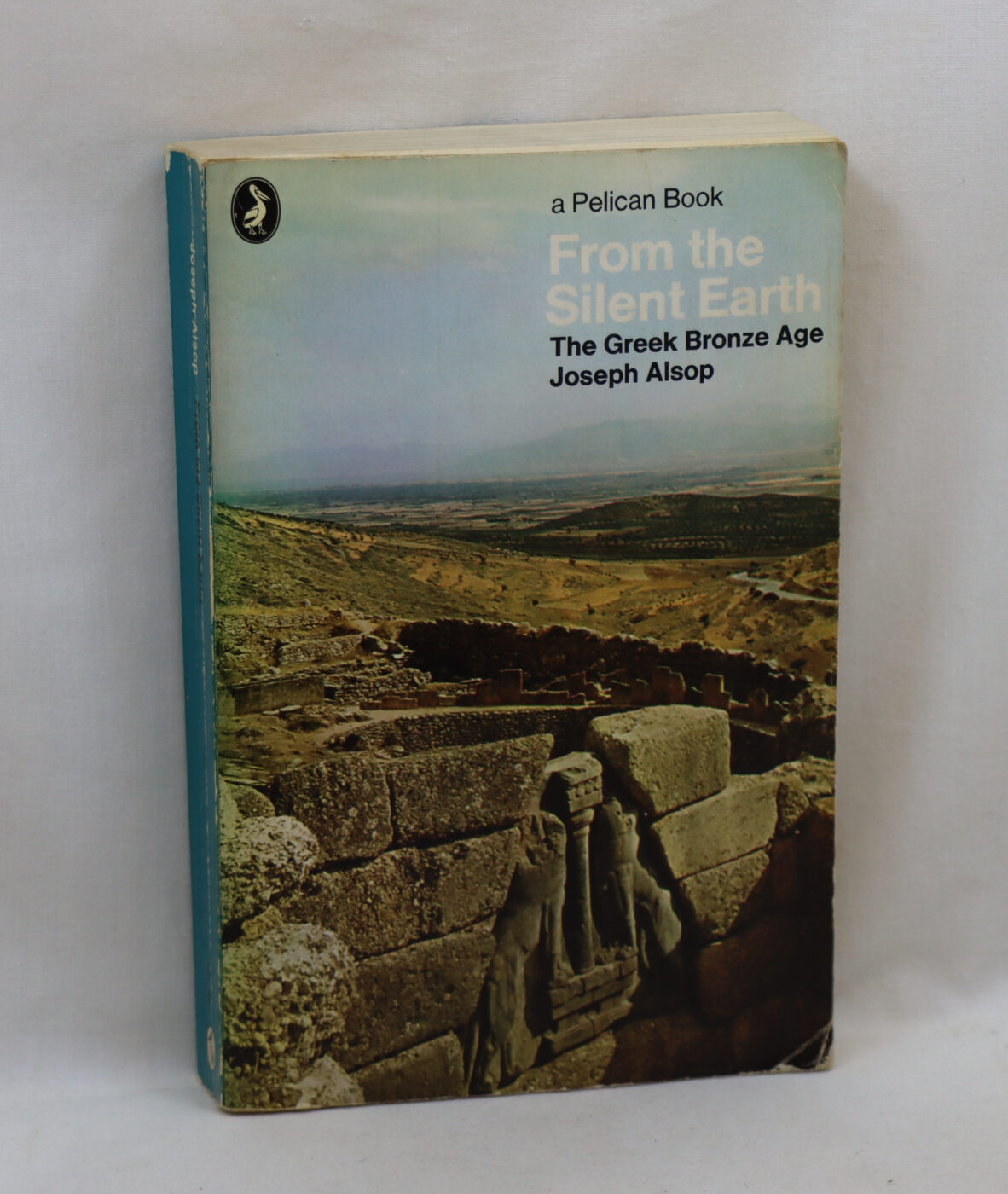
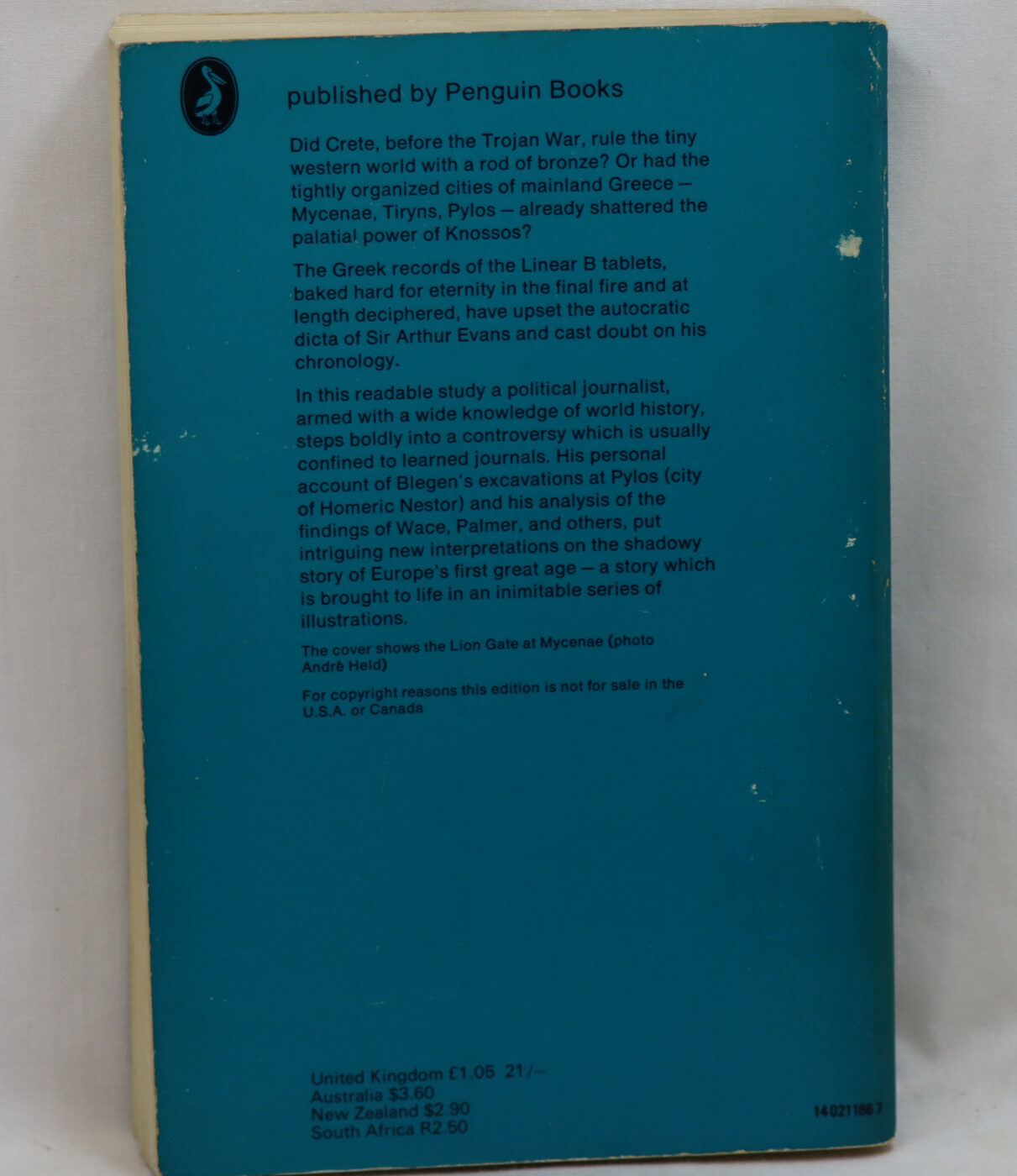
From the Silent Earth. The Greek Bronze Age.
By Joseph Alsop
ISBN: 9780436016004
Printed: 1970
Publisher: Pelican Books. London
| Dimensions | 13 × 20 × 3 cm |
|---|---|
| Language |
Language: English
Size (cminches): 13 x 20 x 3
Condition: Good (See explanation of ratings)
£7.00
Buy Now
Your items
Item information
Description
Paperback. Blue cover with black title.
We provide an in-depth photographic presentation of this item to stimulate your feeling and touch. More traditional book descriptions are immediately available
- A £2 reduction when collected from FBA shop
The Bronze Age is an archaeological and anthropological term defining a phase in the development of material culture among ancient societies in Asia, the Near East and Europe. An ancient civilisation or culture is deemed to be part of the Bronze Age if it either produced bronze by smelting its own copper and alloying it with tin, arsenic, or other metals, or traded other items for bronze from producing areas elsewhere. The Bronze Age is the middle principal period of the three-age system, following the Stone Age and preceding the Iron Age. Conceived as a global era, the Bronze Age follows the Neolithic (“New Stone”) period, with a transition period between the two known as the Chalcolithic (“copper-Stone”) Age. These technical developments took place at different times in different places, and therefore each region’s history is framed by a different chronological system, but the Bronze Age had begun in much of the Old World by 3,000 BC.
Bronze Age cultures were the first to develop writing. According to archaeological evidence, cultures in Mesopotamia, which used cuneiform script, and Egypt, which used hieroglyphs, developed the earliest practical writing systems. In a particular region, whichever comes first of the arrival of the Iron Age, or the development of writing, is usually taken to mark the end of the Bronze Age, as history replaces prehistory; this is not always the case in the earliest areas to develop writing. In the archaeology of the Americas, a five-period system is conventionally used instead, which does not include a Bronze Age, though some cultures there did smelt copper and bronze. No evidence of metalworking has been found on the Australian continent prior to the establishment of European settlements in 1788.
In many areas bronze continued to be rare and expensive, mainly because of difficulties in obtaining enough tin, which occurs in relatively few places, unlike the very common copper. It is likely that the earliest tin deposits were alluvial and perhaps exploited by the same methods used for panning gold in placer deposits. Some societies appear to have gone through much of the Bronze Age using bronze only for weapons or elite art, such as Chinese ritual bronzes, with ordinary farmers largely still using stone tools. However, this is hard to assess as the rarity of bronze meant it was keenly recycled.
NOTE: This is an original book from the library gathered by the famous Cambridge Don, computer scientist, food and wine connoisseur, Jack Arnold LANG. Note: Jack founded the Michelin Guide ‘Midsummer House’- Cambridge’s paramount restaurant. This dining experience is hidden amongst the grassy pastures and grazing cattle of Midsummer Common and perched on the banks of the River Cam. The Midsummer House experience is imaginatively curated to delight and amaze, so the surprise set menu changes regularly and is ‘Midsummer’s’ playground to showcase.
In 2008, Jack was one of the co-founders of the Raspberry Pi Foundation, alongside other members of the Department, and acted as the Foundation’s Chair. The project’s original goals were modest: to build and distribute low-cost computers for prospective applicants to our Computer Science degree. Initially the project was a “success disaster”, as Jack would say, as demand far outstripped the low-scale manufacturing plans. Ultimately the Raspberry Pi became the UK’s most successful computer with more than 60 million sold to date. Jack was drawn to the educational possibilities of the Raspberry Pi, its potential uses in emerging economies and the way it could support self-directed learning.
Want to know more about this item?
We are happy to answer any questions you may have about this item. In addition, it is also possible to request more photographs if there is something specific you want illustrated.
Ask a question
Related products





Share this Page with a friend
