
Essays, Lectures and Orations.
By Ralph Waldo Emerson
Printed: 1851
Publisher: William S Orr & Co. London
| Dimensions | 12 × 18 × 3 cm |
|---|---|
| Language |
Language: English
Size (cminches): 12 x 18 x 3
Condition: Very good (See explanation of ratings)
£95.00
Buy Now


Item information
Description
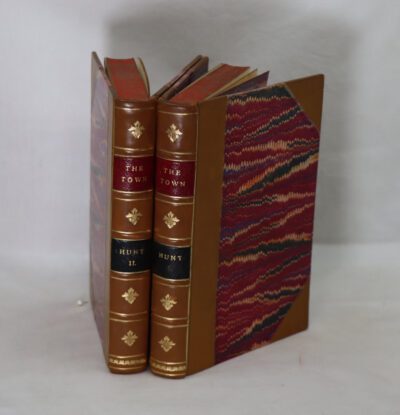
Brown calf spine with black title plate, gilt banding and title. Red and blue marbled boards.
-
F.B.A. provides an in-depth photographic presentation of this item to stimulate your feeling and touch. More traditional book descriptions are immediately available.
As is clearly visible from the photographs this is a quality edition well worthy of this great thinker.

Ralph Waldo Emerson (May 25, 1803 – April 27, 1882), who went by his middle name Waldo, was an American essayist, lecturer, philosopher, abolitionist and poet who led the transcendentalist movement of the mid-19th century. He was seen as a champion of individualism and critical thinking, as well as a prescient critic of the countervailing pressures of society and conformity. Friedrich Nietzsche considered him “the most gifted of the Americans”, and Walt Whitman referred to him as his “master”.
Emerson gradually moved away from the religious and social beliefs of his contemporaries, formulating and expressing the philosophy of transcendentalism in his 1836 essay “Nature”. Following this work, he gave a speech entitled “The American Scholar” in 1837, which Oliver Wendell Holmes Sr. considered to be America’s “intellectual Declaration of Independence.”
Emerson wrote most of his important essays as lectures first and then revised them for print. His first two collections of essays, Essays: First Series (1841) and Essays: Second Series (1844), represent the core of his thinking. They include the well-known essays “Self-Reliance”, “The Over-Soul”, “Circles”, “The Poet”, and “Experience.” Together with “Nature”, these essays made the decade from the mid-1830s to the mid-1840s Emerson’s most fertile period. Emerson wrote on a number of subjects, never espousing fixed philosophical tenets, but developing certain ideas such as individuality, freedom, the ability for mankind to realize almost anything, and the relationship between the soul and the surrounding world. Emerson’s “nature” was more philosophical than naturalistic: “Philosophically considered, the universe is composed of Nature and the Soul.” Emerson is one of several figures who “took a more pantheist or pandeist approach by rejecting views of God as separate from the world.”

He remains among the linchpins of the American romantic movement, and his work has greatly influenced the thinkers, writers and poets that followed him. “In all my lectures”, he wrote, “I have taught one doctrine, namely, the infinitude of the private man.” Emerson is also well known as a mentor and friend of Henry David Thoreau, a fellow transcendentalist.

Photo from Amos Bronson Alcott 1882.
Chronology of Emerson’s Life
1803 – Born in Boston to William and Ruth Haskins Emerson.
1811 – Father dies, probably of tuberculosis.
1812 – Enters Boston Public Latin School
1817 – Begins study at Harvard College: Greek, Latin, History, Rhetoric.
1820 – Starts first journal, entitled “The Wide World.”
1821 – Graduates from Harvard and begins teaching at his brother William’s school for young ladies in Boston.
1825 – Enters Harvard Divinity School.
1829 – Marries Ellen Tucker and is ordained minister at Boston’s Second Church.
1831 – Ellen Tucker Emerson dies, at age 19.
1832 – Resigns position as minister and sails for Europe.
1833 – Meets Wordsworth, Coleridge, J. S. Mill, and Thomas Carlyle. Returns to Boston in November, where he begins a career as a lecturer.
1834 – Receives first half of a substantial inheritance from Ellen’s estate (second half comes in 1837).
1835 – Marries Lidian Jackson.
1836 – Publishes first book, Nature.
1838 – Delivers the “Divinity School Address.” Protests relocation of the Cherokees in letter to President Van Buren.
1841 – Essays published (contains “Self-Reliance,” “The Over-Soul,” “Circles,” “History”).
1842 – Son Waldo dies of scarlet fever at the age of 5.
1844 – Essays, Second Series published (contains “The Poet,” “Experience,” “Nominalist and Realist”).
1847–8 – Lectures in England.
1850 – Publishes Representative Men (essays on Plato, Swedenborg, Montaigne, Goethe, Napoleon).
1851–60 – Speaks against Fugitive Slave Law and in support of anti-slavery candidates in Concord, Boston, New York, Philadelphia.
1856 – Publishes English Traits.
1860 – Publishes The Conduct of Life (contains “Culture” and “Fate”).
1867 – Lectures in nine western states.
1870 – Publishes Society and Solitude. Presents sixteen lectures in Harvard’s Philosophy Department.
1872–3 – After a period of failing health, travels to Europe, Egypt.
1875 – Journal entries cease.
1882 – Dies in Concord.
Want to know more about this item?
We are happy to answer any questions you may have about this item. In addition, it is also possible to request more photographs if there is something specific you want illustrated.
Ask a question
Related products



Share this Page with a friend
