
Erika's Story.
By Ruth Vander Zee
ISBN: 9781566602402
Printed: 2004
Publisher: Jonathan Cape. London
| Dimensions | 26 × 25 × 1 cm |
|---|---|
| Language |
Language: English
Size (cminches): 26 x 25 x 1
Condition: Good (See explanation of ratings)
£17.00
Buy Now
Your items




Item information
Description
Brown hard board binding with black title and cutout yellow star on the front board.
We provide an in-depth photographic presentation of this item to stimulate your feeling and touch. More traditional book descriptions are immediately available.
- Note: This book carries a £5.00 discount to those that subscribe to the F.B.A. mailing list
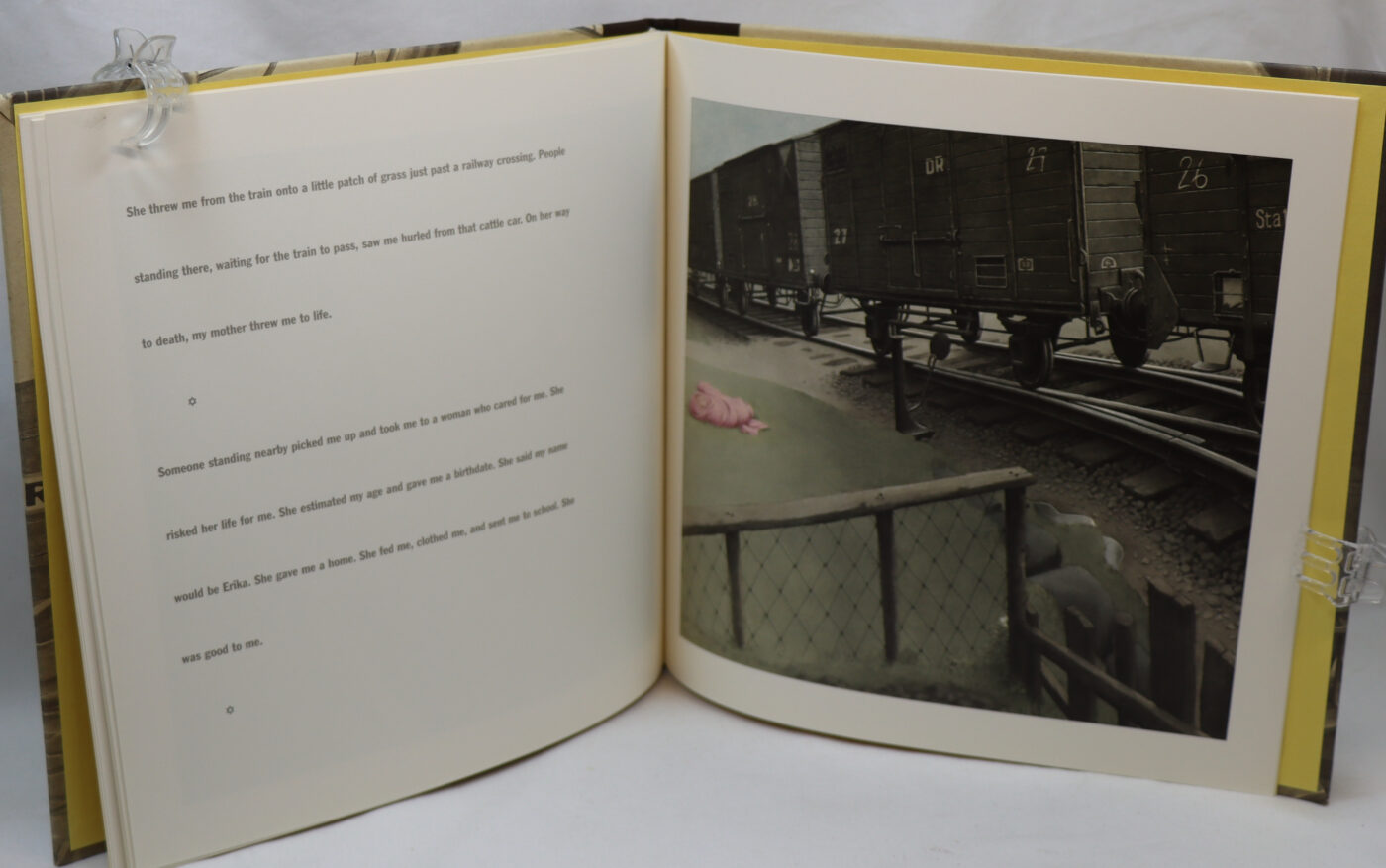
In 1995, the fiftieth anniversary of the end of World War II, Ruth Vander Zee and her husband were in Germany where they met Erika, a German Jew, and listened to her story. Between 1933 and 1945 six million Jews were killed. Starved, shot, burned, gassed. Erika survived. Born some time in 1944, Erika does not know exactly when or where. She does not know what her parents called her, or whether or not she had brothers or sisters. But she does know that when she was just a few months old, she was saved from the Holocaust. In a cattle carriage on their way to death, Erika’s family threw her to life. She was thrown from the train, and taken to a woman who risked her life to care for this baby. She gave her a name, a birthdate, a home, food, clothes, life.
Review: This story is both uplifting and heartbreaking. It is a true story about a jewish baby who was thrown from the train en route to a concentration camp. She was raised by a German family and despite not knowing literally anything about her history has grown up happy and has children and grandchildren of her own now. I have got to read this book to my class in a few weeks but at the moment I can’t actually read it out loud without crying! The illustrations are superb and are mainly monochrome with a few touches of colour which is very effective. A must for older children who are studying WW2.
Ruth Vander Zee (Author) Ruth was brought up in Chicago. At the age of forty, she decided to get her college degree in education and later began writing stories for children. Ruth and her husband Vern live in Miami, Florida.Roberto Innocenti (Illustrator) Roberto Innocenti was born in 1940 in Bagno a Ripoli, a small town near Florence. Never having attended art school, he went to Rome to work in an animation studio. Returning to Florence, he began designing books and illustrating film and theatre posters. He has illustrated Pinocchio, A Christmas Carol, J. Patrick Lewis’s The Last Resort and Ruth Vander Zee’s Erika’s Story. He lives in Florence with his wife.
Erika’s Story – A great review.
Ruth Vander Zee: Illustrator: Roberto Innocenti
Nonfiction Picture Book: For ages 8 and up
The Creative Company, 2003 ISBN: 978-1568461762
Erika does not know when she was born, what her name was, who her parents were, or where she came from. What she does know was that her parents were Jewish and that they, like so many millions of other people, were forced out of their homes, rounded up and put on a train. Perhaps her parents thought they were going to a better place, a place where there would be “food and work.” At the same time they must have worried about rumors that had been going around; rumors about there being death camps.
After a short while Erika’s mother must have realized that they could not possibly be going to “a better place.” They were being transported standing up in cattle cars after all. Surely what lay ahead had to be terrible. She must have known that her baby’s only chance for survival was to get off that train. Out her deep love for her child, Erika’s mother threw her carefully wrapped up baby from the train, no doubt hoping and praying that someone would find and take of the helpless infant.
Luckily Erika was found. A kind woman risked all by taking in the baby. She named her Erika and she gave her a good life.
In this incredibly powerful picture book the author tells the story of how a Jewish mother, on her way to a death camp, did all she could to save her child from the same fate. This is a true story and though it is heartbreaking, it also has a message of hope, for Erika survived. She got married, had children and grandchildren, and she was one of those yellow stars who was able to continue shining.
Sparingly written and perfectly paced, this is a book which truly captures the horror and courage the existed side by side during the years of the Holocaust.
Roberto Innocenti has created stunning artwork for this powerful story. In shades of grey he tells Erika’s story in pictures. This grim color scheme is only relieved when Erika’s mother throws the baby from the train, her pink infant’s blanket bright against the grey background. On the last illustrated page Erika is shown as a young girl living in a world full of color once more. The grey is lifted and life has begun anew.
An author’s note at the beginning of the book explains how the author met Erika and how it was that she came to hear Erika’s story.
Review Written by Marya Jansen-Gruber
The Holocaust,known in Hebrew as the Shoah, was the genocide of European Jews during World War II. From 1941 to 1945, Nazi Germany and its collaborators systematically murdered around six million Jews across German-occupied Europe, approximately two-thirds of Europe’s Jewish population. The murders were committed primarily through mass shootings across Eastern Europe and poison gas chambers in extermination camps, chiefly Auschwitz-Birkenau, Treblinka, Belzec, Sobibor, Chełmno and Majdanek death camps in occupied Poland. Concurrent Nazi persecutions killed millions of other non-Jewish civilians and prisoners of war (POWs); the term Holocaust is sometimes used to include the murder and persecution of non-Jewish groups, such as the Romani and Soviet POWs.
The Nazis developed their ideology based on racism and pursuit of “living space”, and seized power in early 1933. Meant to force all German Jews to emigrate, regardless of means, the regime passed anti-Jewish laws, encouraged violence, and orchestrated a nationwide pogrom known as Kristallnacht in November 1938. After Germany’s invasion of Poland in September 1939, occupation authorities began to establish ghettos to segregate Jews. Following the June 1941 invasion of the Soviet Union, 1.5 to 2 million Jews were murdered by German forces and local collaborators. The Nazis first targeted Jewish Red Army POWs and male civilians, but quickly escalated to murdering Jewish women and children.
By early 1942, following the Wannsee Conference presided by Reinhard Heydrich, the Nazis’ Final Solution was implemented to murder all Jews in Europe. Some historians note that Adolf Hitler frequently communicated major policy decisions verbally to Heinrich Himmler rather than through written directives. Victims were deported to extermination camps where those who had survived the trip were gassed, while others were sent to forced labor camps where many died from starvation, abuse, exhaustion, or being used as test subjects in experiments. Property belonging to murdered Jews was redistributed to the German occupiers and other non-Jews. The murder rate was most intense during Operation Reinhard from March 1942 to November 1943. Although the majority of Holocaust victims died in 1942, the mass murders continued until the end of the war in 1945.
Many Jewish survivors emigrated from Europe after the war. A few Holocaust perpetrators faced criminal trials. Billions of dollars in reparations have been paid, although falling short of the losses suffered by the European Jews. The Holocaust has also been commemorated in museums, memorials, and culture. It is considered to be the single deadliest genocide in human history, and has become central to Western historical consciousness as a symbol of the ultimate human evil.
Want to know more about this item?
We are happy to answer any questions you may have about this item. In addition, it is also possible to request more photographs if there is something specific you want illustrated.
Ask a question
Share this Page with a friend
