
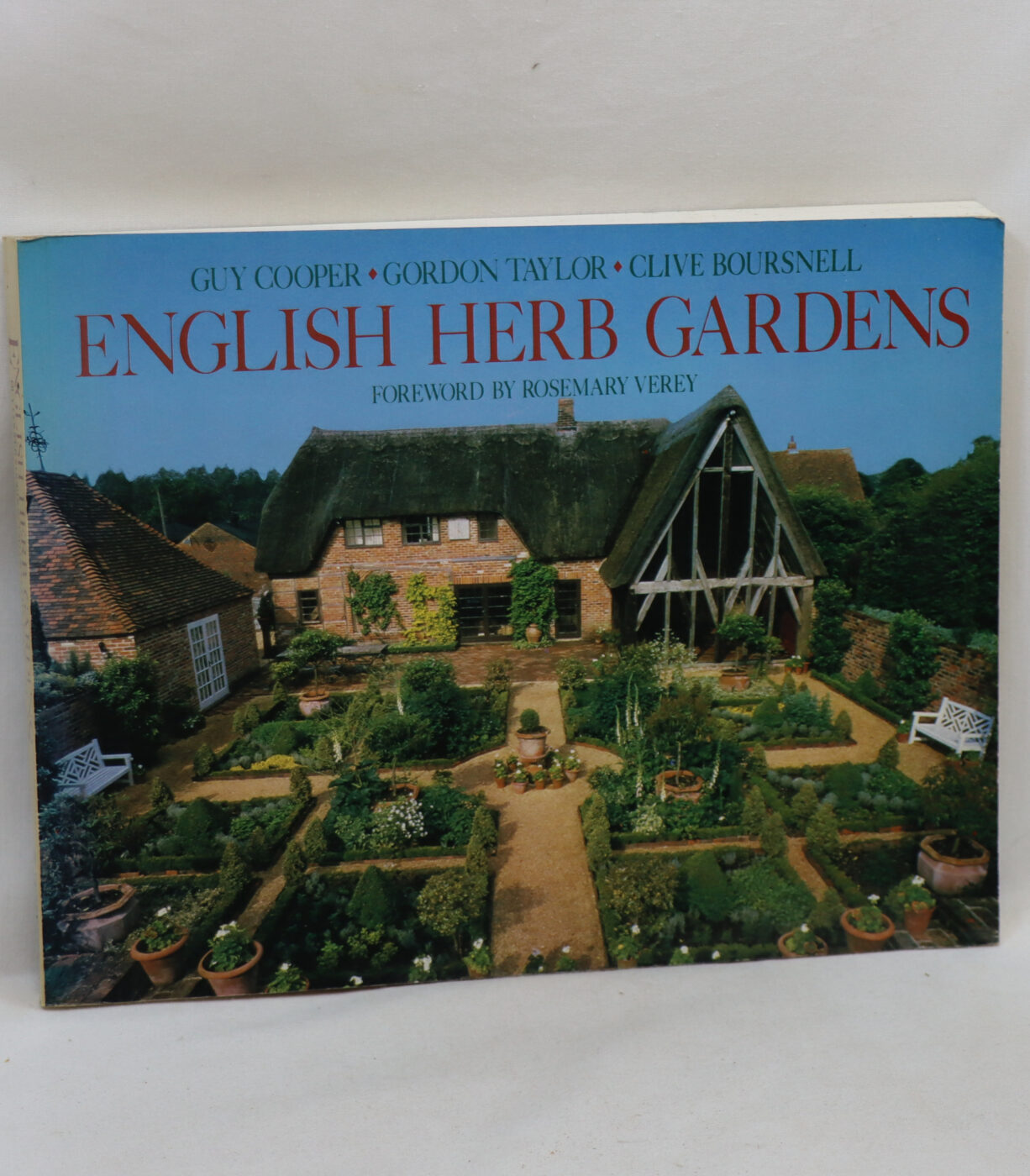
English Herb Garden.
By Guy Cooper. Gordon Taylor. Clive Boursnell
Printed: 1986
Publisher: Weidenfeld & Nicholson. London
| Dimensions | 25 × 19 × 2 cm |
|---|---|
| Language |
Language: English
Size (cminches): 25 x 19 x 2
Condition: Good (See explanation of ratings)
£54.00
Buy Now

Item information
Description
Paperback. Tan cover with red title.
We provide an in-depth photographic presentation of this item to stimulate your feeling and touch. More traditional book descriptions are immediately available.
- Note: This book carries a £5.00 discount to those that subscribe to the F.B.A. mailing list
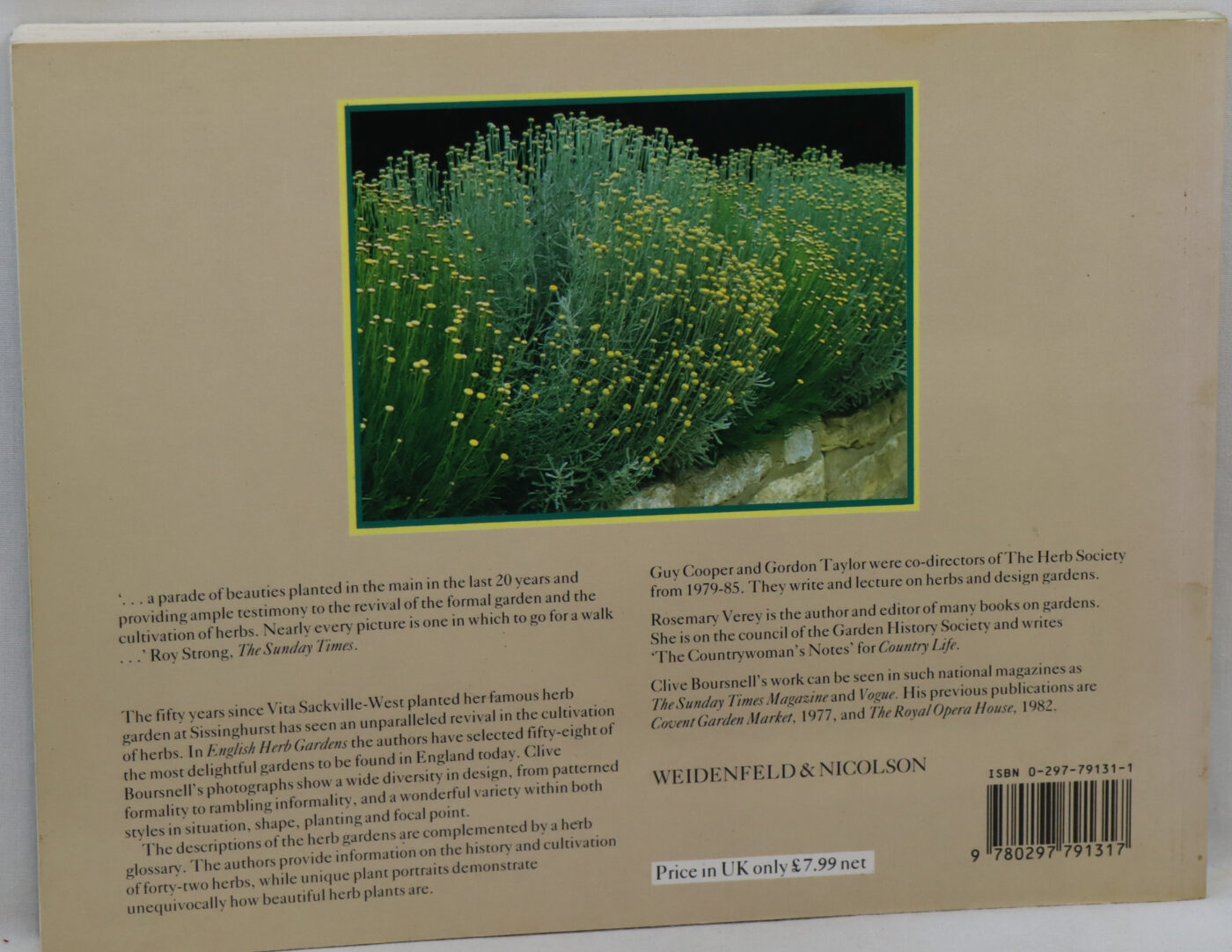
Shows fifty-eight formal and informal herb gardens, briefly describes the history of each garden, and provides information on the cultivation and use of more than forty popular herbs.
This is Jack Arnold Lang’s own personal copy. Jack founded the Michelin Guide ‘Midsummer House’- Cambridge’s paramount restaurant using this book to help grow the restaurant’s own herbs!
Review: The gardens in this book represent every type of herb garden, large and small, that you could imagine, from the precisely laid out knot garden of a stately home to a blowsy, billowing back garden in Birmingham. The format has a big photo on the lefthand page, with a description and relevant background on the right. There are over fifty gardens featured. Some, like York Gate or Hestercombe House, are famous and appear in many books, but even here the editors have taken care to show them from an unfamiliar angle. Several are the display gardens of herb farms or nurseries. A very high proportion are open to the public.
The last part of the book is described as a “glossary” of herbs – a bit misleading as it forms a concise herbal in itself, with two plants to a page, a good photo and text giving history, uses, folklore and cultivation tips. A good range of varieties is featured, with some unfamiliar candidates. This section in itself is better than many so-called guides to herbs.
If you are thinking of planning an herb garden, this book is a very good buy; it is a very much better book than the more recent Jekka’s Complete Herb Book: In Association with the Royal Horticultural Society. You have a gazillion good ideas to inspire you, and much of the technical knowledge to carry it out. It is one of the best books on the subject and I am glad to have stumbled across it.
NOTE: This is an original book from the library gathered by the famous Cambridge Don, computer scientist, food and wine connoisseur, Jack Arnold LANG. Note: Jack founded the Michelin Guide ‘Midsummer House’- Cambridge’s paramount restaurant. This dining experience is hidden amongst the grassy pastures and grazing cattle of Midsummer Common and perched on the banks of the River Cam.
In 2008, Jack was one of the co-founders of the Raspberry Pi Foundation, alongside other members of the Department, and acted as the Foundation’s Chair. The project’s original goals were modest: to build and distribute low-cost computers for prospective applicants to our Computer Science degree. Initially the project was a “success disaster”, as Jack would say, as demand far outstripped the low-scale manufacturing plans. Ultimately the Raspberry Pi became the UK’s most successful computer with more than 60 million sold to date. Jack was drawn to the educational possibilities of the Raspberry Pi, its potential uses in emerging economies and the way it could support self-directed learning.
Want to know more about this item?
We are happy to answer any questions you may have about this item. In addition, it is also possible to request more photographs if there is something specific you want illustrated.
Ask a question
Related products





Share this Page with a friend
