
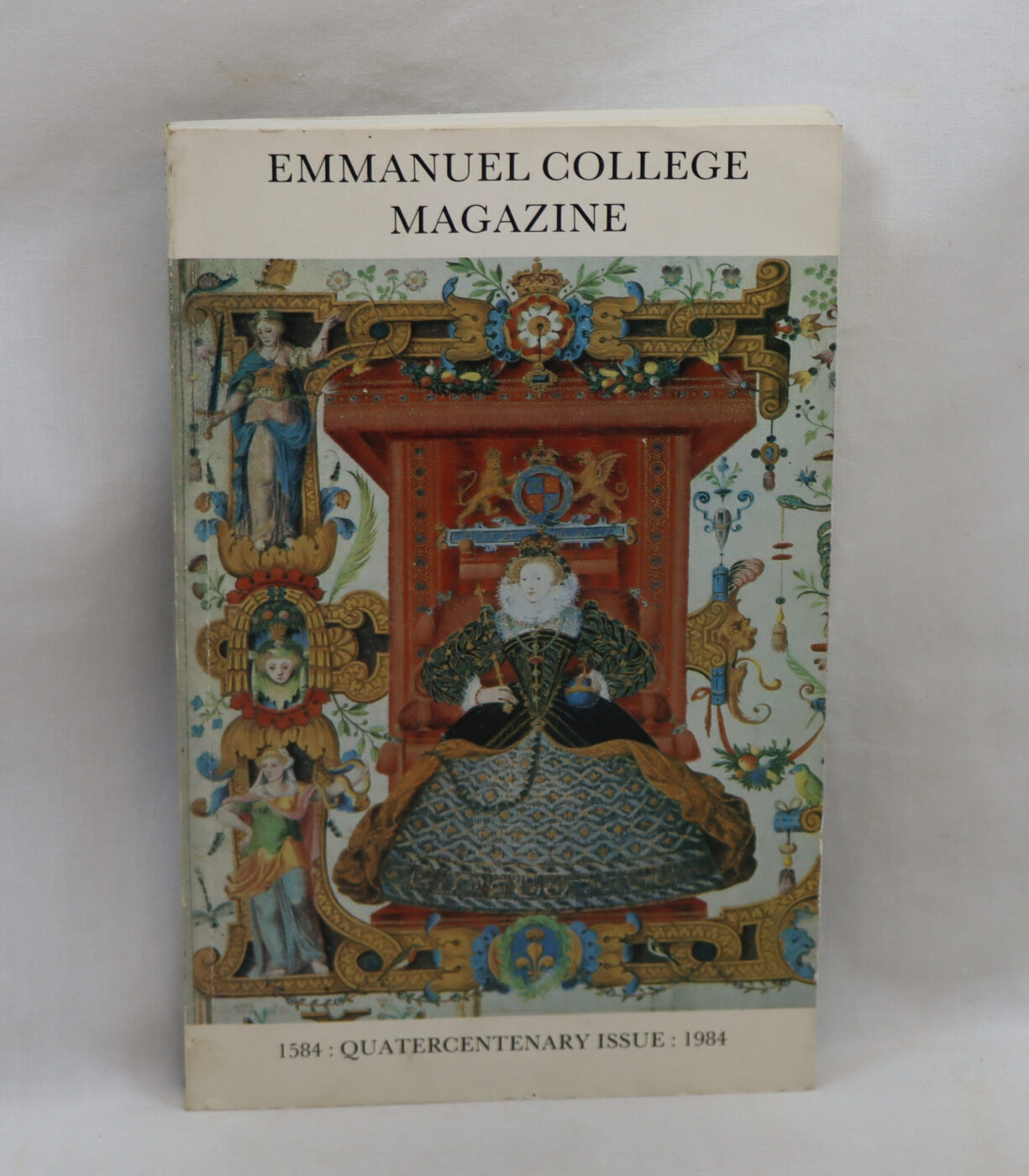
Emmanuel College Magazine. Quatercentenary Issue . 1984.
Printed: 1984
Publisher: Emmanuel College. Cambridge
| Dimensions | 14 × 21 × 1 cm |
|---|---|
| Language |
Language: English
Size (cminches): 14 x 21 x 1
Condition: Very good (See explanation of ratings)
£9.00
Buy Now
Your items
Item information
Description
Paperback. White cover with black title.
- A £2 reduction when collected from FBA shop
Emmanuel College is a constituent college of the University of Cambridge. The college was founded in 1584 by Sir Walter Mildmay, Chancellor of the Exchequer to Elizabeth I. The site on which the college sits was once Cambridge Blackfriars, a priory for Dominican monks, and the College Hall is built on the foundations of the monastery’s nave. Emmanuel is one of the 16 “old colleges”, which were founded before the 17th century.
Emmanuel today is one of the larger Cambridge colleges; it has around 500 undergraduates, reading almost every subject taught within the University, and around 200 postgraduates. Among Emmanuel’s notable alumni are Thomas Young, John Harvard, Graham Chapman and Sebastian Faulks. Three members of Emmanuel College have received Nobel Prizes: Ronald Norrish, George Porter (both Chemistry, 1967) and Frederick Hopkins (Medicine, 1929).
In every year from 1998 until 2016, Emmanuel was among the top five colleges in the Tompkins Table, which ranks colleges according to end-of-year examination results. Emmanuel topped the table five times (2003, 2004, 2006, 2007 and 2010) and placed second six times (2001, 2002, 2008, 2009, 2011 and 2012). Its mean score for 1997–2025 inclusive places it as the second-highest-ranking college after Trinity.
History: The college was founded in 1584 by Sir Walter Mildmay, Chancellor of the Exchequer to Elizabeth I. The site had been occupied by Cambridge Blackfriars, a Dominican friary, until the Dissolution of the Monasteries 45 years earlier, after which the Vice-Chancellor petitioned that the place be given over to the University; his request was refused. After passing through several hands, the former monastery was purchased for £550 to be the site of the new college in June 1583 by Laurence Chaderton, the Master-elect, and his brother-in-law, Richard Culverwell, acting on behalf of Mildmay, to whom they conveyed the property on 23 November 1583. Mildmay’s foundation made use of the existing buildings. The architect was Ralph Symons, and in 1588 the new building was opened with a dedication festival, which Mildmay attended.
Mildmay, a Puritan, intended Emmanuel to be a centre for the training of Anglican preachers. According to Thomas Fuller, Mildmay, on coming to court after the college was opened, was addressed by the Queen with the words: “Sir Walter, I hear you have erected a puritan foundation”, to which Mildmay replied: “No, madam; far be it from me to countenance anything contrary to your established laws; but I have set an acorn, which when it becomes an oak, God alone knows what will be the fruit thereof”.
Like all the older Cambridge colleges, Emmanuel originally took only male students. It first admitted female students in 1979.
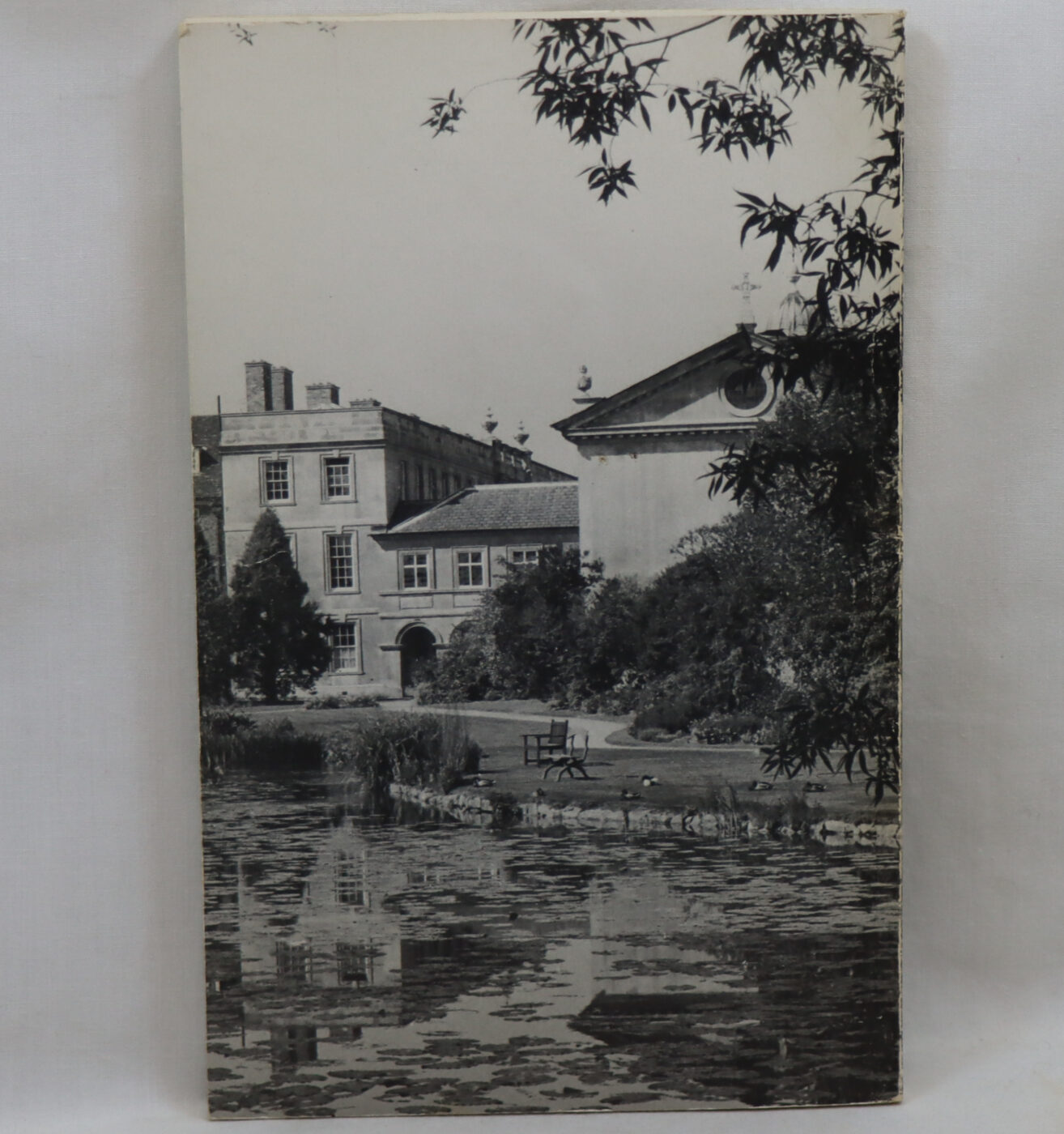
Buildings and grounds: Under Mildmay’s instructions the chapel of the original Dominican Friary was converted into the College’s dining hall and the friars’ dining hall became a chapel. In the late 17th century the College commissioned a new chapel, one of the three buildings in Cambridge designed by Christopher Wren (1677). After Wren’s construction was opened the old chapel became the College library until it outgrew the space. The library moved to its present space in 1930, occupying a large building in South Court completed in 1911 and initially used as lecture rooms. The library was extended in 1974.
There is a large fish pond in the grounds, part of the legacy of the friary. The pond is home to a colony of ducks.
The Fellows’ Garden contains a swimming pool that was the friars’ bathing pool, making it one of the oldest bathing pools in Europe and allegedly the oldest outdoor pool in continuous use in the UK. The Garden also contains an Oriental plane tree that is reputed to have lived far longer than is typical for the species.
It has been claimed that the college has the only privately owned subway (underpass) in the UK, connecting the main site to North Court, but in fact Oriel College, Oxford, has its own tunnel beneath Oriel Street linking the Island Site with the main college buildings. The Bodleian Library in Oxford also has its own tunnel beneath Broad Street.
Queen’s Building: The Queen’s Building encompasses a 150-seat theatre, reception and seminar rooms, and facilities for music practice. The theatre inside the Queen’s Building is frequently utilized by the College for various purposes, such as lectures, Music Society concerts, admissions open day talks, and is a conference venue. Designed by the architects Sir Michael and Patty Hopkins, the Queen’s Building is constructed using Ketton stone. The architectural design combines the robustness of the stone exterior walls with the spanning capabilities and mass of concrete for the floors. The limestone exterior is load bearing, and is the first building to use post-tensioned stone with internal cables. The roof is adorned with lead, and American white oak is extensively incorporated into the roof and panelling. The building was inaugurated in 1995.
NOTE: This is original book from the library gathered by the famous Cambridge Don, computer scientist, food and wine connoisseur, Jack Arnold LANG. In 2008, Jack was one of the co-founders of the Raspberry Pi Foundation, alongside other members of the Department, and acted as the Foundation’s Chair. The project’s original goals were modest: to build and distribute low-cost computers for prospective applicants to our Computer Science degree. Initially the project was a “success disaster”, as Jack would say, as demand far outstripped the low-scale manufacturing plans. Ultimately the Raspberry Pi became the UK’s most successful computer with more than 60 million sold to date. Jack was drawn to the educational possibilities of the Raspberry Pi, its potential uses in emerging economies and the way it could support self-directed learning.
Want to know more about this item?
We are happy to answer any questions you may have about this item. In addition, it is also possible to request more photographs if there is something specific you want illustrated.
Ask a question
Related products





Share this Page with a friend
