
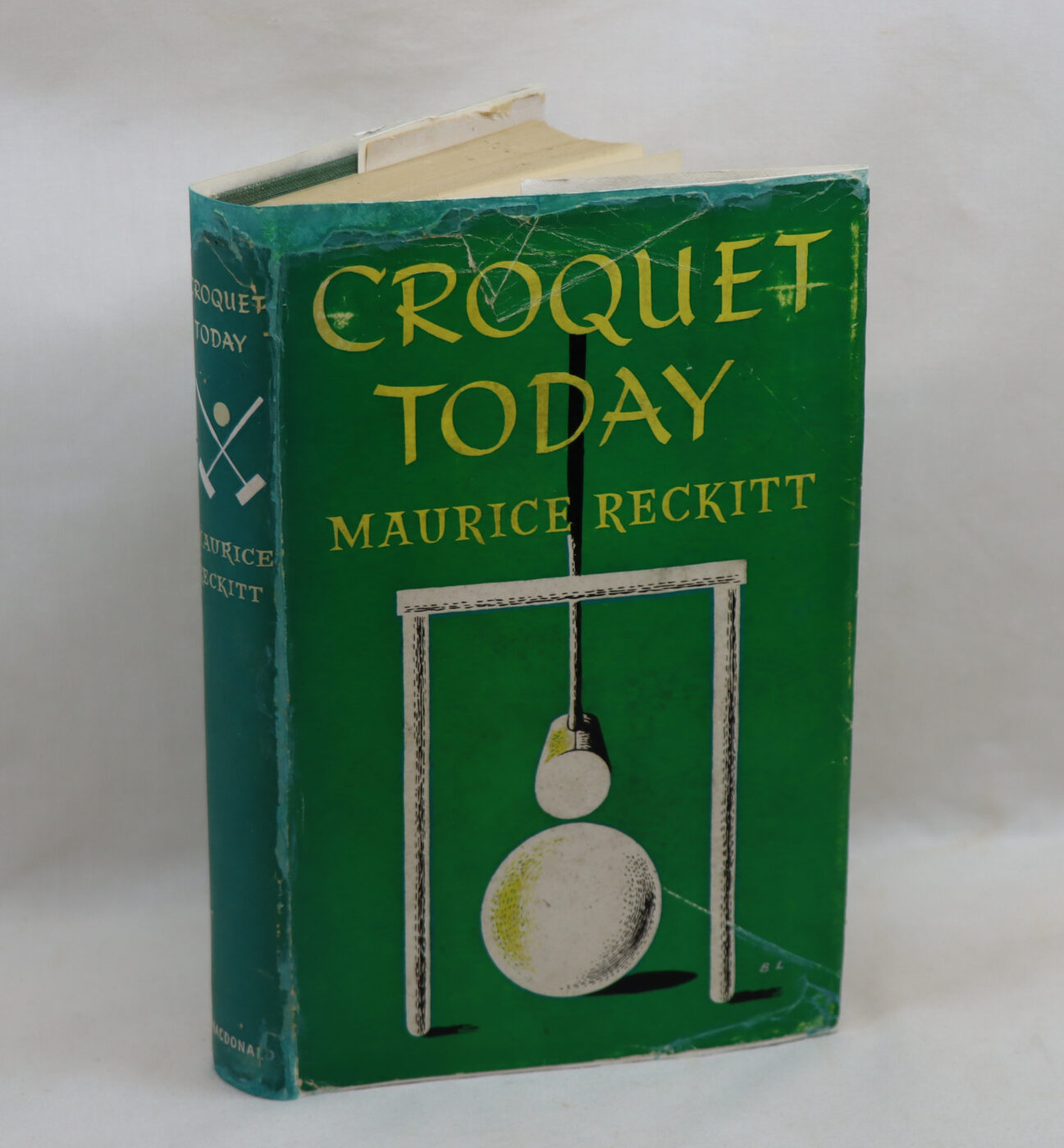
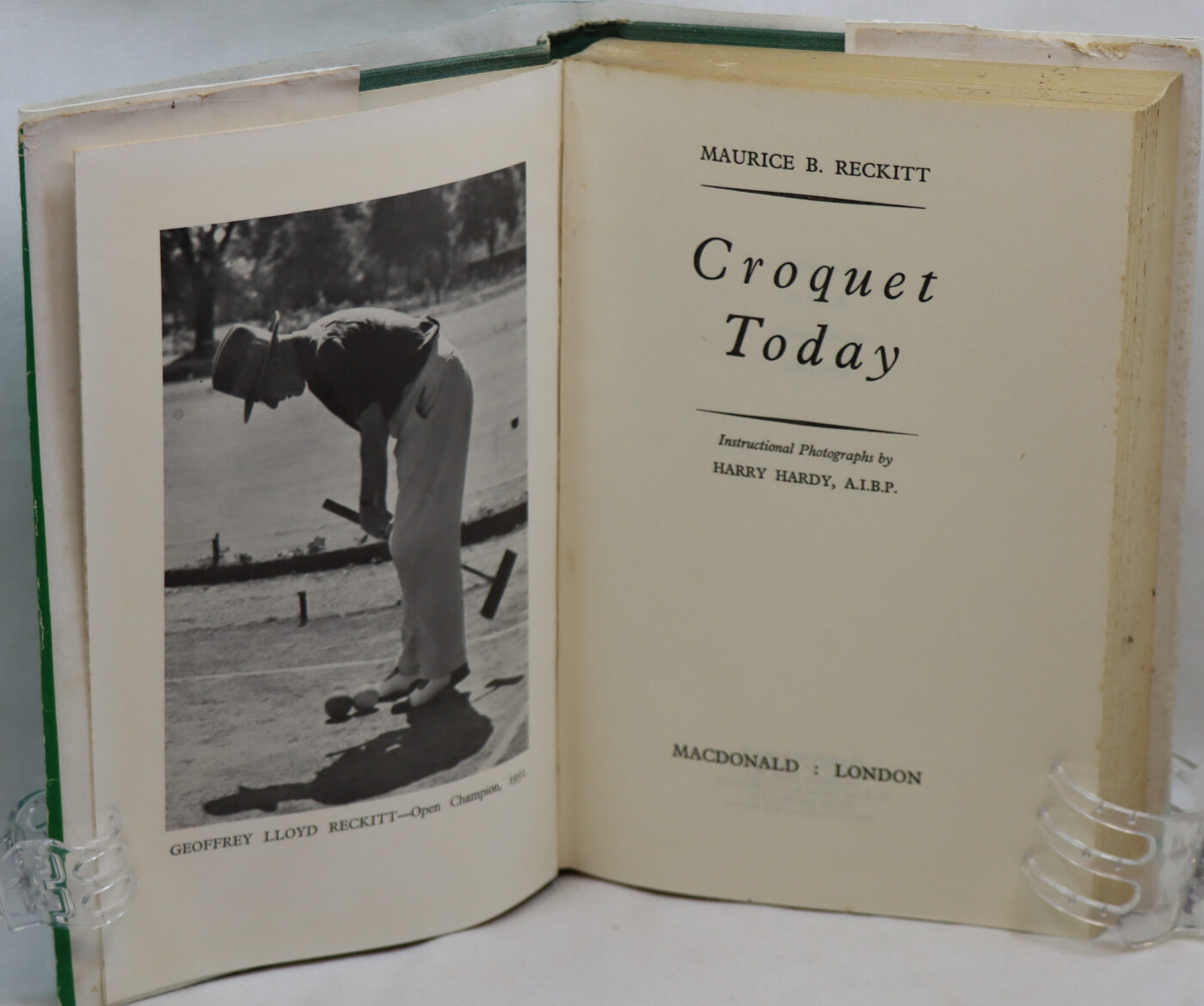
Croquet Today.
By Maurice B Reckitt
Printed: 1954
Publisher: Macdonald- Orbis. London
| Dimensions | 14 × 20 × 3 cm |
|---|---|
| Language |
Language: English
Size (cminches): 14 x 20 x 3
Condition: Good (See explanation of ratings)
£63.00
Buy Now

Item information
Description
In the original (worn) dust cover. Green cloth binding with gilt title on the spine.
We provide an in-depth photographic presentation of this item to stimulate your feeling and touch. More traditional book descriptions are immediately available
- Note: This book carries a £5.00 discount to those that subscribe to the F.B.A. mailing list
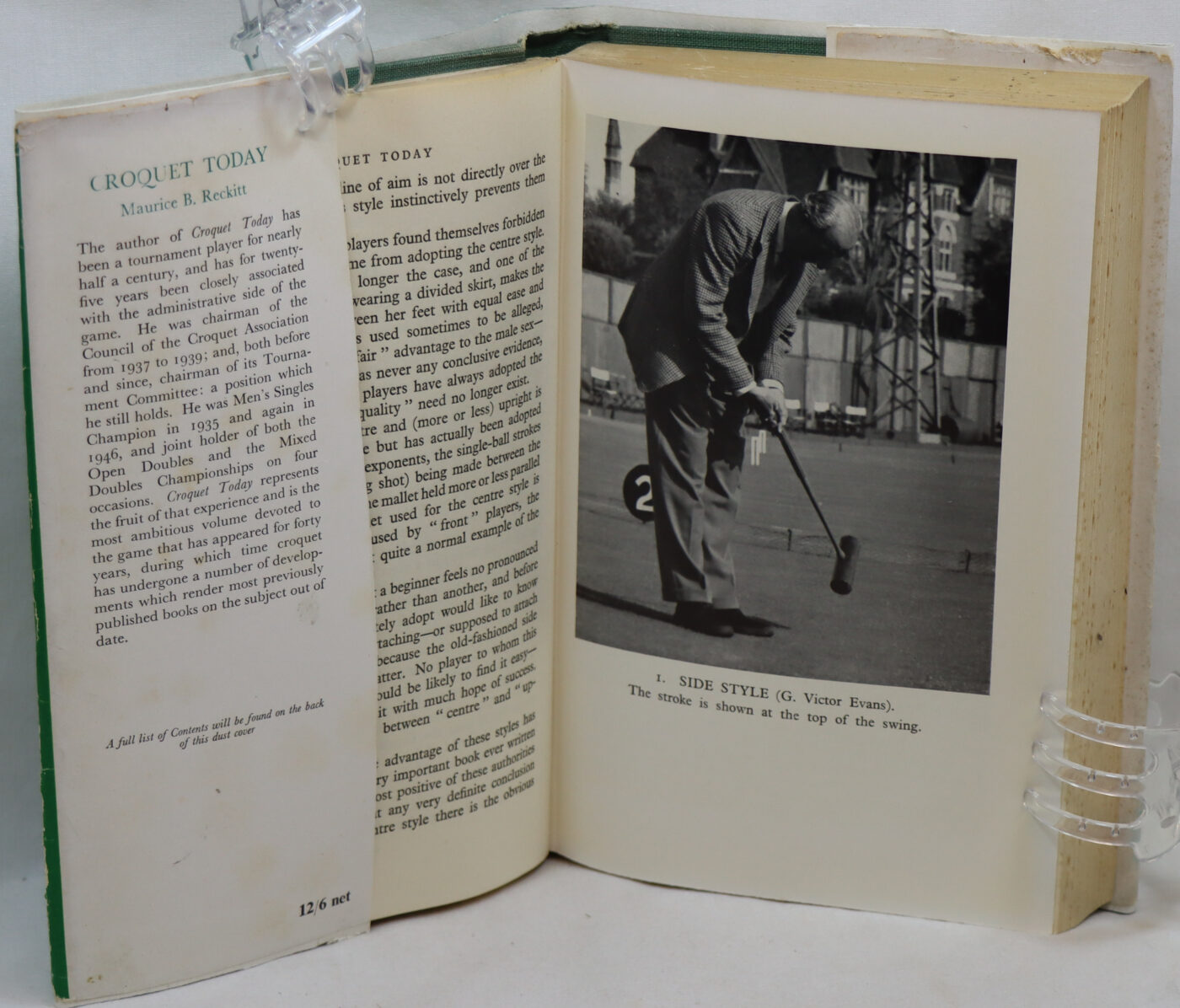
This is one of the best books written on the art and sport of croquet: a must for any player.
Croquet is a sport which involves hitting wooden, plastic, or composite balls with a mallet through hoops (often called “wickets” in the United States) embedded in a grass playing court.
The sport was codified in England in the 1860s and then spread overseas. However, similar games have been recorded back to the late Middle Ages. Today, there are several variations of the game.
At its highest level, the game is played internationally with top players coming from Australia, England, Spain, Egypt, South Africa and the United States amongst other countries.
The sport can be played equally well by men and women. In 2018, two international championships open to both sexes were won by women
NOTE: This is an original book from the library gathered by the famous Cambridge Don, computer scientist, food and wine connoisseur, Jack Arnold LANG. Note: Jack founded the Michelin Guide ‘Midsummer House’- Cambridge’s paramount restaurant. This dining experience is hidden amongst the grassy pastures and grazing cattle of Midsummer Common and perched on the banks of the River Cam.
In 2008, Jack was one of the co-founders of the Raspberry Pi Foundation, alongside other members of the Department, and acted as the Foundation’s Chair. The project’s original goals were modest: to build and distribute low-cost computers for prospective applicants to our Computer Science degree. Initially the project was a “success disaster”, as Jack would say, as demand far outstripped the low-scale manufacturing plans. Ultimately the Raspberry Pi became the UK’s most successful computer with more than 60 million sold to date. Jack was drawn to the educational possibilities of the Raspberry Pi, its potential uses in emerging economies and the way it could support self-directed learning.
Condition notes
Dust cover worn
Want to know more about this item?
We are happy to answer any questions you may have about this item. In addition, it is also possible to request more photographs if there is something specific you want illustrated.
Ask a question
Related products

Share this Page with a friend
