
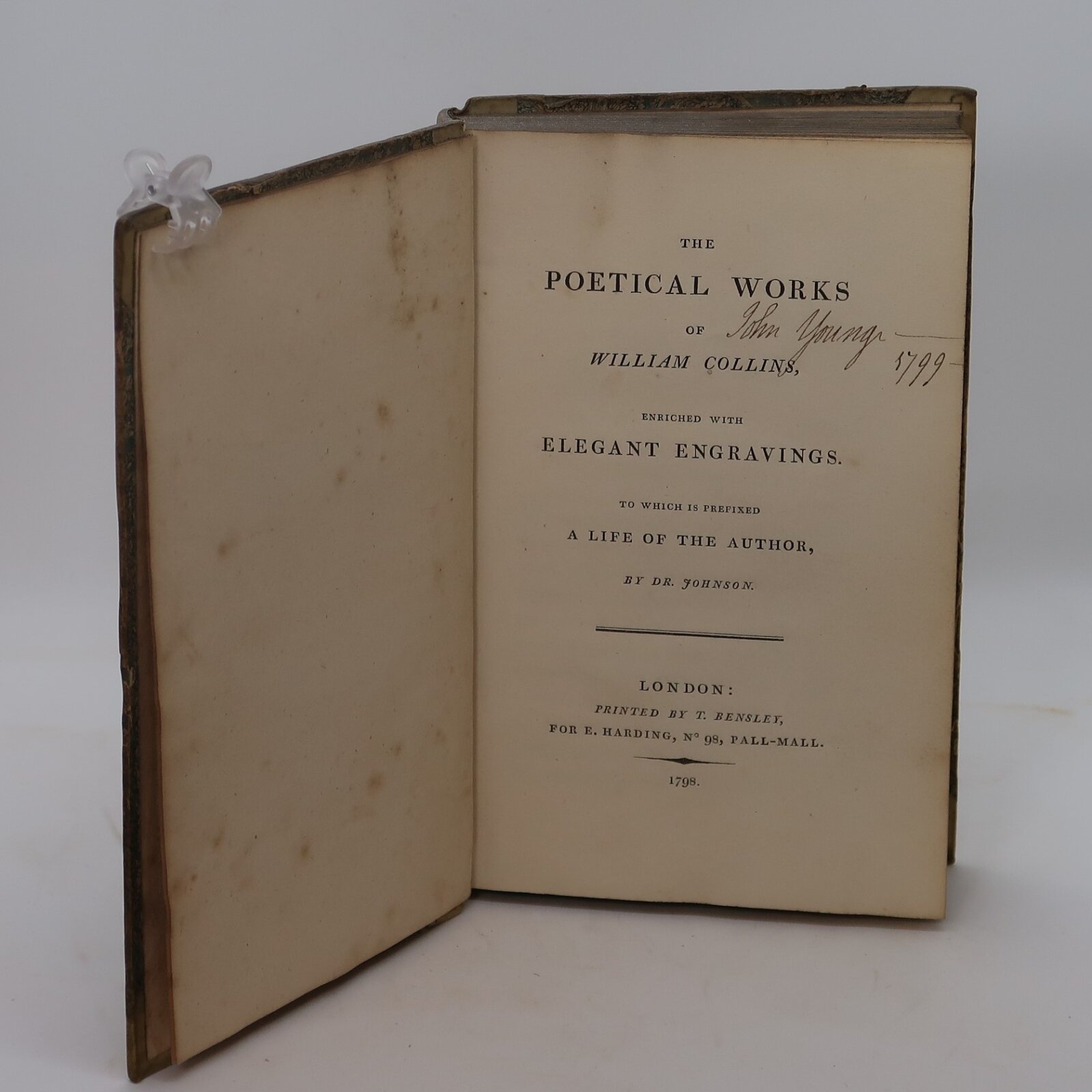
Collin's Poems.
By William Collins
Printed: 1798
Publisher: E Harding. Pall Mall
Edition: revised edition
| Dimensions | 13 × 19 × 2 cm |
|---|---|
| Language |
Language: English
Size (cminches): 13 x 19 x 2
Condition: Fine (See explanation of ratings)
£350.00
FREE shipping
Buy Now

Item information
Description
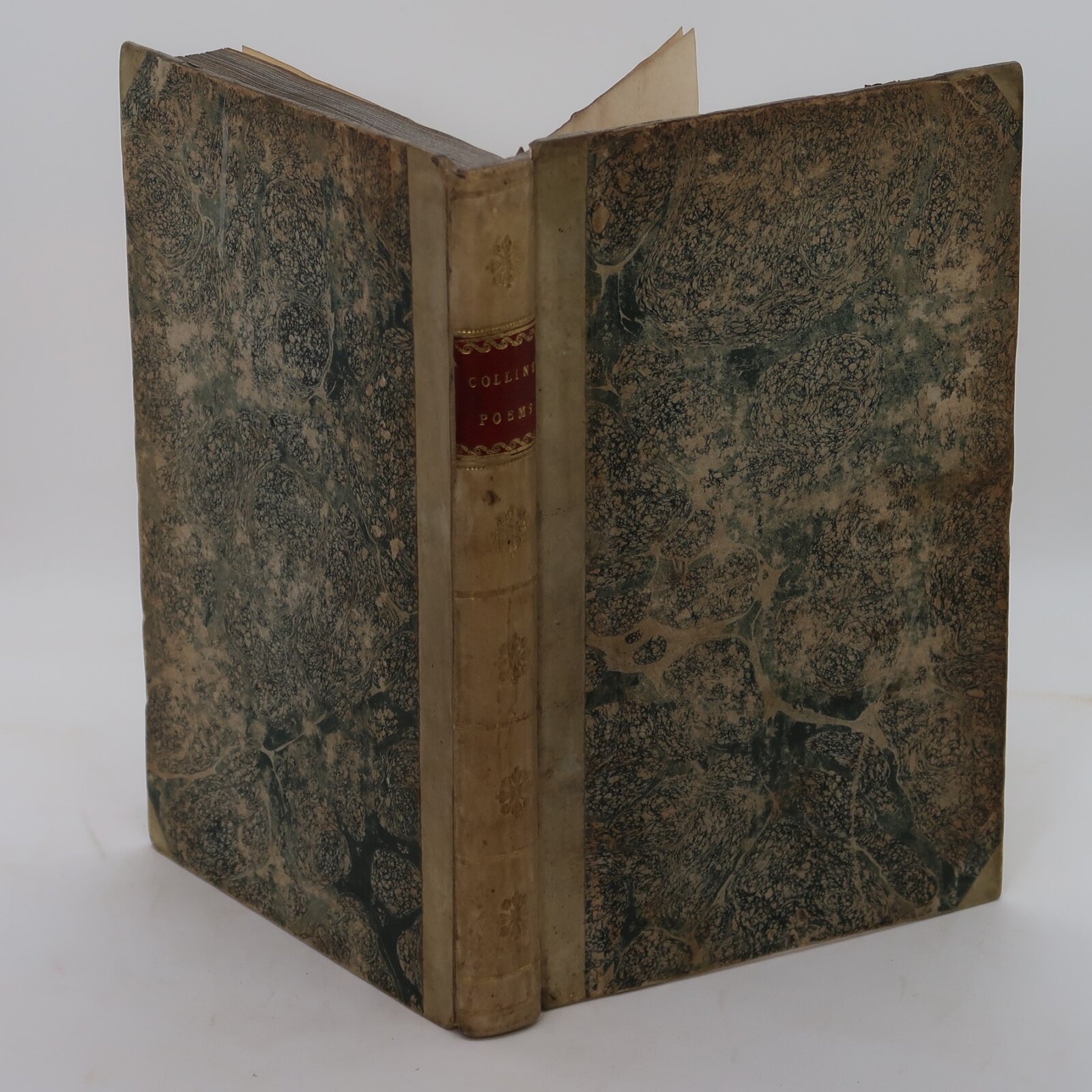
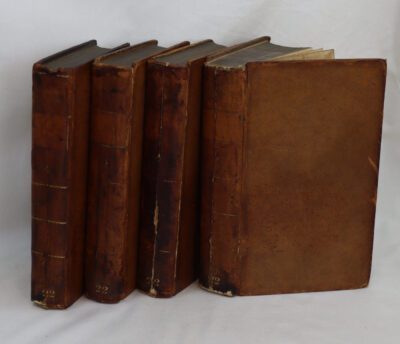
Cream calf spine with red title plate, gilt banding and lettering on the spine. blue marbled boards.
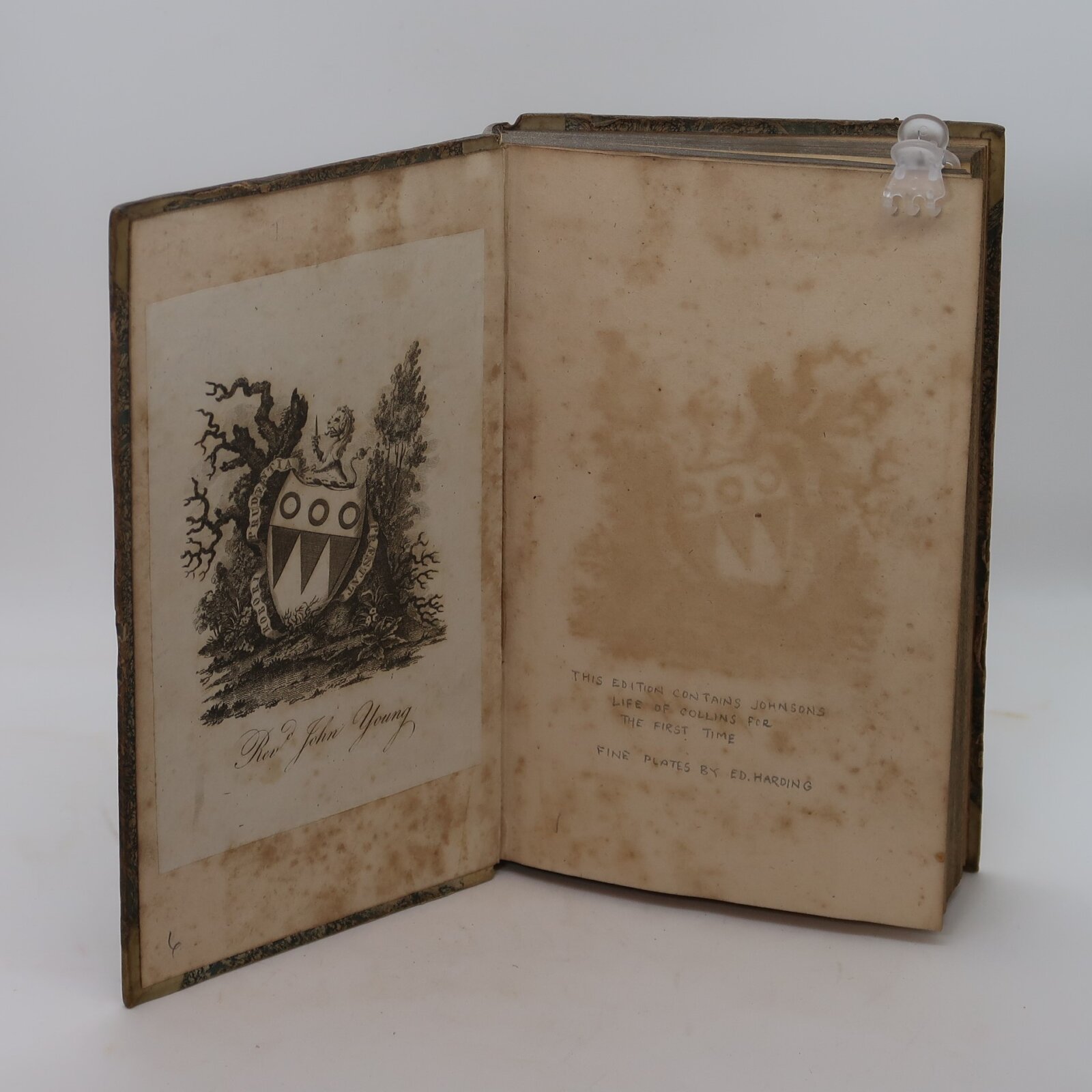
A well-kept copy.
William Collins (25 December 1721 – 12 June 1759) was an English poet. Second in influence only to Thomas Gray, he was an important poet of the middle decades of the 18th century. His lyrical odes mark a progression from the Augustan poetry of Alexander Pope’s generation and towards the imaginative ideal of the Romantic era.
Collins’ Odes also fit within the context of a movement towards the renewal of the genre, although in this case it was largely formal and showed in his preference for pindarics and occasionally dispensing with rhyme. Here he was in the company of Thomas Gray, Mark Akenside, and his Winchester schoolfellow Joseph Warton. At first Collins intended his Odes on Several Descriptive and Allegorical Subjects (1747) to be jointly published with Warton’s Odes on Various Subjects (1746) until Warton’s publisher refused the proposal. Following their appearance, Gray commented in a letter that each poet “is the half of a considerable Man, & one the Counter-part of the other. [Warton] has but little Invention, very poetical choice of Expression, & a very good Ear; [Collins] a fine Fancy, model’d upon the Antique, a bad Ear, a great variety of Words & Images, with no Choice at all. They both deserve to last some years but will not.” Moreover, their new manner and stylistic excess lent themselves to burlesque parody, and one soon followed from a university miscellany in the shape of an “Ode to Horror: In the Allegoric Descriptive, Alliterative, Epithetical, Fantastic, Hyperbolical, and Diabolical Style”. Rumour had it even then that the culprit was Warton’s brother Thomas, and his name was coupled with it in later reprintings.
As Gray had forecast, little favourable notice was taken at the time of poems so at odds with the Augustan spirit of the age, characterised as they were by strong emotional descriptions and the personal relationship to the subject allowed by the ode form. Another factor was dependence on the poetic example of Edmund Spenser and John Milton, where Collins’ choice of evocative word and phrase, and his departures from prose order in his syntax, contributed to his reputation for artificiality. Warton was content to refuse later republication of the products of his youthful enthusiasm, but Collins was less resilient. Although he had many projects in his head in the years that followed, few came to fruition. Republication of his eclogues apart, his closest approach to success was when the composer William Hayes set “The Passions” as an oratorio that was received with some acclaim.
Collins’ only other completed poem afterwards was the “Ode written on the death of Mr Thomson” (1749), but his unfinished works suggest that he was moving away from the contrived abstraction of the Odes and seeking inspiration in an idealised time uncorrupted by the modern age. Collins had showed the Wartons an “Ode on the Popular Superstitions of the Highlands of Scotland, considered as the Subject of Poetry”, an incomplete copy of which was discovered in Scotland in 1788. Unfortunately, a spuriously completed version, published in London the same year as the Scottish discovery, was passed off as genuine in all collections of Collins until the end of the 19th century. The former text was then restored in scholarly editions and confirmed by the rediscovery of the original manuscript in 1967. The poem appealed to bardic subject matter “whose power had charm’d a Spenser’s ear” to the imaginative rehabilitation of true poetry.
Another indication of the new direction his work was taking was the “Ode on the Music of the Grecian Theatre” that Collins proposed sending to Hayes in 1750. There, he asserted, “I have, I hope, Naturally introduc’d the Various Characters with which the Chorus was concern’d, As Oedopus, Medea, Electra, Orestes, &c &c. The Composition too is probably more correct, as I have chosen the ancient Tragedies as my Models But all that has remained to substantiate this large claim is an 18-line fragment titled “Recitative Accompanied” and beginning “When Glorious Ptolomy by Merit rais’d”.
Thomas Warton in his History of English Poetry (1774) made retrospective amends for his youthful lampoon by speaking there of “My late lamented friend Mr William Collins, whose Odes will be remembered while any taste for true poetry remains”. Nevertheless, it was not until a few years after the poet’s death that his work was collected in the edition of John Langhorne in 1765, after which it slowly gained more recognition, although never without criticism. While Dr Johnson wrote a sympathetic account of his former friend in Lives of the Poets (1781), he echoed Gray in dismissing the poetry as contrived and poorly executed. At a much later date, Charles Dickens was dismissive for other reasons in his novel Great Expectations. There Pip describes his youthful admiration for a recitation of Collins’ The Passions and commented ruefully, “I particularly venerated Mr. Wopsle as Revenge throwing his blood-stain’d Sword in Thunder down, and taking the War-denouncing Trumpet with a withering Look. It was not with me then as it was in later life, when I fell into the society of the Passions and compared them with Collins and Wopsle, rather to the disadvantage of both gentlemen”.
But among the posthumous enthusiasts for Collins’ poetry had been Scott of Amwell whose “Stanzas written at Medhurst, in Sussex, on the Author’s return from Chichester, where he had attempted in vain to find the Burial-place of Collins” was published in 1782. This charged that while the tombs of the unworthy were “by Flatt’ry’s pen inscrib’d with purchas’d praise”, those possessing genius and learning were “Alive neglected, and when dead forgot”.
That state of affairs was remedied by the commissioning of a monument to Collins in Chichester Cathedral in 1795, which brought a later tribute from the Wesleyan preacher Elijah Waring in “Lines, composed on paying a visit to the tomb of Collins, in Chichester Cathedral”. This, after initially noting the subject matter of the Odes, soon turned to a celebration of the poet’s faith in religion and his exemplary death. The poem is a response to John Flaxman’s design for the memorial, which depicted Collins seated at a table and studying the New Testament. This in turn was based on the anecdote perpetuated by Johnson in his life of the poet that he “travelled with no other book than an English Testament, such as children carry to the school. When his friend took it into his hand, out of curiosity to see what companion a man of letters had chosen, ‘I have but one book,’ said Collins, ‘but that is the best.'”
Flaxman’s monument to the poet was funded by public subscription. As well as showing the poet in pious contemplation, it depicts a lyre left upon the floor, accompanied by a scrolled copy titled “The Passions: an ode”, representing his abandonment of poetry. On the ridge over the memorial tablet, the female figures of love and piety are lying with arms about each other. Beneath is an epitaph by William Hayley which also makes reference to Johnson’s anecdote of the poet “Who in reviving reason’s lucid hours, | Sought on one book his troubled mind to rest, | And rightly deem’d the book of God the best.”
St Andrews, the church where Collins was buried, was converted to an arts centre in the 1970s, but the poet is now commemorated by a window on the south side drawing on the Flaxman memorial and showing him at his reading. There is also a blue plaque placed on the Halifax building in East Street on the site of his birthplace.
Want to know more about this item?
We are happy to answer any questions you may have about this item. In addition, it is also possible to request more photographs if there is something specific you want illustrated.
Ask a question
Related products
Share this Page with a friend
